
Marketing
From Invisible to Invincible: Mastering Digital Presence Enhancement
May 13, 2025
Enhance Digital Presence: 5 Powerful Ways for Success 2025
The Digital Visibility Imperative
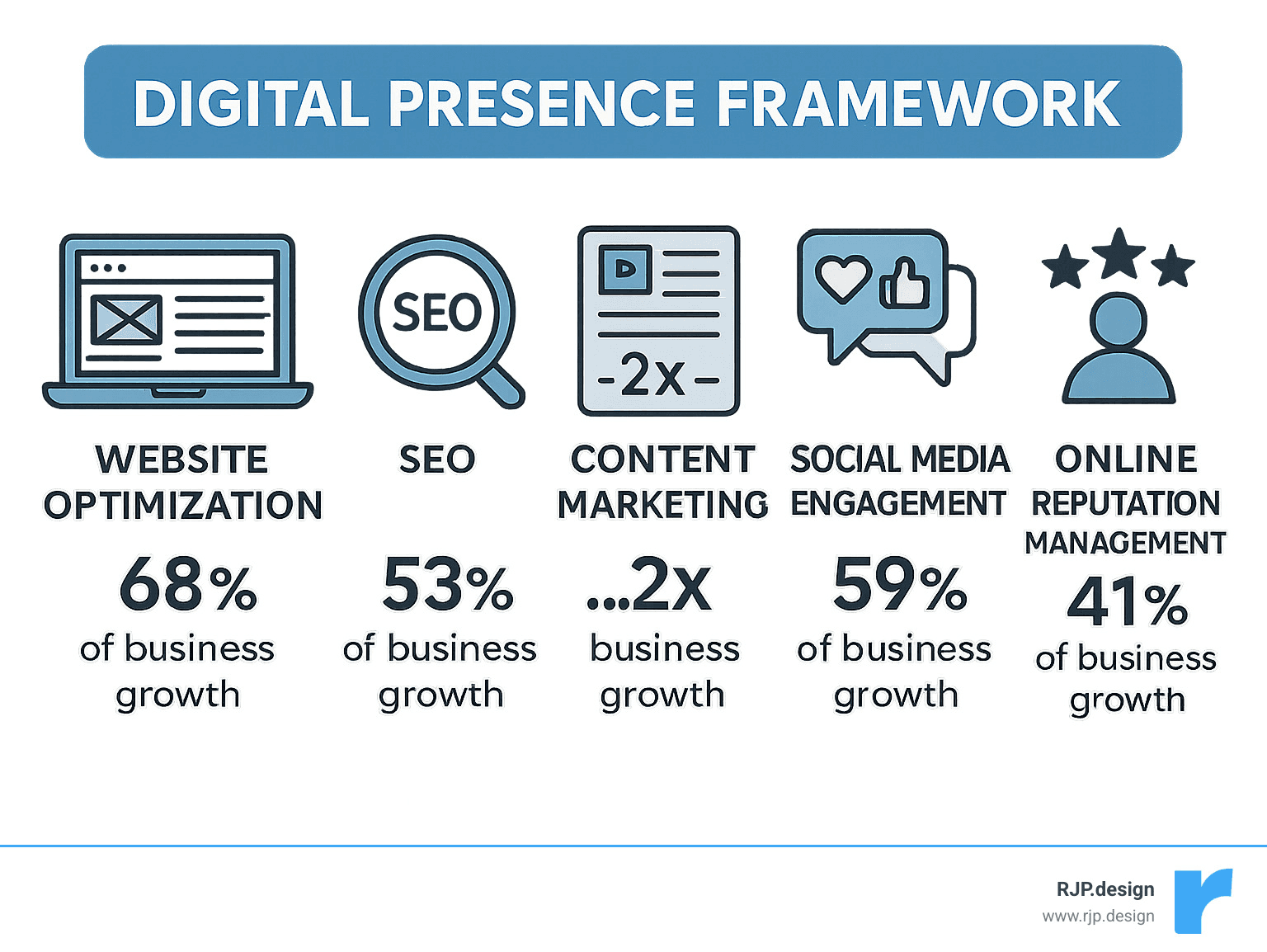
To improve digital presence effectively in today’s hyper-connected world, businesses need a strategic approach that combines website optimization, content marketing, social media engagement, online reputation management, and search engine visibility. Here’s what you need to know:
Quick Answer: How to Improve Digital Presence
1. Optimize your website for mobile, speed, and user experience
2. Create valuable content that addresses audience needs
3. Engage consistently on relevant social platforms
4. Manage online reputation through reviews and mentions
5. Implement SEO best practices for better visibility
6. Maintain directory listings with accurate information
7. Use targeted paid advertising to amplify reach
The average internet user spends almost seven hours online daily—that’s more than most of us sleep. In this digital landscape, your business’s online visibility directly impacts its success. With 97% of consumers searching online to find local businesses and 56% refusing to consider businesses without websites, an invisible digital presence means invisible profits.
Think of your digital presence as your business’s global business card and virtual storefront combined. It’s the sum of your website, social profiles, content, online listings, reviews, and how the public perceives and engages with your brand online. When managed strategically, these elements work together like a flock—each asset amplifying the others for stronger results.
What’s concerning is that visitors spend an average of just 54 seconds on a webpage. That means first impressions must count. A professional, cohesive digital presence establishes credibility instantly, while an outdated or inconsistent one pushes potential customers toward competitors.
I’m Ross Plumer, and I’ve helped businesses market over $20 million in revenue by developing strategies to improve digital presence across multiple channels and touchpoints. My approach integrates psychological insights with technical expertise to create digital presence strategies that resonate deeply with target audiences and drive measurable business growth.
Improve digital presence terms to remember:
– business growth online
– high-converting landing pages
– website conversion strategies
Why You Can’t Afford to Stay Invisible
In today’s omnichannel world, your customers don’t just find you through one path—they zigzag across multiple touchpoints before making a decision. According to research, B2B buyers make an average of 12 searches online before contacting a vendor, and by that time, they’re already 57% through their buying process.
The 54-second rule is particularly sobering: you have less than a minute to make an impression before most visitors bounce. That’s barely enough time to communicate your value proposition, let alone convert a visitor into a lead or customer.
What happens when you remain digitally invisible? Your competitors win by default. As one client told us before we revamped their digital presence: “It felt like shouting into a void—we knew we had a great product, but nobody could find us online.”
How This Guide Works
This guide takes you from digital invisibility to invincibility through actionable, step-by-step strategies that work for businesses of any size. We’ve organized it to be accessible for beginners while including advanced tactics for those ready to take their digital presence to the next level.
Each section builds upon the previous one, creating a comprehensive framework you can implement immediately. We’ll start with auditing your current digital footprint, then explore the five pillars of digital presence improvement, and finally look at advanced strategies and future trends.
By the end, you’ll have a clear roadmap to improve digital presence across all channels, with specific metrics to track your progress and tools to maintain your momentum.
Audit & Benchmark Your Digital Presence
Before you can improve something, you need to measure it. A digital presence audit gives you a clear picture of where you stand today and identifies the highest-impact opportunities for improvement.

Think of this as a friendly check-up for your digital health. Just like you wouldn’t expect a doctor to prescribe medicine without running tests first, you shouldn’t invest in digital improvements without understanding where you’re starting from.
Many of our clients are surprised when we introduce them to the concept of a “Presence Score” – a simple way to benchmark their digital visibility. While Nike might boast an impressive score of 87 (outperforming 93% of brands) with over 340,000 mentions reaching more than 1.6 billion people, your business has its own digital story to tell. The size doesn’t matter – the principle does: you can’t improve what you don’t measure.
Here’s a simple breakdown of your digital assets and how they work together:
Asset Type | Examples | Ownership | Control Level | Measurement |
|---|---|---|---|---|
Owned Media | Website, blog, email list | Complete | High | Traffic, engagement, conversions |
Earned Media | Reviews, PR mentions, shares | None | Low | Sentiment, reach, backlinks |
Paid Media | Ads, sponsored content | Temporary | Medium | ROAS, CPA, CTR |
More info about Digital Presence Improvement
Map Your Current Footprint
First things first – let’s figure out where your brand actually exists online. This is often eye-opening for businesses!
Start with a thorough website crawl using tools like Screaming Frog or Semrush. These will help you spot technical issues, broken links, and SEO opportunities you might have missed. Next, document all your social media profiles – even those dusty ones you haven’t touched in years. Note your followers, engagement rates, and whether your branding looks consistent across platforms.
Don’t forget to check your directory listings on Google, Yelp, Bing Places, and industry-specific sites. You’d be surprised how often we find businesses with outdated phone numbers or addresses floating around online!
One of our clients recently laughed when we showed her the results of her audit: “We found three forgotten social profiles with year-old posts and unanswered customer questions. No wonder people thought we’d gone out of business!”
Measure What Matters
Not all digital metrics deserve your attention. Focus on the ones that actually indicate how well your digital presence is performing:
Your website traffic tells you how many people are finding you and where they’re coming from. Your search visibility shows how easily people can find you when looking for services like yours. Your share of voice compares how often people mention your brand versus competitors.
I always recommend tracking engagement rates – real interactions like comments and shares tell you more than passive likes. And of course, your conversion rate reveals how effectively you’re turning visitors into actual customers.
At RJP.design, we love setting up simple monthly dashboards for clients. Nothing fancy – just a clear view of these key metrics so you can spot trends without drowning in data.
Identify Reputation Gaps
Your online reputation is the digital equivalent of word-of-mouth – and it matters tremendously. Here’s how to take its temperature:
Gather reviews from Google, Yelp, Facebook, and industry platforms, looking for patterns in what customers love (or don’t love) about your business. Check how quickly your team responds to comments and messages – did you know 35% of consumers expect a reply on social media within just two hours?
Also pay attention to your brand’s tone across platforms. Does your website sound professional while your Instagram feels casual? Some variation is normal, but extreme differences can confuse customers.
Try this simple exercise: Google “[your industry] + [your city]” and see where your business appears. Are you on the first page? Do competitors dominate the results? One client did this and called me immediately: “I’ve been in business for 15 years and I’m nowhere on the first three pages!” This quick search often reveals the most obvious opportunities to improve digital presence.
5 Pillars to Improve Digital Presence Today
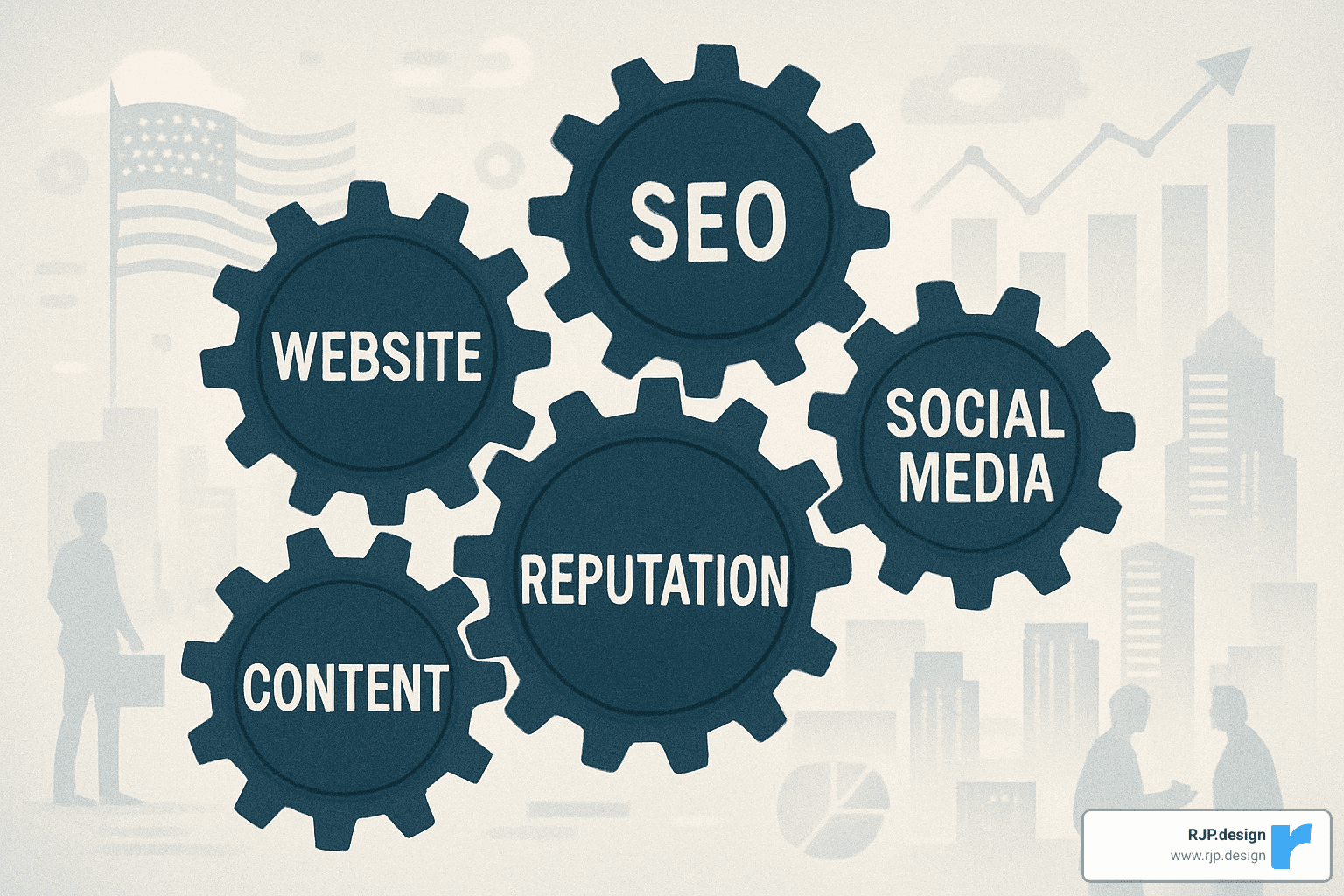
Now that you understand your current digital footprint, it’s time to build a stronger presence using these five foundational pillars. Each works in concert with the others to create a cohesive brand ecosystem that resonates with your audience.
Pillar 1: High-Impact Website Experience
Your website isn’t just another digital asset—it’s the heart of your online presence and often the final destination of your marketing efforts. Think of it as your 24/7 storefront. When we tell clients that 75% of people judge a company’s credibility based on website design, they’re often shocked, but it’s true!
Mobile-first design isn’t optional anymore—it’s essential. With 60% of searches happening on phones, your site needs to look stunning on small screens. I recently worked with a client who couldn’t figure out why their bounce rate was so high until we finded their mobile experience was painfully slow. After optimizing, their engagement doubled almost overnight.
Page speed might seem technical, but it’s actually deeply human. We’re all impatient online—40% of visitors will abandon a site that takes more than 3 seconds to load. That’s barely enough time to take a sip of coffee! Using Google’s PageSpeed Insights can reveal quick fixes that make a huge difference.
Clear navigation might seem obvious, but you’d be surprised how many businesses bury their most important information. Your visitors should find what they need within three clicks, or they’ll likely give up and look elsewhere.
Every page should include compelling calls-to-action that guide visitors toward the next step in their journey with you. And don’t forget ADA compliance—making your site accessible isn’t just the right thing to do; it expands your audience and protects your business.
One of my favorite success stories came from a local bakery whose website was essentially a digital business card. After redesigning with these principles in mind, the owner called me excitedly: “Ross, our new site is like having our best salesperson working 24/7!” Their online orders increased 200% in just two months.
More info about Web Design & Development
Pillar 2: SEO That Works While You Sleep
I love explaining SEO to clients as “the employee who never takes a day off.” Unlike paid ads that stop the moment you stop funding them, good SEO continues driving traffic around the clock, even on weekends and holidays.
The foundation of modern SEO is understanding what your audience is actually searching for. Keyword research isn’t about finding the terms with the highest volume—it’s about uncovering the specific language your ideal customers use when looking for solutions you provide. Tools like Semrush or even Google’s free Keyword Planner can reveal these golden opportunities.
Once you know what people are searching for, on-page optimization helps search engines understand that your content answers those questions. This means naturally incorporating keywords into your headings and text, creating compelling meta descriptions, and structuring content logically with H2 and H3 tags.
Behind the scenes, technical SEO ensures search engines can easily crawl and understand your site. This includes fixing broken links, implementing schema markup, and creating an XML sitemap—think of it as rolling out the red carpet for Google.
Quality backlinks remain one of the strongest ranking factors. When reputable websites link to yours, search engines view it as a vote of confidence. One of our clients, a specialty coffee roaster, earned a single backlink from a popular food blog that ended up driving more qualified traffic than all their social media combined.
For local businesses, local SEO is particularly powerful. One restaurant owner told me, “I was skeptical about all this digital stuff, but after optimizing our Google Business Profile, we started seeing new faces every day who found us through local searches.”
Scientific research on search behavior
Pillar 3: Content Engines That Educate & Sell
Content marketing goes far beyond just maintaining a blog—it’s about creating valuable resources that position you as the go-to authority in your field. The numbers speak for themselves: businesses that publish consistently (around four posts weekly) see 3.5× more traffic and 4.5× more leads than those that don’t.
Strategic blog content works best when each piece targets one specific keyword and genuinely helps your audience solve a problem. I always tell clients, “Don’t just write about what you want to sell—write about what keeps your customers up at night.”
Pillar pages and topic clusters have revolutionized content strategy. Rather than creating dozens of disconnected blog posts, develop comprehensive guides (around 2,000 words) that cover broad topics in depth, then link to related posts that explore specific aspects in more detail. This approach signals to search engines that you’re a comprehensive resource on the subject.
Video content generates an astonishing 1,200% more shares than text and images combined. You don’t need Hollywood production values—authenticity often outperforms polished perfection. Simple tutorials, product demonstrations, or behind-the-scenes glimpses create connection and build trust.
The growing popularity of podcasts and audio content offers another way to reach your audience during times when they can’t read or watch—like during commutes or workouts. One client started a simple Q&A podcast answering common industry questions and was amazed when it became their top lead generation channel within six months.
User-generated content is marketing gold. When real customers share their experiences with your products, it creates authentic social proof that traditional marketing can’t match. Campaigns featuring UGC see 29% higher conversions—people trust other people more than they trust brands.
The secret to content success isn’t volume—it’s value. One exceptional piece that truly helps your audience will outperform ten mediocre ones every time.
Pillar 4: Social Media Relationships That Last
Social media success isn’t about collecting followers like Pokémon—it’s about building genuine relationships with the people who matter to your business. With nearly 5 billion social media users worldwide, the opportunity is massive, but so is the noise you need to cut through.

Setting SMART goals for each platform keeps your social efforts focused and measurable. Instead of vague aims like “get more followers,” try specific targets like “increase Instagram engagement by 30% within six months” or “generate 15 qualified leads from LinkedIn each month.”
One of the biggest mistakes I see is brands trying to maintain a presence on every platform. It’s far better to choose platforms wisely and excel on 2-3 networks where your audience is most active. For a B2B software company, this might be LinkedIn and Twitter; for a boutique clothing store, perhaps Instagram and TikTok.
Creating an editorial calendar removes the daily stress of “what should we post today?” and ensures a balanced mix of content. I love seeing clients’ relief when they realize they can plan and schedule a month’s worth of posts in a single afternoon using tools like Buffer or Hootsuite.
The rise of short-form video has changed the social media landscape dramatically. Platforms are heavily prioritizing video content, especially quick clips like TikTok videos, Instagram Reels, and YouTube Shorts. One food brand I worked with generated more engagement from a 15-second product demonstration than from a month of carefully crafted static posts.
Partnering with micro-influencers often delivers better results than celebrity endorsements. These content creators with smaller, highly engaged audiences (typically 1,000-100,000 followers) have authentic connections with their followers and generate higher engagement rates. One client’s collaboration with a local micro-influencer with just 5,000 followers outperformed their previous campaign with a national influencer who had 500,000+ followers.
The magic happens when you create content that encourages participation rather than passive consumption. Little Moons, a mochi ice cream brand, saw a 2,000% increase in UK sales after their products went viral on TikTok—not because they spent millions on advertising, but because they inspired users to create and share their own content.
Pillar 5: Reputation & Trust Signals
In today’s transparent digital world, your reputation isn’t just part of your online presence—it’s often the deciding factor in whether someone chooses you or your competitor. With over 99.9% of customers reading reviews when shopping online, managing how you’re perceived is critical to business success.
A proactive review strategy puts you in control of your online reputation. Instead of hoping satisfied customers leave reviews, systematically request feedback through email follow-ups, QR codes on receipts, or personal thank-you notes with review links. One florist I worked with doubled their Google reviews in three months simply by adding a small card to each arrangement with a QR code linking to their review profile.
Your Google Business Profile is often the first impression potential customers have of your business. Claiming and fully optimizing this free listing with accurate information, high-quality photos, regular posts, and Q&A responses can dramatically improve your local visibility. One restaurant owner told me, “I was skeptical about all this digital stuff, but after optimizing our GBP, we started seeing new faces every day who found us through local searches.”
Using social listening tools to monitor and respond to brand mentions across the web shows customers you’re engaged and responsive. Whether it’s thanking someone for positive feedback or professionally addressing concerns, your responses demonstrate your values in action.
Showcasing testimonials and case studies prominently on your website provides social proof that builds confidence in potential customers. Seeing real results you’ve achieved for others helps prospects envision similar success for themselves.
Every business should develop a crisis management playbook before they need it. Preparing response templates and escalation procedures for potential reputation issues ensures you can respond quickly and appropriately if problems arise, rather than panicking in the moment.
The impact of reputation management can be profound. A hospitality client saw bookings increase by 32% after implementing a systematic review generation strategy and responding to 100% of their Google reviews. “People tell us they booked specifically because of how we engaged with past guests in the reviews,” they shared. That’s the power of actively managing your digital reputation.
Advanced Amplifiers & Trends for 2025+
The digital landscape never stands still. Once you’ve built a solid foundation with the five pillars we’ve discussed, it’s time to look ahead. Let’s explore how cutting-edge strategies can take your digital presence from good to extraordinary—and prepare you for what’s coming next.
Think of these advanced techniques as turbochargers for your digital engine. They don’t replace the fundamentals but rather amplify their impact in powerful ways.
AI content tools have transformed from clunky text generators to sophisticated creative partners. Tools like Writer and ChatGPT can now help brainstorm ideas, draft compelling content, and even personalize messages at scale. At RJP.design, we’ve seen clients cut content production time by 40% while actually improving quality. Remember though—AI works best as your creative assistant, not your replacement. The human touch remains essential for truly connecting with your audience.
Voice search continues its quiet revolution as smart speakers and voice assistants become household staples. We’re seeing businesses gain significant advantages by optimizing for how people actually speak: using conversational keywords, implementing proper schema markup, and creating concise answers to common questions. One local client saw a 27% increase in “near me” searches after making these simple adjustments.
The rise of zero-click searches might sound concerning at first—after all, over 50% of Google searches now end without a click to any website. But smart businesses are turning this challenge into an opportunity by optimizing for featured snippets, knowledge panels, and local packs. The key is structuring your content to directly answer specific questions, making it irresistible for Google to feature your information prominently.
More info about SEO Consultant Price
Leverage Paid Ads Without Blowing Budget
While organic strategies build lasting digital presence, strategic paid advertising can deliver immediate results and help you reach audiences that might otherwise take months or years to develop naturally.
The secret is being surgical rather than scattershot with your ad spend. Search ads work wonderfully for high-intent keywords where organic ranking is challenging—just be sure to set daily spending caps to keep costs predictable. Retargeting campaigns typically deliver the highest ROI of any paid strategy by reconnecting with visitors who showed interest but didn’t convert.
Google’s Performance Max campaigns have been game-changers for many of our clients. These AI-driven campaigns automatically optimize ad delivery across Search, Display, YouTube, Gmail, and Maps from a single campaign, often finding pockets of opportunity human managers might miss.
For service-based businesses, Local Service Ads with the “Google Guaranteed” badge appear above traditional search ads and operate on a pay-per-lead model rather than pay-per-click, often delivering higher-quality prospects.
One of our favorite success stories comes from a local plumbing company that started with just $10/day on Google Ads, focusing exclusively on emergency services. After careful optimization, every $1 spent returned $4.20 in revenue, allowing them to confidently scale their budget while maintaining that impressive return.
Collaborate to Accelerate
Sometimes the fastest way to improve digital presence isn’t doing everything yourself—it’s partnering with others who already have the audience and credibility you want to build.
Influencer marketing has exploded from a $9.7 billion industry in 2020 to $16.4 billion in 2022, and for good reason. When done right, it delivers authenticity that traditional advertising simply can’t match. The key isn’t chasing influencers with the biggest followings, but finding those whose audience and values genuinely align with your brand.
Don’t overlook the potential of employee advocacy. Your team’s collective networks are typically 10× larger than your company’s follower base. At RJP.design, we’ve helped clients develop simple systems that make it easy for employees to share company content while adding their personal perspective—resulting in engagement rates that often outperform official brand channels.
Strategic partnerships with complementary businesses can also work wonders. We helped a local wedding photographer team up with venues, florists, and caterers for a content series that reached completely new audiences for everyone involved.
The online fashion retailer ASOS provides a brilliant example of collaboration done right. During lockdown, they partnered with micro-influencers to create at-home fashion content that felt genuine and relatable. The result? A 24% boost in sales when many retailers were struggling. The authenticity of these collaborations resonated deeply with audiences seeking realistic style inspiration during challenging times.
Prepare for Emerging Tech
The digital horizon is always expanding with new technologies that reshape how brands connect with audiences. Staying informed helps you separate genuinely transformative trends from passing fads.
Augmented reality shopping has moved beyond novelty to become a practical tool for brands like IKEA and Sephora, allowing customers to visualize products in their homes or on their faces before purchasing. This technology bridges the confidence gap that sometimes prevents online purchases.
Conversational commerce through sophisticated chatbots and voice assistants is evolving rapidly. These tools have graduated from simple FAQ responders to become personalized shopping guides that understand context and can lead customers through entire buying journeys.
In the Web3 space, forward-thinking brands are experimenting with token-gated content and experiences—exclusive digital spaces accessible only to customers who hold specific digital tokens. While still emerging, this approach creates compelling new ways to reward your most loyal supporters.
At RJP.design, we help clients evaluate these technologies through a practical lens: Will this genuinely solve a problem for your customers? Does it align with how your audience already behaves? Can you implement it in a way that feels natural rather than forced?
The businesses that thrive in tomorrow’s digital landscape won’t be those that chase every shiny new tool, but those that thoughtfully adopt technologies that improve their core value proposition and meet their customers where they’re heading next.
Frequently Asked Questions about Enhancing Digital Presence
How often should I update my strategy to improve digital presence?
Digital presence isn’t something you can set up once and ignore—it needs regular care, like tending a garden. Think of it as an ongoing relationship with your online audience rather than a one-time project.
At RJP.design, we’ve found that a rhythm of regular check-ins works best for most businesses:
Quarterly strategy reviews give you the perfect opportunity to take a step back and look at the big picture. This is when you can assess what’s working, what isn’t, and make meaningful adjustments to your approach. It’s like having a seasonal check-up for your digital health.
Monthly metric analysis helps you catch trends before they become problems. We recommend setting aside just an hour each month to review your key numbers across all channels. You’d be surprised how often these monthly check-ins reveal opportunities you might otherwise miss!
Weekly content and engagement check-ins keep everything running smoothly between the deeper dives. This is when you ensure your content calendar stays on track and that you’re responding promptly to comments and messages.
I love how one of our clients described their new approach: “We used to treat our digital strategy like an annual physical. Now we treat it like daily exercise—consistent attention that compounds over time.” That mindset shift made all the difference in their results.
Which metrics show that I successfully improve digital presence?
While every business has unique goals, certain signals generally indicate your digital presence is getting stronger:
Organic traffic growth is perhaps the clearest sign that your visibility is improving. When more people find you naturally through search engines, it means your content is resonating and search engines trust you more.
Domain Authority (a metric from Moz) measures your website’s predicted ranking ability. Think of it as your website’s credit score—it typically climbs as your overall digital presence strengthens.
Branded search volume tells you how many people are searching specifically for your company name. Rising branded searches mean awareness is growing—people can’t search for a brand they don’t know exists!
Engagement rates across your platforms show whether your content is connecting with real humans. Comments, shares, and meaningful interactions matter more than passive likes or views.
Sentiment score—the ratio of positive to negative mentions—should gradually improve as your digital presence matures and you respond effectively to feedback.
Conversion rate is where digital presence meets business results. A stronger online presence should ultimately lead to more leads, sales, or whatever actions drive your business forward.
Here at RJP.design, we love creating custom dashboards that bring these metrics together alongside your specific business KPIs. This gives you a clear picture of how your improved digital presence translates to actual business growth.
Can small budgets still improve digital presence effectively?
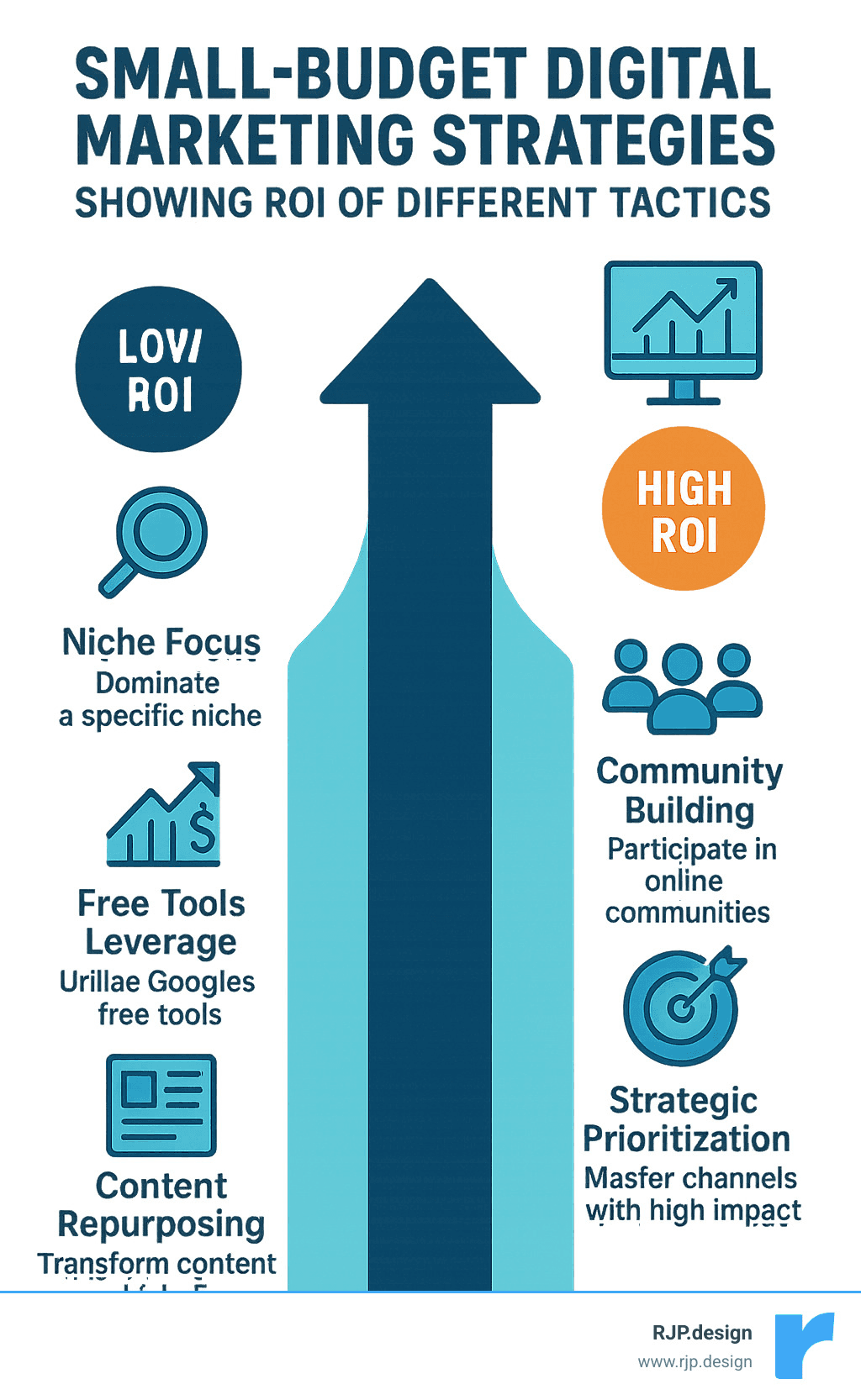
Absolutely! Some of the most dramatic digital changes we’ve seen have come from small businesses with modest budgets. The secret isn’t spending more—it’s spending smarter.
When resources are limited, strategic focus becomes your superpower. Instead of trying to be everywhere and do everything, identify where you can make the biggest impact and pour your energy there.
Niche focus works wonders for smaller budgets. Rather than competing for broad, highly competitive terms, dominate a specific corner of your industry where you can become the go-to authority. Being a big fish in a small pond beats being invisible in the ocean.
Free tools can take you surprisingly far. Google’s suite of free resources (Analytics, Search Console, Business Profile, Keyword Planner) offers incredible insights before you need to invest in paid alternatives.
Content repurposing stretches your investment. Create one high-quality piece of content, then transform it into multiple formats—a blog post becomes video clips, social posts, an infographic, and maybe even podcast material.
I still smile thinking about one of our clients who had just $500 monthly to invest. By focusing exclusively on optimizing their Google Business Profile and creating in-depth content for their three most valuable service pages, they achieved a 147% increase in qualified leads. As they put it: “We couldn’t do everything, so we did the right things exceptionally well.”
Conclusion
In today’s digital-first world, the journey from invisible to invincible online isn’t about luck or massive marketing budgets—it’s about strategic, consistent efforts across the right channels. By implementing the five pillars we’ve explored and staying ahead of emerging trends, any business can dramatically improve digital presence, boost credibility, and ultimately, strengthen their bottom line.
The digital landscape might feel overwhelming, but the most successful digital presence strategies share three simple characteristics:
First, they accept a future-proof mindset that anticipates changes rather than merely reacting to them. This means staying curious about emerging technologies without chasing every shiny new platform.
Second, they show commitment to continuous optimization based on real data and audience feedback. Your digital presence is never “done”—it’s a living, breathing entity that grows stronger with consistent attention.
Third, they ensure integration across all touchpoints to create a cohesive brand experience. When your website, social profiles, content, and customer service all tell the same story, your digital presence becomes greater than the sum of its parts.
At RJP.design, we’ve seen how these principles transform businesses of all sizes. One client put it beautifully: “Before working with you, we felt like we were shouting into the void. Now it feels like the digital world is working for us, not against us.”
Our down-to-earth team combines technical expertise with creative thinking to create digital strategies that don’t just look good—they perform. We believe in keeping things simple, transparent, and focused on what actually moves the needle for your business.
Enhancing digital presence is not a destination but a journey. While platforms and algorithms will continue to evolve, the fundamental principles of providing genuine value, building authentic relationships, and maintaining consistency will always remain relevant. These are the true north of digital presence—unchanging guides in an ever-changing landscape.
Think of your digital presence as a garden that requires regular tending rather than a monument you build once and forget. With the right care and attention, it will continue to bear fruit for years to come.
Ready to transform your digital presence from invisible to invincible? Learn more about our Digital Marketing services and find how we can help your business thrive online. Your digital future is waiting—and it’s brighter than you think.