
Web
Don't Get Caught Flat-Footed: Designing a Retail Website That Works
Jan 8, 2026
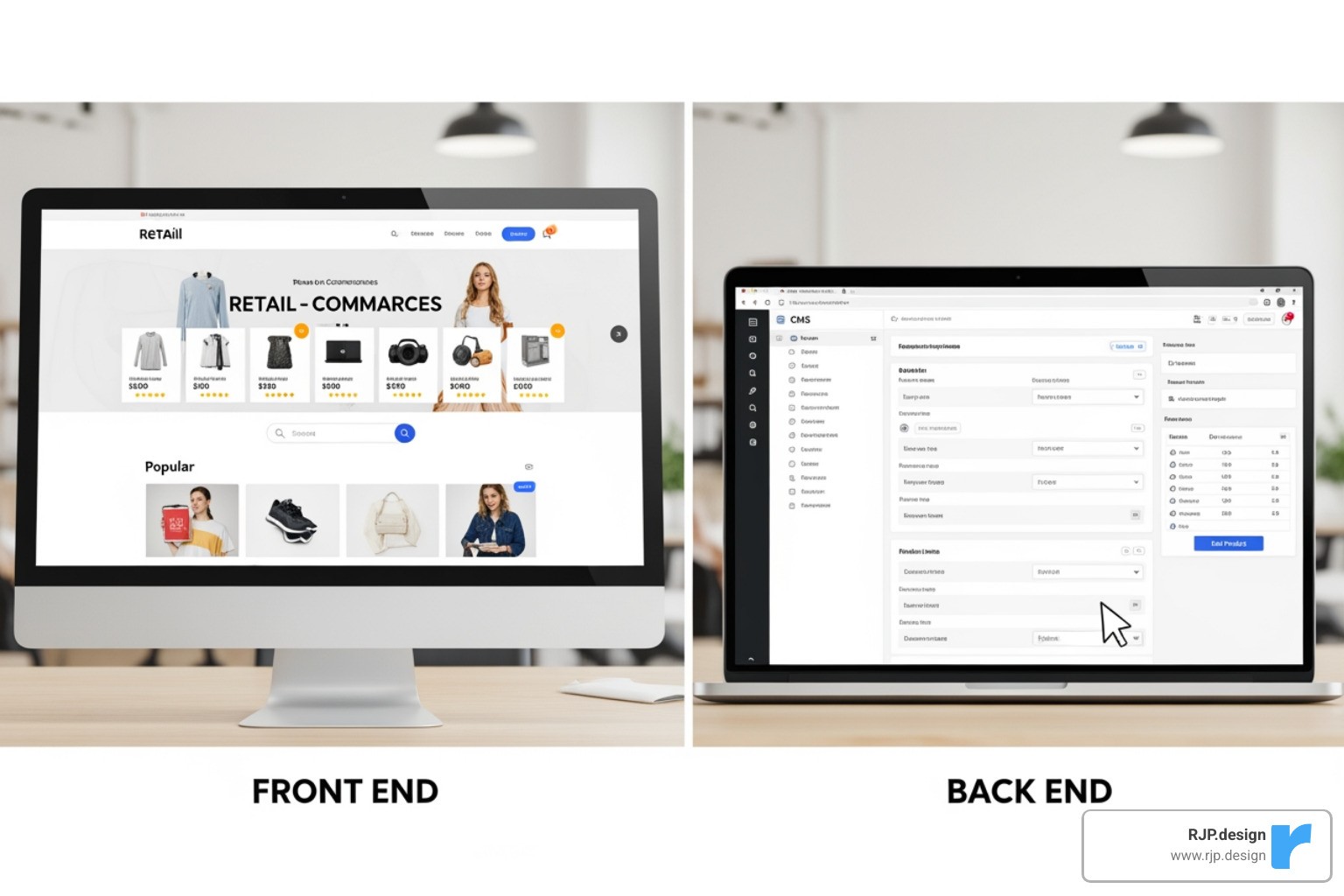
Why Your Retail Website Design Matters More Than Ever
Your retail website isn't just a digital storefront; it's your 24/7 sales representative and brand ambassador. The stakes are high: it takes just 50 milliseconds for visitors to form their first impression of your site. In that split second, your design either builds confidence or plants doubt.
With e-commerce sales growing and the average cart abandonment rate near 70%, the difference between a well-designed site and a mediocre one directly impacts your bottom line. A successful retail website balances aesthetics with functionality, builds trust, and optimizes for conversions. Here's a quick roadmap:
Build Trust First: Display security badges, clear policies, and contact info.
Create Intuitive Navigation: Use clear menus and a prominent search bar.
Optimize for Mobile: Ensure a responsive design, as mobile drives most site visits.
Streamline Checkout: Minimize steps and offer guest checkout.
Focus on Speed: Aim for 0-2 second load times to maximize conversions.
Leverage Social Proof: Feature customer reviews, as they heavily influence purchases.
Customer expectations, shaped by giants like Amazon, mean seamless navigation and fast checkout are baseline requirements. While standing out is important, straying too far from established conventions can confuse visitors and hurt sales.
The good news? You don't need a massive budget to create a retail website that works. You need a clear strategy and a commitment to the fundamentals that drive results.
I'm Ross Plumer, and I've helped businesses market over $20 million in revenue by creating digital experiences that convert. I've seen what separates thriving sites from struggling ones, and I'm here to share those insights with you.
The Blueprint: How to Design a Retail Website That Converts
Designing a retail website today means creating a digital experience that's both beautiful and functional. It's about crafting an online space where customers feel welcome, confident, and ready to buy. Let's explore the essential elements.
1. Build a Foundation of Trust and Strong Brand Identity
When customers land on your site, their first impression is about trust. A strong, consistent brand identity is the cornerstone of this trust, effectively communicating your brand values and unique selling propositions.
Brand Consistency is Key Your brand's personality should shine through every element:
Color Psychology: Colors evoke emotions. For instance,
Wellyuses a colorful aesthetic for its fun brand, whileSatya Organicuses earthy tones to signal its natural products. We ensure your palette is consistent and accessible, using tools likeColorable’s Contrast Checkerto verify high-contrast combinations for readability.Typography: Fonts convey emotion and establish hierarchy.
MVMTuses sleek typography for its affordable style, whileKluruses a single typeface for a cohesive feel. We prioritize readability with clear fonts and responsive typography that looks great on any device.Layout and Visual Hierarchy: The arrangement of elements guides the user's eye. Principles like the
golden ratio and the rule of thirdshelp achieve visual balance, making your site feel professional and easy to steer.
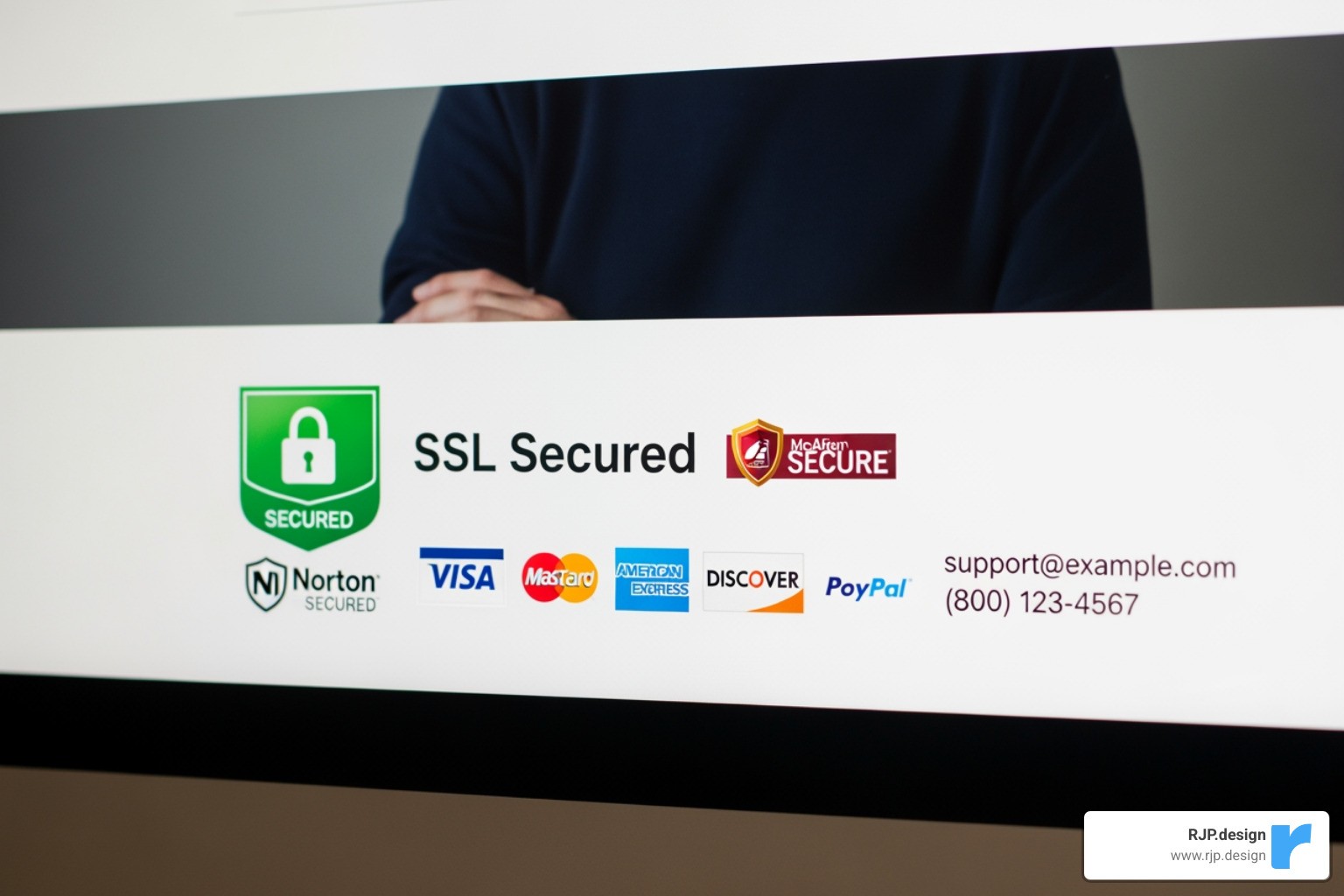
Building Trust Through Design Beyond aesthetics, specific elements actively build trust:
Clear Policies & Contact Info: Prominently display return policies and contact details.
Supergoopdoes this well, reducing buyer apprehension. An accessible 'Contact Us' page shows there's a real business behind the screen.Payment Security: Integrate trusted providers like
Shopify Paymentsand display their logos. Security certification logos build confidence.Accessibility: An accessible website is good practice and often a legal requirement under acts like the
Americans with Disabilities Act (ADA). We ensureW3C compliancewith features likealt textfor images and use tools like theWebAIM color contrast checker.
Essential trust indicators for your retail site include:
SSL certificate badges (padlock icon)
Recognizable payment gateway logos (Visa, PayPal, etc.)
Clear return and refund policies
Detailed contact information
Privacy policy and terms of service links
Security certification logos (e.g., McAfee Secure)
Ethical or industry membership badges
For more insights, explore our [More info about brand identity services](https://rjp.design/services/brand-identity).
2. Structure the Storefront for Intuitive Navigation
Clear navigation is paramount. Imagine a physical store with unmarked aisles—that's what a poorly designed website feels like.
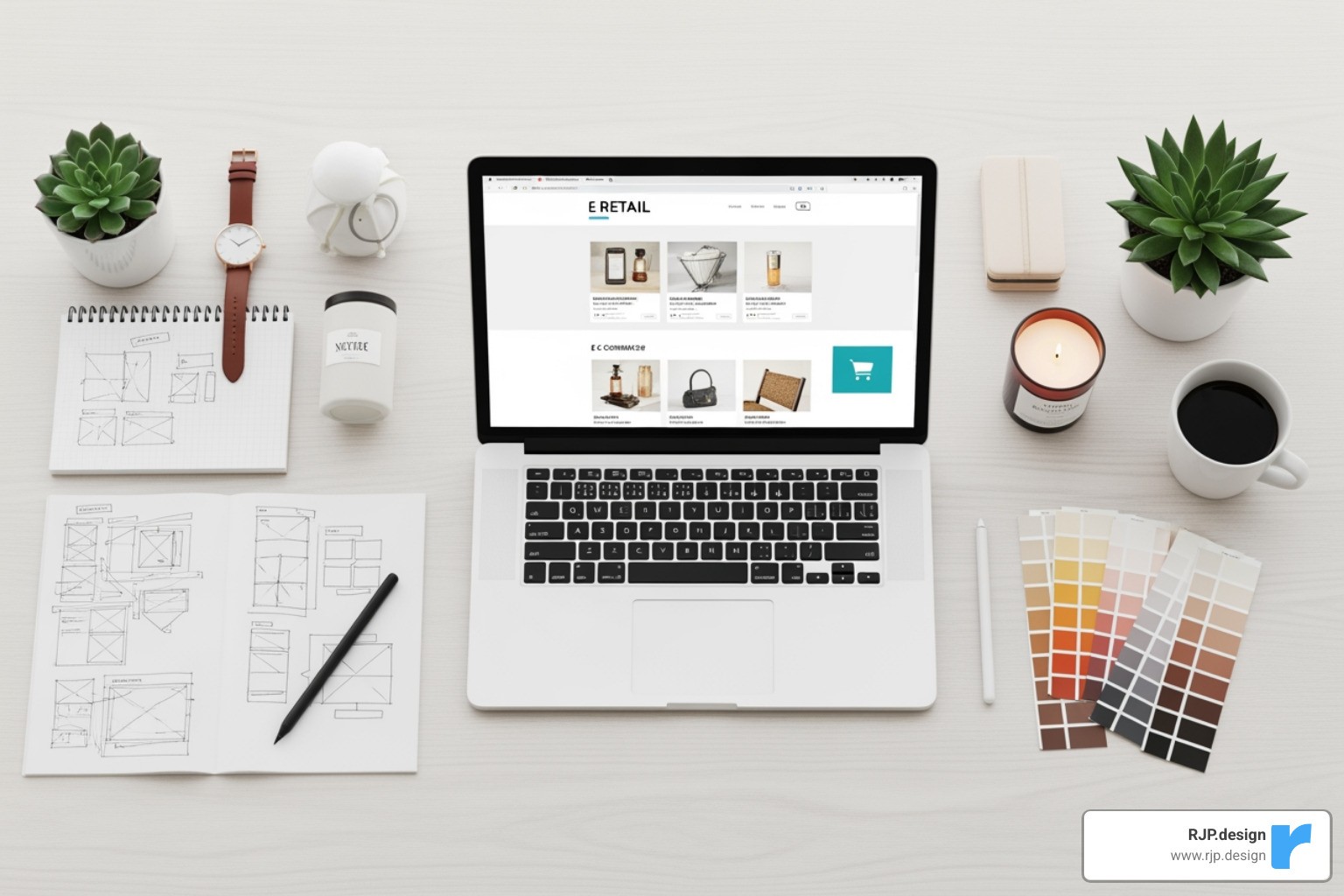
Guiding Customers Seamlessly We make it effortless for customers to find what they need:
User-Friendly Navigation: We keep navigation simple and consistent. For sites with many products, mega menus organize categories, while breadcrumbs show customers their path.
Prominent Search Bar: A visible search bar is crucial. We implement auto-suggestions to speed up the process.
Clear Product Pages: Your Product Listing Pages (PLPs) and Product Detail Pages (PDPs) are where products shine. PLPs need intuitive filtering and sorting, like on
Bliss. PDPs need comprehensive info, multiple images, and clear calls to action, as seen onC'est Beau.
The Power of Visuals High-quality visuals are non-negotiable and can improve a website's conversion rate by 40%.
High-Resolution Photos: Customers rely on visuals. We recommend
high-resolution photoswitheven lighting.Kylie Cosmeticsdisplays products beautifully on plain backgrounds.Lifestyle Images: Show the product in use.
Outdoor Voicesuses lifestyle images to create an aspirational aesthetic, whileTopo Designsshowcases products in exciting travel destinations.Image Optimization: Images must be optimized for the web. We ensure they are
color calibratedand compressed toreduce file sizeswithout losing quality.
Clear product descriptions are also vital, complementing your visuals and providing all the details for a confident purchase.
See how these elements come together in our favorite [See examples of amazing ecommerce website designs](https://rjp.design/amazing-ecommerce-website-designs).
3. Streamline the Path to Purchase with a Flawless Checkout
A complicated checkout is a major roadblock. The average cart abandonment rate is nearly 70%, so our goal is to make the journey from cart to conversion as smooth as possible.
Reducing Cart Abandonment We create a seamless checkout experience by:
Offering Guest Checkout: Forcing registration can deter
17% of shoppers.Using Progress Indicators: Visually show customers where they are in the process.
Providing Multiple Payment Options:
35% of shoppers abandon carts when their preferred payment method isn’t available.Creating Clear Calls-to-Action (CTAs): The "Add to Cart" button should be prominent and easy to click.
WellyandFinnuse clear "Shop Now" CTAs effectively.Minimizing Steps and Fields: We ask only for essential information.
Optimizing for Mobile Checkout: With mobile cart abandonment as high as 85%, a simplified, single-column layout with large buttons is non-negotiable.
Leveraging Social Proof Customer reviews are powerful trust-builders, as 93% of consumers say online reviews impact their purchasing decisions.
Showcase Reviews Prominently:
Verve Coffee Roastersuses customer reviews throughout its site.Tiny Organicsfeatures a carousel of testimonials.Use User-Generated Content (UGC):
Tessemae'suses fan photos to show its products are loved by real customers.Implement Review Schema: We can implement
schema markupfor reviews, which can create rich snippets in search results.
A smooth checkout, reinforced by social proof, transforms browsers into loyal customers. [Learn more about website conversion strategies](https://rjp.design/website-conversion-strategies).
4. How to design a retail website for peak performance on any device
Your retail website must perform flawlessly across all devices. This means delivering a fast, responsive experience that keeps customers engaged.
The Imperative of Mobile-First Design Mobile responsiveness is a fundamental requirement. Mobile shoppers account for more than 60% of all site visits, and Google's mobile-first indexing means your mobile site is what search engines evaluate first. A non-responsive design can cause 73.1% of users to leave. We design with a mobile-first approach, ensuring layouts adapt to any screen size with touch-friendly elements. You can test your site with Google’s Mobile-Friendly Test.
Speed is a Conversion Driver A fast website is crucial. Just a one-second delay in page load time can decrease your conversion rate by up to 7%. The highest ecommerce conversion rates occur on pages with load times between 0–2 seconds.
We optimize for speed through:
Image and Video Optimization: Compressing media without sacrificing quality.
Code Minification: Reducing code file sizes for faster loading.
Caching: Storing frequently accessed data to speed up page delivery.
Content Delivery Network (CDN): Using a CDN like
Jetpack CDNdistributes content globally, reducing latency.Choosing the Right Web Host: A good host provides infrastructure built for speed and scale.
We use tools like Google PageSpeed Insights to continuously monitor your site's performance.
For a deeper dive, check out [More on responsive web design](https://rjp.design/responsive-web-design) and [Learn about SEO for e-commerce websites](https://rjp.design/seo-for-e-commerce-websites).
5. Implement Advanced Strategies and Avoid Common Pitfalls
Moving beyond the basics, advanced strategies can differentiate your retail website, while avoiding common mistakes can prevent lost sales.
Personalization and AI Customers expect custom experiences. We help you gather first-party data through surveys or user behavior analysis to understand preferences. Integrating AI allows for dynamic product recommendations, creating a shopping experience that feels unique to each customer.
B2B vs. B2C Design Considerations While many principles apply universally, there are key differences between B2B and B2C sites. 90% of B2B buyers expect a consumer-like shopping experience, so B2B sites must blend great UX with their unique functionalities.
Feature | B2C Retail Website | B2B Retail Website |
|---|---|---|
Target Audience | Individual consumers | Businesses, procurement managers, departments |
Purchasing Behavior | Emotional, impulse, quick decisions, single buyer | Rational, planned, complex, multiple stakeholders |
Product Display | Lifestyle images, aspirational, clear pricing | Detailed specs, bulk pricing, technical data, case studies |
Checkout Process | Simple, guest checkout, diverse payment options | Quotes, purchase orders, account management, credit terms |
Navigation | Intuitive, visually driven, curated collections | Robust search, advanced filtering, reorder functionality |
Content Focus | Benefits, reviews, trends | ROI, efficiency, compliance, support documentation |
Relationship | Transactional, brand loyalty | Long-term, partnership, dedicated support |
Omnichannel Integration Your website should integrate with physical retail and other sales channels:
In-Store Pickup: Allow customers to buy online and pick up in-store.
Inventory Sync: Integrate online and offline inventory for accuracy.
Multi-Channel Selling: Connect seamlessly with marketplaces like Amazon or eBay. Learn how to
Sell on marketplaces.Physical Retail Support: Features like "find-in-store" functionality improve the overall customer journey.
Common Pitfalls to Avoid
Cluttered Layout: Too many elements overwhelm visitors. Simple is better.
Confusing Navigation: If customers can't find what they want, they'll leave.
Weak or Unclear CTAs: Users won't know what to do next without clear direction.
Hidden Costs: Unexpected fees at checkout are a top reason for cart abandonment.
Insufficient Product Information: Lack of details or quality images creates hesitation.
Your Next Step to a High-Performing Retail Site
Designing a retail website that works is an ongoing investment. We've covered the essentials: building trust, creating intuitive navigation, streamlining checkout, and optimizing for performance. High-quality ecommerce website design is a nonnegotiable business asset.
At RJP.design, we create websites that not only look great but are also easily found online. Our down-to-earth team works with you to deliver a site that converts browsers into buyers. The digital landscape is always evolving, so continuous improvement based on analytics and user feedback is key.
Ready to transform your retail vision into a high-performing online reality? [Explore our portfolio of the best retail website designs](https://rjp.design/best-retail-website-designs) and see how we help businesses like yours thrive.