
SEO
SEO Analysis Unveiled: A Guide to Boosting Your Online Presence
May 21, 2025
Search Engine Optimization Analysis: 7 Powerful Ways to Win 2025
Understanding the Power of SEO Analysis
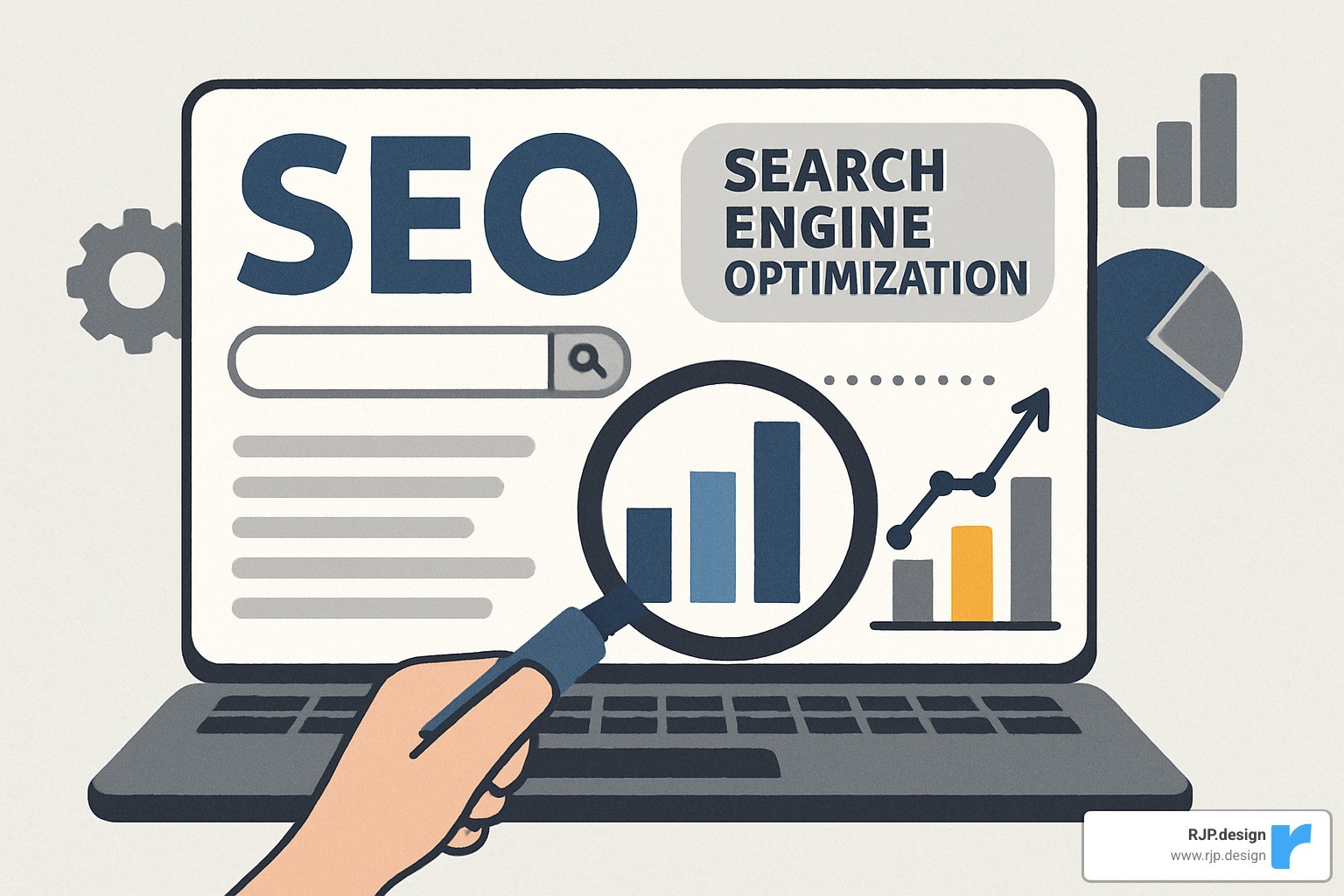
Search engine optimization analysis is a comprehensive evaluation of your website’s performance in search engines, identifying strengths, weaknesses, and opportunities to improve your organic visibility and traffic.
What is SEO Analysis?
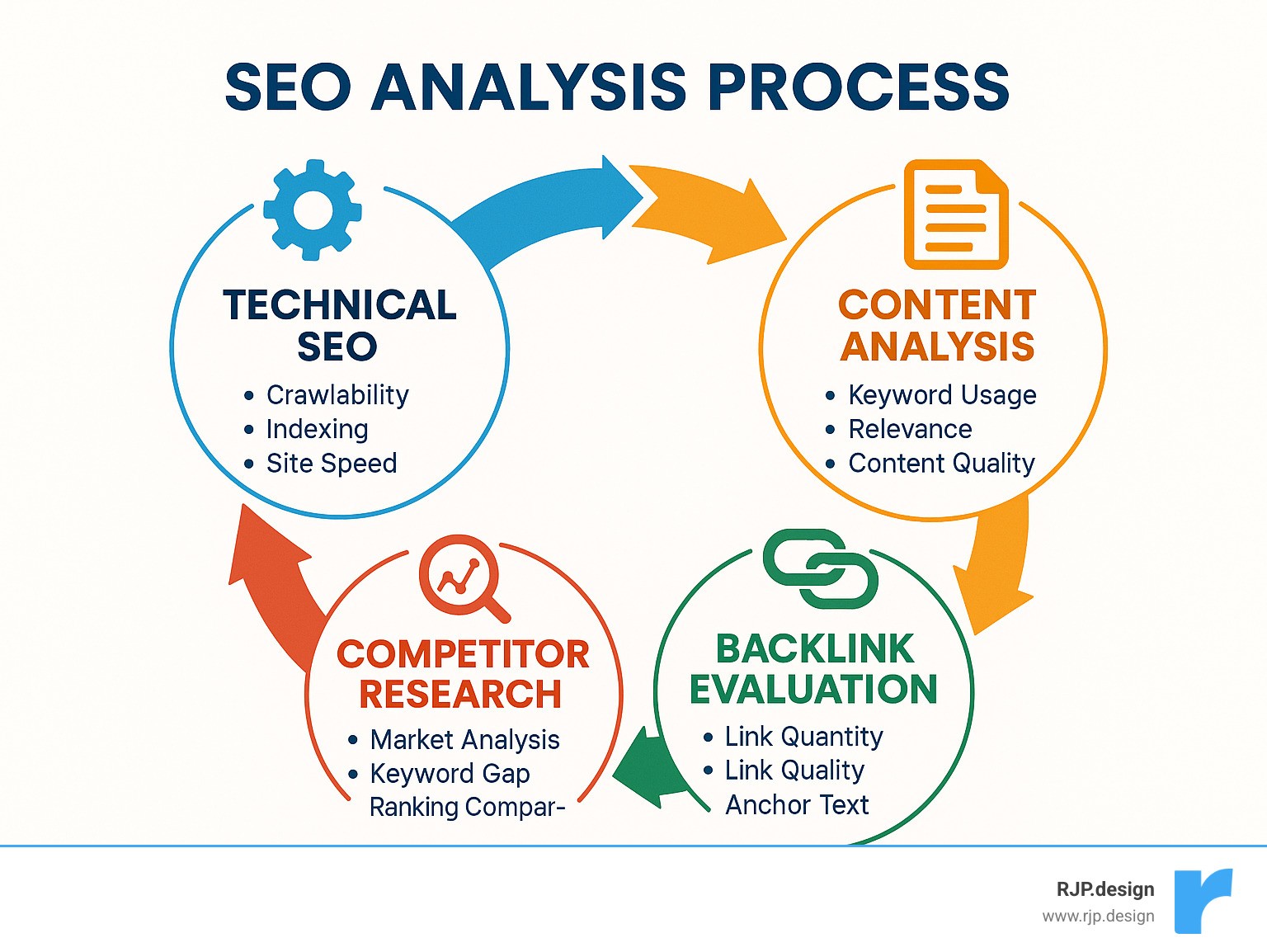
SEO analysis examines four key areas:
1. Technical health: Site crawlability, indexation, speed, and mobile-friendliness
2. Content quality: Keyword targeting, search intent alignment, and content depth
3. Backlink profile: Link quantity, quality, and relevance from external websites
4. Competitive positioning: How your site compares to others ranking for your target keywords
Did you know that organic search delivers 53% of all website traffic? With over 8.5 billion searches happening every day on Google alone, the opportunity to connect with potential customers is massive. But without proper search engine optimization analysis, your business remains invisible in this digital landscape.
Think of SEO analysis as a health check-up for your website. Just as a doctor examines various vital signs to assess your overall health, an SEO analysis looks at multiple factors that determine how well your site performs in search results.
I’m Ross Plumer, a digital marketing specialist who has helped businesses optimize their online presence through comprehensive search engine optimization analysis, driving over $20 million in revenue for clients through data-driven SEO strategies that transform underperforming websites into traffic-generating assets.
Relevant articles related to search engine optimization analysis:
– seo content optimizer
– seo optimizer audit
– technical seo experts
Why This Guide Matters
The global SEO industry is forecast to reach $122.11 billion by 2028, and there’s a good reason for this explosive growth. Businesses are recognizing that in a digital-first world, being found online is no longer optional—it’s essential for survival and growth.
With the right search engine optimization analysis, you can tap into the power of those 8.5 billion daily searches, connecting with potential customers at the exact moment they’re looking for what you offer. This isn’t just about traffic—it’s about qualified, intent-driven visitors who are actively seeking solutions.
At RJP.design, we’ve seen how a thorough SEO analysis can transform a business’s online presence. One of our clients saw a 312% increase in organic traffic after implementing the recommendations from our comprehensive analysis—all within just four months.
What Is Search Engine Optimization Analysis?
Search engine optimization analysis is like giving your website a complete health checkup. It’s not just a quick glance at your rankings—it’s a deep dive into everything that affects how your website performs in search results. While a basic audit might spot obvious issues, a proper analysis examines every nook and cranny of your digital presence.
When we conduct a search engine optimization analysis at RJP.design, we’re essentially looking at your website through Google’s eyes. Search engines consider hundreds of different factors when deciding where to rank your content, and a thorough analysis examines all the critical ones:
Crawlability matters because search engines need to easily steer your site—think of it as making sure all the doors in your house are open uped for visitors. If Google’s bots can’t access certain pages, those pages simply don’t exist in search results.
Indexation is the next step, where we ensure your content is properly stored in search engine databases. You might have amazing content, but if it’s not indexed correctly, it’s like having a book that’s not listed in the library catalog.
Ranking signals focus on how well your site demonstrates expertise, authority, and trustworthiness—what Google calls E-E-A-T. This is where the real competitive edge happens.

A complete search engine optimization analysis looks at both what’s happening on your website (your content quality, HTML structure, and site architecture) and what’s happening off your site (who’s linking to you, how your brand is mentioned online, and your social media presence).
Search Engine Optimization Analysis vs. Ongoing SEO
Think of search engine optimization analysis as taking a detailed snapshot of your current position. It’s like getting a comprehensive map of where you are before planning a journey. This diagnostic process reveals your strengths, weaknesses, and most promising opportunities.
Ongoing SEO, on the other hand, is the actual journey—the day-to-day work of implementing improvements, creating fresh content, building quality links, and adapting to Google’s ever-changing algorithms. The relationship works in a continuous cycle:
Start with a thorough analysis to understand your current position
Develop a strategic roadmap based on what you’ve finded
Roll up your sleeves and implement the necessary changes
Keep an eye on your performance metrics to see what’s working
Periodically conduct a fresh analysis to reassess and adjust course
Without a proper search engine optimization analysis to guide your efforts, you might be investing time and resources in the wrong places—like trying to steer without knowing your starting point.
Search Engine Optimization Analysis and Business ROI
At the end of the day, search engine optimization analysis isn’t just about technical improvements—it’s about driving real business results. When done right, the return on investment can be substantial:
Conversion rates typically climb when your site better matches what searchers are actually looking for. By aligning your content with search intent, you’re connecting with people who genuinely want what you offer.
Better visibility in search results means more eyes on your business. Higher rankings translate directly into more clicks and impressions for your brand.
Long-term traffic growth becomes sustainable. Unlike paid advertising that stops the moment you stop paying, organic traffic continues flowing without ongoing costs.
The numbers back this up: organic search has a close rate of 14.6%, compared to just 1.7% for traditional outbound marketing. This remarkable difference shows why investing in proper search engine optimization analysis makes so much business sense.
Here at RJP.design, we’ve helped businesses achieve ROI of 10:1 or higher on their SEO investments through careful analysis and strategic implementation. The secret is focusing on metrics that actually matter to your business—not vanity metrics like rankings alone, but actual revenue and conversions that impact your bottom line.
Core Components of an Effective SEO Analysis
When we roll up our sleeves to do a proper search engine optimization analysis, we’re looking at five key areas that work together to determine how well your site shows up in search results. Think of these as the vital organs of your SEO health – each one needs to be functioning well for the whole system to thrive.
Technical Deep-Dive
The technical foundation of your website is like the plumbing and electrical system of a house – not glamorous, but without it, nothing works right. When we examine your technical SEO, we’re checking:
Your robots.txt file – is it helpfully guiding search engines or accidentally blocking them from seeing your best content? I can’t tell you how many times I’ve seen a simple robots.txt error hiding valuable pages from Google.
Your XML sitemap should be a well-organized map of your important content, not a cluttered junk drawer that includes every low-value page on your site.
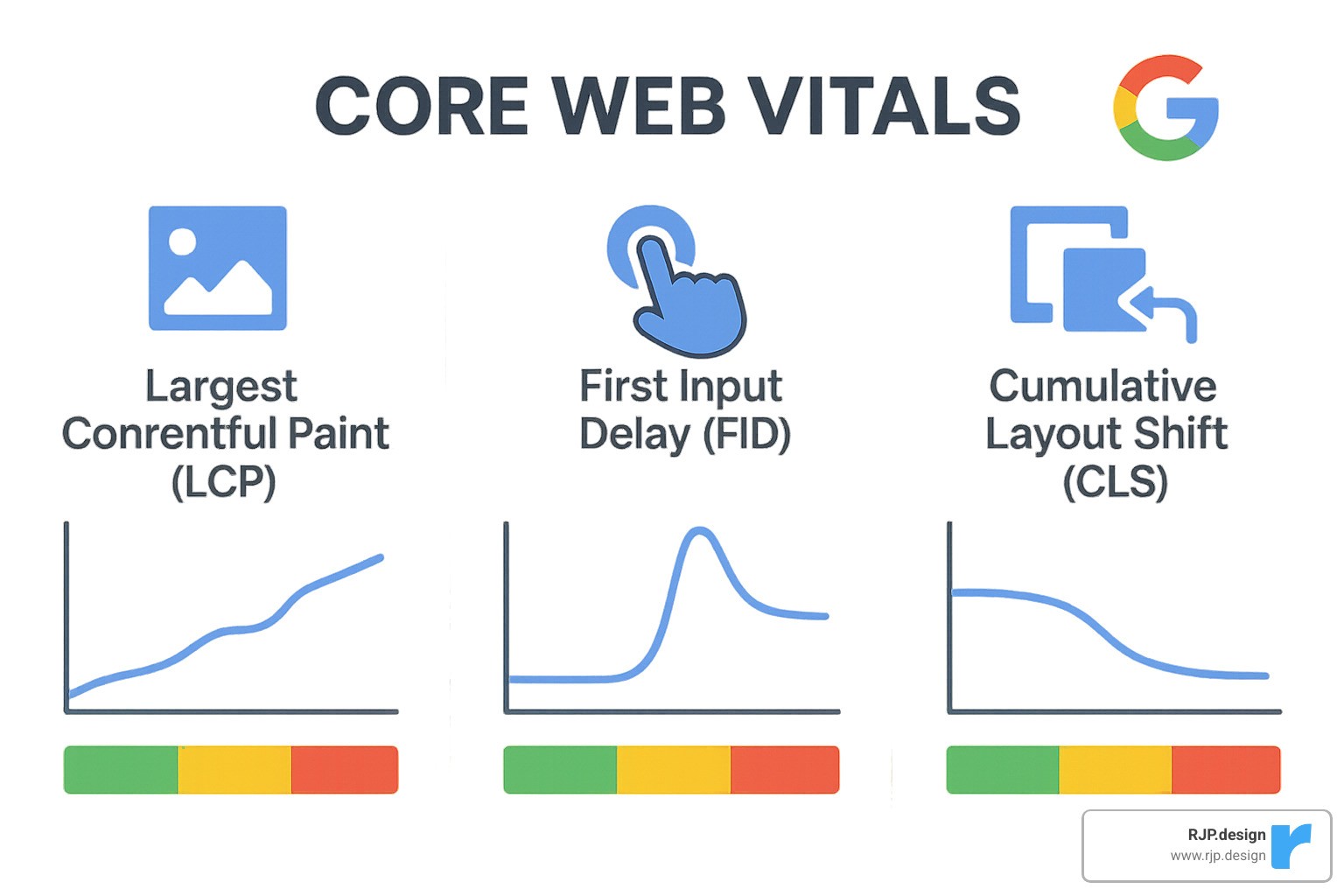
Those Core Web Vitals metrics you might have heard about? They’re not just technical jargon – they directly impact how users experience your site. When pages load quickly (LCP), respond promptly to interactions (FID), and don’t jump around while loading (CLS), visitors stay longer. Google has found that sites passing Core Web Vitals assessments see up to 70% better user engagement. That’s huge!
Is your site fully HTTPS secure? Any mixed content issues can trigger security warnings that send visitors running.
And with Google’s mobile-first approach to indexing, your site absolutely must shine on smartphones and tablets.
One thing many site owners miss is crawl budget optimization. Google only allocates so much time to explore your site, and if it’s wasting time on duplicate or thin content, your valuable pages might get ignored. At RJP.design, we typically find that up to 40% of crawl budget is being wasted on pages that don’t deserve attention.
Content & Keyword Evaluation
Content is where the magic happens – it’s what your visitors actually came to see. A thorough search engine optimization analysis looks at your content with a critical eye:
Does your content actually match what users are searching for? This search intent alignment is crucial – you could have beautifully written content that completely misses what people actually want to know.
How deeply do you cover your topics? Shallow content rarely ranks well anymore. Google wants to see topical depth and breadth that thoroughly answers users’ questions.
Google’s E-E-A-T guidelines (that’s Experience, Expertise, Authoritativeness, and Trustworthiness) aren’t just suggestions – they’re especially important in YMYL (Your Money or Your Life) niches like health, finance, and safety.
Have you checked for content decay? We often find that pages older than 18 months lose about 30% of their traffic without regular updates. Refreshing these pages can be one of the quickest ways to boost your traffic.
I love identifying “striking distance” keywords – those terms where you’re ranking on page two (positions 11-20). With some targeted optimization, these can often be nudged onto page one where they’ll get significantly more clicks.
Backlink & Authority Signals
Even in 2023, backlinks remain powerful ranking signals. When we analyze your link profile, we’re looking at quality, not just quantity:
Link relevance matters tremendously – a link from a respected site in your industry carries far more weight than dozens of random links from unrelated sites.
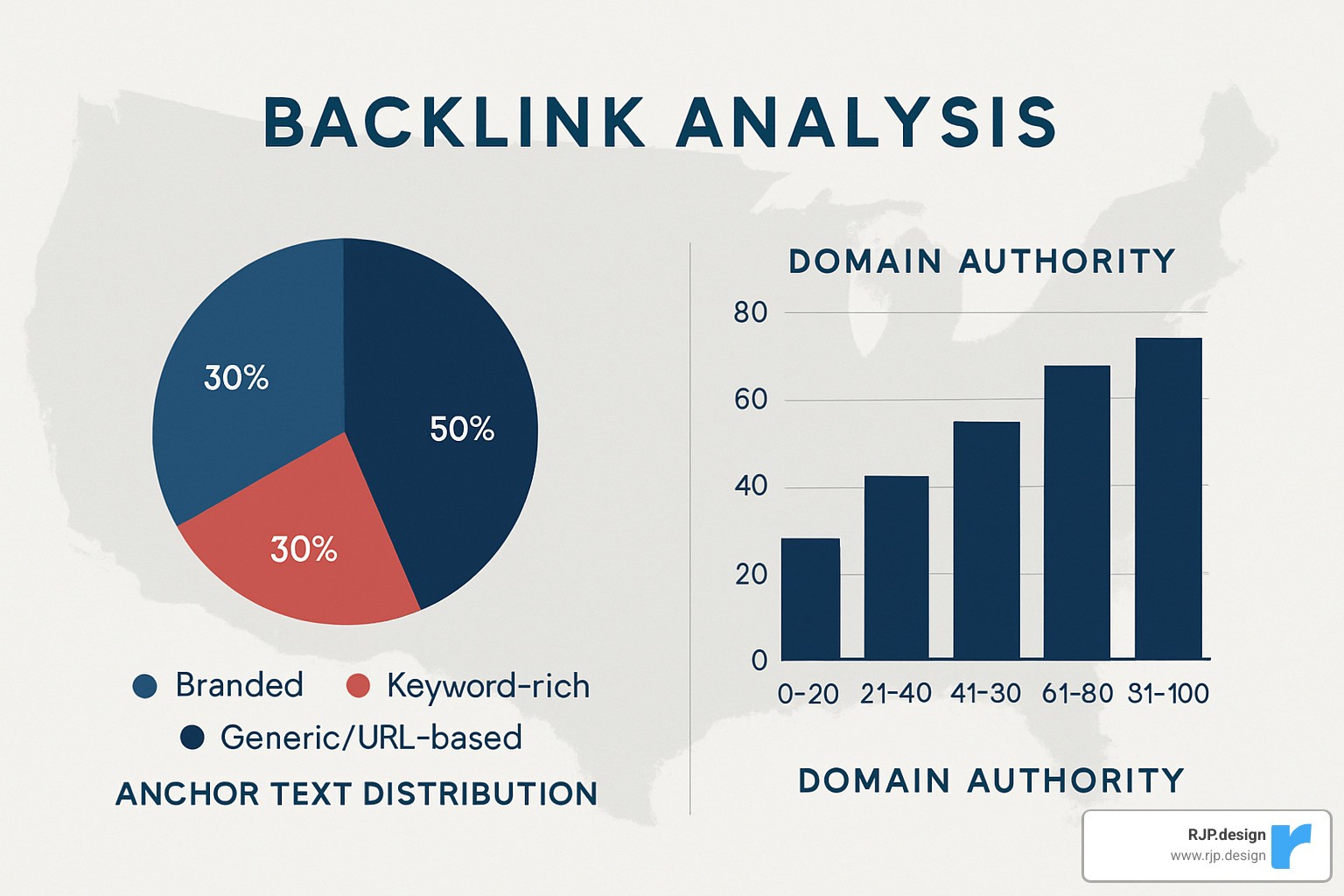
Is your anchor text diverse and natural-looking? Too many exact-match keyword anchors can trigger spam filters, while a natural mix of branded, descriptive, and generic anchors looks legitimate to Google.
We also hunt for toxic links that might be holding your site back. Sometimes a few bad backlinks can suppress your rankings across the board.
One insight we’ve gained from years of analysis: reclaiming lost backlinks (valuable links that have disappeared over time) is often much easier than building new ones from scratch. It’s like finding money you didn’t know you had!
Competitive Landscape
Understanding how you stack up against competitors gives crucial context to your search engine optimization analysis. We look at:
Keyword gaps – what valuable terms are your competitors ranking for that you’re missing? These often represent quick opportunities.
SERP feature opportunities like featured snippets, knowledge panels, and image packs can dramatically increase your visibility without necessarily changing your ranking position.
Your positioning strategy – how can you differentiate your content in crowded search results? Sometimes the path to ranking isn’t about doing the same things better, but doing something different that adds unique value.
What’s fascinating is that the #1 ranking site for competitive terms often isn’t the one with the most backlinks or highest domain authority. Instead, they excel at meeting user intent with exceptionally helpful content.
According to Scientific research on search index size, Google has indexed over 4.3 billion web pages. Standing out in this digital ocean requires understanding not just your own site, but also your competitive environment.
User Experience Factors
The fifth component, which traditional SEO audits often overlook, is user experience. Google increasingly uses behavior signals to evaluate content quality:
Do users stick around on your site, or do they quickly bounce back to search results? These engagement metrics tell Google volumes about whether your content satisfied the searcher’s needs.
Page speed and Core Web Vitals directly impact user experience. We’ve found that improving Core Web Vitals scores can reduce bounce rates by up to 24%, indirectly boosting SEO through improved engagement signals.
Can visitors easily steer your site and find what they’re looking for? Confusing information architecture frustrates users and search engines alike.
Want to learn more about how we approach SEO analysis for specific business types? Check out our detailed guide on SEO Consultant Price to understand what goes into professional SEO services.
Step-by-Step Guide: Performing a Comprehensive Search Engine Optimization Analysis
Now that we understand the components of a thorough search engine optimization analysis, let’s walk through the process step by step:
1. Check Indexation Status
Begin by assessing how much of your site is actually in Google’s index:
Use the
site:yourdomain.comsearch operator to get a rough count of indexed pagesCompare this number with your actual page count to identify indexation gaps
Check Google Search Console’s Coverage report for specific indexing issues
At RJP.design, we often find that 15-30% of client pages aren’t properly indexed due to technical issues that are easily fixable once identified.
2. Crawl Your Site
Use a crawling tool to simulate how search engines see your site:
Identify technical issues like broken links, redirect chains, and duplicate content
Check for proper heading structure and HTML markup
Evaluate internal linking patterns and site architecture
A thorough crawl often reveals that internal link distribution is heavily skewed, with 80% of links pointing to just 20% of pages. Balancing this distribution can significantly improve the visibility of underperforming content.
3. Analyze Site Speed and Core Web Vitals
Site speed is both a ranking factor and a key user experience metric:
Use PageSpeed Insights to evaluate both mobile and desktop performance
Pay special attention to Core Web Vitals metrics
Identify specific elements causing slow loading (large images, render-blocking scripts, etc.)
Our analysis typically finds that unoptimized images account for 60-70% of page weight on most sites, making image optimization a high-impact improvement area.
4. Review Content Quality and Search Intent
Evaluate your content through the lens of search intent:
Are you matching the format users expect (guides, listicles, product pages, etc.)?
Does your content cover the topic comprehensively?
Are you addressing the questions users are actually asking?
Content that misaligns with search intent rarely ranks well, regardless of its technical quality or backlink profile.
5. Benchmark Your Backlink Profile
Analyze your backlinks in comparison to top-ranking competitors:
Look at total referring domains and their quality distribution
Identify link gaps where competitors have valuable links you don’t
Check for potentially harmful links that might need disavowal
Our search engine optimization analysis process has found that the most successful sites typically have a natural distribution of backlink anchor text: roughly 60% branded, 20% keyword-rich, and 20% generic or URL-based anchors.
Search Engine Optimization Analysis Checklist
To make this process more manageable, we’ve created a checklist that distinguishes between quick wins and long-term strategic improvements:
Area | Quick Wins | Long-Term Improvements |
|---|---|---|
Technical | Fix 404 errors | Implement schema markup |
Content | Update title tags | Develop content clusters |
Backlinks | Reclaim lost links | Build industry relationships |
User Experience | Fix mobile usability issues | Implement user testing |
“Striking distance” keywords deserve special attention in your search engine optimization analysis. These are terms where you rank in positions 11-20 (page two of search results). With targeted optimization, these can often be moved to page one for relatively quick traffic gains.
Search Engine Optimization Analysis for Local Businesses
Local businesses face unique SEO challenges and opportunities. A local-focused search engine optimization analysis should include:
NAP consistency: Are your Name, Address, and Phone number consistent across all online directories?
Google Business Profile optimization: Is your profile complete, accurate, and enriched with photos and posts?
Local link building: Do you have links from local organizations, chambers of commerce, and regional publications?
According to recent data, 46% of all Google searches have local intent, and 88% of consumers who conduct a local search on their smartphone visit a related store within a week. This highlights the enormous potential of local SEO for brick-and-mortar businesses.
For more detailed guidance on local SEO, check out our Local SEO Services page.
Tools & Methods: Choosing the Right Stack
Finding the right tools for your search engine optimization analysis is like picking the perfect ingredients for a recipe. You need reliable measurements to cook up success! Let’s walk through the essentials that will make your SEO analysis both effective and manageable.
Free & Native Tools
The good news? You don’t need a massive budget to get started with solid search engine optimization analysis. These powerful free tools should be your first stop:
Google Search Console is truly the foundation of any good SEO work. It’s like having a direct line to Google about how they see your website. The data is straight from the source, showing exactly what’s working and what needs attention. According to Search Console Documentation, they now process over 240 billion pages daily – that’s some serious data at your fingertips!
PageSpeed Insights is your go-to for understanding how quickly your site loads and how it performs on those all-important Core Web Vitals. Since Google now uses these metrics as ranking factors, this tool has become essential rather than optional.
Google Analytics helps you connect the dots between your SEO efforts and actual user behavior. Are people finding what they need? Are they converting once they arrive? These insights help refine your approach.
The URL Inspection Tool lets you peek behind the curtain to see exactly how Google views specific pages. This can be incredibly helpful when troubleshooting why a particular page isn’t performing as expected.
Paid & Advanced Workflows
As your site grows or your needs become more complex, you might consider investing in more sophisticated tools:
Enterprise crawlers become essential when dealing with larger sites. If you’ve got thousands of pages, these tools can efficiently identify issues across your entire site that might otherwise go unnoticed.
API-based tools allow for much deeper customization. At RJP.design, we often use these to create custom reports that combine data from multiple sources, giving our clients a more complete picture of their SEO health.
Automation scripts are worth their weight in gold for ongoing monitoring. Rather than manually checking for issues, these scripts can alert you when problems arise, letting you address them before they impact your rankings.
We’ve found that the magic often happens when you combine tools in thoughtful ways. For instance, merging crawl data with analytics information can reveal fascinating correlations between technical issues and real user behavior. These insights often lead to the most impactful improvements.
For businesses with physical locations, the toolset looks a bit different. Local SEO requires specialized approaches to things like citation management and Google Business Profile optimization. If that sounds like you, you might want to check out our detailed approach on our Google Maps Optimization page.
Tools are just that – tools. They’re only as good as the strategy behind them and the person interpreting the results. The best search engine optimization analysis comes from combining the right tools with experienced judgment about what the data is really telling you about your site’s performance.
Interpreting Results & Continuous Improvement
You’ve collected all this valuable data from your search engine optimization analysis – now what? This is where the real magic happens. It’s not just about finding issues; it’s about changing those insights into meaningful actions that boost your business.
Turning Insights into Action
After spending hours analyzing your site, the last thing you want is a beautiful report that sits in your inbox gathering digital dust. Here’s how to make your search engine optimization analysis work for you:
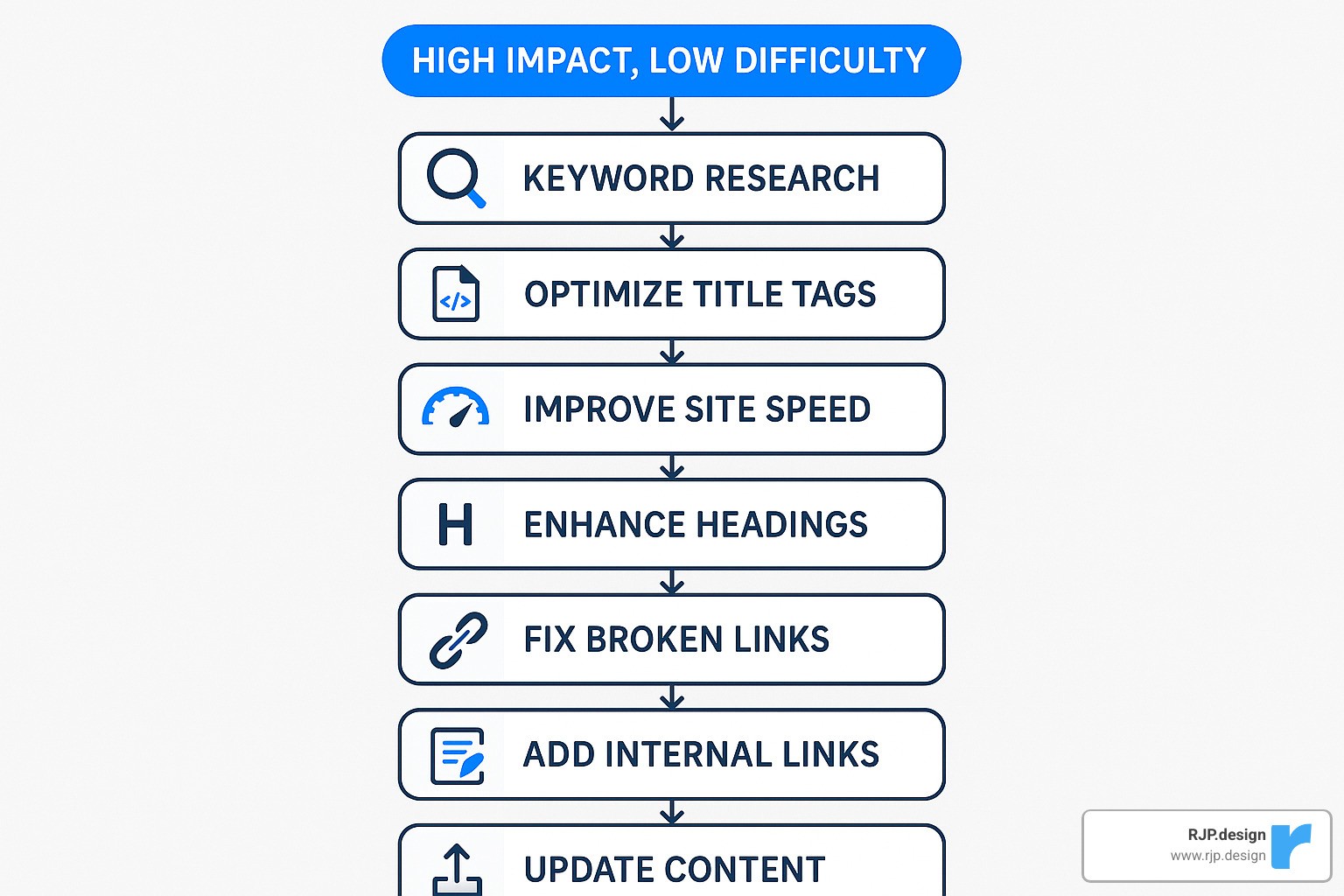
Create a prioritized roadmap that organizes tasks based on potential impact and how difficult they’ll be to implement. Think of it as your SEO treasure map – some treasures are easier to dig up than others, but all add value to your site.
At RJP.design, we’ve found that breaking work into sprint cycles makes the process much more manageable. Rather than facing a mountain of tasks, you tackle related improvements in focused bursts. This approach keeps momentum going and helps your team stay motivated.
The most important step? Monitoring the impact of your changes. Track rankings, traffic, and conversions after implementing fixes. This feedback loop tells you what’s working and what needs adjustment.
We use a straightforward prioritization framework that rates tasks on a 1-5 scale for both potential impact and implementation difficulty. This simple but effective approach helps our clients focus first on what I like to call the “golden opportunities” – high-impact tasks that are relatively easy to implement.
Presenting Findings that Drive Change
Even the most brilliant search engine optimization analysis won’t help if nobody acts on it. The way you present your findings dramatically affects whether they’ll be implemented.
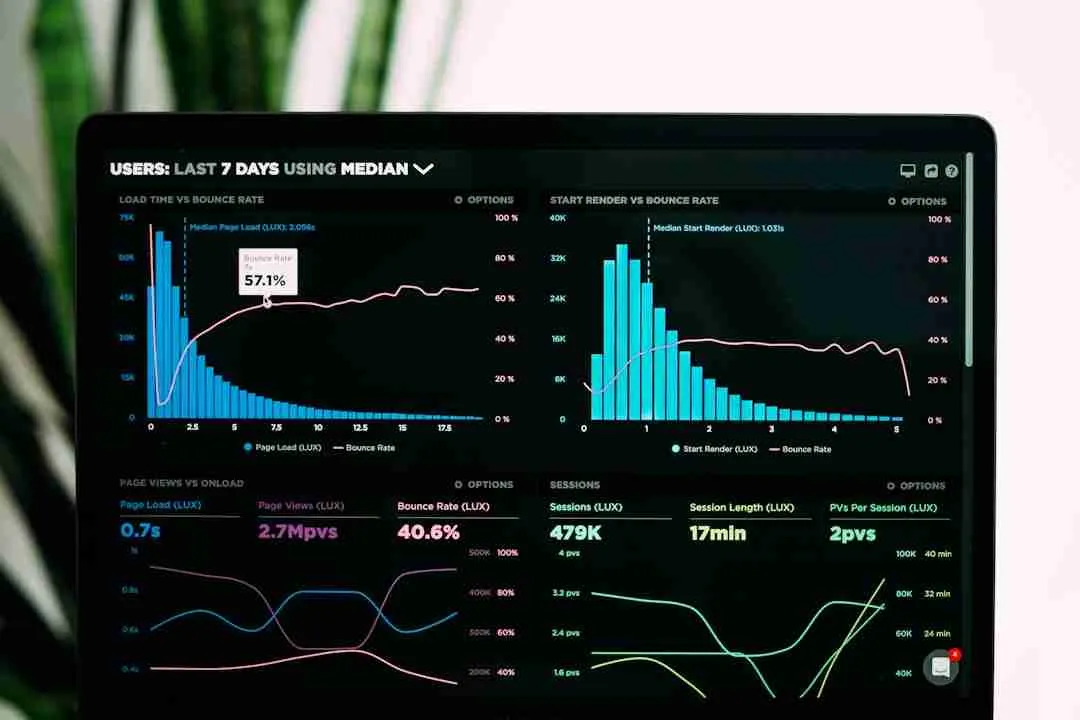
Visual dashboards work wonders for illustrating key issues and opportunities. Our brains process visual information much faster than text, making charts and graphs powerful tools for communicating complex SEO concepts.
Always provide plain-language summaries that translate technical jargon into business language. Your developer might understand what “canonicalization errors” means, but your marketing director probably needs a different explanation.
Include executive highlights that summarize the most critical issues for decision-makers. These busy professionals often need just the essentials – what’s wrong, why it matters, and how fixing it will impact the bottom line.
Different stakeholders need different levels of detail. Your technical team needs specific coding instructions, while executives need high-level insights tied directly to business outcomes. Tailoring your communication to each audience dramatically increases the chances your recommendations will be implemented.
For more information about our approach to SEO strategy and pricing, visit our Search Engine Optimization Price page.
Search engine optimization analysis isn’t a one-and-done activity. The most successful businesses view it as part of an ongoing cycle of improvement. Each analysis builds on the last, creating a continuous upward trajectory in your search performance.
The digital landscape changes constantly, with search engines updating their algorithms hundreds of times each year. Regular analysis helps you stay ahead of these changes rather than scrambling to catch up after your traffic takes a hit.
Frequently Asked Questions about Search Engine Optimization Analysis
What’s the ideal frequency for a full SEO analysis?
When clients ask me how often they should conduct a search engine optimization analysis, I always tell them it depends on their unique situation. It’s not a one-size-fits-all answer.
For most businesses, a comprehensive analysis every 6 months strikes the right balance. This gives you enough time to implement changes and see results, without letting issues fester too long.
That said, your schedule might need to be more frequent if you:
– Run a large, complex website with thousands of pages
– Operate in a highly competitive industry where rankings change weekly
– Recently launched a new site or completed a major redesign
I remember working with a client in the financial services industry—rankings would shift dramatically with each Google update. For them, quarterly analysis became essential to stay competitive.
More importantly, certain events should trigger an immediate analysis regardless of your regular schedule. If you notice a sudden 20% drop in traffic, hear about a major Google algorithm update, launch a site redesign, or spot a new competitor gaining ground quickly, it’s time for a fresh look at your SEO health.
Which metrics matter most after completing the analysis?
While it’s tempting to obsess over rankings (we all do it!), they’re actually lagging indicators of SEO success. Think of rankings as the result, not the cause, of good SEO.
At RJP.design, we’ve found that focusing on these metrics gives a more accurate picture of your SEO health:
Organic traffic growth tells you if more people are finding you through search engines. Look at both overall growth and traffic to specific landing pages to identify winners and losers.
Conversion rates from organic traffic reveal whether you’re attracting the right visitors. After all, what good is traffic if nobody takes action on your site?
Crawl stats and indexation metrics from Google Search Console show whether search engines can properly access and understand your content—essential prerequisites for ranking.
Page speed metrics, especially Core Web Vitals, often predict future ranking changes. We’ve consistently seen that technical improvements precede ranking jumps by 4-8 weeks, making them valuable early indicators of success.
One client was puzzled when their rankings stayed flat despite months of content improvements. When we dug into their Core Web Vitals, we finded serious performance issues. After fixing those problems, rankings improved dramatically—but only after that 4-8 week lag.
How does algorithm volatility affect ongoing analysis?
Google makes thousands of algorithm updates yearly, with major core updates dropping several times annually. This constant change makes search engine optimization analysis both challenging and essential.
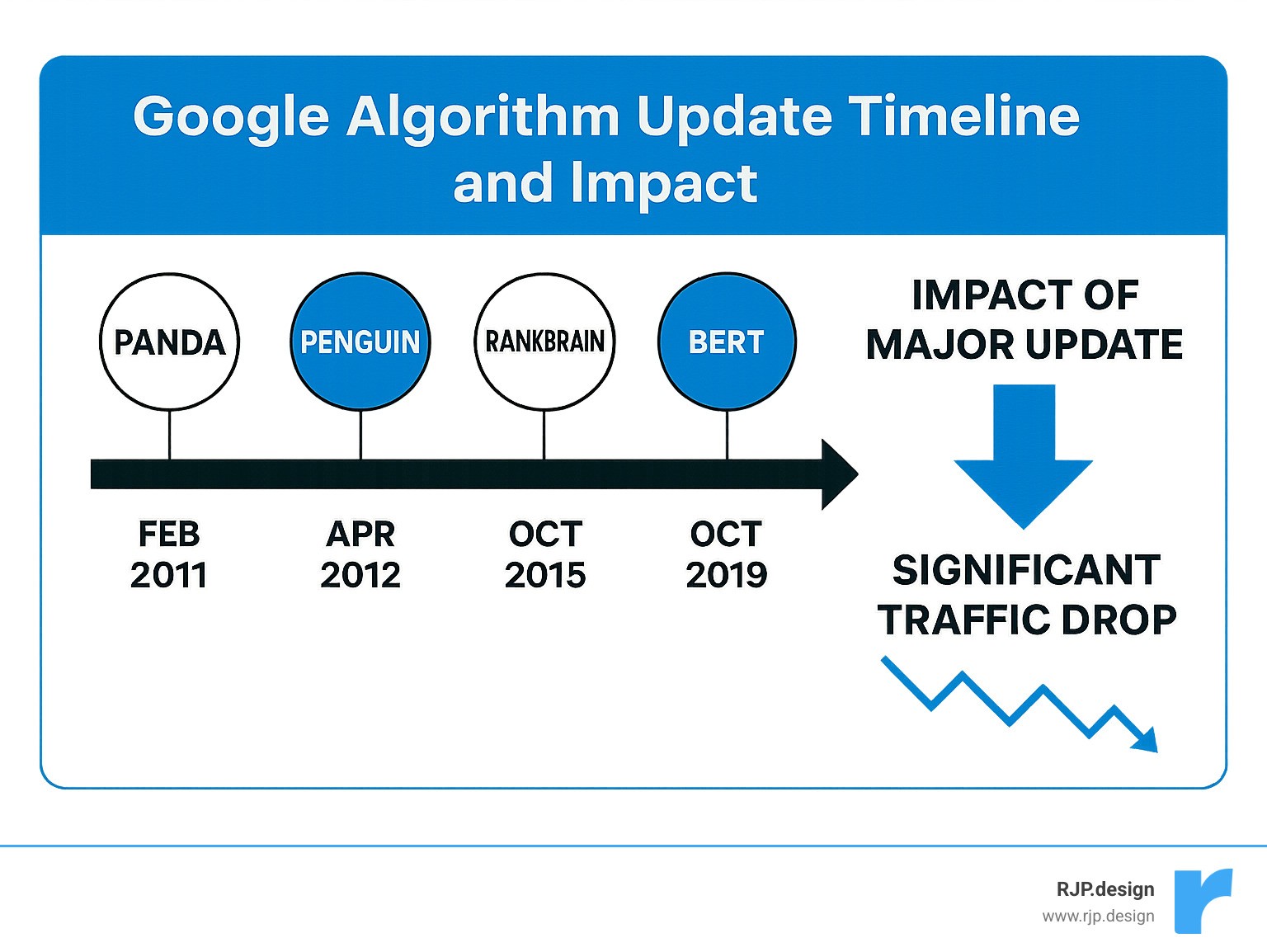
Algorithm volatility affects your analysis in several important ways:
First, it creates baseline shifts. What worked beautifully in 2022 might be merely adequate in 2023. I’ve seen sites that were perfectly optimized by last year’s standards suddenly lose ground because Google raised the bar.
Second, Google regularly introduces new ranking factors. Core Web Vitals is a perfect example—websites had to scramble to measure and improve these new metrics when Google added them to the algorithm. Regular analysis helps you spot these new factors before they hurt your rankings.
Finally, algorithm changes make interpretation more challenging. When traffic drops, is it because of something you did, or a Google update affecting your entire industry? Good analysis separates site-specific issues from broader algorithm impacts.
The best protection against this volatility isn’t trying to outsmart Google (that rarely works long-term). Instead, focus on building a diverse, quality-focused SEO strategy. Sites that rely on technical tricks or narrow optimization approaches tend to get hit hardest by updates.
As one client wisely put it: “We stopped trying to please the algorithm and started trying to please our users. Somehow, the algorithm seemed to notice.”
Conclusion
A thorough search engine optimization analysis is the foundation of any successful SEO strategy. By systematically examining technical health, content quality, backlink profile, and competitive positioning, you can identify the specific improvements that will have the greatest impact on your organic search performance.
SEO is not a one-time project but an ongoing process of analysis, implementation, and refinement. The digital landscape and search algorithms continue to evolve, making regular analysis essential for maintaining and improving your search visibility.
At RJP.design, we specialize in data-driven SEO analysis that goes beyond surface-level metrics to identify the root causes of performance issues and opportunities for growth. Our approach combines technical expertise with a deep understanding of search intent and user experience, resulting in sustainable improvements that drive qualified traffic and conversions.
The global SEO industry is projected to reach $122.11 billion by 2028 for good reason—effective search engine optimization delivers best ROI compared to other marketing channels. With organic search delivering 53% of all website traffic, the businesses that excel at SEO analysis and implementation will have a significant competitive advantage in the digital marketplace.
Ready to transform your online presence with expert search engine optimization analysis? Explore our digital marketing solutions to learn how we can help your business achieve sustainable growth through data-driven SEO strategies.