
Marketing
The A to Z of E-commerce: Developing Your Digital Shopfront
Nov 11, 2025

E-commerce Website Development: The Ultimate 6-Step
Why E-commerce Website Development is Your Path to Digital Success
E-commerce website development is the process of creating an online platform for selling products or services directly to customers. It involves building the frontend (the visual storefront) and the backend (the technical infrastructure), along with integrating essential systems like payment gateways and optimizing for mobile use and search engines.
The global web development market is projected to hit $130.9 billion by 2032, reflecting a simple truth: your website is your digital storefront, and it directly impacts your bottom line. For small businesses, this is critical: 75% of consumers have abandoned a purchase because a website appeared unprofessional, while 92% of consumers feel more confident buying from a smooth, well-operating site. Your website is the foundation of customer trust.
Understanding the development process helps you make informed decisions about platforms, features, and budget. You’ll need to consider everything from SaaS platforms vs. custom solutions to mobile responsiveness, as mobile transactions will account for nearly 50% of US e-commerce sales by 2027.
I’m Ross Plumer, and I’ve helped businesses market over $20 million in revenue by developing e-commerce strategies that combine technical excellence with customer psychology. My approach creates digital storefronts that don’t just look good—they drive measurable results.
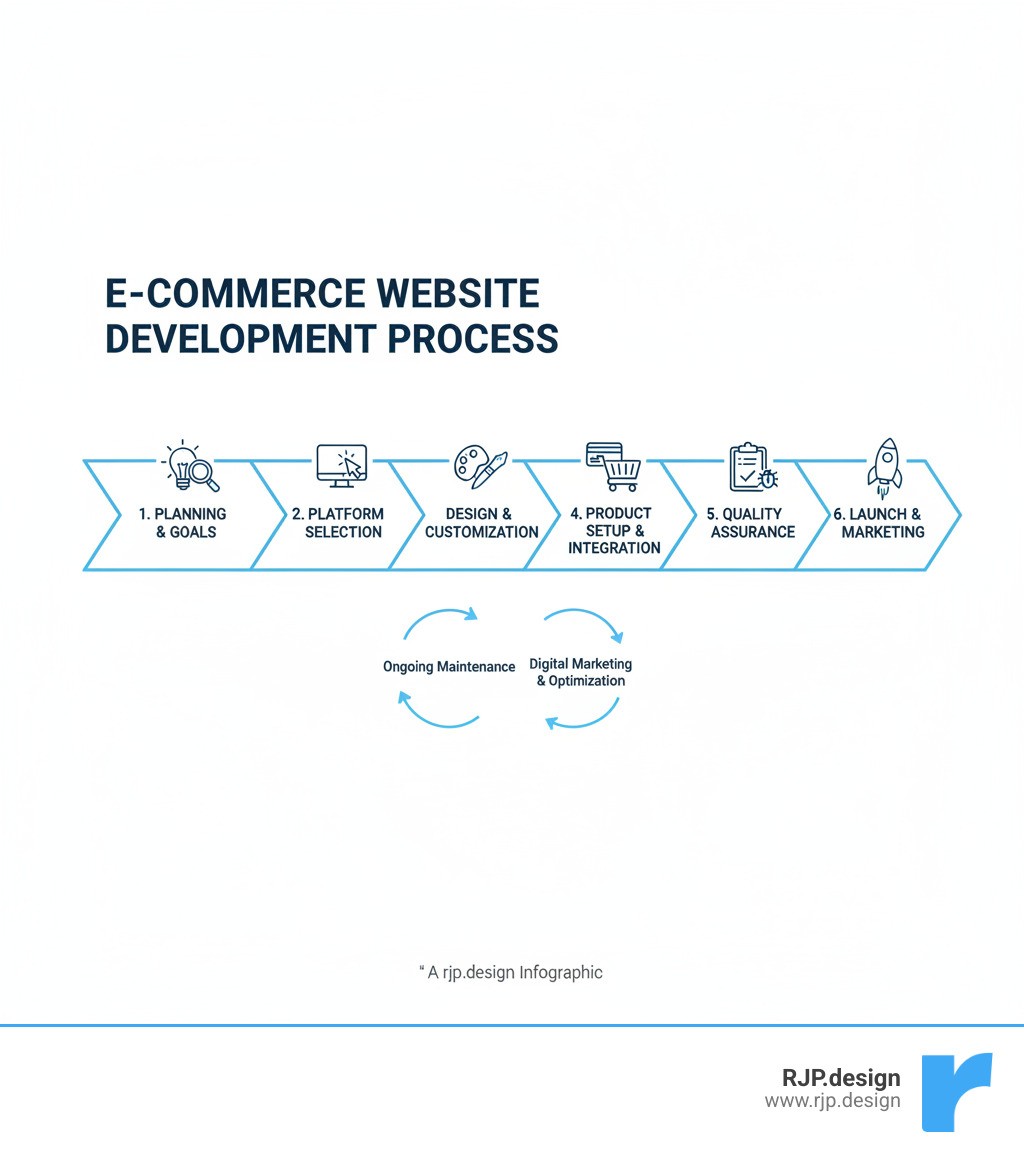
Important e-commerce website development terms:
Deconstructing E-commerce: Key Components and Must-Have Features
Think of e-commerce website development like building a house: you need a beautiful exterior (frontend) and solid plumbing and wiring (backend). The frontend is what customers see—your design, product pages, and navigation. The backend is the engine that processes orders, tracks inventory, and secures data. When both work seamlessly, shopping feels effortless.
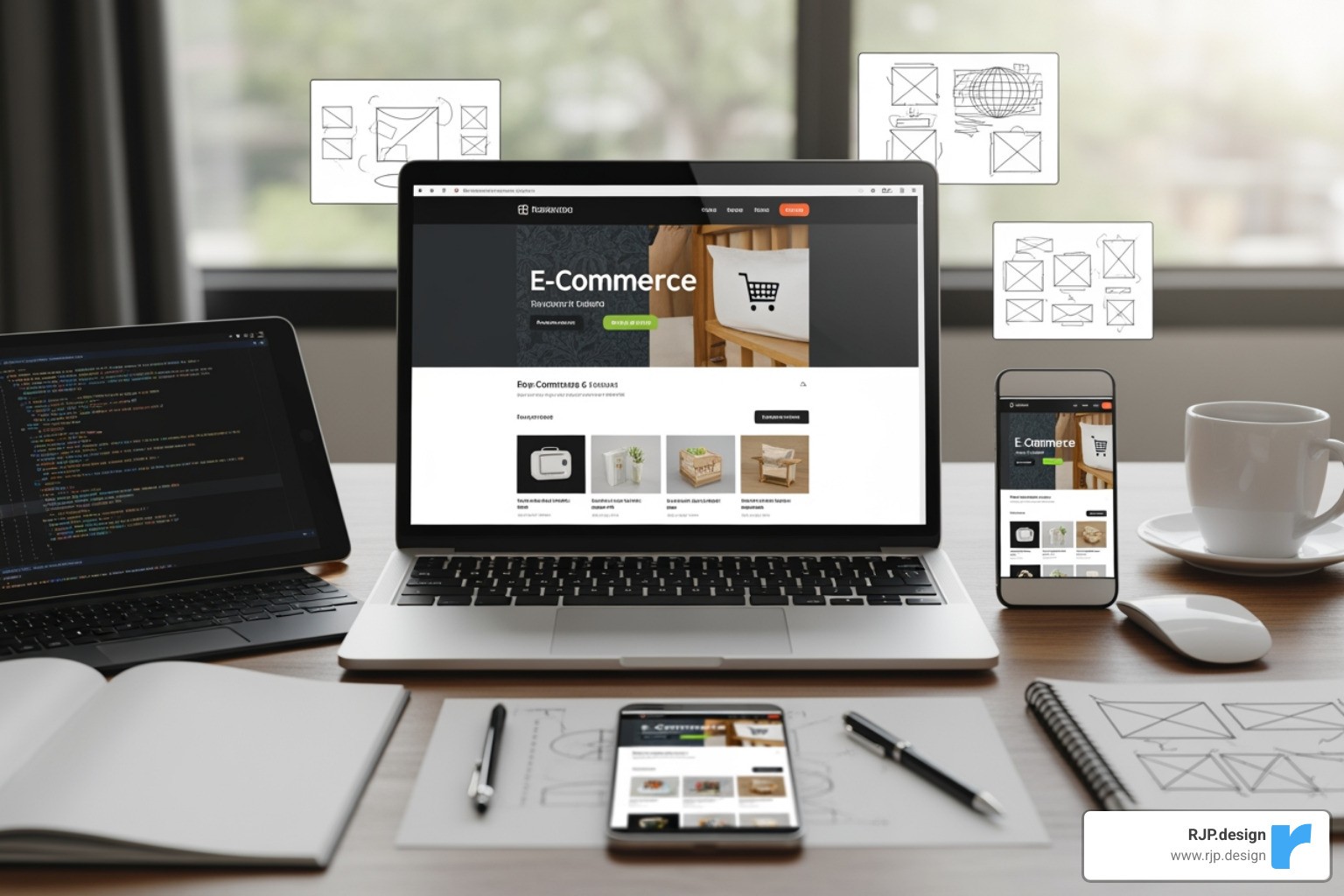
To function, your store needs several core components. Shopping cart technology must be user-friendly, while a product management system simplifies adding items and tracking stock. A feature often overlooked is sophisticated search and filtering, which helps customers quickly find what they need, dramatically increasing the likelihood of a purchase.
On the financial side, payment gateways securely process transactions, and order processing and inventory management systems track products from purchase to delivery. Personal touches like customer accounts for faster checkout, gift certificates, and customized email confirmations improve the experience and reinforce your brand.
With mobile transactions projected to account for almost 50% of US e-commerce sales by 2027, every one of these components must work flawlessly on a smartphone.
The Critical Role of UX/UI Design
Great design is useless if a site is hard to steer. User Experience (UX) is about how the site feels—is it easy and enjoyable? User Interface (UI) is what customers see—the visual layout and interactive elements.
Intuitive navigation ensures customers never feel lost. Clear menus and logical categories guide them through your store. Every design choice, from button colors to image sizes, should support conversion optimization, gently guiding users toward checkout. Small design tweaks can lead to significant sales improvements.
Brand consistency ensures your online store feels unmistakably yours, reflecting your brand’s personality and values. We use customer journey mapping to understand how people move through your site, identifying and smoothing out friction points before they cost you sales. For inspiration, explore amazing ecommerce website designs and study best ecommerce sites ux to see how professional web design turns browsers into buyers.
Essential Security and Responsive Design
Trust is the currency of e-commerce. Website security and PCI compliance are non-negotiable. SSL certificates encrypt data (like credit card numbers) in transit, signified by the padlock icon in the address bar. Data encryption protects stored information, and PCI compliance is a mandatory set of rules for handling card payments.
A site that looks broken on a phone will lose customers in seconds. Responsive web design ensures your site automatically adapts to any screen size. A mobile-first approach is key, as Google rewards mobile-friendly sites with better search rankings. The benefits of responsive web design are clear: better user experience, higher rankings, and more sales. 92% of consumers report greater confidence when a website operates smoothly. Creating good mobile website design that loads quickly builds the confidence that converts.
The Role of AI in Modern E-commerce Website Development
Artificial Intelligence is already changing e-commerce. AI product recommendations analyze customer behavior to suggest relevant items, increasing average order value. AI-powered search understands natural language and corrects typos, making it easier for customers to find products.
AI also enables personalized shopping experiences, adjusting content and promotions for each user. It can generate unique, SEO-friendly AI product descriptions in minutes and power 24/7 customer support chatbots. These custom web applications automate repetitive tasks, freeing up your team to focus on growth.
Choosing Your Build Path: Platforms and Development Options
One of the first major decisions in e-commerce website development is choosing how to build your store. This choice impacts your budget, timeline, and control over the final product. Your three main paths are SaaS platforms, open-source platforms, and custom or headless commerce solutions.
Think of it this way: SaaS is like renting a furnished apartment (quick but limited), open-source is like buying a house (full control but requires maintenance), and custom development is like building a dream home from scratch (unlimited possibilities but a significant investment).

Comparing E-commerce Development Approaches
Let’s break down what each approach means for your business.
SaaS (Software-as-a-Service) Platforms: These are subscription-based services where the provider handles hosting and security. They offer templates and drag-and-drop builders for a quick launch, making them ideal for small businesses starting out. The downside is limited customization and potential transaction fees.
Open-Source Platforms: These give you complete control over the code for unlimited customization. You own the site and there are no licensing fees (though you’ll need hosting). This path requires technical expertise (in-house or an agency) to manage setup, customization, and security. It’s great for businesses with specific needs that off-the-shelf solutions can’t meet.
MACH Architecture (Microservices, API-first, Cloud-native, Headless): This cutting-edge approach separates the frontend from the backend, allowing for highly customized experiences across multiple channels (web, mobile apps, etc.). It’s built for scalability but has the highest complexity and cost, making it best for enterprise-level businesses.
Here’s a quick comparison:
Cost: SaaS has low upfront costs but ongoing fees. Open-source has higher initial costs but lower ongoing expenses. Custom solutions have the highest investment.
Customization: SaaS is limited, open-source is highly flexible, and custom is unlimited.
Time-to-Market: SaaS is fastest, open-source is moderate, and custom is slowest.
Technical Skill: SaaS requires low skill, open-source requires moderate to high, and custom requires expert developers.
Key Factors for Choosing an E-commerce Platform
Choosing the right platform isn’t about finding the “best” one, but the right fit for you. When we work on e-commerce website development, we consider these factors:
Business Goals: Are you testing the market, expanding an existing store, or building a complex B2B portal? Your goals dictate the required capabilities.
Budget: Consider the total cost of ownership, including the initial build, transaction fees, premium apps, hosting, and ongoing maintenance.
Technical Expertise: If you lack a development team, a user-friendly SaaS platform is a good choice. If you have resources, open-source or custom solutions offer greater flexibility.
Integration Needs: Ensure the platform can connect with your essential systems, like ERP, CRM, and marketing software. Some integrations may require custom work.
SEO Capabilities: The platform must support SEO best practices, including customizable URLs, editable meta tags, and fast load times. Poor SEO capabilities mean poor visibility.
Scalability: Choose a platform that can grow with your business, handling more products, traffic, and features without requiring a complete rebuild.
Whether you’re considering bigcommerce website development, a shopify ecommerce development agency, or a custom e-commerce portal developer, matching the solution to your needs is key.
The 6-Step Process of Custom E-commerce Website Development
Building a custom e-commerce website is a structured journey that turns a business vision into a digital reality. At RJP.design, we follow six distinct phases to ensure every detail aligns with your goals.
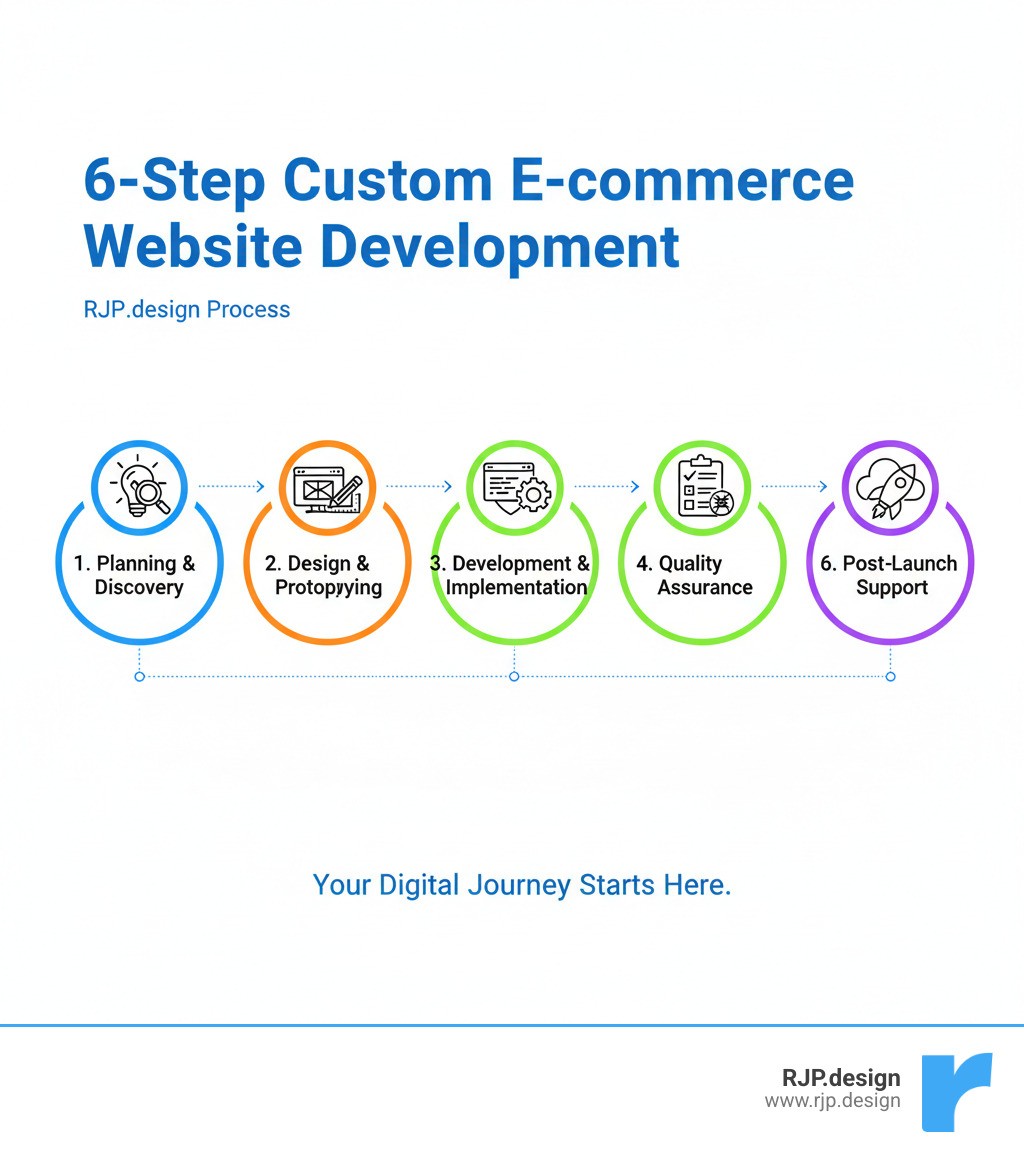
Step 1: Planning and Findy
This foundational phase is about understanding the why behind your project. We define your business goals, whether it’s increasing revenue, expanding into new markets, or replacing an outdated system. Next, we identify your target audience—their demographics, behaviors, and pain points—to create an experience custom to them. We also conduct competitor analysis to find opportunities for you to stand out. Finally, we map out all feature requirements, creating a detailed roadmap prioritized by business value. This planning is crucial for successful business website development.
Step 2: Design and Prototyping
With a solid plan, we begin to visualize your store. We start with wireframes, which are simple, black-and-white layouts that establish the site’s structure. Next, we create full-color mockups that show exactly how the site will look, incorporating your brand’s typography, colors, and imagery. We then build interactive prototypes that you can click through. This allows us to test the user flow and refine the experience before development begins, ensuring the journey from landing page to checkout is effortless. Our creative web design agency approach focuses on crafting an experience that converts, making us a custom website design company that delivers results.
Step 3: Development and Implementation
This is where your approved designs become a functional e-commerce platform. Our developers begin coding the frontend (what customers see) and the backend (the engine behind the scenes). We set up your chosen platform and structure the database to efficiently store product, customer, and order information. Through API integration, we connect your site to essential services like payment gateways, shipping providers, and your CRM or ERP systems. We also implement a user-friendly content management system (CMS), empowering you to manage your site’s content without needing a developer. This phase is the heart of e-commerce website development, turning strategy into reality.
Budgeting for Success: Costs and Ongoing Maintenance
Understanding the financial investment for e-commerce website development is essential. The cost can range from a few hundred dollars for a basic template site to tens or even hundreds of thousands for a fully custom, enterprise-level solution. In Canada, for example, a small e-commerce site typically costs $1,000 – $5,000, a mid-range site $5,000 – $50,000, and a large platform can exceed $50,000.
However, the initial build is just the beginning. Your online store has ongoing costs to keep it running, secure, and effective.
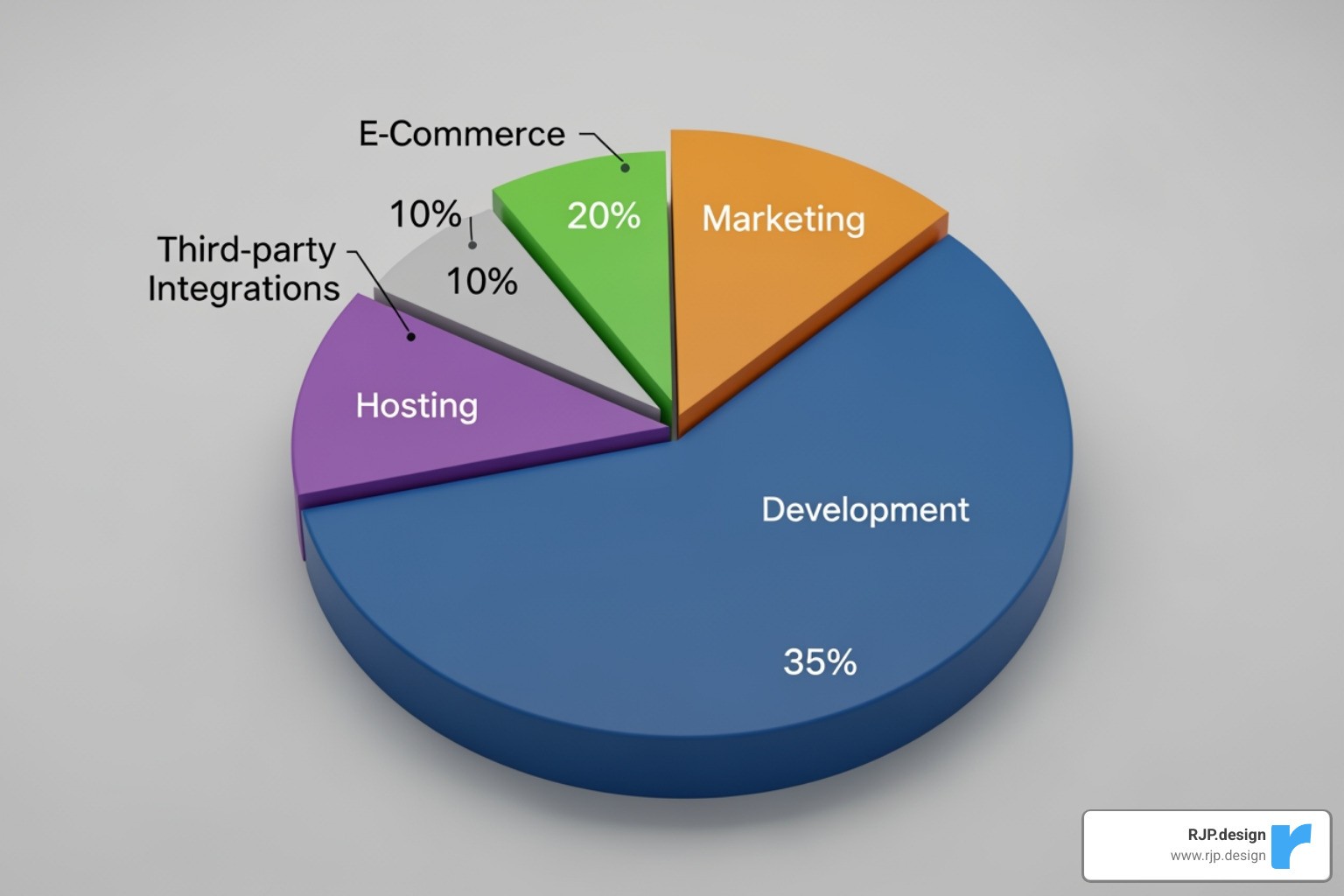
Key Factors in E-commerce Website Development Costs
Several factors determine your initial investment:
Project Complexity: A simple store with a few products costs less than a complex platform with thousands of SKUs and advanced integrations.
Custom Features: Bespoke functionalities like product configurators or membership systems require custom coding and increase the investment.
Design Uniqueness: A custom, branded design costs more than a template but builds credibility. 75% of consumers have avoided a purchase due to an unprofessional website.
Agency vs. Freelancer: An agency brings a full team of experts and reliable processes, which costs more upfront but offers greater value and reliability.
SEO Services: Integrating a search engine optimization price strategy from the start is vital for long-term visibility.
Third-Party Integrations: Connecting your site to other systems like an ERP or CRM requires development work that adds to the cost.
Understanding Ongoing Maintenance Costs
Your e-commerce website is not a one-time purchase; it requires ongoing care. Maintenance fees typically range from $50 – $1,200 per month, depending on complexity. Key ongoing costs include:
Website Hosting: The cost to keep your site live on the internet, typically $20 – $300 per month.
Security & Software Updates: Essential for protecting against threats and ensuring smooth performance.
Bug Fixes: An inevitable part of website ownership that requires a plan for quick resolution.
Content Updates: Adding new products, promotions, and blog posts to keep your site fresh.
Payment Gateway Fees: Most gateways charge 2-3% per transaction.
Technical Support: Access to experts for troubleshooting and guidance.
Marketing and SEO: Continuous effort in managed internet marketing services is needed to drive traffic and generate revenue.
As your business evolves, your site will need updates or even a website redesign service to stay competitive. When done right, the return on this investment far outweighs the costs, turning your website into a 24/7 revenue-generating asset.
Frequently Asked Questions about E-commerce Development
You’ve made it this far, which means you’re serious about building your online store. That’s fantastic! But I know you probably still have some questions bouncing around in your head. Let me address the most common ones I hear from business owners just like you.
What is e-commerce website development?
E-commerce website development is the complete process of building an online store to sell products or services. It involves creating the frontend (the visual design customers interact with) and the backend (the server, database, and applications that power the site). This includes integrating essential features like shopping carts, secure payment gateways, and inventory management to ensure a seamless and secure customer experience.
What are the most critical features for a new e-commerce site?
When you’re building a new online store, you want to get the essentials right from day one. The most critical feature is a mobile-responsive design that adapts beautifully to any device, whether your customers are shopping on a phone while commuting or browsing on a tablet from their couch.
Security comes next—and it’s non-negotiable. You need an SSL certificate to encrypt customer data and protect sensitive information like credit card numbers. 92% of consumers report greater confidence when a business’s website operates smoothly and securely.
Your user interface and user experience (UI/UX) should be intuitive enough that customers never feel confused or frustrated. They should find what they’re looking for quickly and complete their purchase without obstacles. High-quality product images and detailed descriptions help customers make confident buying decisions, even though they can’t physically touch your products.
A streamlined checkout process with multiple payment options is crucial—the fewer steps between “I want this” and “order complete,” the better. And finally, built-in SEO optimization services ensure that when potential customers search for what you sell, they actually find you.
How long does it take to build an e-commerce website?
This is one of the most common questions I get, and honestly, the answer is: it depends on what you’re building.
If you’re using a template-based platform and keeping things relatively simple, you could have a basic store up and running in a few days to a few weeks. This works well if you need to launch quickly and don’t require extensive customization.
For a fully custom e-commerce website development project with unique features, specialized integrations, and a design built specifically for your brand, the timeline extends considerably. Working with an agency like ours, you’re typically looking at 3 to 9 months from initial planning to launch.
The complexity of your project drives this timeline. A simple online store with 50 products and basic functionality will obviously take less time than a sophisticated platform with custom product configurators, multiple integrations with your ERP and CRM systems, and advanced features like AI-powered recommendations. The number of third-party integrations, the uniqueness of your design requirements, and the overall scope all play a role.
The good news? We work efficiently without cutting corners, and we’ll give you a realistic timeline upfront so you can plan accordingly.
Conclusion
Building an e-commerce website is about creating a digital home for your business that builds trust and drives growth 24/7. From technical components to platform choice and budgeting, every element forms the foundation for your success.
The numbers are clear: with the web development market set to hit $130.9 billion by 2032, a professional online presence is non-negotiable. 75% of consumers will avoid a site that looks unprofessional, while 92% feel more confident buying from a smooth, secure website. This makes e-commerce website development a strategic investment, not an expense.
The digital landscape is always evolving with trends like mobile commerce and AI. Your site needs to be flexible, secure, and high-performing to adapt and convert. This is where the right partner is critical. At RJP.design, we’ve helped businesses market over $20 million in revenue by combining technical skill with a deep understanding of customer behavior. We’re partners in your growth, focused on building websites that deliver real results.
A great website is just the beginning. To bring customers to your digital door and keep them coming back, you need a comprehensive growth strategy. Explore our digital marketing services to learn more.
Your digital future starts now. Let’s build something remarkable together.