
SEO
Off-Page SEO: The Secret Sauce to Boost Your Rankings
Apr 25, 2025

The Power of Off-Page SEO: Building Authority Beyond Your Website
Link building off page SEO refers to strategies used to improve your website’s search rankings through actions taken outside your website, primarily by acquiring backlinks from other sites.
Here’s what you need to know about link building for off-page SEO:
Element | Description |
|---|---|
Definition | Actions taken outside your website to improve search rankings |
Primary Focus | Acquiring quality backlinks from relevant, authoritative sites |
Key Benefits | Increases domain authority, improves rankings, drives referral traffic |
Most Effective Tactics | Guest posting, broken link building, data-driven content, HARO outreach |
Quality Indicators | Relevance, authority of linking site, contextual placement, natural anchor text |
Think of link building off page SEO as building your website’s reputation and authority in the eyes of search engines. While on-page SEO optimizes elements within your site, off-page SEO focuses on external signals that tell Google your content is trustworthy and valuable.
As Google’s John Mueller stated: “Links are really important for us to find content initially. If nobody links to your website ever, then we’re going to have a hard time recognizing that it even exists.”
The days of simply creating great content and hoping for links are long gone. Today’s off-page SEO requires a strategic approach to actively earn backlinks through relationship building, value creation, and targeted outreach.
For small businesses, effective link building off page SEO can be the difference between appearing on page one of search results or being buried pages deep where customers never find you.
I’m Ross Plumer, and I’ve helped businesses generate over $20 million in revenue through strategic link building off page SEO campaigns that build authority while avoiding common pitfalls that trigger Google penalties.
Link building off page seo word roundup:
Link Building Off-Page SEO 101
At its core, off-page SEO link building is like building your website’s reputation in the online world. When Google burst onto the scene, their PageRank algorithm changed everything about how search engines worked. Instead of just looking at the content on your page, they started counting links as votes of confidence. And while search algorithms have grown incredibly sophisticated, this fundamental principle still holds true today.
Think of PageRank like this: when another website links to you, they’re essentially saying, “Hey, this content is worth checking out!” It’s like getting a recommendation from a friend. And just like in real life, a recommendation from someone respected (like an industry leader) carries much more weight than one from someone nobody knows.
Over time, Google has refined its approach to include what they call E-E-A-T principles: Experience, Expertise, Authoritativeness, and Trustworthiness. Your off-page SEO link building efforts directly influence how search engines measure these qualities for your website.
What Is Off-Page SEO and Why It Still Moves the Needle
Off-page SEO includes everything you do outside your website that helps your search rankings. While on-page SEO is about making your actual website better (content, code, structure), off-page SEO builds your site’s reputation through external signals.
Why does this matter so much? Because Google doesn’t just take your word for it when you claim to be an expert. They want to see that other trustworthy sites agree with you. It’s like the difference between saying “I’m the best plumber in town” versus having dozens of happy customers saying it for you.
Former Google CEO Eric Schmidt put it perfectly: “Brands are the solution, not the problem… Brands are how you sort out the cesspool.” In other words, strong brand signals help search engines identify who’s truly trustworthy in the vast ocean of online content.
Off-page SEO creates powerful advantages that on-page optimization alone simply can’t match:
Building domain authority means your entire website gains the ability to rank for competitive terms, not just individual pages. It’s like having a good credit score – it makes everything easier.
Creating a reputation moat makes it harder for competitors to overtake you in rankings. Once you’ve established authority, you have a cushion that protects your positions.
Breaking SERP ties happens when Google has to decide between two similar pages. When everything else is equal, the site with better off-page signals typically wins.
Increasing branded searches occurs naturally as more people find you across the web. When more people search specifically for your brand name, Google sees this as a strong signal that you’re relevant and trustworthy.
In our experience at RJP.design, sites with 40-50 quality backlinks to the homepage and around 100 links to key pages typically perform well in rankings. But remember – quality always trumps quantity when it comes to off-page SEO link building.
Types of Backlinks & How They Influence Off-Page SEO
Not all backlinks deliver the same value. Understanding these differences helps you build a more effective strategy:
Natural links are the gold standard – they happen when other sites link to you without any prompting. It’s like having someone recommend your business unprompted because they genuinely love what you do. For example, when a popular blog references your research because it contains valuable insights their readers need.
Built or manual links come from deliberate outreach efforts. This might include writing guest posts for industry publications, reaching out after creating a helpful resource, or asking sites that mentioned your brand to add a link. These links require work but are completely legitimate when you’re providing genuine value.
Self-created links are ones you place yourself in forums, comments, or directories. Most have minimal SEO impact, and overdoing it can actually hurt your site. That said, relevant industry directories and professional association listings can still provide legitimate signals.
The way links are coded also affects their value. Dofollow links pass ranking power and are the most valuable. Nofollow links include a special attribute that traditionally didn’t pass value, though Google now treats them as “hints” rather than ignoring them completely. Sponsored links (marked with rel=”sponsored”) identify paid placements, while UGC links (rel=”ugc”) identify user-generated content.
The clickable text of your links (anchor text) matters too. A natural link profile includes a mix of:
Branded anchors using your company name, naked URLs showing the full website address, generic phrases like “click here,” partial-match anchors that contain some related terms, and a smaller number of exact-match anchors that precisely match your target keywords.
Having too many exact-match keyword anchors can trigger penalties – it looks unnatural because that’s not how people typically link in the wild. A diverse, natural-looking anchor text profile works best.
Spotting High-Quality vs. Toxic Links
Not every link helps your SEO – some can actually harm it. Here’s how to tell the good from the bad:
High-quality links typically come from relevant sites in your industry or related fields. A link from a respected plumbing association to your plumbing business carries more weight than one from a random fashion blog with no connection to your services.
Authority matters enormously. Links from trusted “seed sites” like major news publications, educational institutions (.edu domains), or government sites (.gov domains) provide tremendous value. Tools like Domain Rating (DR) or Domain Authority (DA) help quantify this authority.
Real traffic is a quality signal. Sites that people actually visit are more valuable than dormant websites nobody reads. Many SEO professionals filter for sites with at least 500 monthly visitors when building links.
Editorial placement within the main content of a page carries more weight than links hidden in footers or sidebars. Google recognizes when a link is truly vouching for your content versus being an afterthought.
The company a site keeps matters too. Quality websites are selective about where they link. If a site links to suspicious or spammy domains, its own links carry less weight – guilt by association.
Freshness counts. Recently acquired links often carry more weight than very old ones, as they signal current relevance.
On the flip side, toxic links can damage your SEO efforts. Watch out for links from spammy site categories (gambling, adult content, or pill sites – unless relevant to your industry), pages with hundreds of outbound links that dilute each link’s value, private blog networks (PBNs) created solely for link manipulation, low-quality directories with no editorial standards, and services promising hundreds of links quickly.
Google’s Webmaster Guidelines are clear: “Any links intended to manipulate PageRank or a site’s ranking in Google search results may be considered part of a link scheme and a violation of Google’s Webmaster Guidelines.”
At RJP.design, we help clients build robust backlink profiles through white-hat techniques focused on quality over quantity. This ensures sustainable growth without risking penalties that could set you back months or years.
More info about Google Search Optimization
2024 Link Building Playbook: 8 Proven Tactics
Let’s face it – link building off page SEO isn’t what it used to be. As Google gets smarter, we’ve had to get more strategic about how we earn those valuable backlinks. The good news? Some approaches still work incredibly well in 2024, and I’m excited to share them with you.
First things first: don’t put all your eggs in one basket. The most successful link building campaigns we’ve run at RJP.design combine several of these tactics rather than relying on just one method. This creates a natural-looking backlink profile (which Google loves) while giving you multiple pathways to success.
Did you know that long-form content gets a whopping 77% more links than shorter posts? We’ve seen this play out time and again with our clients. There’s something about comprehensive, in-depth content that naturally attracts links – especially when it includes original research or unique insights that others in your industry can’t find elsewhere.
Speaking of research, one of my favorite statistics comes from our work with HARO (Help a Reporter Out). We’ve found that roughly 1 in 50 links acquired through HARO can be what we call a ‘unicorn’ link – those coveted placements on major publications that can significantly boost your domain authority overnight.
The beauty of modern link building off page SEO is that it aligns perfectly with other marketing goals. Many of these tactics don’t just build links – they build brand awareness, establish thought leadership, and even drive direct traffic to your site.
I’ve helped dozens of businesses transform their search visibility through strategic link building, and these eight tactics consistently deliver the best results while staying safely within Google’s guidelines. Whether you’re just starting out or looking to level up your existing strategy, these approaches will help you build genuine authority without risking penalties.
Let’s explore the eight most effective tactics for link building off page SEO in 2024, starting with my personal favorite – creating data-driven content that people can’t help but link to.
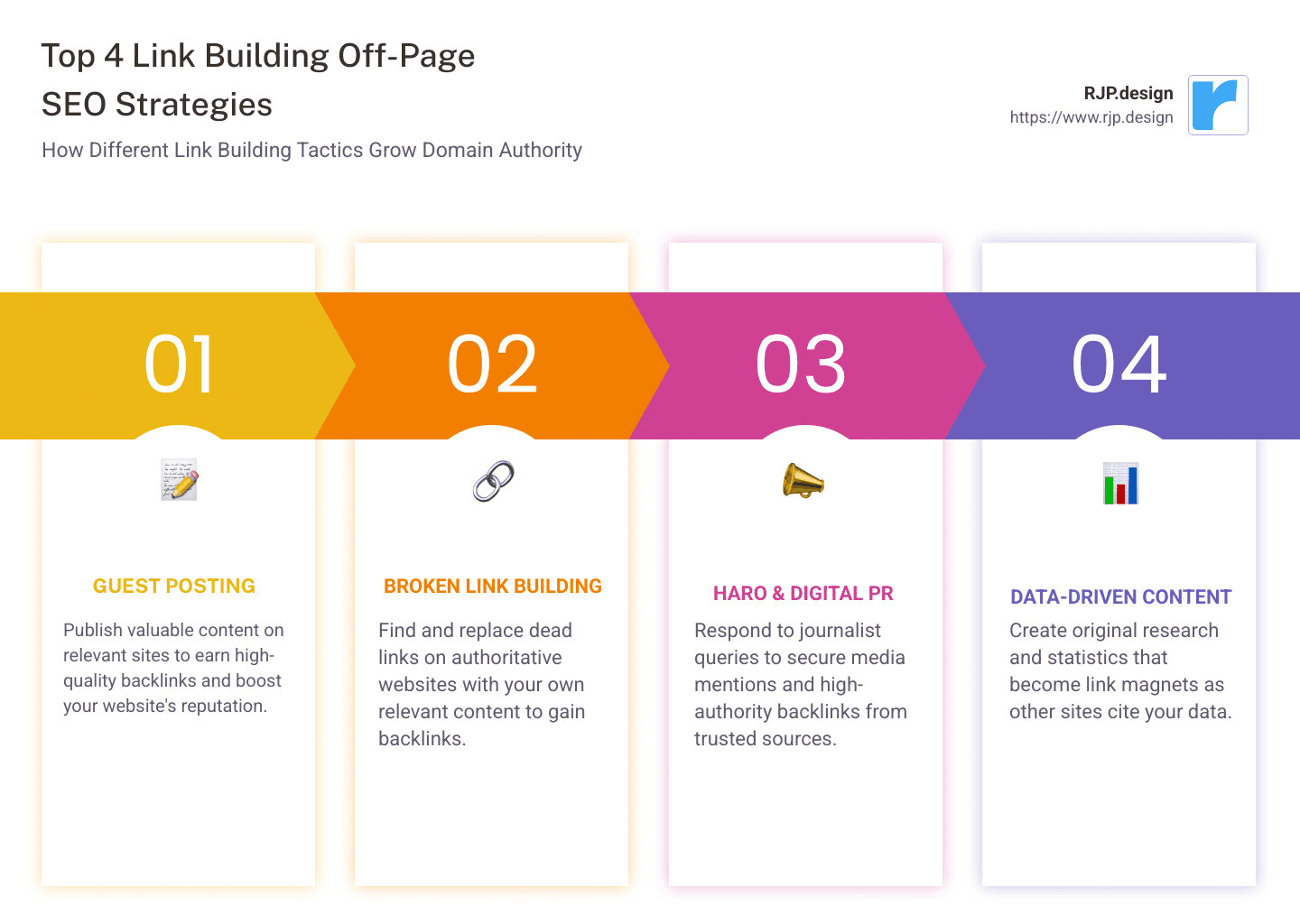
1. Data-Driven Content & Original Studies
If there’s a crown jewel in the link building off page SEO world, it’s creating original research and data-driven content. This approach isn’t just effective—it’s downright magnetic for attracting high-quality backlinks.
Why does this work so well? It’s simple: journalists, bloggers, and content creators are constantly hunting for fresh statistics and insights to make their content more credible. When you become the source of that data, you become the natural citation.
I’ve seen how powerful this can be. One of our clients in the marketing space surveyed 500 social media managers about their daily challenges and workflow bottlenecks. The resulting report wasn’t just informative—it became a link-generating machine, pulling in over 120 quality backlinks from industry blogs, news sites, and even scored a mention in a major business publication. All this happened within just six months of publishing!
Creating linkable data doesn’t need to be complicated. Start by identifying questions in your industry that lack solid answers or statistics that haven’t been updated recently. These information gaps represent golden opportunities.
Once you’ve spotted your opportunity, gather unique data through customer surveys, analyzing your internal metrics, or by compiling publicly available information in a fresh, insightful way. The key is offering something that simply doesn’t exist elsewhere.
The presentation matters tremendously. Make sure your findings are visually appealing with clear charts and graphs. Extract bite-sized, quotable statistics that make it easy for others to reference your work. You’re not just publishing data—you’re creating citation-ready content.
When your research is ready, don’t just hit publish and hope for the best. Strategic promotion is crucial. Share your findings with industry publications, reach out to journalists who cover related topics, and connect with influencers who might find your insights valuable.
As one SEO expert told me during our research: “Link building is essentially a sales process—offer value before asking for a link.” This perfectly captures the essence of data-driven content strategy. You’re not begging for links; you’re providing something genuinely valuable that naturally earns citations.
Google’s Quality Rater Guidelines emphasize this approach too, instructing evaluators to “Look for independent reviews, references, news articles, and other sources of credible information about the website or content creators.” When you publish original research, you’re creating exactly the kind of content Google wants to see referenced across the web.
At RJP.design, we’ve helped numerous clients identify their unique data advantages and transform them into powerful link magnets. The beauty of this approach is that it builds your authority while simultaneously generating valuable backlinks—a true win-win for your link building off page SEO strategy.
Scientific research on data-driven outreach
2. Broken Link Building Reloaded
Broken link building might sound like yesterday’s news, but this strategy remains one of the most effective white-hat techniques in your link building off page SEO arsenal. It’s like being the helpful neighbor who not only points out a problem but brings the solution right to the doorstep.
Why it works: Website owners hate broken links. They frustrate visitors, damage user experience, and can even hurt SEO. When you spot these digital dead-ends and offer a perfect replacement, you’re solving a real problem. The webmaster gets to fix their site, visitors get working links, and you get a valuable backlink – everybody wins.
I’ve seen clients triple their backlink acquisition rate by focusing on broken link building for just 2-3 hours per week. The beauty is in the simplicity and mutual benefit.
Implementation steps:
First, hunt for resource pages in your industry – these content goldmines typically link out to dozens of helpful resources, making them perfect targets. Educational institutions, industry associations, and “ultimate guide” style posts are fantastic places to start.
Next, investigate these pages for broken links using tools like Ahrefs, the Check My Links browser extension, or Screaming Frog. When you find those 404 errors, you’ve struck digital gold.
Then comes the crucial step – create replacement content that matches or exceeds what the broken link originally pointed to. This isn’t about throwing together a quick blog post; it’s about crafting something genuinely valuable that deserves to take the place of what was lost.
Finally, reach out with a friendly, helpful email that alerts the webmaster to the broken link and naturally suggests your content as the perfect replacement. Keep it conversational and focus on how you’re helping them, not what you want from them.
Pro tip: Look for expired domains or discontinued products and services in your industry. When companies shut down or rebrand, their content often disappears, creating broken link opportunities across the web. One client found over 50 link opportunities when a competitor was acquired and their resource center was taken offline.
A Reddit user shared this success story that shows the power of this approach: “I accidentally outranked Amazon for product pages by diligent keyword targeting and thorough content, then used broken link building to secure links from Fortune 500 company articles.”
What makes broken link building so effective in 2024 is that it’s completely aligned with how Google wants websites to earn links – by providing genuine value rather than gaming the system.
3. Strategic Guest Posting Under E-E-A-T
Guest posting isn’t dead – it’s just evolved. While Google’s John Mueller has warned against mass guest posting purely for links, thoughtful contributions to relevant publications remain one of the most effective link building off page SEO strategies when done right.
Think of guest posting like being invited to speak at someone else’s dinner party. You wouldn’t show up and talk only about yourself – you’d offer interesting insights that their friends would appreciate, while naturally establishing your expertise.
The key difference today is quality and intent. Google’s E-E-A-T guidelines (Experience, Expertise, Authoritativeness, and Trustworthiness) actually support guest posting when it demonstrates genuine expertise to relevant audiences.
When I work with clients at RJP.design, we focus on finding the sweet spot – publications where your expertise genuinely adds value to their audience. This creates a win-win-win situation: the publication gets great content, their readers get valuable information, and you earn both exposure and a quality backlink.
Here’s how to make guest posting work in 2024:
First, be selective about where you contribute. Look for websites that tick these boxes:
They have a Domain Authority of at least 30 (check using Moz’s free tool)
Their comment sections show real reader engagement (not just spam)
They maintain clear editorial standards
They cover topics directly relevant to your business
Before sending a single pitch, take time to understand the publication’s content style and audience needs. Read their recent articles, study their comment sections, and note which topics generate the most engagement. This research is what separates successful guest posters from the masses of rejected pitches.
Our research found something interesting: 76% of editors publish up to 10 guest posts weekly, but they reject 79% of submissions for being too promotional. This creates a perfect opportunity for businesses who focus on delivering genuine value rather than thinly-disguised advertisements.
As one editor told me, “I can spot a link-hungry contributor from the first paragraph. The ones who get published repeatedly are those who clearly understand our audience and provide insights they can’t get elsewhere.”
When crafting your pitch, think about what unique perspective or data you can offer. Do you have original research? Specialized expertise? A contrarian viewpoint backed by evidence? These elements make your pitch stand out among dozens of “7 Tips for…” submissions.
One thoughtful post on an authoritative industry site carries more link building off page SEO value than ten posts on low-quality sites. Quality truly trumps quantity in today’s guest posting landscape.
As one successful guest poster shared with us: “Approach guest posting like you’re preparing for a job interview at your dream company. Research thoroughly, understand their needs, and show them exactly how you can provide unique value their audience can’t get elsewhere.”
4. HARO & Digital PR “Unicorn” Links
There’s something almost magical about seeing your expertise quoted in a major publication. That’s the power of HARO (Help a Reporter Out) and similar digital PR platforms – they connect journalists who need expert insights with people like you who have knowledge to share.
I’ve personally seen businesses transform their backlink profiles with just a handful of these high-authority links. We call them “unicorn” links because they’re rare and incredibly valuable.
Why it works: Journalists are constantly hunting for expert quotes and insights to add credibility to their stories. When you provide valuable expertise, you can earn mentions and backlinks from prestigious websites that would otherwise be nearly impossible to access through traditional link building off page SEO methods.
Think about it – would you rather spend months trying to get a link from Forbes through cold outreach, or respond to a direct request from a Forbes writer who’s actively seeking your expertise?
One of our clients, a financial advisor, landed a quote in The Wall Street Journal after just three weeks of consistent HARO pitching. That single link drove more referral traffic than all their other backlinks combined.
Here’s how to make HARO work for your business:
First, sign up for HARO as a source and select relevant industry categories. You’ll receive three emails daily filled with journalist requests. When scanning these emails, look for queries where your specific expertise truly shines – authenticity matters tremendously here.
When you spot a relevant query, respond quickly with concise, valuable insights. Journalists often work on tight deadlines, so prompt, well-formatted responses stand out from the crowd. I recommend creating a simple template with your bio and credentials that you can customize for each pitch.
Remember to focus on providing genuine expertise rather than promotional content. Journalists can smell a sales pitch from miles away, and nothing will get your response deleted faster.
If your quote gets used without a link, don’t despair! A polite follow-up can sometimes result in a link addition. One simple template that works well: “Thank you so much for including my insights in your article! I was wondering if you might consider adding a link to our website so readers can learn more about our work in this area?”
Our research shows the success rate for HARO is approximately one high-value link per 50 pitches. That might sound low, but consider this perspective from a marketing director we interviewed: “I secured links from Fortune 500 company articles via HARO after investing ~$10-15k in labor. The ROI was tremendous compared to other link building methods.”
The beauty of HARO is that it aligns perfectly with Google’s E-E-A-T guidelines – you’re earning links by demonstrating genuine Experience, Expertise, Authoritativeness, and Trustworthiness. These aren’t just any links; they’re editorial endorsements from trusted publications.
At RJP.design, we’ve helped clients implement systematic HARO strategies that consistently deliver these high-value backlinks while simultaneously building their reputation as industry authorities. It’s a win-win that improves both SEO and brand credibility.
More info about Web Marketing Solution
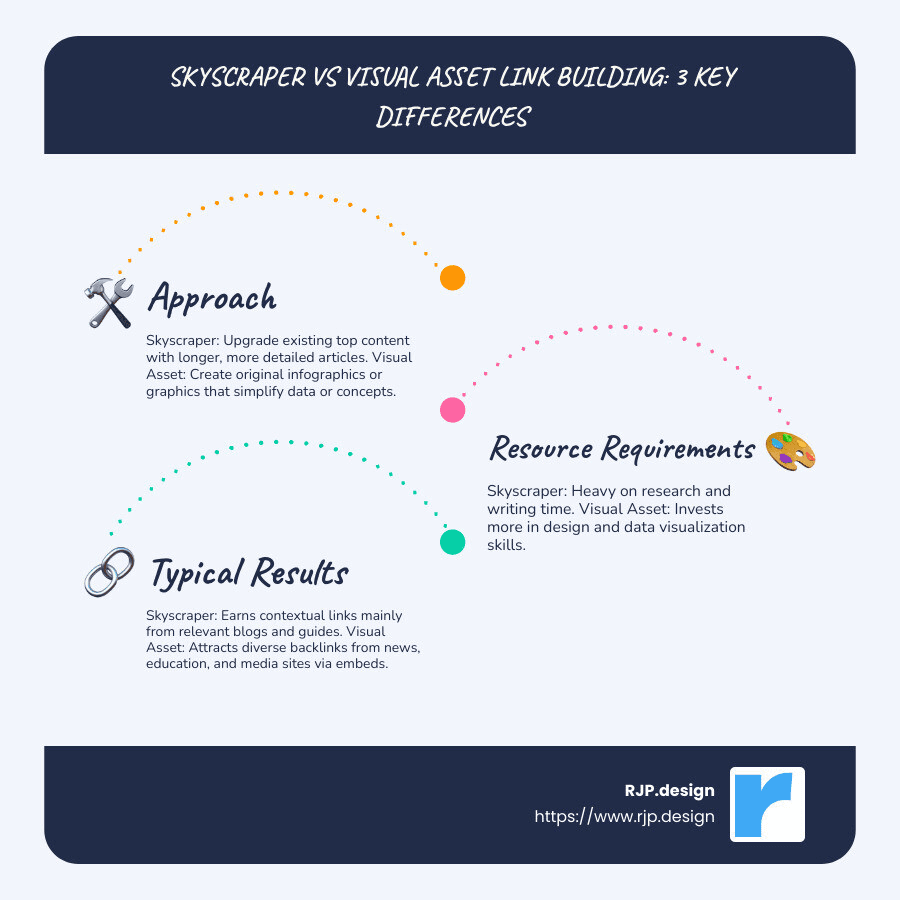
5. Visual Assets: Infographics & Shareable Graphics
You might have heard that infographics are yesterday’s news, but don’t believe everything you hear! Visual content remains one of the most powerful tools in your link building off page SEO arsenal—when done right. The secret isn’t just creating any old graphic; it’s about crafting visuals that genuinely help people understand complex ideas.
Think about it: when was the last time you bookmarked a text-heavy page versus a clear, beautiful visualization that explained something tricky in seconds? That’s the power of great visual assets.
Why it works: Our brains process visuals 60,000 times faster than text. When you create unique graphics that simplify complex data or processes, other site owners naturally want to share them with their audiences. Each share typically comes with that precious attribution link pointing back to you.
I’ve seen clients earn dozens of high-quality backlinks from a single well-designed infographic—far more efficiently than through text content alone. The visual format makes your content instantly more shareable and reference-worthy.
Implementation steps:
Creating link-worthy visuals doesn’t happen by accident. Start by identifying concepts in your industry that people struggle to understand. What data points or processes could benefit from visual clarity? This is where opportunity lives.
Next, invest in quality design. This doesn’t necessarily mean spending thousands, but it does mean prioritizing clean, simple aesthetics that work well on mobile devices. Cluttered, confusing graphics get ignored—no matter how good your data is.
One often-overlooked step is including ready-made embed code with your visual assets. Make it ridiculously easy for bloggers and journalists to share your work by providing HTML they can copy-paste, complete with your backlink already built in.
Finally, don’t just post your visual and hope for the best. Promote it strategically to industry publications and influencers who regularly cover related topics. A gentle nudge often makes all the difference.
The most successful visual assets in link building off page SEO typically follow certain principles: they use minimal text with a simple color palette, focus on a single clear message or data story, include subtle branding, and provide standalone value even without the accompanying article.
The goal isn’t just to create something pretty—it’s to create something useful that others will want to reference. When you solve a real information problem with your visual, the links tend to follow naturally.
6. Podcasts, Webinars & Expert Interviews
Podcasts and webinars aren’t just popular content formats—they’re goldmines for link building off page SEO. Being featured as a guest expert creates a double win: you get to showcase your expertise while naturally earning valuable backlinks.
Think about it—when you appear on a podcast, the host typically includes links to your website in their show notes. These links often come from established domains with engaged audiences who trust the host’s recommendations. It’s like getting a warm introduction to potential customers and search engines simultaneously.
One client of ours appeared on just three industry podcasts and earned not only quality backlinks but also saw a 22% increase in branded searches the following month. People heard him speak, liked what he said, and looked him up online. That’s the power of audio content for building your digital footprint.
Why podcasts and webinars work so well: Unlike written content that requires focused attention, podcasts can reach people during their commute, workout, or household chores. This expanded accessibility means your expertise reaches audiences in moments when they’re particularly receptive. Plus, the conversational format allows your personality to shine through in ways that written content simply can’t match.
To get started with this strategy, begin by identifying relevant shows in your industry. Look for podcasts where the audience aligns with your target market. Don’t just aim for the biggest shows—niche podcasts often have more engaged listeners and hosts who are open to featuring new guests.
Next, develop your unique angle. Podcast hosts aren’t looking for generic expertise—they want specific insights their audience can’t get elsewhere. Ask yourself: “What perspective can I offer that’s different from what listeners typically hear?” Maybe it’s a counterintuitive approach to a common problem or experience with an emerging trend.
When crafting your pitch to hosts, make it about their audience, not about you. One successful approach we’ve used at RJP.design sounds something like: “I noticed your recent episodes about X, and thought your listeners might benefit from understanding Y, which complements those topics nicely.”
Before recording, thoroughly prepare by listening to several episodes to understand the host’s style and audience expectations. This preparation shows respect for the platform and helps you deliver more value.
After your appearance, don’t forget to request link inclusion in the show notes. A simple “Would you mind including a link to our resource on [topic discussed] in the show notes?” is usually all it takes. Most hosts are happy to oblige since it provides additional value to their listeners.
The beauty of this strategy is how perfectly it aligns with Google’s E-E-A-T guidelines. You’re demonstrating Experience, Expertise, Authoritativeness, and Trustworthiness in a format that feels natural rather than forced. As one client told us after implementing this strategy: “It doesn’t even feel like link building—it feels like having great conversations and sharing knowledge.”
At RJP.design, we’ve seen clients transform their authority positioning through strategic podcast appearances. One small business owner went from unknown to industry thought leader in just six months through consistent podcast guesting, resulting in not just backlinks but speaking engagements and partnership opportunities that dramatically expanded their business.
7. Unlinked Brand Mention Reclamation
Finding people already talking about your brand online is like finding hidden treasure. Unlinked brand mentions—places where websites mention your company but don’t include a link to your site—represent one of the lowest-hanging fruits in the link building off page SEO world.
Think of it this way: these websites already know who you are and think highly enough of you to mention your brand. They’re warm leads, not cold prospects. Half the battle is already won!
“We’ve found that unlinked mention outreach has about a 5-10% higher conversion rate than cold outreach campaigns,” says one of our SEO strategists at RJP.design. “People are naturally more receptive when they’ve already shown interest in your brand.”
Setting up a system to catch these mentions is surprisingly simple. Start with Google Alerts—it’s free and easy to configure. Just enter your brand name, products, or even the names of key team members, and Google will email you whenever these terms appear online. For more robust tracking, tools like BuzzSumo or the mentions tracking feature in Ahrefs can provide deeper insights.
Once you’ve gathered a collection of unlinked mentions, don’t just blast out identical emails to everyone. Take a moment to prioritize your opportunities. A mention on a high-authority industry blog deserves more attention than a casual reference on a low-traffic site. Quality always trumps quantity in link building off page SEO.
When you reach out, keep your message warm, genuine, and brief. Something like:
“Hey Sarah, I just read your article about email marketing trends and noticed you mentioned our email tool. Thanks so much for the shout-out! I wondered if you might consider adding a link to our site so your readers could easily check out the features you referenced? No pressure either way, and thanks again for including us in your excellent piece!”
This approach works because it’s not demanding or entitled—it’s appreciative and helpful. You’re suggesting the link would benefit their readers, not just your SEO efforts.
One client of ours recovered over 30 high-quality backlinks in a single month using this technique, simply by monitoring mentions of their distinctive product name. The best part? These were all from sites that already knew and valued their brand—the perfect foundation for a lasting relationship.
Don’t forget to set up ongoing monitoring rather than treating this as a one-time campaign. Fresh mentions appear constantly, and the sooner you reach out after a mention appears, the better your chances of securing that link.
8. Local Citations, Reviews & GBP Optimization
If your business has a physical location, the local side of link building off page SEO becomes incredibly important. Think of local citations, customer reviews, and your Google Business Profile as your digital storefront – they’re often the first impression potential customers have of your business.
Local SEO signals work differently than traditional backlinks, but they’re just as powerful for businesses serving specific geographic areas. They tell search engines, “Yes, this is a legitimate business that real people interact with.”
Why local signals matter so much: When someone searches for “coffee shop near me” or “plumber in [city name],” Google relies heavily on local signals to determine which businesses to show in the Map Pack (those prominent business listings with the map at the top of search results). Without strong local citations and reviews, you’re essentially invisible for these high-intent searches.
The foundation of local link building off page SEO starts with what we call the NAP – your Name, Address, and Phone number. This seemingly simple information is actually critical. Your NAP must be consistent across the web – and I mean exactly consistent, down to whether you write “Street” or “St.” Even small inconsistencies can confuse search engines about your business identity.
Beyond consistency, you need visibility in the right places. Start with your Google Business Profile (formerly Google My Business). This free tool is arguably your most important local SEO asset. Take time to:
Fill out every possible field with accurate, keyword-rich information
Add high-quality photos of your business, team, and products
Post updates regularly to show Google your profile is actively managed
Answer questions promptly to demonstrate responsiveness
Next, build out your local citation footprint. This includes business directories, chamber of commerce websites, and industry-specific platforms. For example, restaurants should be on Yelp and OpenTable, while home service businesses should appear on Angi and HomeAdvisor.
Reviews play a dual role in your local link building off page SEO strategy. They influence both search engines and potential customers. In fact, our research shows 85% of consumers trust online reviews as much as personal recommendations from friends. That’s powerful!
Develop a systematic approach to generating reviews. This might be as simple as sending follow-up emails after completing a service or including review request cards with purchases. The key is making it easy for customers to leave feedback without being pushy.
When you receive reviews – good or bad – always respond. This shows both customers and search engines that you’re engaged and care about customer feedback. For negative reviews, a thoughtful response can often turn a detractor into a supporter.
Local press coverage creates another valuable layer of local authority. Get involved in community events, sponsor local teams, or offer expert commentary for local news stories. These activities often generate mentions and links from local news sites, which carry significant weight for local search rankings.
One of our clients, a boutique fitness studio, increased their Map Pack visibility by 320% after implementing a comprehensive local link building off page SEO strategy. They focused on citation consistency, actively solicited reviews (going from 8 to over 60 in three months), and secured coverage in two local lifestyle publications. The result? A 43% increase in new client inquiries.
Local SEO is especially powerful for small businesses competing against larger brands. While you might not have the resources to compete nationally, a focused local strategy lets you dominate in your specific geographic area.
More info about Local SEO Services
Outreach, Tools & Scaling Framework
Building a strong off-page SEO link building strategy isn’t just about knowing the tacticsit’s about implementing them efficiently and systematically. Think of it as building a well‑oiled machine that consistently generates quality backlinks without triggering Google’s alarm bells.
Competitor Backlink Analysis for Off-Page SEO
One of my favorite starting points when working with clients is peeking over the digital fence to see what the competition is doing. It’s not about copyingit’s about smart reconnaissance.
When we analyze competitor backlinks at RJP.design, we’re essentially creating a treasure map of opportunities. These are sites that have already shown interest in your industry by linking to similar businesses. They’re warm leads, not cold calls.
The process is surprisingly straightforward. First, identify 3‑5 competitors who rank well for your target keywords. Then use tools like Ahrefs or Semrush to export their backlink profiles. The magic happens in the filteringwe typically look for sites with Domain Authority above 10 and organic traffic exceeding 500 monthly visitors. This simple filtering cuts out the noise and leaves you with realistic opportunities.
I recently helped a local business owner who was amazed when we uncovered over 200 quality link opportunities just by analyzing three competitors. “It’s like they did the prospecting work for us,” he said with a smile.
Remember to organize these opportunities in a spreadsheet with categories that make sense for your outreach strategy. Look for patterns tooif multiple competitors have earned links from publishing industry statistics, that’s a content gap you might want to fill.
Crafting Emails That Convert
Let’s be honestmost outreach emails are terrible. They’re generic, self‑centered, and scream “template.” No wonder response rates are often dismal.
The secret to emails that actually get responses? Make them human. When I write outreach emails, I imagine I’m reaching out to a colleague I respect but haven’t met yet. This mindset shift transforms your approach.
Start with genuine personalizationnot just “I love your website” but specific references to their work. “Your article about sustainable packaging solutions was eye‑opening, especially the section on biodegradable alternatives” shows you’ve actually engaged with their content.
Always lead with value. What’s in it for them? Whether it’s fresh data for their audience, a different perspective, or fixing a broken resource, make the benefit crystal clear. Keep it concise toobusy editors and site owners appreciate emails they can scan in 30 seconds.
One technique that’s worked wonders for our clients is including subtle social proof. Rather than bragging, try something like: “We recently created a guide that [Publication X] found helpful enough to reference.” It establishes credibility without sounding arrogant.
For follow‑ups, I recommend the 3‑7‑7 approach: an initial email, followed by a gentle reminder after 3 days, and a final check‑in after another 7 days. After that, move on gracefully. This respects their inbox while maximizing your chances of a response.
Tools like Hunter.io for finding emails and BuzzStream for managing campaigns can streamline this process, but they’ll never replace the human touch that makes an email compelling.
Building Your Tool Stack & Dashboards
Having the right tools doesn’t just make off‑page SEO link building easierit makes it possible to scale without losing your mind (or your weekends).
At RJP.design, we’ve tested dozens of tools and settled on combinations that provide the most value for different budget levels. For businesses just starting out, Ahrefs is often worth the investment as an all‑in‑one solution. It’s like the Swiss Army knife of link buildingproviding competitor analysis, opportunity finding, and performance tracking in one platform.
For outreach management, the choice often depends on volume. Smaller campaigns can work beautifully with a simple spreadsheet and Gmail. As you scale, tools like BuzzStream or Pitchbox become invaluable for keeping track of hundreds of prospects and conversations.
The real game‑changer for many of our clients has been setting up custom dashboards that track what matters. We typically focus on:
New referring domains (not just total backlinks)
Link quality distribution (DA/DR ranges)
Organic visibility for target keywords
Referral traffic from earned links
Google Search Console provides free backlink data that’s surprisingly useful, especially when combined with Google Analytics to see which links actually drive traffic. This traffic insight often reveals that some lower‑authority links from highly relevant sites outperform impressive‑looking links from less relevant domains.
Tools are just thattools. They support your strategy; they don’t replace it. As one client put it, “These tools are like having a power drill instead of a screwdriverthe job is the same, but you get there much faster.”
Scaling Without Triggering Penalties
Growing your link profile requires the delicate balance of a tightrope walkermove too fast or lean too far in one direction, and you’ll fall. Google has become remarkably sophisticated at identifying unnatural link patterns.
Natural link velocity is crucial. Think of link building like making friendssuddenly acquiring 50 new best friends in a week would seem suspicious to anyone. The same applies to backlinks. A steady, gradual increase aligns with Google’s expectations of how sites naturally earn links.
Diversification is your safety net. This applies to everything: the types of sites linking to you, the anchor text they use, the pages they link to, and even the link building strategies you employ. At RJP.design, we typically recommend clients use at least three different link building tactics simultaneously rather than putting all their eggs in one basket.
Anchor text diversity deserves special attention. A natural link profile includes:
Your brand name
Your naked URL
Generic phrases like “click here” or “learn more”
Partial matches containing some keywords
The occasional exact match keyword
When I review client link profiles, an overabundance of exact‑match anchors is often the first red flag I notice. It practically screams “manipulation” to search engines.
As you scale, the make‑or‑buy decision becomes important. Some businesses successfully build in‑house link building teams, while others prefer to outsource. If you choose the latter, thoroughly vet any agency or freelancer. Ask pointed questions about their methods and request examples of links they’ve built. Avoid anyone promising guaranteed numbers or using language that suggests manipulation.
Remember what John Mueller from Google said: “You shouldn’t be creating links to your site in general.” While this statement requires some interpretation, the spirit is clearfocus on creating link‑worthy content and earning links rather than manufacturing them.
The most sustainable approach to scaling is building systems rather than just accumulating links. Develop repeatable processes for content creation, outreach, and relationship building that your team can execute consistently. This creates a foundation for long‑term growth that withstands algorithm updates and industry changes.
Measure Success & Protect Your Site
Tracking the impact of your link building off page SEO efforts isn’t just about counting links—it’s about understanding how those links translate into real business results. At RJP.design, we’ve found that the businesses who approach link building strategically and measure their efforts consistently see the greatest returns on their investment.
Core Metrics & Reporting
When clients ask me, “How do we know if this is actually working?” I always point them to these key indicators:
New referring domains tell a much more compelling story than raw link counts. One link from a new, relevant website often provides more value than ten additional links from a site that already links to you. Think of each new referring domain as a new vote of confidence in your website.
Domain authority growth serves as your website’s credit score in the eyes of search engines. While it fluctuates naturally, the overall trend should move upward as your link building strategy matures. We’ve seen clients gain 5-10 points in domain authority over 6-12 months of consistent link building work.
Organic traffic trends provide the clearest picture of success. After all, the whole point of link building off page SEO is to improve your visibility in search. Pay special attention to traffic increases for pages that have recently earned quality backlinks.
Your keyword ranking improvements should align with your link building targets. We typically see ranking jumps within 4-8 weeks after earning quality links to specific pages.
Don’t overlook referral traffic itself! Quality backlinks should bring actual visitors to your site, not just SEO value. Some of our clients’ best customers initially found them through a well-placed link on an industry publication.
The conversion rate from referral traffic often tells an interesting story about link quality. Links from highly relevant sites typically convert better than those from general publications with broader audiences.
Your link quality ratio – the percentage of your backlinks coming from authoritative, relevant sites – should improve over time as you focus on quality over quantity.
I recommend creating a simple monthly dashboard combining these metrics. This makes it easy to demonstrate ROI to stakeholders and helps identify which link building tactics are delivering the best results for your specific business.
Strengthening E-E-A-T with Brand Signals
Google’s E-E-A-T guidelines have become the North Star for quality assessment in search. While your on-site content demonstrates expertise, it’s often the off-site signals that truly validate your authority and trustworthiness.
Building strong E-E-A-T signals through off-page efforts is like collecting character references for a job application. When respected industry voices vouch for you, Google takes notice.
Start with your team’s author expertise signals. We’ve helped clients improve their rankings by ensuring their content creators maintain complete profiles on LinkedIn, participate in industry forums, and secure speaking opportunities at relevant events. One client saw a 22% increase in organic traffic after we helped position their CEO as an industry thought leader through podcast appearances and guest articles.
Third-party validation acts as independent confirmation of your expertise. Awards, certifications, and mentions in respected publications all contribute to a stronger E-E-A-T profile. When The New York Times or an industry-specific publication mentions your brand, it carries significant weight with both users and search engines.
Brand consistency across the web reinforces trust. We audit our clients’ online presence to ensure their business information appears consistently across all citations, profiles, and mentions. This seemingly simple factor can have a surprising impact on local search performance especially.
Working toward a Knowledge Graph presence through structured data and notable mentions helps establish your brand as an entity Google recognizes and trusts. This typically requires a combination of strong on-site signals and off-site validation.
Display trust badges and affiliations prominently on your site, but also look for opportunities to have them mentioned in third-party content. Industry memberships, security certifications, and professional credentials all contribute to a stronger trust profile.
As one of Google’s Search Quality Evaluators noted, “Educational degrees, peer validation, expert co-authors, and citations can be evidence of positive reputation information for professionals who publish their work.” These off-page signals help search engines determine whether your content deserves to rank highly.
Common Mistakes & Black-Hat Traps to Avoid
Even the most well-intentioned SEO efforts can sometimes wander into risky territory. I’ve seen businesses unwittingly damage their search visibility by falling into common traps.
Paid links without disclosure remain one of the most common violations of Google’s guidelines. If you’re compensating someone for a link—whether with money, products, or services—that link should carry a rel=”sponsored” attribute. One client came to us after receiving a manual penalty for undisclosed paid links arranged by their previous agency. Recovery took months.
Simple link exchanges might seem harmless, but reciprocal linking schemes are easily detected by Google’s algorithms. Instead, focus on creating genuine relationships where links might naturally flow in both directions over time, but aren’t directly traded.
Private Blog Networks (PBNs) promise quick link building results but carry enormous risk. These networks of sites created solely for link building purposes leave footprints that Google’s algorithms are specifically designed to detect. We’ve helped several clients recover after PBN penalties, but it’s always better to avoid this approach entirely.
Over-optimized anchor text is a red flag for search engines. When too many of your backlinks contain exact-match keyword phrases as anchor text, it appears manipulative. Natural link profiles contain a diverse mix of branded terms, naked URLs, and contextual phrases.
The landscape of low-quality guest posting has become increasingly problematic. Mass submission of thin content to irrelevant sites provides little value and significant risk. As Google’s former head of web spam, Matt Cutts, famously declared: “Stick a fork in it: guest blogging is done; it’s just gotten too spammy.” While quality guest posting on relevant sites remains valuable, the mass-production approach should be avoided.
Comment spam and automated link building techniques might seem like shortcuts, but they typically lead to penalties rather than progress. These approaches violate the fundamental principle that links should represent genuine endorsements, not manipulated placements.
If you find toxic backlinks pointing to your site, first attempt to have them removed by contacting the webmasters directly. As a last resort, use Google’s disavow tool to tell search engines to ignore these harmful links when assessing your site.
At RJP.design, we believe in building link profiles that will stand the test of time—focusing on quality relationships, valuable content, and genuine authority signals rather than shortcuts that put your search visibility at risk.
Scientific research on black hat SEO
Conclusion
Let’s face it – building links outside your website is still one of the most powerful ways to boost your search rankings and bring in steady traffic. While the tactics have certainly evolved over the years, the core idea remains unchanged: earning links from websites that genuinely value what you bring to the table.
Here at RJP.design, we take a different approach to link building off page SEO. We’re not interested in quick wins that might hurt your site later. Instead, we focus on creating real connections and valuable content that naturally attracts links. Our clients appreciate this honest approach because it leads to sustainable growth without the anxiety of potential Google penalties.
What have we learned throughout this journey? Well, a few high-quality links from respected websites in your industry will always outperform dozens of random, low-quality ones. It’s like having a few solid recommendations from industry leaders versus a stack of generic reference letters.
The best links come from amazing content. When you invest in creating original research, comprehensive guides, or genuinely useful tools, you’re essentially creating link magnets. People naturally want to reference valuable resources.
Link building off page SEO is fundamentally about relationships. The most successful campaigns happen when you build genuine connections within your industry rather than treating the process like a factory assembly line. Take time to understand what other site owners need, and find ways to provide value before asking for anything in return.
Don’t put all your eggs in one basket, either. The most resilient link profiles come from a mix of strategies – some guest posts, some resource mentions, some PR features, and some local citations. This natural variety not only looks better to search engines but also protects you if one tactic becomes less effective over time.
Finally, keep a close eye on what’s working. Track your results regularly and be willing to shift your approach based on real data. The digital landscape changes quickly, and flexibility is key to staying ahead.
Building your site’s authority through off-page signals isn’t something that happens overnight. It requires consistent effort over months and years – but the results compound over time, creating a moat around your business that competitors will struggle to cross.
Ready to build a link profile that actually moves the needle? Our team at RJP.design would love to chat about how we can help your business build the kind of backlink profile that drives both rankings and revenue. We’ve helped businesses of all sizes develop sustainable strategies that deliver real results without cutting corners.