
SEO
Local Citations SEO Explained Clearly (No Jargon Allowed!)
May 28, 2025
Local Citations SEO: 7 Powerful Ways for Amazing Results 2025
Why Local Citations SEO Can Make or Break Your Business
Local citations SEO is the practice of building and managing online mentions of your business name, address, and phone number (NAP) to improve your local search rankings and help customers find you.
Quick Answer – Local Citations SEO Essentials:
• What they are: Online mentions of your business NAP on directories, review sites, and other platforms
• Why they matter: Help Google verify your business and boost local search rankings
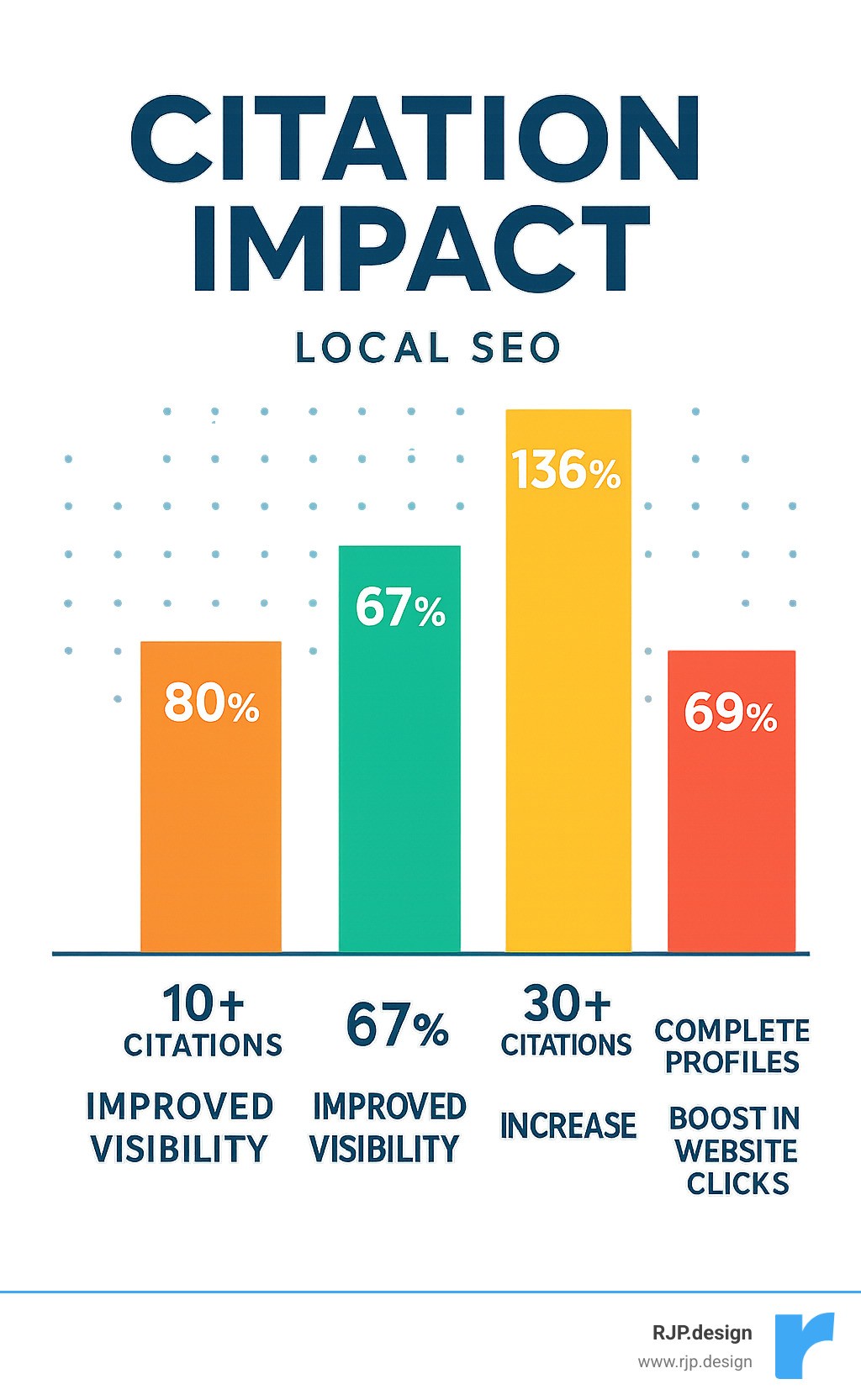
• Key benefit: Businesses with 10+ citations see 80% improved search visibility
• Main types: Structured (directories like Yelp) and unstructured (blog mentions)
• Critical factor: NAP consistency across all platforms prevents customer confusion
Think of local citations like digital breadcrumbs that lead customers to your door. When your business information appears consistently across the web, search engines gain confidence in your legitimacy. This trust translates directly into better rankings when someone searches for businesses like yours.
The numbers tell a compelling story. Research shows that businesses with citations on more than 10 sites received 80% improved visibility in Google search, while those with 30+ citations saw consumer actions increase by 136%. Even more striking – 80% of consumers lose trust in a business if its online contact details are inconsistent.
But here’s the challenge many small business owners face: managing citations feels overwhelming. Between claiming listings, fixing inconsistencies, and staying on top of new platforms, it’s easy to let citation management slide. That’s exactly why understanding the fundamentals matters so much.
I’m Ross Plumer, and I’ve helped businesses that have marketed over $20 million in revenue optimize their local citations SEO strategies to drive real results. My experience working with high-revenue companies has shown me how proper citation management can transform a business’s online visibility and customer acquisition.
Key local citations seo vocabulary:
– local business SEO tips
– local keyword seo
– content for local seo
What Are Local Citations?
Picture this: you’re searching for a great pizza place nearby, and Google shows you three options. One restaurant appears everywhere – Yelp, Google Maps, the local newspaper’s “best of” list, and even mentioned in food blogs. Another barely has a Google listing. Which one feels more trustworthy? That’s the power of local citations in action.
A local citation is simply any online mention of your business that includes your name, address, and phone number (NAP). These mentions can pop up on business directories, review sites, social media platforms, blogs, news articles, or pretty much any website that talks about your business.
Here’s what makes citations surprisingly powerful: they don’t even need a link back to your website to help your rankings. Google recognizes these NAP mentions alone as signals that your business is real, established, and part of the local community. It’s like having digital witnesses vouching for your existence.
Think of local citations as falling into two camps. Structured citations appear on formal business directories where you fill out specific fields – places like Yelp, Yellow Pages, or your local chamber of commerce website. Everything follows a neat, organized format.
Unstructured citations are the wild cards. These happen when a food blogger mentions your restaurant in a review, when the local newspaper writes about your grand opening, or when customers post about you on social media. They’re often more valuable because they feel genuine and natural.
Structured Citations | Unstructured Citations |
|---|---|
Business directories (Yelp, Yellow Pages) | Blog posts mentioning your business |
Review platforms | News articles |
Industry-specific directories | Social media posts |
Chamber of commerce listings | Forum discussions |
Standardized NAP format | Natural, contextual mentions |
Easy to control and claim | Harder to influence directly |
Local Citations SEO Definition
When we talk about local citations SEO, we’re diving into the strategic side of things. This isn’t just about getting your business listed anywhere and everywhere. It’s about building, managing, and optimizing these online mentions to actually improve your local search rankings.
The key word here is strategic. You could spend hours submitting your business to random directories, but that’s like throwing spaghetti at the wall. Local citations SEO focuses on consistency, accuracy, and smart placement on platforms that actually matter.
You might see the term NAPW floating around – that’s Name, Address, Phone, and Website. It evolved from the basic NAP because most directories now want your website URL too. Your Google Business Profile acts as the foundation of everything else, like the master record that other platforms reference when they’re checking if your information is legit.
Core Citation Types Explained
Not all citations are created equal, and understanding where to focus your energy can save you from citation overwhelm. Let’s break this down in order of importance.
Search engines are your non-negotiables. Google Business Profile, Bing Places, and Apple Maps directly feed the local search results and maps that customers see every day. If you do nothing else, get these three locked down perfectly.
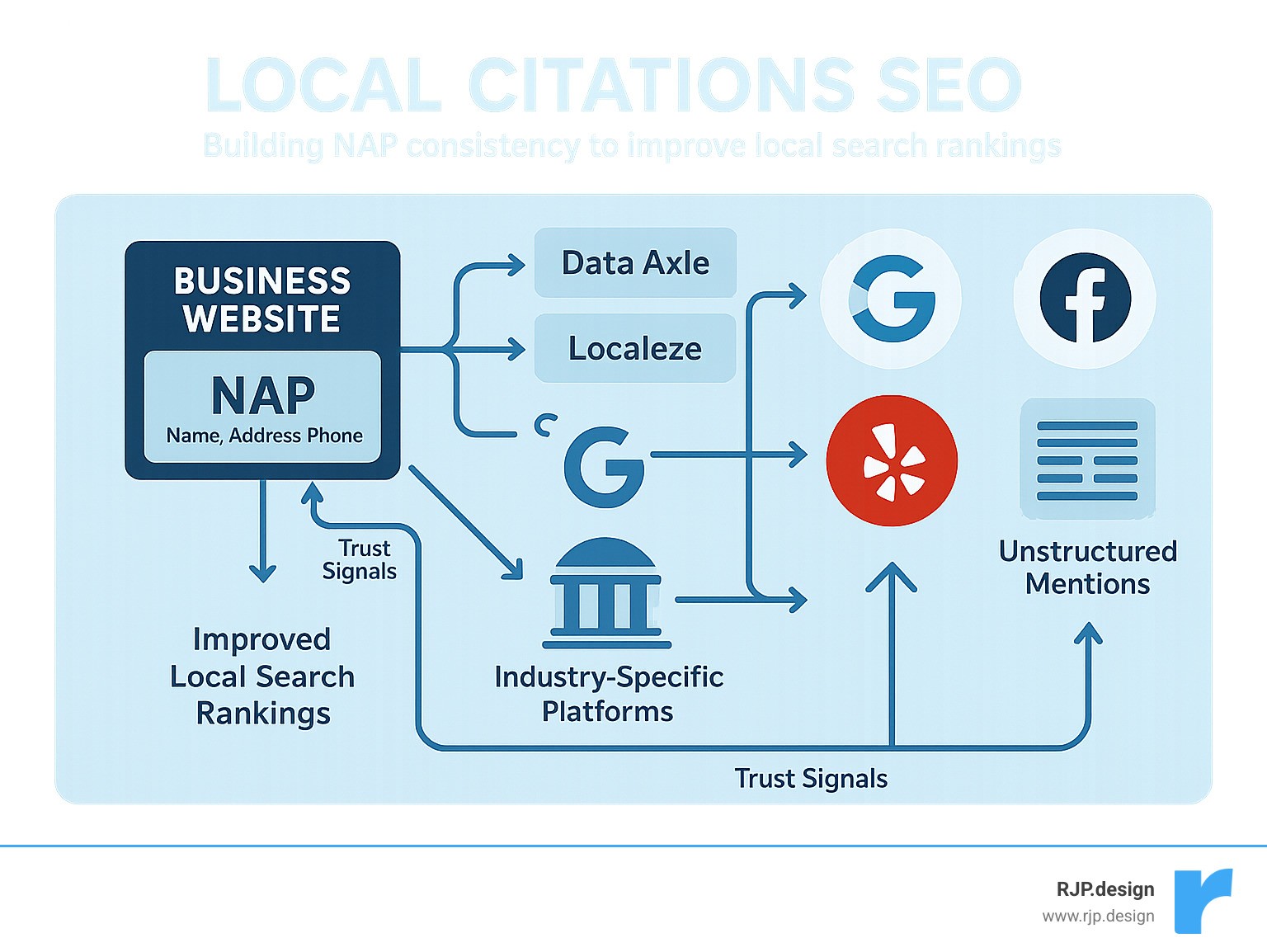
Primary data aggregators are the unsung heroes of the citation world. Companies like Data Axle, Neustar Localeze, and Foursquare work like information highways. Submit your business data to these platforms, and they automatically distribute it to hundreds of other directories and websites. It’s like updating your address with the post office – suddenly everyone gets the memo.
Major directories and platforms include the household names that customers actually use – Facebook, Yelp, Yellow Pages, and Better Business Bureau. These sites have serious credibility with search engines and often show up prominently when people search for local businesses.
Industry-specific directories are where you can really shine. A restaurant should focus on TripAdvisor and food-focused sites, while a law firm would prioritize legal directories. These niche platforms often convert better because they attract people already looking for your specific type of business.
The beauty of understanding these categories is that you can work smarter, not harder. Start with the search engines, tackle the data aggregators next, then move through the major directories before diving into your industry-specific options.
Why Local Citations Matter for Search Rankings
Think of local citations as your business’s digital reputation spread across the internet. Every time your name, address, and phone number appear on a trusted website, you’re essentially getting a vote of confidence that tells Google “this business is real, established, and worth showing to searchers.”
Google’s local search algorithm isn’t just looking at your website when deciding which businesses to show. It’s considering three key factors: how relevant you are to the search, how close you are to the searcher, and how prominent your business appears to be. Citations directly boost that prominence factor by proving your business is well-known and talked about in your community.
The numbers behind citation impact are pretty impressive. Research shows that citation signals account for roughly 7% of the top local ranking factors. Now, 7% might not sound like much, but in competitive local markets where businesses are fighting for those coveted top three spots in Google’s Local Pack, that percentage can make all the difference between getting found and getting forgotten.
Here’s what happens when businesses invest in their citation strategy:
Companies with 10+ citations see 67% improvement in consumer actions like calls and website visits
Businesses with 30+ citations experience 136% increase in consumer engagement
Fully completed business profiles lead to a 69% boost in website clicks
Strong citation signals help companies perform up to 18 times stronger in online search results
These aren’t just vanity metrics either. We’re talking about real business growth – more phone calls, more website visitors, and ultimately more customers walking through your door.
Local Citations SEO & Google’s Algorithm
When someone searches for a business like yours, Google has milliseconds to decide which companies deserve those precious spots in the Local Pack – those three business listings that appear right at the top of search results. Local citations SEO plays a starring role in this decision-making process.
Google uses citations like a fact-checking system. When it finds your business information mentioned consistently across multiple trusted websites, it builds what we call “citation authority.” This authority directly influences your prominence score, which can boost your rankings not just in the Local Pack, but also in regular search results when people look for services you offer.
The beauty of Google’s system is that it weighs both quantity and quality. A mention in a major newspaper or industry publication carries significantly more weight than a listing on a sketchy directory created just for SEO purposes. Google has gotten pretty smart about distinguishing between genuine business mentions and artificial citation spam.
Consumer Behaviour Statistics
The algorithmic benefits are just half the story. Real people use these citations to find and contact businesses every single day, and their behavior reveals exactly why getting your citations right matters so much for your bottom line.
Here’s what research tells us about how customers actually behave:
80% of consumers lose trust in a business when they find inconsistent or incorrect contact information online. Imagine someone trying to call your restaurant for a reservation, but the phone number on Yelp is different from the one on Google. They’re not going to spend time playing detective – they’ll just call your competitor instead.
60% of mobile local searchers click to call a business directly from search results. These are hot leads ready to buy, and if your phone number is wrong or missing, you’re literally watching potential customers slip away.
Local search on mobile phones has increased 900% compared to previous years. More people than ever are searching for local businesses while they’re out and about, ready to make immediate purchasing decisions.
We’ve witnessed this with our clients at RJP.design. When we clean up citation inconsistencies and ensure accurate information appears everywhere online, businesses typically see phone calls and website traffic improve within just a few weeks. It’s one of those changes that delivers quick, measurable results.
The takeaway is simple: citations aren’t just about appeasing Google’s algorithm. They’re about making it easy for real customers to find you, trust you, and contact you when they’re ready to buy. Get them right, and you’ll see the impact in both your search rankings and your revenue.
Building & Managing Local Citations SEO
Building an effective local citations SEO strategy isn’t about throwing your business information at every directory you can find. It’s like planting a garden – you need the right foundation, the right locations, and consistent care to see real growth.
Most business owners are shocked when they find their company is already mentioned across dozens of websites they’ve never heard of. Some of these mentions are helpful, others are outdated nightmares with wrong phone numbers from three moves ago. That’s exactly why we start every citation project with a thorough audit.
Think of citation management like maintaining your reputation in a small town. When people talk about your business, you want them sharing accurate information. The same principle applies online, except instead of chatting over coffee, these conversations happen on hundreds of websites that Google pays attention to.
Our proven workflow follows four essential steps: audit your existing presence, clean up the mess, build strategic new citations, and monitor everything ongoing. This systematic approach prevents you from wasting time on low-value directories while ensuring you don’t miss the platforms that actually matter.
The big question most business owners ask is whether to handle citations manually or use automated tools. Here’s the honest answer: it depends on your situation. Manual management gives you complete control and often results in higher-quality listings, but it’s incredibly time-intensive. Automated tools can distribute your information to hundreds of platforms quickly, but they sometimes miss the nuanced details that make a listing truly valuable.
For most businesses, we recommend a hybrid approach. Handle your most critical citations manually – your Google Business Profile, major directories, and industry-specific platforms deserve personal attention. Use automation for broader distribution through data aggregators, which can save you dozens of hours while ensuring consistent information reaches hundreds of smaller directories.
At RJP.design, we’ve learned that quality beats quantity every single time. Rather than chasing listings on every obscure directory, we help businesses identify the 30-50 most valuable citation sources for their specific industry and location. This focused approach delivers better results with less effort. More info about Local SEO Services
Step-by-Step Audit & Cleanup
Starting your citation journey without an audit is like renovating a house without checking the foundation first. You might build something beautiful, but it won’t last if there are cracks underneath.
Begin by searching for your business name in quotes on Google, along with your city name. Try different variations of your business name, including common misspellings customers might use. You’ll be amazed at what you find – listings you forgot about, mentions in local blog posts, and sometimes completely incorrect information that’s been spreading across the web.
Citation finder tools become your detective assistants here, scanning hundreds of directories simultaneously to identify where your business appears. These tools reveal both claimed listings (where you have control) and unclaimed listings (where your information exists but you can’t edit it yet).
Create a simple tracking spreadsheet to document every citation you find. Include the platform name, current information displayed, whether you can claim or edit the listing, and any inconsistencies you notice. This becomes your master reference for cleanup efforts and helps you avoid duplicating work.
Identifying inconsistencies is where things get interesting. Common problems include phone numbers formatted differently, street names abbreviated inconsistently, suite numbers missing or formatted strangely, outdated business hours, and old contact information from previous locations or phone systems.
The cleanup process requires patience but delivers immediate results. Start with your most important platforms – Google Business Profile, Bing Places, Apple Maps, and Facebook – then work your way down your priority list. Claim any unclaimed listings first, since these are usually the easiest wins. For listings you can’t control directly, reach out to the platform’s support team with documentation proving your business ownership.
Duplicate removal deserves special attention because multiple listings for the same business create confusion for both search engines and customers. When you find duplicates, identify which listing has better information, more reviews, or higher visibility, then request removal of the inferior version through the platform’s support channels.
Creating High-Value Citations
Not every citation opportunity deserves your time and attention. Smart local citations SEO focuses on platforms that deliver real impact for your business rather than trying to be everywhere at once.
Data aggregators should top your priority list because they work like information highways, distributing your business data to hundreds of downstream sites automatically. Data Axle feeds information to over 100 websites, Neustar Localeze powers many local search platforms, and Foursquare supplies location data to major apps and services. Getting your information correct on these platforms creates a ripple effect across the entire web.
Core search engines and maps platforms are absolutely non-negotiable. Your Google Business Profile serves as the foundation of everything else, while Bing Places for Business and Apple Maps Connect ensure you appear when people search on different platforms. Don’t forget your Facebook Business Page, which often appears prominently in local search results.
Industry-specific directories often provide the highest-quality traffic because they attract people actively looking for your type of business. A restaurant owner should prioritize platforms like OpenTable and TripAdvisor, while a contractor might focus on Angie’s List and HomeAdvisor. These targeted platforms typically convert better than general directories because the audience is already interested in your services.
Local and regional directories help establish your connection to the community. Chamber of Commerce websites, local newspaper business directories, city government business listings, and regional business associations all signal to Google that you’re genuinely part of the local business ecosystem.
Ensuring Accuracy & Consistency
Consistency doesn’t mean every single character must be identical across all platforms – Google is smart enough to understand that “123 Main Street” and “123 Main St” refer to the same location. However, your core information should follow logical formatting standards to avoid confusion.
Acceptable variations include standard abbreviations like Street vs. St., Avenue vs. Ave., or Suite vs. Ste. Phone numbers can be formatted as (555) 123-4567, 555-123-4567, or 555.123.4567 without causing problems. Minor punctuation differences in business names are usually fine as long as the essential information remains clear.
Unacceptable inconsistencies include completely different phone numbers, different street addresses, significantly different business names, or conflicting business hours. These types of discrepancies confuse both search engines and potential customers, often resulting in lost business and lower search rankings.
Review monitoring becomes part of your ongoing citation management because customer reviews sometimes include mentions of your business information. Respond promptly to reviews and gently correct any factual errors customers might mention in their feedback. This ongoing attention ensures your citation accuracy remains strong over time.
Advanced Tactics & Tools
Ready to take your local citations SEO game to the next level? Once you’ve got the basics down pat, these advanced strategies can help you pull ahead of competitors who are still stuck doing citation management the old-fashioned way.
The beauty of advanced citation tactics is that they work behind the scenes to amplify everything else you’re doing. Think of them as force multipliers for your local SEO efforts.
Schema markup is like giving Google a cheat sheet about your business. When you add LocalBusiness schema to your website, you’re essentially telling search engines exactly what your business is, where it’s located, and how to contact you. This structured data creates a rock-solid foundation that supports all your citation efforts.
Here’s what makes schema so powerful: when Google sees the same business information in your website’s code and across your citations, it’s like getting confirmation from multiple trusted sources. This consistency boost can significantly improve how search engines interpret and rank your business.

Voice search optimization is becoming impossible to ignore. More people are asking their phones and smart speakers to find local businesses, and citations play a huge role in voice search results. When someone asks “Hey Google, find a plumber near me,” the algorithm relies heavily on citation data to determine which businesses to recommend.
The key difference with voice search is that people typically get just one or two recommendations instead of a full list. This makes citation authority even more critical for voice search success.
Unstructured citations with links (we call them “linktations”) are the holy grail of citation building. These happen when local news sites write about your business, industry blogs mention you, or community organizations link to your website. They’re valuable because they combine the trust signals of citations with the SEO power of quality backlinks.
You can’t force these to happen, but you can create opportunities by getting involved in your community, hosting events, or becoming a go-to expert for local media when they need quotes about your industry.
ROI tracking separates the pros from the amateurs in citation management. Without measuring results, you’re essentially throwing darts in the dark. The good news is that citation ROI is very trackable once you know what metrics matter.
We track everything from ranking improvements and phone call increases to website traffic bumps and actual revenue growth. This data helps us double down on what’s working and stop wasting time on citation sources that don’t deliver results.
Leveraging Data Aggregators at Scale
Here’s where citation management gets really smart. Instead of manually submitting your business to hundreds of directories (which would take forever), you can work with the major data aggregators and let them do the heavy lifting.
Data Axle is like the mother ship of business data. When you get your information correct in their database, it automatically flows out to over 100 other platforms. It’s like updating your information once and having it magically appear everywhere else.
Localeze (now part of Neustar) powers the location data for countless apps and websites you use every day. Getting your business information right in their system ensures accuracy across a massive network of services.
Foursquare has quietly become one of the most important location data providers on the internet. Their database feeds information to Apple Maps, major ride-sharing apps, social media platforms, and hundreds of other services that people use to find businesses.
The feed propagation process typically takes 30-90 days to fully roll out across all downstream platforms. This means you need to be patient, but the results are worth the wait. We’ve seen businesses go from having 20 citations to over 200 citations simply by getting their data aggregator information correct.
Think of it this way: would you rather spend 100 hours manually submitting to directories, or spend 5 hours getting your data aggregator information perfect and let automation handle the rest? The choice is pretty obvious.
Measuring ROI of Local Citations SEO
Measuring the success of your local citations SEO efforts isn’t just about feeling good – it’s about proving that your time and money are well spent. The businesses that track their citation ROI consistently outperform those that don’t.
Rank tracking shows you the most immediate impact of citation building. We typically see ranking improvements within 4-8 weeks of consistent citation work. The key is tracking rankings for your most important local search terms before you start building citations, then monitoring changes over time.
Phone call tracking reveals which citations actually drive business to your door. Some directories generate tons of calls, while others barely move the needle. Use call tracking numbers when possible, or simply ask new customers how they found you. This data helps you focus future efforts on the citation sources that deliver real results.
Revenue attribution is the ultimate measure of citation success. We help our clients track new customer acquisition and revenue growth that correlates with their citation building timeline. The businesses that invest in proper citation management typically see a 15-30% increase in local customer acquisition within six months.
At RJP.design, we’ve learned that the most successful citation strategies combine smart automation with careful measurement. Our clients don’t just build more citations – they build better citations that actually drive business growth. Scientific research on citation impact consistently shows that quality and consistency matter more than quantity alone.
The bottom line? Advanced citation tactics aren’t just for big businesses with huge budgets. With the right tools and approach, any local business can implement these strategies and see real results.
Common Mistakes & How to Avoid Them
I’ve seen countless businesses accidentally sabotage their local citations SEO efforts by making preventable mistakes. The frustrating part? These errors often take months to find and even longer to fix.
The most damaging mistake is inconsistent NAP information across platforms. When your phone number appears as (555) 123-4567 on Google but 555.123.4567 on Yelp, you’re essentially telling search engines that these might be two different businesses. Google’s algorithm gets confused, and your rankings suffer as a result.
I remember working with a client who couldn’t figure out why their local rankings kept dropping despite having dozens of citations. After digging deeper, we finded their old business phone number was still listed on 15 different directories. Every month they delayed fixing these inconsistencies cost them potential customers who were calling a disconnected number.
Over-building low-quality citations is another trap that catches many business owners. The thinking goes: “If 10 citations are good, then 100 must be better!” But submitting your business to every directory you can find often backfires. Search engines are smart enough to recognize spammy, low-authority directories, and they can actually penalize businesses that appear on too many questionable sites.
Quality always beats quantity in citation building. Thirty citations on respected, relevant platforms will outperform 200 citations on random directories every time.
Ignoring customer reviews on citation platforms wastes valuable opportunities to build trust and correct misinformation. When someone leaves a review mentioning incorrect business hours or an old phone number, that review becomes part of your online presence. Responding professionally not only shows you care about customers but also gives you a chance to provide accurate information.
The biggest money-waster I see is outsourcing citation building to cheap virtual assistants without proper oversight. While VAs can be helpful for many tasks, citation building requires attention to detail and understanding of your specific business. Too many business owners hire the lowest-cost option, only to find months later that their citations contain errors, duplicates, or inconsistent information that actually hurts their search rankings.
Here’s how to avoid these costly mistakes: Set up Google Alerts for your business name so you know immediately when new citations appear online. Use one consistent email address for all citation submissions to make management easier later. Take screenshots of important citation pages before making any changes – you’ll thank yourself if something goes wrong. Keep a master document with your exact NAP formatting that everyone on your team can reference. Most importantly, audit your citations quarterly rather than treating it as a one-time task.
The businesses that succeed with citation management treat it as an ongoing process, not a checkbox to mark off once. When you stay consistent and avoid these common pitfalls, your local citations SEO efforts will steadily build the trust and authority that drive real business results.
Frequently Asked Questions about Local Citations SEO
The world of local citations SEO can feel confusing at first, but most business owners have similar questions. Let me address the most common concerns I hear from clients who want to get their citation strategy right.
How often should I update my citations?
Here’s the honest answer: it depends on what’s happening with your business. If you’re moving locations, changing phone numbers, or updating your hours, you need to act fast. Those core citations – Google Business Profile, Bing, Apple Maps, and Facebook – should be updated within 24 to 48 hours of any change.
Think about it from a customer’s perspective. If they find your old address on Google and drive across town to visit you, that’s not just a lost sale – it’s a frustrated customer who might never give you another chance.
For routine maintenance, I recommend checking your most important citations every three months. Set a calendar reminder and spend an hour making sure everything still looks accurate. Once a year, do a deeper dive and audit your entire citation portfolio.
The businesses I work with at RJP.design that stay on top of this quarterly maintenance rarely run into major problems. It’s much easier to catch and fix small issues before they multiply across dozens of platforms.
What information must every citation include?
Your business name, complete address, and primary phone number form the foundation of every citation. These three elements – your NAP – are absolutely non-negotiable. Even if a platform only asks for basic information, these three pieces must be consistent and accurate.
Beyond that foundation, your website URL should be included whenever possible. This creates valuable link signals that support your overall SEO efforts. Most modern directories expect and allow website links, so there’s rarely a reason to skip this.
Business hours deserve special attention because they change more frequently than other information. Nothing frustrates customers more than showing up to a closed business because the hours online were wrong. Keep holiday hours updated too – it shows you care about the customer experience.
A well-written business description helps both search engines and potential customers understand what you do. Use natural language that includes relevant keywords, but write for humans first. This isn’t the place for keyword stuffing.
Photos make a huge difference in how professional and trustworthy your business appears. Include shots of your storefront, your team, and your products or services when the platform allows it.
How do local citations relate to reviews & backlinks?
This is where local citations SEO gets really interesting. Citations, reviews, and backlinks aren’t separate strategies – they work together like pieces of a puzzle to build your overall online authority.
Citations establish the foundation by telling search engines that your business exists and where it’s located. Reviews add social proof and fresh content that search engines love. Backlinks from authoritative local websites boost your credibility in Google’s eyes.
The most powerful citation platforms give you all three benefits at once. When someone finds your business on Yelp, they see your accurate contact information, they can read what other customers say about you, and Yelp provides a link back to your website. That’s a triple win.
Industry-specific directories often provide the strongest combination of these signals because they attract people who are already interested in your type of business. A restaurant listing on a local food blog that includes accurate information, customer reviews, and a website link carries more weight than a generic directory listing.
The key is thinking about these elements as part of one cohesive strategy rather than separate tasks. When you’re building citations, look for platforms that also encourage reviews and provide quality backlinks. Your time investment will deliver better results across multiple ranking factors.
Conclusion
Local citations SEO isn’t just another marketing checkbox to tick off – it’s the digital foundation that helps your business show up when customers are actively looking for what you offer. Think of it as planting seeds across the internet that grow into a network of trust signals, guiding both search engines and real people straight to your door.
The numbers don’t lie. When businesses get serious about citation management, they see 80% improved search visibility and measurable jumps in phone calls and website visits. But here’s what really matters: those statistics represent real customers finding real businesses and making real purchases.
What separates successful businesses from the ones still struggling to get noticed online? Consistency and patience. The companies that treat citations as an ongoing relationship-building exercise rather than a one-time project consistently outrank their competitors.
Your next steps are straightforward but important. Start with an audit to see where you stand right now – you might be surprised by what you find. Claim your core profiles on Google, Bing, Apple, and Facebook first, because these directly feed the search results people see every day. Work with data aggregators to spread your information efficiently, then focus on industry-specific directories where your ideal customers actually spend time browsing.
Remember to monitor your citations quarterly. Business information changes, platforms update their requirements, and new opportunities emerge. What worked six months ago might need tweaking today.
At RJP.design, we’ve watched businesses transform their local presence through smart citation strategies. Our work with companies that have marketed over $20 million in revenue has taught us that the details matter enormously in local search. Sometimes the difference between being found and being forgotten comes down to having consistent information across the right platforms.
The local search landscape keeps getting more competitive, but that creates opportunity for businesses willing to do the work properly. While your competitors are ignoring their citations or managing them haphazardly, you can build a solid foundation that pays dividends for years to come.
Your customers are searching for businesses like yours right now. Make sure they can find you easily, trust what they see, and take action confidently. That’s what effective local citations SEO delivers.
Ready to build a citation strategy that actually drives business results? We’re here to help you create an online presence that works as hard as you do. More info about Google Search Optimization