Web
Your Website Called, It Wants a Makeover – Small Business Edition
May 29, 2025
Small business website redesign: 8 Powerful Reasons to Upgrade
Why Your Small Business Website Desperately Needs Professional Attention
Small business website redesign isn’t just about keeping up with trends—it’s about survival in today’s digital marketplace. Here’s what you need to know:
Key Benefits of Small Business Website Redesign:
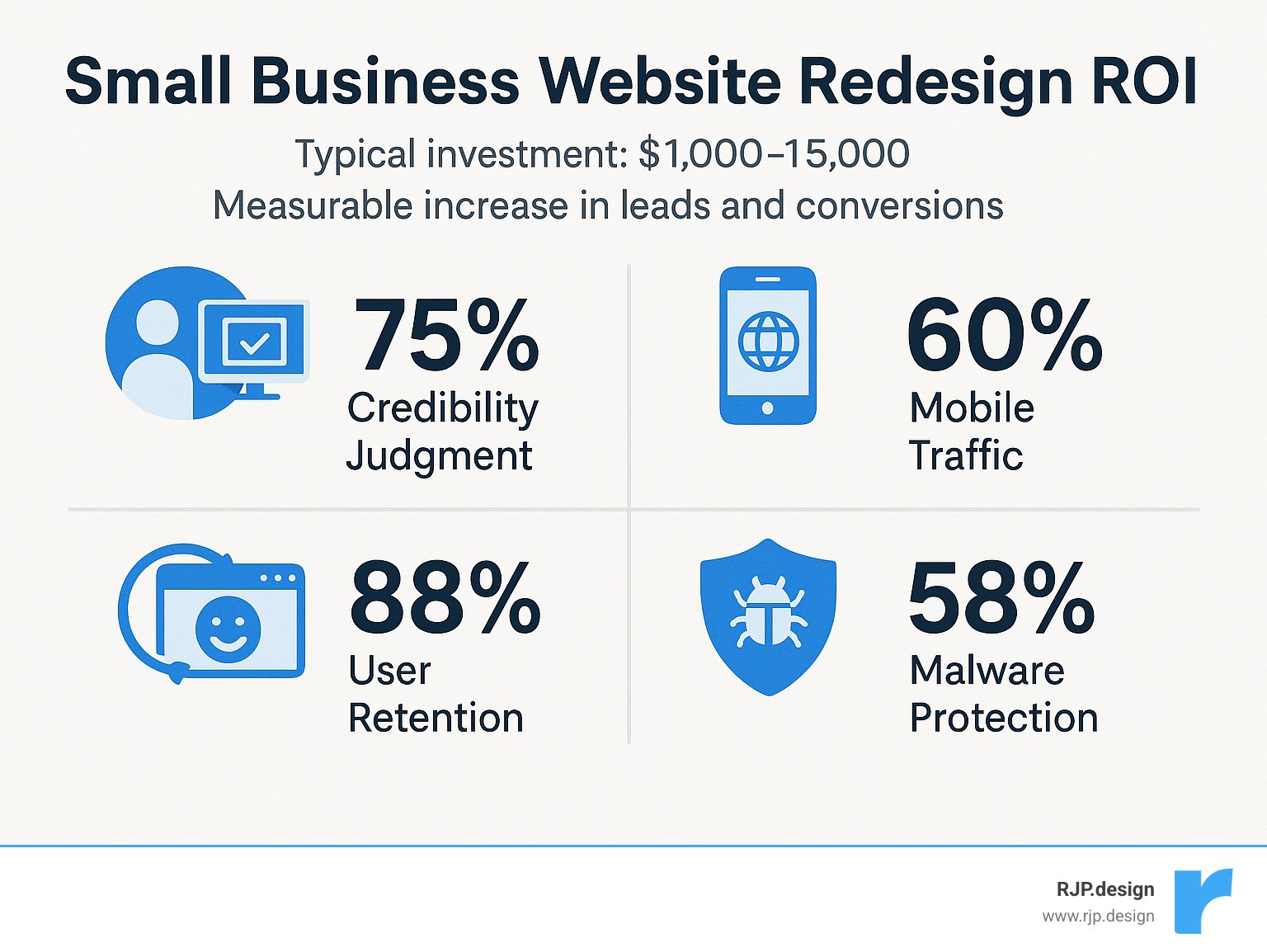
• Credibility boost – 75% of users judge your company’s credibility based on website design
• Mobile optimization – Over 60% of traffic comes from mobile devices
• Performance gains – Page load improvements prevent 123% bounce rate increases
• Lead generation – Better UX converts more visitors into customers
• Security updates – Protection against the 58% of malware attacks targeting small businesses
The numbers don’t lie. 94% of users’ first impressions are influenced by your website design and functionality. Yet many small business owners are stuck with sites that actively hurt their credibility and turn away potential customers.
Think about it: when was the last time you updated your website? If you’re like most small business owners, it’s been way too long. Your competitors are investing in modern, mobile-friendly sites while yours might still look like it’s from 2015.
The reality is stark. 88% of online users won’t return to a site with bad user experience. That’s not just lost traffic—that’s lost revenue walking out your digital front door.
I’m Ross Plumer, and I’ve helped businesses that have marketed over $20 million in revenue transform their digital presence through strategic small business website redesign projects. My approach combines psychology, business strategy, and technical expertise to create websites that actually convert visitors into customers.
Related content about Small business website redesign:
– professional web design
– web design company site
– affordable mobile website redesign
Refresh vs. Redesign: Choose the Right Level of Change
Here’s the thing about small business website redesign decisions—you don’t always need to blow everything up and start over. Sometimes your website just needs a good makeover, not major surgery.
Think of it this way: a website refresh is like redecorating your living room. You keep the same layout but update the paint, swap out some furniture, and maybe hang new artwork. A website redesign is more like gutting the whole house and rebuilding from the foundation up.
The smart money says most businesses should redesign every 2-3 years, but here’s what I’ve learned working with real small business owners: strategic refreshes between those major overhauls can keep you competitive without breaking the bank.
About 38% of businesses choose refreshes primarily to update their branding or messaging. It’s often the right call, especially when your core website structure still works but your look feels dated.
The key is being honest about what’s really broken versus what just needs sprucing up.
Quick Wins With a Website Refresh
Sometimes the smallest tweaks create the biggest “wow” moments. A refresh typically takes 1-12 weeks and can transform how visitors see your business.
Visual updates make an immediate impact. Modernizing your color palette to match current design trends instantly makes your site feel fresh. Updating your typography improves readability while strengthening your brand voice. And refreshing your photography to showcase your current work? That’s pure gold for credibility.
Performance improvements might not be flashy, but they’re conversion killers when ignored. Load-speed boosts through image optimization and code cleanup can dramatically reduce bounce rates. Even small content tweaks—rewriting key pages with clearer messaging, adding fresh testimonials, or updating service descriptions—can transform visitor behavior.
I had one client who saw a 40% increase in contact form submissions just by updating their homepage messaging and adding clearer calls-to-action. No major redesign needed—just strategic refreshing that spoke directly to their customers’ needs.
When a Ground-Up Overhaul Is Non-Negotiable
But let’s be real—some problems can’t be fixed with fresh paint. You need a complete small business website redesign when your current site actively fights against your business goals.
UX flow problems are deal-breakers. If visitors can’t figure out how to contact you or buy from you, no amount of visual updates will help. When your navigation confuses people or your conversion paths lead nowhere, it’s time for a complete rebuild.
CMS switch needs often trigger full redesigns. Maybe you’ve outgrown your current platform or need better integration with your business tools. Security gaps that can’t be patched are non-negotiable—your reputation depends on protecting customer data.
Scalability issues tell you it’s time to think bigger. If your current site can’t handle the growth you’re planning or support the functionality your business demands, a refresh is just putting lipstick on a pig.
The timeline for a full redesign typically runs 3-9 months, but when you’re dealing with fundamental structural problems, it’s the only path forward that makes business sense.
Platform migration alone often justifies a complete overhaul, especially when you’re moving to a system that better supports your long-term goals.
The Business Case for Small Business Website Redesign
Here’s the truth that might surprise you: Small business website redesign isn’t just another business expense—it’s one of the smartest investments you can make. The numbers tell a story that’s hard to ignore.
Think about your own browsing habits for a moment. When you land on a website that looks like it hasn’t been updated since 2010, what’s your first reaction? You probably question whether the business is still operating, right? You’re not alone in that thinking.
75% of people judge your company’s credibility based purely on your website design. That’s three out of every four potential customers making snap decisions about whether to trust you before they even read your content.
But it gets more interesting. Nearly 80% of people visit a website before contacting a business. Your website isn’t just a nice-to-have anymore—it’s often the first (and sometimes only) impression you get to make.
The mobile revolution has changed everything too. With 60% of web traffic now coming from mobile devices, having a site that works beautifully on phones isn’t optional. Yet 61% of users won’t return to a mobile site they had trouble accessing. That’s a lot of potential customers walking away because of a poor mobile experience.
Here’s where it gets really exciting: 80% of U.S. consumers search for local businesses online weekly. That’s a massive pool of potential customers actively looking for what you offer. The question is whether your website is ready to capture them.
Signs Your Small Business Website Redesign Can’t Wait
Some warning signs are subtle, but others hit you like a brick wall. I’ve seen businesses lose thousands in potential revenue because they ignored the red flags their website was waving.
Performance problems are often the first culprit. If your site takes longer than 3 seconds to load, you’re watching potential customers disappear in real-time. People have zero patience for slow websites, and honestly, can you blame them?
Mobile disasters are equally damaging. When your site looks broken on phones or tablets, you’re essentially telling 60% of your audience that you don’t care about their experience. That’s not exactly the message you want to send.
Visual outdatedness might seem superficial, but it’s not. When your website screams “I haven’t been updated since flip phones were cool,” visitors assume your business practices are equally behind the times. Fair or not, that’s the reality we’re working with.
Navigation nightmares frustrate everyone. If visitors can’t figure out how to find your contact information or learn about your services within seconds, they’ll find a competitor who makes it easier. Why would they struggle when alternatives are just a click away?
Poor search rankings often stem from technical issues that only a redesign can fix. If your competitors consistently appear above you in Google searches, your website might be the weak link holding back your entire marketing strategy.
Security vulnerabilities pose the biggest risk of all. With 58% of malware attacks targeting small businesses, an outdated website isn’t just hurting your marketing—it’s potentially exposing your entire business to cyber threats.
Tangible Benefits That Boost the Bottom Line
The beautiful thing about small business website redesign is that the benefits show up in your bank account, not just your analytics dashboard.
Faster load times do more than improve user experience—they directly impact your bottom line. When pages load quickly, people stick around longer, explore more of your site, and ultimately convert at higher rates. Google notices this too, often rewarding faster sites with better search rankings.
Mobile optimization opens the floodgates to that massive mobile audience. Instead of losing 60% of potential visitors to a poor mobile experience, you’re capturing them with a site that works beautifully on every device.
Better navigation turns confused visitors into engaged prospects. When people can easily find what they’re looking for, they’re more likely to contact you, request quotes, or make purchases. It’s amazing how much revenue you can open up just by making things easier to find.
Improved credibility builds the trust that turns visitors into customers. When your site looks professional and current, people feel confident doing business with you. That confidence translates directly into more leads and higher conversion rates.
Stronger SEO brings qualified traffic to your door. A well-designed site with proper technical structure helps Google understand and rank your content, bringing you more of those 80% of consumers searching weekly for local businesses.
Modern security protects everything you’ve built. Beyond preventing costly breaches, visible security features like SSL certificates add another layer of credibility that visitors notice and appreciate.
The maintenance savings alone can justify the investment. Newer platforms and cleaner code mean fewer headaches, lower ongoing costs, and more time to focus on running your business instead of fixing website problems.
One of our clients saw their organic traffic jump from 29,000 to 140,000 monthly visitors after their redesign, with conversions increasing 329% year-over-year. Those aren’t just impressive numbers—they represent real revenue growth that transformed their business.
Dollars, Deadlines & Decisions: Budget, Timeline, and Partner Options
Let’s talk money. I know it’s the question keeping you up at night: “How much is this going to cost me?”
Small business website redesign projects typically run anywhere from $1,000 to $15,000, with most businesses investing around $15,000 for a comprehensive overhaul. But here’s the thing—that range exists for good reason. Your neighbor’s simple brochure site won’t cost the same as your e-commerce platform with custom booking functionality.
The timeline usually stretches 4-9 months for a complete redesign, though simpler refreshes can wrap up in just 1-12 weeks. I’ve learned that setting realistic expectations from day one saves everyone headaches down the road.
What drives these costs? Page count is a big factor—a 5-page site costs less than a 50-page catalog. E-commerce add-ons can bump your budget significantly. Custom functionality, professional copywriting, and ongoing maintenance all play their part too.
Scope creep is the silent budget killer. You start wanting a simple contact form, then decide you need appointment booking, then realize you want customer portals. Each addition pushes both cost and timeline further out.
For more detailed information about what goes into professional website redesign pricing, check out our Professional Website Redesign page. You can also explore the latest research on website redesign cost to help benchmark your investment.
Cost Breakdown At a Glance
Understanding where your money goes helps you make smarter decisions. Think of it like building a house—you wouldn’t start without knowing what you’re paying for.
Design work typically eats up 30-40% of your budget. This covers the visual planning, user experience mapping, and making sure everything looks professional on every device. It’s the foundation that everything else builds on.
Development claims the biggest chunk at 40-50%. This is where the magic happens—turning those beautiful designs into a functioning website. Front-end coding, back-end functionality, setting up your content management system, and connecting third-party tools all happen here.
Copywriting and SEO usually runs 10-20% of the total. Professional writing makes the difference between a site that converts and one that confuses. SEO optimization ensures people can actually find you online.
Ongoing maintenance runs $250-$1,000 annually. This covers security updates, performance monitoring, regular backups, and keeping everything running smoothly. Think of it as insurance for your digital investment.
Timelines From Kickoff to Launch
Most website projects follow a predictable rhythm, though each phase can stretch depending on complexity and how quickly you provide feedback.
The findy phase kicks things off with 1-2 weeks of goal setting and requirements gathering. We dig into your competitors, audit your current content, and nail down exactly what you need. This prevents costly changes later.
Design development takes 2-4 weeks. We create wireframes, develop the visual design, and cycle through revisions until everything feels right. Client feedback speed really impacts this timeline.
Development and building spans 4-8 weeks for most projects. The team codes everything, migrates content, and runs extensive testing. Complex functionality or e-commerce features can extend this phase.
Quality assurance and launch wraps up in 1-2 weeks. Final testing, DNS changes, going live, and post-launch monitoring all happen here. We also handle training and handover during this phase.
Here’s a reality check: 28% of companies blow past their planned timeline. Build buffer time into your expectations.
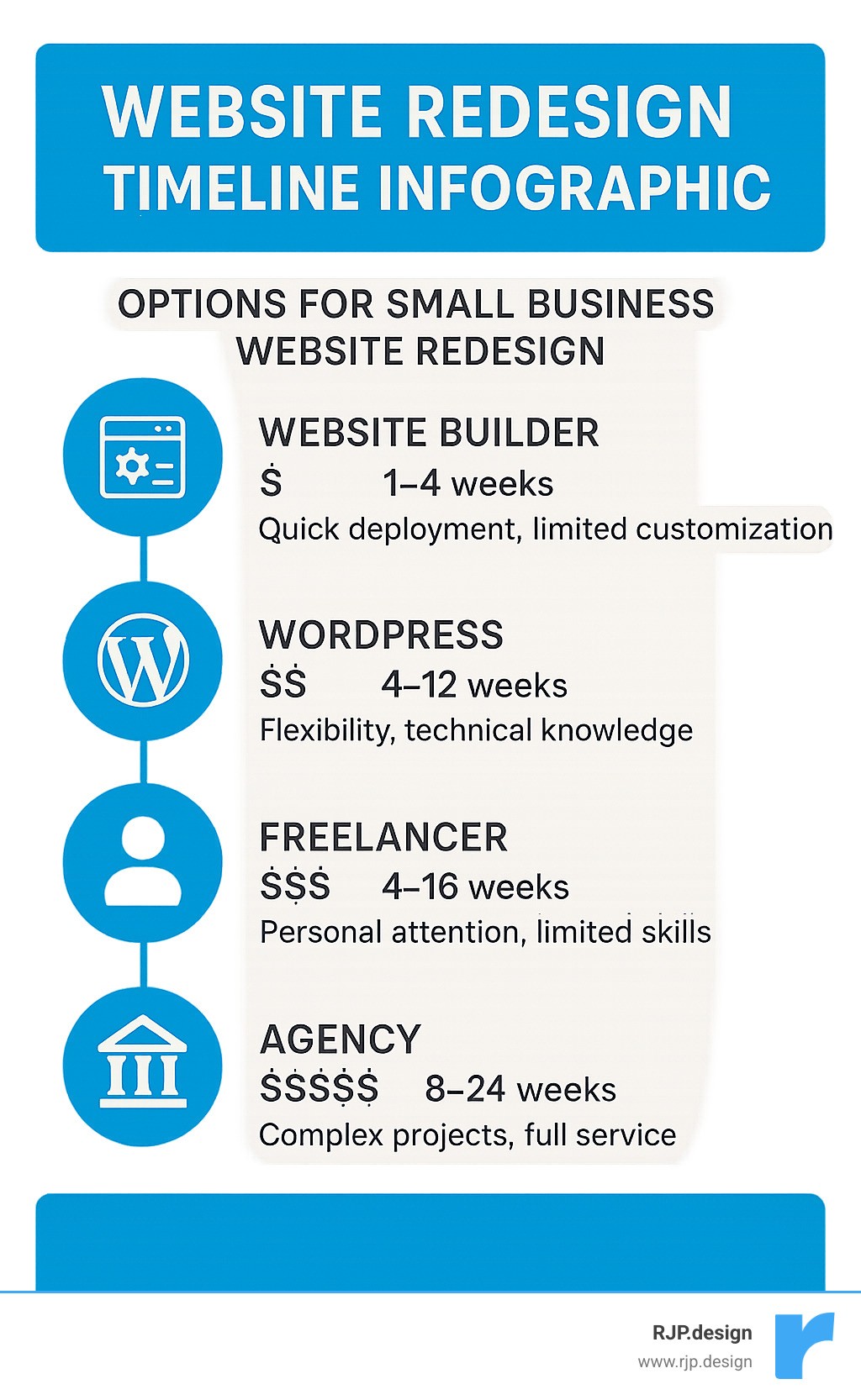
Partner Choices: Builder vs CMS vs Agency
Choosing the right partner feels overwhelming, but understanding your options makes the decision clearer.
Option | Cost Range | Timeline | Best For | Scalability |
|---|---|---|---|---|
Website Builder | $100-$3,500 | 1-4 weeks | Simple sites, tight budgets | Limited |
WordPress CMS | $1,000-$10,000 | 4-12 weeks | Growing businesses, flexibility | High |
Freelancer | $2,000-$10,000 | 6-16 weeks | Custom needs, personal attention | Variable |
Agency | $10,000-$50,000+ | 8-24 weeks | Complex projects, full service | Highest |
Website builders like those drag-and-drop platforms work great if you need something simple and fast. They’re budget-friendly but limit your growth options. WordPress offers incredible flexibility and scales beautifully, but requires more technical skill to manage properly.
Freelancers provide personal attention and often specialize in specific areas. The challenge is finding someone with comprehensive skills across design, development, and strategy. Agencies deliver full-service expertise but often at premium pricing with less personal touch.
At RJP.design, we’ve positioned ourselves as the sweet spot—agency-level expertise with a down-to-earth approach that puts your success ahead of our profit margins.
Setting Measurable Goals for Your Small Business Website Redesign
Success without measurement is just expensive guesswork. Before starting your small business website redesign, nail down specific, measurable goals that align with your business objectives.
Traffic improvements might include increasing organic search traffic by a specific percentage, boosting direct traffic from brand searches, reducing bounce rate below 60%, or extending average session duration. These metrics tell you if people are finding and engaging with your site.
Conversion goals focus on business results. Maybe you want more contact form submissions, increased phone calls from your website, higher email newsletter signups, or improved online sales if you’re selling products. These directly impact your bottom line.
Technical benchmarks ensure your site performs well. Achieving page load times under 3 seconds, improving mobile usability scores, increasing accessibility compliance, and strengthening security all create a better foundation for everything else.
The key is choosing goals that matter to your specific business. A local service business cares more about phone calls and contact forms. An e-commerce site focuses on sales and cart completion rates.
For deeper insights on making data-driven decisions, explore this scientific research on data-driven objectives.
From Sitemap to Launch: An 8-Step Plan That Protects SEO & Accessibility
Your small business website redesign doesn’t have to be a white-knuckle experience where you lose everything you’ve built. With the right process, you can actually improve your search rankings while creating a better user experience.
I’ve guided dozens of businesses through redesigns without losing their hard-earned Google rankings. The secret? A methodical approach that treats your existing SEO value like the asset it is.
Here’s our proven 8-step process that protects what’s working while fixing what isn’t:
Step 1 starts with a comprehensive audit where we dig deep into your current site’s performance. We’re looking at user behavior patterns, identifying your star-performing content, and documenting every technical hiccup. Think of it as a full medical exam for your website.
Step 2 focuses on goal setting and strategy development. We create detailed user personas, map out customer journeys, and establish clear success metrics. This isn’t just about making things prettier—we’re building a roadmap for measurable business growth.
Step 3 involves creating the information architecture through detailed sitemaps and wireframes. We plan your URL structure carefully and design user flows that actually convert visitors into customers. This is where we map out our redirect strategy to protect your SEO juice.
Step 4 brings responsive design to life with a mobile-first approach. We ensure accessibility compliance with WCAG guidelines while creating a consistent brand experience across every device your customers use.
Step 5 handles development and integration on a robust, scalable platform. We implement necessary third-party integrations, optimize for lightning-fast performance, and set up proper analytics tracking so you can measure success.
Step 6 manages content migration and SEO with surgical precision. We implement 301 redirects for any URL changes, migrate your existing content while optimizing it, and add proper meta tags and structured data throughout.
Step 7 covers quality assurance and testing across devices and browsers. We verify every form submission, check loading speeds, and validate accessibility to ensure nothing breaks when real users start clicking around.
Step 8 executes launch and ongoing monitoring. We start with a soft launch to catch any issues, then move to full launch with marketing support and continuous performance monitoring.
For businesses wanting ongoing peace of mind after launch, our Website Concierge Maintenance service handles all the technical details so you can focus on running your business.
Map Everything With a Content & URL Audit
Before we touch a single pixel, we need to understand exactly what you have. This isn’t just good practice—it’s the difference between a smooth redesign and a traffic disaster.
Your content inventory becomes our treasure map. We catalog every page on your current site and identify high-performing content using Google Analytics. Some pages might surprise you with their traffic numbers. That boring “About Us” page might be driving more leads than your flashy homepage.
We document each page’s purpose and conversion goals, then note content gaps and opportunities. Maybe you’re missing key service pages that your competitors rank for, or perhaps you have outdated content that’s actually hurting your credibility.
The technical audit uses tools like Screaming Frog to crawl your entire site systematically. We identify broken links, missing images, and document your current URL structure. This helps us plan canonical URL strategies for any duplicate content issues.
Our SEO analysis reviews your current search rankings for key terms and identifies pages driving the most organic traffic. We document backlinks and referring domains, then create a comprehensive redirect strategy to preserve all that valuable link equity you’ve built over the years.
This foundation work ensures nothing valuable gets lost in translation during your redesign.
Design Mobile-First and Accessible For All
With over 60% of web traffic coming from mobile devices, designing for mobile first isn’t just smart—it’s survival. But true accessibility goes far beyond just making things work on phones.
Mobile-first design means we start with smartphone layouts and scale up from there. We prioritize essential content and functionality, optimize touch targets for actual human fingers, and ensure readable text without forcing people to pinch and zoom like they’re performing surgery.
Accessibility standards following WCAG guidelines ensure everyone can use your site effectively. We maintain proper color contrast ratios so text is readable for people with vision challenges. Every image gets descriptive alt text that helps screen readers paint the picture for visually impaired users.
Keyboard navigation works for all functions because not everyone uses a mouse. We use semantic HTML that screen readers can interpret correctly, making your site welcoming to users with disabilities.
Our responsive design elements include flexible grid systems that adapt to any screen size, scalable images that load appropriately for each device, and touch-friendly buttons that work whether someone’s using their thumb or their index finger.
The typography remains readable across all devices, from massive desktop monitors to tiny smartwatches. For businesses watching their budget carefully, our guide on Revamp Your Mobile Site on a Budget: Affordable Redesign Tips offers practical strategies that won’t break the bank.
Preserve & Improve Your SEO During Migration
The biggest nightmare with any redesign is watching your search rankings disappear overnight. With proper planning, you can not only preserve your existing SEO value but actually improve it.
Before migration, we document all current URLs and their rankings carefully. We identify pages with the most backlinks because these are your SEO goldmines. Our comprehensive redirect mapping ensures every old URL points to the right new location, and we set up new Google Search Console properties to monitor everything.
During migration, we implement 301 redirects for all URL changes without exception. We optimize page speed and Core Web Vitals because Google cares about user experience as much as content quality. Structured data markup gets added where appropriate to help search engines understand your content better.
The internal linking structure gets a complete overhaul to distribute SEO value more effectively throughout your site. We’re not just preserving what you had—we’re building something stronger.
Post-migration monitoring becomes our obsession for the first few weeks. We watch Search Console for crawl errors like hawks and track ranking changes for your key terms. XML sitemaps and robots.txt files get updated, and we submit new URLs for indexing to speed up the process.
Technical SEO improvements include optimizing images with proper compression and alt text, implementing schema markup for rich snippets that make your listings stand out in search results, and improving site architecture so search engines can crawl and understand your content more easily.
The goal isn’t just to survive the redesign—it’s to emerge with better SEO than when we started.
Post-Launch Maintenance: Keep the Engine Running
Your small business website redesign isn’t finished when we flip the switch and go live. Like a car, your website needs regular maintenance to keep performing at its best.
Security maintenance happens behind the scenes with regular software updates and security patches. We set up automated backups with tested restoration procedures because hoping nothing goes wrong isn’t a strategy. Security monitoring and malware scanning run continuously, and SSL certificate maintenance keeps that little lock icon in your browser address bar.
Performance monitoring includes regular speed tests and optimization tweaks. Uptime monitoring sends alerts if anything goes wrong, and we track user experience metrics to spot improvement opportunities. Mobile performance gets special attention because that’s where most of your traffic lives.
Content management keeps your site fresh and relevant. Regular content updates and additions show both users and search engines that your business is active and current. Blog posting and content marketing help establish your expertise while driving more traffic.
Image optimization and management ensure your site stays fast even as you add new content. SEO monitoring and adjustments help you maintain and improve your search rankings over time.
Analytics and reporting provide monthly insights into how your site is performing. We track goal completions and conversion analysis to measure actual business impact, not just vanity metrics. User behavior analysis reveals opportunities for improvements, and competitive monitoring helps you stay ahead of industry changes.
This ongoing attention ensures your redesign investment continues paying dividends for years to come, not just the first few months after launch.
Frequently Asked Questions about Small Business Website Redesign
We get these questions almost daily from business owners just like you. Here are the honest answers about small business website redesign projects that help you make informed decisions:
How much does a small business website redesign cost?
Here’s the truth about pricing: most small businesses invest between $1,000 and $15,000 for a complete redesign, with the sweet spot around $8,000-$12,000. But here’s what really drives those numbers.
Complexity matters most. A simple five-page site showcasing your services costs significantly less than an e-commerce platform with hundreds of products. Custom functionality like appointment booking, member portals, or complex integrations require more development time and expertise.
Content creation adds value. Professional copywriting that actually converts visitors into customers isn’t free, but it’s often the difference between a website that just looks good and one that grows your business. Same goes for professional photography that showcases your work properly.
Timeline affects cost. Need it done yesterday? That premium rush fee reflects the reality of pulling resources from other projects. Give us reasonable time, and you’ll get better value.
The smartest way to think about this investment? Most well-executed redesigns pay for themselves within 6-12 months through increased leads and conversions. One client told us their new site generated enough additional business in the first quarter to cover the entire project cost.
How long does a typical redesign take?
Timeline depends entirely on what you’re trying to accomplish, but here’s what to expect realistically.
Simple refreshes take 1-4 weeks when you’re updating colors, fonts, and content but keeping the same basic structure. Think of it as repainting your house—fresh look, same foundation.
Standard redesigns typically run 8-16 weeks for a complete visual and functional overhaul. This includes new design, development, content migration, and proper testing across devices.
Complex projects with extensive custom development, e-commerce integration, or multiple third-party connections can stretch 3-9 months. These are the “tear it down and build from scratch” projects.
Here’s how a typical standard redesign breaks down: 1-2 weeks for findy and planning where we figure out exactly what you need. 2-4 weeks for design creation and your feedback rounds. 4-8 weeks for development and testing to make sure everything works perfectly. 1-2 weeks for launch and optimization.
Quality takes time, and rushing usually creates problems that cost more to fix later. We’d rather do it right the first time.
Should I DIY or hire a pro?
This question comes down to your skills, time, and what you’re trying to achieve. Let me be straight with you about both options.
DIY might work if you already have web development experience and genuinely enjoy troubleshooting technical problems. If you need only basic functionality and have plenty of time to learn as you go, website builders can get you started. But be honest about your technical comfort level—getting stuck halfway through a project is expensive and frustrating.
Hiring a professional makes sense when you want to focus on running your business instead of learning web development. If you need custom functionality, SEO optimization, or ongoing support, professional expertise saves time and delivers better results. The reality is that most business owners are better at their own expertise than trying to become web developers.
There’s also a middle ground that works well for many clients. We handle the complex technical foundation, design, and setup, then train you to manage day-to-day content updates. You get professional results with the flexibility to make changes yourself.
At RJP.design, we often recommend this hybrid approach because it gives you the best of both worlds—professional quality with ongoing control over your content.

Conclusion
Your website never sleeps. It’s working around the clock, greeting potential customers, making first impressions, and either building trust or sending people straight to your competitors. The question is: what kind of impression is it making?
The numbers tell a stark story. 94% of first impressions are design-related. That means before anyone reads a single word about your amazing products or services, they’ve already decided whether you look professional or amateur. 75% of people judge your credibility based purely on how your website looks and feels.
Think about your own browsing habits. When you land on a website that looks like it hasn’t been updated since 2010, what do you do? You probably hit the back button faster than you can say “outdated.” That’s exactly what’s happening to your potential customers if your site isn’t up to par.
Here’s the thing about small business website redesign—it’s not just about pretty colors and fancy animations. It’s about creating a digital experience that converts visitors into customers, builds trust with your audience, and gives you a competitive edge in your market.
The businesses winning today understand this. They know their website is their hardest-working employee, their best salesperson, and their most important marketing tool all rolled into one. They invest in making it the best it can be because they know the return is worth it.
At RJP.design, we get it. We’re not here to sell you the most expensive website package or impress you with technical jargon you don’t need. We’re here to build something that actually works for your business. Our down-to-earth team focuses on what matters: creating websites that look professional, load fast, work perfectly on mobile devices, and most importantly—turn visitors into customers.
We’ve helped businesses market over $20 million in revenue by focusing on the fundamentals that drive results. Better user experience, clearer messaging, faster loading times, and mobile optimization that actually converts. We don’t just build websites; we build digital marketing machines that work 24/7 to grow your business.
Your competitors are already investing in modern, professional websites. Every day you wait is another day of lost opportunities, missed leads, and customers choosing someone else because their website simply looks more trustworthy than yours.
The good news? You don’t have to figure this out alone. We specialize in taking the complexity out of small business website redesign and making the process straightforward, affordable, and results-focused.
Ready to stop losing customers to an outdated website? Let’s have a conversation about how a strategic redesign can transform your online presence and boost your bottom line.
For more information about our comprehensive approach, visit our web design & development page to see how we can help your business thrive online.
Your website is calling—and it’s time to give it the attention it deserves.