
SEO
SEO Campaign Management Made Simple—No Stress, Just Success
Jul 21, 2025

SEO Campaign Management: Simple Success 2025
Why SEO Campaign Management Is Your Path to Online Success
SEO campaign management is the strategic process of planning, executing, and monitoring search engine optimization efforts to improve your website’s visibility and drive organic traffic. Rather than random SEO tasks, it’s a coordinated approach that combines keyword research, content optimization, technical fixes, and link building into a measurable campaign with clear goals and timelines.
Here’s what effective SEO campaign management involves:
Strategic Planning – Setting SMART goals and identifying target keywords
Content Optimization – Creating high-quality, search-friendly content
Technical SEO – Fixing site speed, mobile issues, and crawlability problems
Link Building – Earning quality backlinks from reputable sites
Performance Tracking – Monitoring rankings, traffic, and conversions
Continuous Improvement – Adapting strategy based on results and algorithm changes
The numbers speak for themselves: 68% of online experiences begin with a search engine, and 75% of users never scroll past the first page of search results. This means your SEO campaign management directly impacts whether potential customers find your business or your competitors.
Unlike paid advertising that stops working when you stop paying, well-executed SEO campaigns drive results long after active work stops. Most companies start seeing meaningful results four to six months after implementing their strategy, with compounding benefits over time.
I’m Ross Plumer, and I’ve helped businesses that have marketed over $20 million in revenue develop and execute successful SEO campaign management strategies. My approach combines technical expertise with psychological insights to create campaigns that not only rank well but truly connect with your target audience.
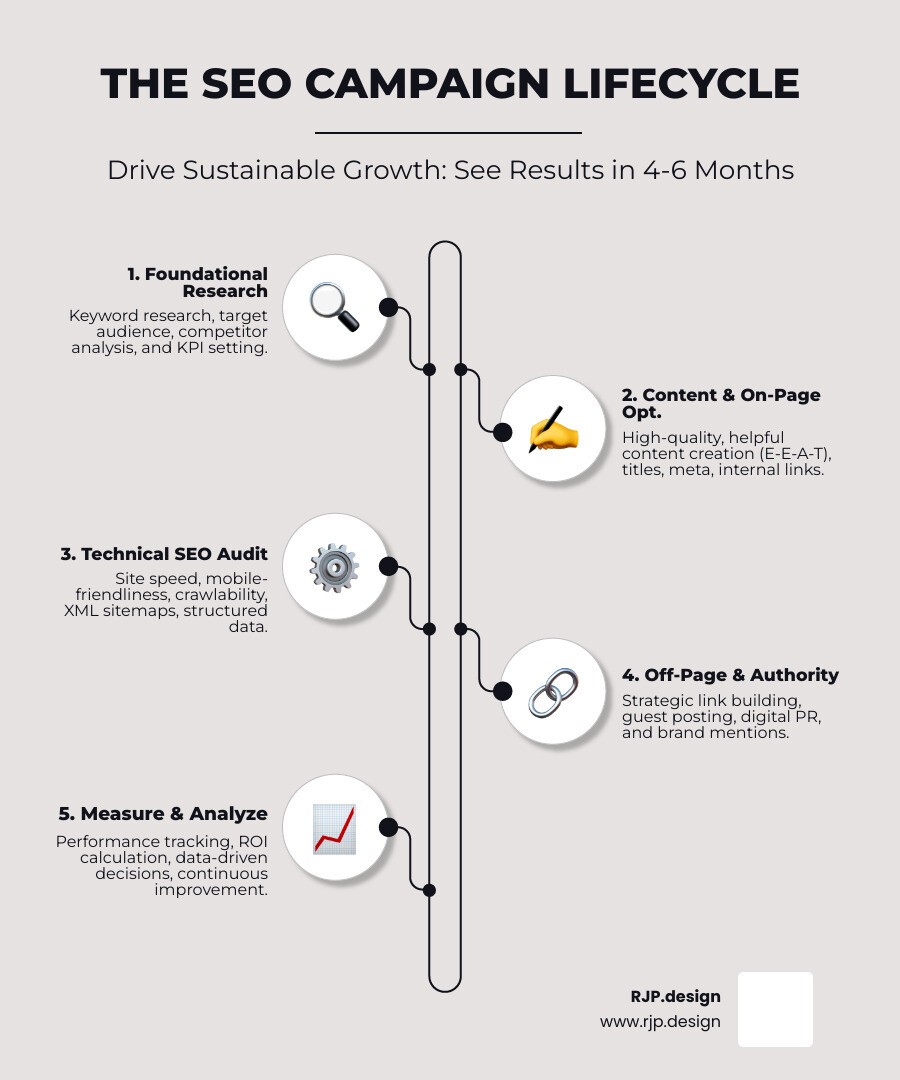
Key terms for seo campaign management:
The Core Process of SEO Campaign Management
Successful SEO campaign management is like conducting an orchestra – every element must work in harmony. It’s a continuous process of strategic planning and adaptation to Google’s ever-changing algorithms, requiring solid project management skills.
The goal is to align your SEO efforts with your business goals, attracting the right visitors who are ready to take action. That’s where our expertise in SEO Optimization Services makes the difference.
Step 1: Foundational Research and Strategy
Before touching your website, we must understand your digital landscape. This foundational step is critical for success.
Keyword research is about more than finding popular search terms; it’s about uncovering the exact phrases your target audience uses. We analyze search volume, keyword difficulty, and, most importantly, search intent—whether users are looking to buy, research, or learn.
Long-tail keywords are a key part of this. While they have lower search volume, they often have less competition and higher conversion rates due to their specificity. Our SEO Keyword Research approach uncovers these valuable opportunities.
Next is competitor analysis. We don’t copy competitors; we identify gaps in their strategy. We analyze what keywords they rank for and what content they produce to find areas where we can outperform them.
We organize keywords into topic clusters, a hub-and-spoke system with a main “pillar page” on a broad topic and several “cluster pages” on specific subtopics. This structure, connected by internal links, builds topical authority.
Finally, we set SMART goals. Instead of a vague goal like “get more traffic,” we aim for specific targets, such as “increase organic traffic to product pages by 20% in six months.” These KPIs guide our entire strategy.
Step 2: Content Creation and On-Page Optimization
This step involves creating content that connects with people and ranks well. High-quality content is the core of any successful SEO strategy. Following Google’s helpful content systems, we create “people-first” content that is genuinely useful.
Your content must demonstrate E-E-A-T (Experience, Expertise, Authoritativeness, and Trustworthiness). This means creating valuable, unique content from a knowledgeable perspective, not just stuffing keywords.
Once the content is created, we optimize it for search engines:
Title tags are your storefront in search results—compelling, accurate, and around 50-60 characters.
Meta descriptions act as an elevator pitch (around 105 characters) to encourage clicks.
Header tags (H1, H2s, H3s) structure your content logically for readers and search engines.
URL structure is kept clean and descriptive (e.g.,
yoursite.com/category/product-name).Internal linking creates a roadmap through your site, guiding users and passing link authority between pages.
Image optimization involves using descriptive alt text and ensuring fast load times.
We prioritize user experience. Easy-to-read content that loads quickly keeps users engaged, which search engines reward.
Step 3: Technical SEO Audit and Fixes
Technical SEO is the foundation of your website. If search engines can’t find, crawl, and understand your content, even the best articles won’t rank.
Our Technical SEO Experts focus on the core elements that impact search performance:
Site speed: Slow websites frustrate users and hurt rankings. We use tools like Google’s PageSpeed Insights tool to optimize load times.
Mobile-friendliness: With mobile-first indexing, a seamless mobile experience is non-negotiable.
Crawlability and indexability: We ensure search engines can access and index your important pages by checking robots.txt, meta tags, and other potential barriers.
XML sitemaps: We create and submit sitemaps to give search engines a clear roadmap of your site’s structure.
Structured data (schema markup): This helps search engines understand your content (products, reviews, etc.) and can result in rich snippets that make your listings stand out.
Duplicate content: We resolve duplicate content issues using canonical tags or redirects to avoid confusing search engines.
We also identify and prune “zombie pages”—low-value pages that don’t contribute to your goals. Removing these can significantly boost your site’s overall performance.
Step 4: Off-Page SEO and Authority Building
Off-page SEO builds your website’s reputation and authority across the internet. The cornerstone of this effort is backlinks—votes of confidence from other websites. Quality is more important than quantity; links from reputable, relevant sites tell search engines your content is valuable and trustworthy.
Our Link Building Off-Page SEO strategies focus on earning high-quality backlinks naturally. We create remarkable content that others want to reference, such as original research or comprehensive guides. Since 75% of content gets zero inbound links, creating exceptional content is key.
Key tactics include:
Guest posting: Earning backlinks and exposure by publishing on reputable industry websites.
Digital PR: Securing mentions and links from news outlets and blogs through strategic outreach.
Brand mentions: Monitoring for unlinked mentions of your brand and requesting a link.
For local businesses, local SEO is vital. We optimize your Google Business Profile, ensure consistent business information online, and acquire local citations. Our Local SEO Services help you dominate local search results, where 46% of Google searches are for local information and 28% of those searches result in a purchase.
Off-page SEO is a long-term investment that steadily builds your domain authority and proves to Google that you are a trusted industry source.
Measuring and Analyzing Your Campaign’s Success
Here’s where the magic happens – turning all that hard work into measurable results. Think of this phase as your SEO report card, where we find what’s working, what needs tweaking, and most importantly, how much money your SEO campaign management is putting back in your pocket.
The beauty of SEO lies in its trackability. Unlike traditional marketing where you’re often shooting in the dark, SEO gives us concrete data to work with. We can see exactly which keywords are driving traffic, which pages are converting visitors into customers, and where your investment is paying off.
Our approach to Search Engine Optimization Analysis goes beyond just counting visitors. We dig deep into the data to understand the story behind the numbers.

Key Metrics and Tools for Effective SEO Campaign Management
Let’s talk about the tools that help us track your success. Think of these as your SEO dashboard – they show us exactly what’s happening under the hood.
Google Analytics is our trusty sidekick for understanding how people interact with your website. We watch your organic traffic like a hawk – this is the lifeblood of any SEO campaign. But it’s not just about numbers; we also track your bounce rate (how many people leave after viewing just one page) and conversion rate (how many visitors actually do what you want them to do). The Google Analytics platform gives us insights that help us understand not just how many people visit, but how they behave once they’re there.
Google Search Console is like getting insider information straight from Google. It tells us which keywords are bringing people to your site, how often your pages appear in search results, and whether Google is having any trouble crawling your website. It’s essentially Google’s report card on your site’s performance.
Rank tracking tools help us monitor where your target keywords sit in search results. While rankings aren’t everything, they’re a good indicator of whether our optimization efforts are moving the needle. We track these positions over time to spot trends and opportunities.
Backlink analysis tools keep tabs on your website’s authority by monitoring who’s linking to you. We track new links, identify lost ones, and analyze the quality of sites that are vouching for your content.
The real magic happens when we combine data from all these sources. It’s like putting together a puzzle – each tool gives us a piece, and together they create a complete picture of your SEO performance.
Calculating ROI and Proving Value
Here’s the million-dollar question: “Is this SEO stuff actually making me money?” I get it – you need to see real results, not just vanity metrics. That’s why calculating ROI isn’t just something we do at the end; it’s baked into everything we track.
Defining what success looks like is our starting point. For an online store, success might be sales. For a service business, it could be phone calls or contact form submissions. For a SaaS company, it might be free trial signups. We work with you to define these conversions clearly from day one.
Tracking revenue and leads becomes our obsession (in the best way). We carefully monitor which organic visitors are turning into customers. For e-commerce sites, this means tracking actual dollar amounts. For lead generation businesses, we track both the quantity and quality of leads, and when possible, we follow them through to see their customer lifetime value.
Analyzing costs means we account for everything – tool subscriptions, content creation, our services, and any internal time your team spends on SEO. We believe in complete transparency about what your SEO investment actually costs.
The ROI calculation itself is straightforward: we take your gains from SEO, subtract your costs, and divide by those costs. If your SEO campaign generated $10,000 in revenue and cost $2,000, your ROI is 400%. But we don’t stop there.
The bigger picture includes benefits that are harder to quantify but equally valuable. Improved brand awareness, better website authority, and improved user experience all contribute to long-term business growth. These compound over time, making your SEO investment more valuable with each passing month.
By focusing on these real, measurable outcomes, we ensure your SEO campaign management isn’t just busy work – it’s a powerful engine driving actual business growth and truly enhancing your website’s ROI.
Assembling Your Team: In-House vs. Agency
When starting with SEO campaign management, a key decision is whether to build an in-house team or hire an agency. Both options can be effective, but they suit different needs and budgets.
Here’s a breakdown of the key differences:
Feature | In-House SEO Team | SEO Agency (like an Internet Marketing Agency) |
|---|---|---|
Cost | Higher fixed costs (salaries, benefits, training, tools). Average base salary for an SEO manager in the U.S. is $80,310, plus additional specialists. | Variable costs based on services. Can be more cost-effective for smaller budgets or specific projects. Access to a team of experts for a single fee. |
Expertise | Deep knowledge of your specific business, brand, and internal processes. May lack broad industry experience or specialized skills (e.g., advanced technical SEO, niche link building) without significant investment. | Access to diverse specialists (technical SEO, content strategists, link builders, analysts) with broad industry experience. Up-to-date with latest algorithm changes and trends across various clients. |
Scalability | Difficult to scale up or down quickly. Requires hiring/firing, which is time-consuming and costly. | Highly scalable. Can adjust services based on your evolving needs without the complexities of internal hiring. |
Control | Full control over strategy, execution, and data. Direct communication and immediate feedback loops. | Less direct control, but strategy is collaborative. Requires clear communication and trust. One point of contact to avoid confusion. |
Communication | Seamless, daily communication within the team. | Requires scheduled check-ins and clear reporting. Communication can sometimes be less frequent but should be highly efficient. |
Focus | Dedicated solely to your business’s SEO needs. | Manages multiple clients, potentially dividing attention. However, this also means broader insights and diverse problem-solving experience. |
Tools & Tech | Requires investing in and maintaining various SEO software licenses. | Agencies typically have licenses for a wide array of premium tools, which you benefit from without direct cost. |
An in-house team offers deep company knowledge but comes with higher fixed costs and less scalability. An agency provides access to diverse specialists and premium tools for a variable fee, offering greater flexibility.
The Role and Qualifications of an SEO Manager
Regardless of your choice, a skilled SEO manager is vital for your SEO campaign management success. This person coordinates the entire strategy.
A great SEO manager is a strategic planner, data analyst, and project manager rolled into one. Key qualifications include:
Communication skills: The ability to explain complex SEO concepts to different teams and stakeholders.
Technical knowledge: A solid understanding of website architecture, HTML, and how technical issues impact rankings.
Adaptability: The capacity to thrive on change, as Google’s algorithms are constantly evolving.
The average base salary for an SEO manager in the U.S. is $80,310, reflecting the specialized skill set required. This doesn’t include the cost of additional specialists for content, technical SEO, and link building.
Choosing the Right Path for Your Business
The best choice depends on your specific situation. Consider your budget, business size, industry complexity, and long-term goals. For many small to medium businesses, an agency is more cost-effective. Larger enterprises in complex industries might benefit from a dedicated in-house team.
A hybrid approach, where an agency handles specialized tasks like technical audits while an in-house team manages content, can also be effective. This model offers both specialized expertise and internal control.
Finding the right partner is crucial. Look for clear communication, proven results, and a genuine understanding of your business goals. Setting clear expectations upfront will ensure a smooth and successful partnership.
Frequently Asked Questions about SEO Campaigns
SEO campaign management can seem complex. Here are answers to common questions to help you understand how it works.
How long does it typically take to see results from an SEO campaign?
SEO is a marathon, not a sprint. Be wary of anyone promising overnight results.
Most companies see meaningful changes from SEO campaign management efforts in four to six months. This typically includes improved rankings for some keywords and a steady increase in organic traffic. More significant results, like substantial ROI and revenue growth, usually take six to twelve months or longer. This is because building genuine authority with search engines takes time.
Several factors influence this timeline:
Website age and authority: Newer sites take longer to build trust with Google than established ones.
Industry competition: Highly competitive fields require more time to gain traction.
Website’s current health: Major technical issues must be fixed before you can see significant progress.
Budget and resources: Campaigns with more resources for content and technical SEO tend to see faster results.
The key benefit of SEO is its compounding returns. The work done today builds lasting value, unlike paid ads that stop when you stop paying.
What are common SEO mistakes to avoid?
Avoiding common pitfalls can save your campaign from setbacks. Here are the main ones:
Keyword stuffing: Forcing keywords into content makes it unreadable and violates Google’s spam policies. Write for humans first.
Ignoring mobile optimization: With mobile-first indexing, a poor mobile experience will severely hurt your rankings.
Buying links: This is a risky shortcut that can lead to penalties. Focus on earning high-quality, natural backlinks.
Neglecting technical SEO: Issues like slow site speed or crawl errors can prevent your content from being found, no matter how good it is.
Creating thin or duplicate content: Google prioritizes comprehensive, unique content. Low-value or copied pages can harm your site’s authority.
What is the difference between SEO and PPC?
SEO and PPC (Pay-Per-Click) are both effective but work differently.
SEO (Search Engine Optimization): This is the process of earning organic, unpaid traffic from search engines. It’s a long-term strategy that builds lasting authority and trust. Think of it as owning your online real estate.
PPC (Pay-Per-Click): This involves paying for ads to appear at the top of search results. It delivers immediate traffic but stops as soon as you stop paying. Think of it as renting a billboard.
Key Differences:
Time: SEO takes months to show significant results, while PPC is almost instant.
Cost: SEO is an investment in assets (content, authority) that provides long-term value. PPC requires continuous payment for every click.
Trust: Users often trust organic results more than paid ads, as they are seen as a more genuine recommendation from the search engine.
SEO and PPC work best together. You can use PPC for immediate visibility while your long-term SEO strategy builds momentum. This combined approach often yields the best results. To learn more about paid advertising, see our PPC Management Services Company page.