
SEO
From Clicks to Conversions: Your E-commerce SEO Journey
Sep 3, 2025

SEO for e-commerce websites: Boost Sales 2025
Why E-commerce SEO Drives Business Growth
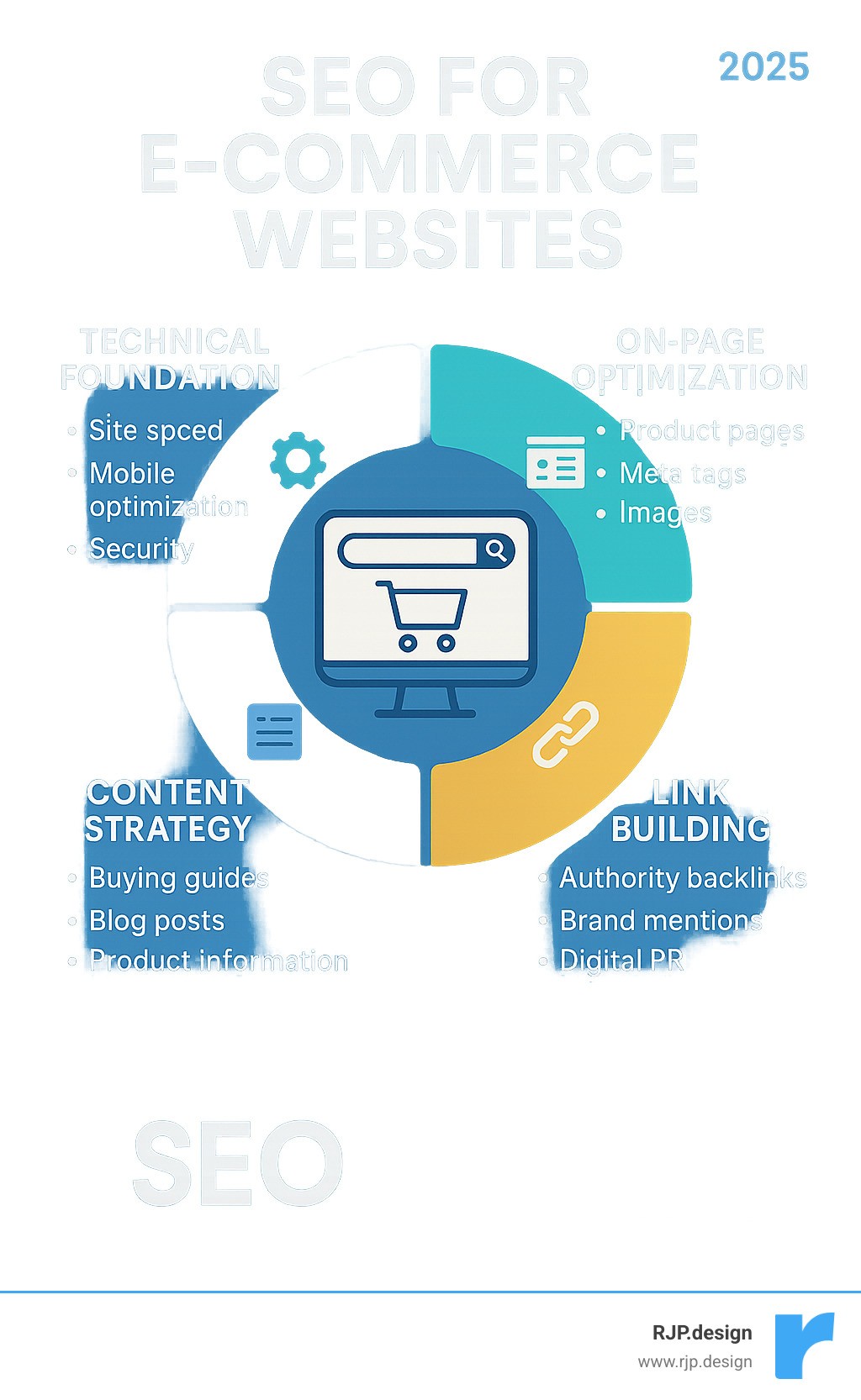
SEO for e-commerce websites is the process of optimizing online stores to rank higher in search engines like Google, driving organic traffic and increasing sales without paying for ads. It involves several core elements:
Core Elements of E-commerce SEO:
Keyword Research – Target product-focused and buying-intent keywords
Site Architecture – Create clear navigation paths from homepage to products
On-Page Optimization – Optimize product pages, titles, and descriptions
Technical SEO – Ensure fast loading, mobile-friendly, secure sites
Content Marketing – Create buying guides and helpful product content
Link Building – Earn authority through quality backlinks
With e-commerce sales projected to hit $8 trillion by 2027, competition is fierce. Since only 0.63% of searchers click past page one and the top result gets 27.6% of clicks, high rankings are essential for survival.
Unlike paid advertising that stops when you stop paying, SEO builds lasting organic visibility. While 82% of marketers report positive effects from SEO, many e-commerce businesses struggle with the unique challenges of optimizing large product catalogs and managing technical complexity.
I’m Ross Plumer, and I’ve helped businesses market over $20 million in revenue through strategic digital marketing and SEO for e-commerce websites. My experience has shown me what separates thriving online stores from those that get lost in search results.
Key SEO for e-commerce websites vocabulary:
Laying the Groundwork: Keyword Research and Site Architecture
Building an online store is like constructing a house; you need a solid foundation first. For SEO for e-commerce websites, that foundation consists of smart keyword research and solid site architecture.
Your customers are already searching for your products. Understanding what they type into Google—and why—is the blueprint for your entire SEO strategy.
At RJP.design, we know successful e-commerce SEO starts with understanding your customers’ pain points, language, and buying journey. This insight shapes your site structure for a better user and search engine experience.
Mastering E-commerce Keyword Research
E-commerce keyword research isn’t just about traffic; it’s about finding customers ready to buy. This requires focusing on distinct search behaviors.
Transactional keywords are searches made by people ready to buy (e.g., “buy wireless headphones”). They have high competition but also high conversion rates due to clear buyer intent.
Informational keywords (e.g., “best headphones for working out”) target users in the research phase. Creating helpful content around these terms builds trust and positions you as an expert for when they are ready to purchase.
Long-tail keywords are more specific phrases like “waterproof trail running shoes for wide feet.” They have lower search volume but attract highly qualified traffic with less competition.
We analyze successful competitors to spot missed opportunities and find hidden keywords.
Our SEO keyword research process uses our experience alongside free tools. Google Search Console reveals what’s already working, while Google Trends helps spot seasonal patterns and emerging product interest.
RJP.design’s in-house research process goes deeper than tools. We analyze customer language from forums and reviews and study market dynamics to uncover valuable keywords that automated tools often miss.
The approach differs for B2B and B2C keyword intent. B2C searches are often emotional and immediate (“cute summer dresses”), while B2B searches are methodical and solution-focused (“enterprise inventory management software”). This distinction is key to keyword selection and content strategy.
Designing a Winning Site Architecture
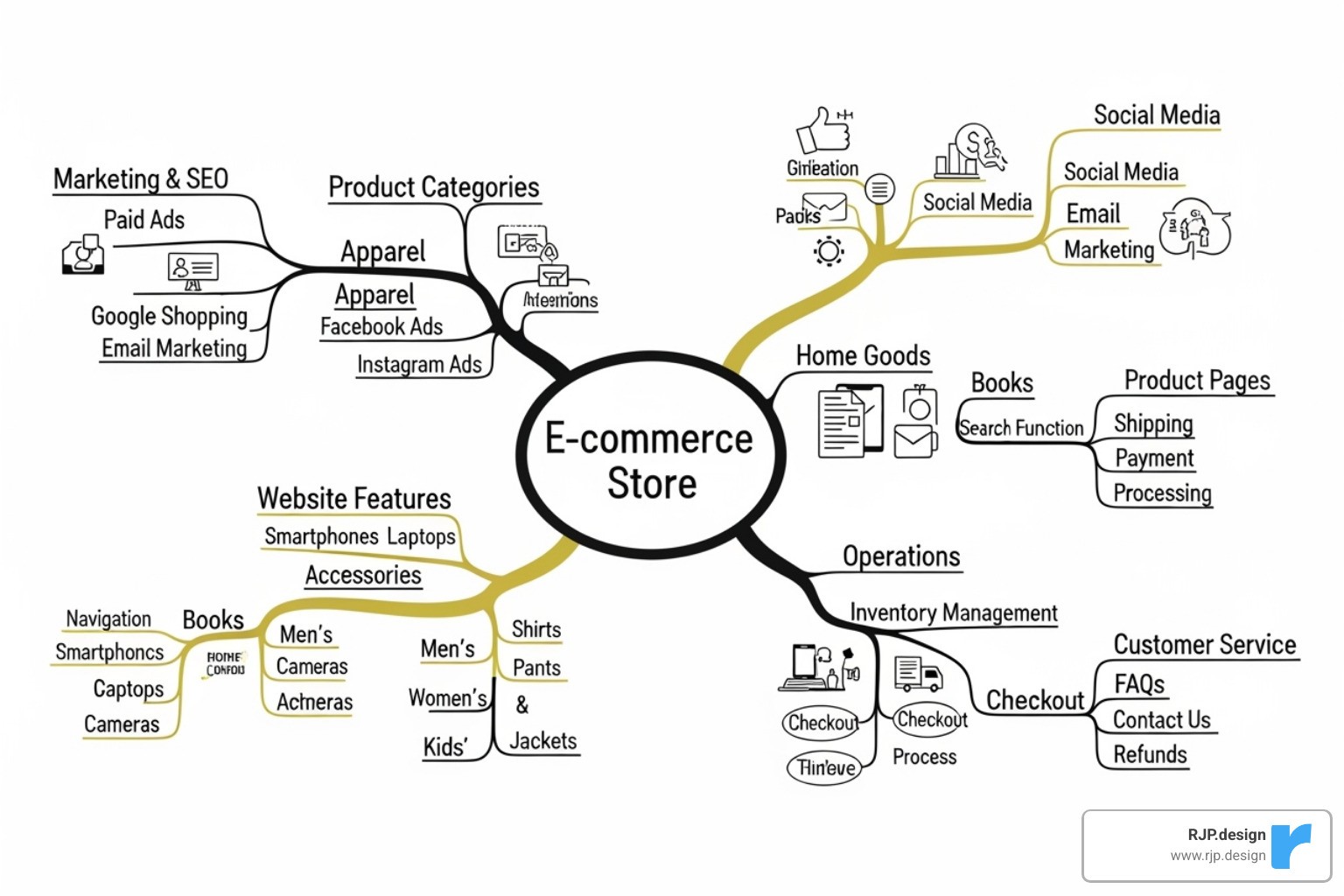
With keywords identified, we build a site architecture that’s logical for both users and search engines, like a well-organized department store.
Homepage optimization starts with clear navigation to your main categories. From there, category pages group related products, and product pages work to convert browsers into buyers.
Simple navigation is essential. A customer should be able to reach any product in three or four clicks from the homepage. This flat structure also helps search engines crawl your site efficiently.
Your internal linking strategy connects your content. Linking between related products, category pages, and blog posts helps search engines understand page relationships and keeps users engaged.
URL structure best practices focus on clarity. A URL like /mens-running-shoes/nike-air-zoom-pegasus clearly tells users and search engines what the page is about. Keep URLs short, descriptive, and keyword-rich.
Breadcrumbs (e.g., Home > Shoes > Running) are navigation trails that improve user experience and provide clean internal links for SEO, helping users understand their location on your site.
The goal is a scalable site structure. For more on creating customer-friendly experiences, see our guide on Best E-commerce Sites UX. When you get keyword research and site architecture right, everything else becomes easier.
Optimizing Your Digital Storefront: On-Page & Technical SEO for E-commerce Websites
With the foundation in place, it’s time to optimize your digital storefront for search engines and customers. This phase is about creating a clean, organized shopping experience that turns visitors into happy customers.
E-commerce SEO excels when on-page optimization (what customers see) and technical SEO (the behind-the-scenes mechanics) work together. Getting this right is a win-win: search engines reward user-friendly sites, and customers appreciate an easy shopping experience, driving both rankings and sales.

Best Practices for On-Page SEO for E-commerce Websites
This is where keyword research turns into sales. Every element on your product and category pages must attract search engines and persuade customers.
Product page optimization is crucial. Your title tags must grab attention in under 60 characters. Include the product name, a key benefit, and your brand, like “Nike Air Zoom Pegasus 40 – Men’s Running Shoes | Free Shipping.”
Meta descriptions are your 105-character sales pitch in search results. Highlight what makes the product special to convince users to click.
Header tags (H1, H2s) create a logical flow, making your content easy for shoppers to scan.
Write unique product descriptions. Never copy from the manufacturer, as Google penalizes duplicate content. Create detailed, benefit-focused descriptions that answer customer questions and naturally include long-tail keywords.
High-quality product images are non-negotiable. Use multiple angles and lifestyle shots. For SEO, use descriptive file names and alt text (e.g., nike-air-zoom-pegasus-40-blue.jpg with alt text “Men’s blue Nike Air Zoom Pegasus 40 running shoes”).
Customer reviews and user-generated content are SEO gold. They provide fresh, unique content full of long-tail keywords. Since nearly 70% of shoppers read reviews, make them easy to leave and display them prominently. This aligns with our Google Search Optimization approach.
Don’t forget category page content. These pages are perfect for capturing broader search terms with unique, helpful content that guides customers to the right products.
Essential Technical SEO for E-commerce Websites
Technical SEO is the invisible foundation of your store. For e-commerce sites with thousands of products, a solid technical base is critical for everything else to function correctly.
Page speed is crucial, as 53% of users abandon sites that take over three seconds to load. Focus on Core Web Vitals by compressing images, streamlining code, and using a Content Delivery Network (CDN).
Mobile-first indexing means Google ranks you based on your mobile site. With most people shopping on phones, a fast, easy-to-steer mobile experience is essential.
HTTPS and security build trust with shoppers and are a confirmed Google ranking factor.
Schema markup for products gives Google structured data about your items. This can generate rich snippets in search results with ratings, price, and availability, which increases click-through rates. You can learn more about implementing schema markup for products.
XML sitemaps and robots.txt files help search engines crawl your site efficiently. Submit your sitemap via Google Search Console.
Handling duplicate content from product variations is a major challenge. Use canonical tags to specify the main version of a page.
For permanently out of stock products, use 301 redirects to guide visitors to similar items or categories. This preserves SEO value and prevents a poor user experience.
Expanding Your Reach: Content, Links, and Product Visibility
Your store is optimized and technically sound. Now, it’s time to attract visitors. This phase focuses on building authority and expanding your reach beyond your site to attract new customers by sharing expertise and making connections that drive traffic back to your store.

Leveraging Content Marketing
Content marketing for SEO for e-commerce websites means solving customer problems instead of just pushing products. This builds relationships and captures users making informational searches who are not yet ready to buy.
Blogging for e-commerce is a powerful tool. By answering questions like “how to choose running shoes for flat feet,” you provide value, earn trust, and convert researchers into buyers.
Buying guides, such as “The Complete Guide to Choosing Your First Road Bike,” attract newcomers by helping them make informed decisions, which naturally leads them to explore your products.
How-to articles like “How to Care for Your Leather Boots” showcase your expertise, position you as an authority, and create opportunities to promote related products.
Product comparison posts (e.g., “Nike vs. Adidas Running Shoes”) help customers make informed decisions, showing confidence in your selection and guiding them to your product pages.
Video content, such as product demonstrations, creates an emotional connection that static images can’t. Embedding videos on product pages increases engagement and purchase confidence.
This content builds topical authority, helping all your pages rank better. It’s a core part of our Digital Marketing and SEO Services approach.
Building High-Quality Backlinks
Backlinks from reputable sites act as votes of confidence that boost your credibility with Google. It’s crucial to earn these links honestly and avoid paid link schemes to prevent penalties.
At RJP.design, we use proven strategies to build authority naturally:
Guest posting on reputable sites allows us to share expertise, earn backlinks, and reach new, relevant audiences.
Broken link building is a win-win strategy. We find broken links on other sites and offer our content as a replacement, helping the site owner and earning us a quality backlink.
Unlinked brand mentions are another opportunity. We find where your brand is mentioned without a link and reach out to request one.
Digital PR involves creating highly shareable content, like industry studies or infographics, to earn high-authority backlinks and brand exposure.
Maximizing Product Visibility with Google and Other Channels
Getting products seen beyond traditional search results is key. This requires complete and accurate product data optimization.
The Google Shopping tab and free product listings are a massive, often overlooked opportunity. Properly optimized products can appear in these sections for free, offering fantastic organic exposure.
To get these free listings, you must submit your product data to Google in their required format. Following Google’s guidelines on optimizing product information is key to success.
Monitoring product visibility and performance across all channels helps us track impressions, clicks, and conversions to continuously refine our approach.
Frequently Asked Questions about E-commerce SEO
SEO for e-commerce websites can feel overwhelming. Business owners often ask about the biggest challenges, the time it takes to see results, and how to measure success. Let’s tackle these common business concerns with straight answers.
What are the most common challenges in e-commerce SEO?
Online stores face unique SEO challenges, but they are manageable once you know what to expect.
Duplicate content is a major issue, often arising from product variations (e.g., different colors or sizes). This creates nearly identical pages that confuse search engines and dilute your SEO authority.
Thin content on product pages is another problem. Relying on manufacturer descriptions isn’t enough; search engines and customers need rich, unique content to understand your product’s value.
Managing thousands of products feels impossible, but prioritization is key. Start by optimizing your best-sellers and highest-margin items first.
Technical SEO complexity is a common hurdle. Managing product feeds, out-of-stock items, and site speed for large sites requires careful attention.
Link acquisition difficulties are common, as it’s harder to earn links to product pages than to blog posts. This makes creative content marketing and digital PR essential.
Overcoming these challenges requires a systematic, step-by-step approach.
How long does it take to see results from e-commerce SEO?
This is a common question, but the truth is that e-commerce SEO is a marathon, not a sprint.
Several factors influence your timeline, including market competition, your site’s starting point (new vs. existing), budget, and consistency of implementation.
Initial improvements often appear within 4-6 months, such as better rankings for long-tail keywords. However, significant, bottom-line results typically take 6 to 12 months or longer.
While it takes time, SEO is a worthwhile investment that delivers compounding returns. Unlike paid ads, the work you do today builds lasting value and continues to deliver results for years.
What are the key KPIs to measure SEO success?
Tracking the right metrics is crucial for understanding SEO performance. Avoid vanity metrics that look impressive but don’t impact your business goals.
Organic traffic shows increased visibility, but it must be qualified.
Keyword rankings track your progress for important business terms.
Click-through rate (CTR) measures how compelling your search listings are.
Conversion rate from organic search shows if your SEO traffic is buying. A 2% rate is a decent benchmark, but this varies by industry.
Revenue from organic traffic is the ultimate KPI, directly tying SEO efforts to your bottom line and making it easy to calculate ROI.
Bounce rate can indicate a mismatch between user expectations and your page content, signaling potential UX or content issues.
Tracking these metrics tells a complete story about your SEO performance, from visibility to revenue.
Conclusion: Start Your E-commerce SEO Journey Today
We’ve covered the entire SEO for e-commerce websites journey: from keyword research and site architecture to on-page, technical, and off-page strategies like content and link building.
E-commerce SEO isn’t a one-time task; it’s an ongoing process of nurturing and adapting. The digital world is always changing, and so should your SEO strategy. The effort you invest today pays dividends for years to come.
While competitors pay for every click, you’re building a sustainable, organic presence that attracts customers without a constant ad spend. That’s the power of SEO.
At RJP.design, we’ve seen the transformative power of a well-executed SEO strategy. Our down-to-earth team is committed to helping business owners achieve their goals with high-quality service that delivers real results, like increased traffic and sales.
The path from clicks to conversions is no longer a mystery. You have the roadmap, but you don’t have to go it alone if you feel overwhelmed.
Your products deserve to be found. Don’t let them get buried in search results. Get started with our comprehensive SEO services today, and let’s work together to turn your online store into the traffic and sales magnet it was meant to be.
The journey starts now. Are you ready?