
Web
Ultimate Checklist for Hiring Website Developers in New York
Oct 8, 2026

How to Hire Website Developers in New York
Start with what your website needs to accomplish. Then ask each developer for relevant work samples, a written scope and timeline, an explanation of who will do the work, and clear terms for site ownership and post-launch support. Compare every proposal against the same criteria so a low price does not distract from missing essentials.
If your current site is outdated or hard for customers to find and use, the right developer should be able to explain how their proposed work addresses those problems in plain language. This checklist helps you evaluate website developers in New York against the same standards, whether you are hiring a solo specialist or a full-service agency.
I'm Ross Plumer, and my experience in website design, development, and digital marketing helps me make searches like "website developers new york" more useful for business owners. Here's the checklist I'd use to evaluate the work, the team, and the proposal before hiring.

Essential Criteria for Evaluating Website Developers in New York
Hiring a development team in a competitive market like NYC requires a structured vetting process. It is easy to be swayed by flashy pitch decks, but true technical excellence lies beneath the surface. You need a partner who combines strong architectural foundations with clear communication.

When we evaluate talent, we focus on three foundational pillars:
Seniority distribution: Ensure your project is not handed off entirely to junior engineers. You want senior technical leads driving the architecture, supported by experienced mid-level developers who follow established standards.
Code audit protocols: Ask prospective teams how they review code. High-performing agencies enforce automated linting, peer code reviews, and continuous integration checks before any line of code reaches production.
Thorough technical discovery: A dependable partner does not jump straight into coding without mapping user journeys, data structures, and edge cases. Discovery prevents costly mid-project redesigns and keeps timelines predictable.
Technical Stacks and Architecture Used by Website Developers in New York
Selecting the right technology stack dictates how quickly your site loads, how easily it scales, and how much it costs to maintain. Modern projects demand modular architectures that separate content management from the presentation layer.
For frontend experiences, frameworks like React and Next.js offer server-side rendering and lightning-fast page transitions. For backend logic and data storage, pairings like Node.js with PostgreSQL provide dependable, enterprise-grade data management. Combining these technologies with cloud infrastructure on AWS, Vercel, or Google Cloud gives your platform the stability to handle sudden traffic spikes without slowdowns.
Review our custom web design nyc guide for details on crafting custom visual systems. Choosing a qualified web development company in new york city ensures your underlying architecture is built for both performance and search engine visibility. For a broader view of modern development practices, the Web development entry on Wikipedia offers useful background on how these technologies fit together.
Tech Stack Combination | Performance Rating | Scalability Potential | Ongoing Maintenance Needs |
|---|---|---|---|
Next.js + Node.js + PostgreSQL | Ultra-Fast (Server-Side Rendered) | High (Microservices & Serverless) | Moderate (Standard Modern Tooling) |
Headless CMS + Static Site (Jamstack) | Exceptional (Pre-rendered edge delivery) | High (Zero server bottlenecks) | Low to Moderate (Decoupled systems) |
Monolithic Frameworks (PHP/Ruby) | Moderate (Depends on heavy caching) | Moderate (Requires vertical scaling) | High (Frequent plugin/core patching) |
Modern stacks deliver fast load times and clean codebases, keeping your technical debt low for years to come.
How Website Developers in New York Handle Brownfield and Legacy Systems
Not every project starts with a clean slate. Many growing businesses manage existing applications that process active customer orders and critical company data. Modernizing these "brownfield" systems requires caution, precision, and respect for current operations.
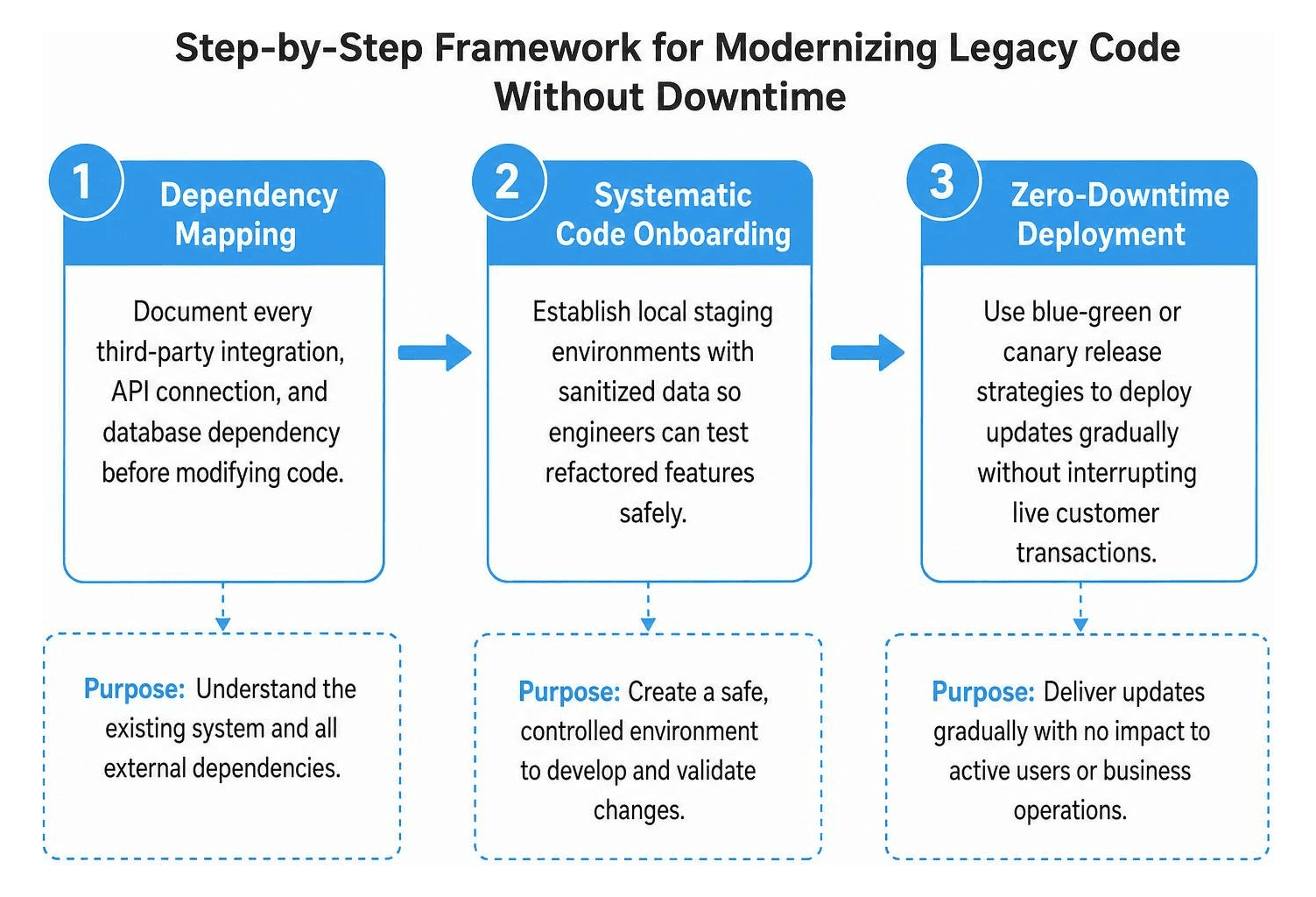
A professional modernization workflow includes:
Dependency mapping: Documenting every third-party integration, API connection, and database dependency before modifying code.
Systematic code onboarding: Establishing local staging environments with sanitized data so engineers can test refactored features safely.
Zero-downtime deployment: Using blue-green or canary release strategies to deploy updates gradually without interrupting live customer transactions.
To learn more about structured build phases, read our nyc website development ultimate guide.
AI-Augmented Workflows, Security, and IP Ownership
Modern development incorporates artificial intelligence to boost productivity, but it requires strict oversight and robust data safeguards.
We use AI to speed up routine boilerplate creation, generate unit tests, and spot syntax errors early. However, every automated output must undergo thorough human code review to verify logic, security, and performance.
Security must never be an afterthought. Your partner should implement zero-trust protocols, conduct automated vulnerability scans, and adhere to strict data compliance standards (such as SOC2 or HIPAA isolation where required).
Equally important is intellectual property ownership:
Ensure your contract states in writing that your company owns 100% of the custom code, design assets, and database architecture upon payment.
Prevent agencies from using proprietary components that lock you into exclusive long-term hosting deals.
Ensure intuitive UX principles protect your brand equity, as detailed in our guide to user experience design nyc.
Pricing Models, Scope SLAs, and Delivery Timelines
Budget clarity keeps projects on track and prevents unwelcome billing surprises. Most development projects follow one of two commercial arrangements: fixed-price milestone statements of work (SOWs) or monthly retainer engagements.
Pricing Model | Best Used For | Scope Flexibility | Cost Predictability |
|---|---|---|---|
Fixed-Price Milestone SOW | Clearly defined MVPs & redesigns | Rigid (Changes need formal change orders) | Maximum (Agreed price tied to deliverables) |
Monthly Dedicated Retainer | Ongoing product iteration & scaling | High (Pivot priorities sprint by sprint) | Variable (Predictable recurring burn rate) |
For most startups and mid-market organizations, an MVP build takes between 8 and 16 weeks, while larger enterprise transformations can span 4 to 8 months. Look for proposals that provide a formal launch warranty (typically 30 to 90 days post-launch) to resolve unexpected edge-case bugs at no extra cost.
Choosing the Right Partner for Long-Term Growth
Building your digital presence is not a one-and-done event; it is an ongoing asset that must evolve alongside your business goals.

A true partner focuses on proactive technical roadmapping, performance tuning, and regular software updates rather than just checking off project requirements. If you are selling online, review our ecommerce development nyc guide 2026 to see how strategic engineering choices drive higher checkout conversion rates and smoother user journeys.
Seamless In-House Team Integration and Vetting Checklist
Whether you are augmenting an internal technical team or hiring an agency to serve as your entire engineering department, strong day-to-day collaboration is vital.
Use this checklist during your agency interviews:
Do you work within our Eastern Standard Time (EST) business hours for real-time problem-solving?
Will we have direct access to lead engineers via Slack or Microsoft Teams, or only through account managers?
Do you conduct bi-weekly sprint demos so we can review functioning software throughout the build?
What testing environments (development, staging, production) are included in the scope?
How do you manage technical documentation to ensure our in-house staff can maintain the platform later?
At RJP.design, we prioritize high-quality service, practical problem-solving, and complete transparency. Our down-to-earth team focuses on creating clean, fast digital experiences that help your business stand out and thrive. Explore what our dedicated web design agency in nyc can do to turn your digital goals into reliable, measurable growth.