Web
The New York Guide to Better UX Design
Sep 18, 2026

Why User Experience Design in NYC Is a Make-or-Break Decision for Your Business
User experience design in NYC sits at the intersection of one of the world's most competitive digital markets and some of the highest user expectations on the planet. Whether you're a small business owner in Brooklyn or a startup founder in Manhattan, the quality of your digital experience can determine whether a visitor stays — or bounces in seconds.
Here's a quick snapshot of what you need to know:
What | Why It Matters |
|---|---|
UX design improves usability and engagement | Users who struggle with your site leave — and don't come back |
NYC is a top-tier digital market | Competition is fierce across fintech, healthcare, media, and retail |
Accessibility compliance (WCAG, Section 508) | Required for government and increasingly expected everywhere |
Salary range for UX designers in NYC | $58K–$250K depending on experience and industry |
Job growth in the field | 16% projected growth through 2032, with 34,000+ new jobs expected |
Key tools employers want | Figma, prototyping software, Google Analytics, HTML/CSS familiarity |
New York's digital landscape moves fast. Users expect intuitive, accessible, and visually polished experiences — and businesses that deliver them consistently see real results. The difference between a forgettable website and one that converts comes down to intentional, research-driven design.
Good UX isn't just about making things look nice. It's about making things work for the people who use them. That means understanding your users, removing friction, and building trust at every touchpoint — from the first click to the final conversion.
I'm Ross Plumer, a digital marketing and web design strategist with experience helping businesses drive over $20 million in revenue — and in this guide, I'll walk you through everything you need to know about user experience design in NYC, from the job market and industry trends to practical strategies for elevating your own digital presence. Let's dig in.
Navigating User Experience Design NYC in 2026
New York City’s tech ecosystem is a unique beast. In May 2026, the city stands as a massive global hub where finance, healthcare, media, fashion, and civic technology collide. Because of this diversity, designing digital products here requires a delicate balancing act. Local designers must champion user advocacy while simultaneously driving aggressive business goals and navigating tight regulatory environments.

When we build digital products in this environment, we aren't just designing in a vacuum. The local expectations are incredibly high. For example, professional design teams operating in competitive boroughs like Brooklyn frequently report achieving user satisfaction rates as high as 94% across hundreds of successful local projects. To survive in this market, businesses must move away from generic templates and invest in custom, high-impact NYC Website Design that speaks directly to their target audience.
The NYC Job Market and Career Paths in User Experience Design NYC
If you are looking to build a career in user experience design NYC has one of the most lucrative yet demanding job markets in the world. Backed by a projected 16% job growth in web development and digital design through 2032—which will add over 34,000 new jobs to the industry—the demand for talented designers remains incredibly strong.
In New York City, compensation reflects both the high cost of living and the sophisticated skill sets required by local employers:
Junior & Associate Designers: Typically start around $58,000 to $85,000 annually.
Mid-Level & Senior UX Designers: Command salaries between $98,000 and $150,000.
UX Directors & Executive Leaders: Can earn upwards of $200,000 to $250,000+, especially within major financial institutions or fast-growing tech companies.
To prepare for these roles, many local designers pursue specialized academic paths. New York institutions offer highly ranked programs, with some placing in the top 15% of best value colleges for art and boasting a top 10% return on investment (ROI) over 20 to 40 years for UX/UI design education. Whether you enter the field through a formal master's program or transition from a related creative field, securing a role here requires a deep understanding of Professional Web Design principles, hands-on testing, and a portfolio that proves you can solve complex business problems.
Industry-Specific Demands: From Fintech to Government UX
One of the most fascinating aspects of user experience design NYC is how wildly the design requirements change from one industry to the next.
Fintech and Wealth Management: In the financial capital of the world, fintech UX is all about making complex financial data digestible. Designers must build trust and clarity. Whether they are designing a stock-investing app for Gen Z or a high-volume enterprise trading dashboard, they must balance real-time data visualization with strict financial regulations.
Healthcare and Pharma: New York is home to massive healthcare networks and pharmaceutical giants. Designers in this space focus on accessible patient portals, multi-brand digital experiences, and platforms that simplify complex medical procedures. In healthcare, clear UX can literally save lives by ensuring patients find the care and information they need without friction.
Government and Public Services: Civic tech in New York requires a heavy emphasis on plain language, absolute accessibility, and clear information architecture. Government UX designers focus on translating complex civic processes—like health services, procurement, licensing, and public housing—into simple digital steps.
Across all these sectors, the ultimate goal is Effective Web Design that respects the user's time, protects their privacy, and guides them seamlessly to their destination.
Designing for the Future: AI, Accessibility, and NYC Agency Best Practices
As we look at the state of design in May 2026, the tools and methodologies we use are evolving rapidly. NYC-based design agencies and in-house teams are increasingly relying on automated workflows, robust design systems, and advanced AI technologies to keep up with the city's fast-moving market.

While in-house teams often focus on deeply optimizing a single product over several years, a premier Web Design Agency NYC must remain highly adaptable. Agencies routinely jump between completely different industries, requiring them to establish highly efficient, repeatable processes for user research, prototyping, and developer handoff.
The Role of Design Systems and Prototyping in User Experience Design NYC
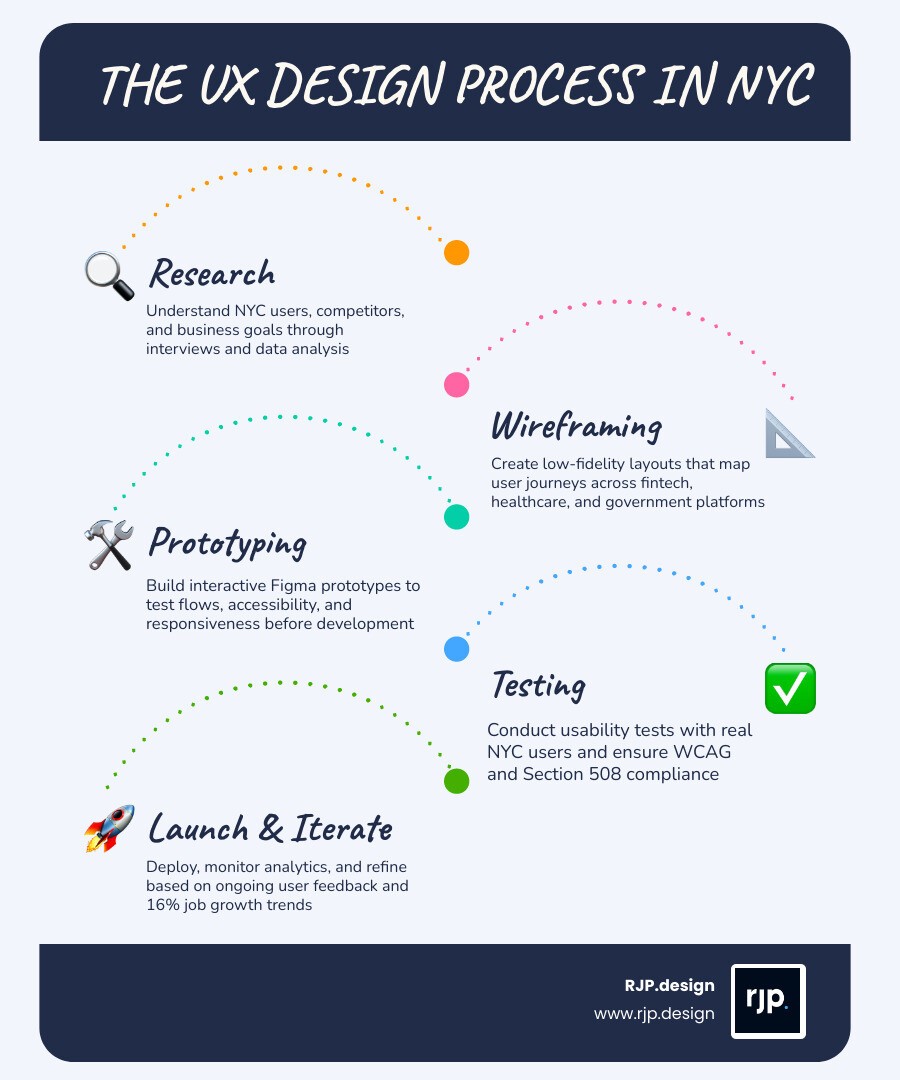
In modern product design, building from scratch every time is a recipe for failure. To maintain consistency across web, mobile, and app platforms, teams rely heavily on Figma to build and maintain enterprise-scale design systems.
These design systems use reusable component libraries, Figma variants, and design tokens to ensure that every button, form field, and navigation bar looks and behaves exactly the same way. This systematic approach is crucial for executing a seamless Responsive Design UX strategy. By mapping out structural blueprints and low-fidelity wireframes early in the process, designers can easily test how layouts adapt to different screen sizes before writing a single line of code.
Furthermore, interactive, clickable prototypes allow teams to conduct usability testing with real users early and often. This collaborative process ensures that developers, product managers, and designers are aligned, reducing development friction and preventing costly post-launch redesigns.
Balancing AI Integration, WCAG Compliance, and User Advocacy
The integration of artificial intelligence is rewriting the fundamentals of UX. We are moving beyond static layouts toward "agentic AI" and conversational interfaces that adapt dynamically to user behavior. Large enterprises are actively hiring specialized talent to design these systems ethically, as seen in the Studio+ Experience Designer, Senior - UX/UI, Human + AI Experiences Job Details | EY posting, which emphasizes the need for designers who can create human-centered, AI-enabled interactions grounded in trust and transparency.
At the same time, accessibility is no longer optional. Under Web Content Accessibility Guidelines (WCAG 2.1/2.2) and Section 508 compliance laws, digital platforms must be fully usable for individuals with visual, auditory, motor, or cognitive impairments. Whether you are building an enterprise SaaS platform or optimizing a Responsive UI UX layout for a local business, ensuring high-contrast colors, keyboard navigability, and screen-reader compatibility is a core legal and ethical requirement in the New York market.
To see how top strategists navigate these intersecting challenges of AI, regulation, and human-centered design, you can explore the work of industry leaders like Design Strategist & Omni-channel NYC leadership Providing UX, CX, AI, UXR, Blue Sky, Facilitation and Alicia Brooks Design .
How to Stand Out in the Competitive New York Market
With so much talent flooding the city, standing out to top NYC agencies, startups, or enterprise companies requires more than just a collection of pretty UI screens. Employers want to see how you think, how you collaborate, and how you measure success.
To make your portfolio stand out, keep these strategies in mind:
Show Your Messy Middle: Don't just show the polished final product. Include your initial user research, sketches, wireframes, and the failures that forced you to pivot.
Focus on Real-World Impact: Frame your case studies around metrics. Did your redesign reduce user drop-off? Did it increase conversions or cut down operational times?
Demonstrate Systems Thinking: Show that you know how to build and maintain component libraries in Figma, and explain how you collaborated with engineering teams to bring those designs to life.
For inspiration, take a look at the portfolio of Meredith Pahoulis | Director of Experience Design , which demonstrates over 15 years of design leadership across global brands, or check out the clean, user-centric case studies of Michelle Kwon | Product Designer and UX Thinker . Crafting a portfolio with this level of depth is essential if you want to compete for high-value Custom Web Design NYC projects.
Elevating Your Digital Presence with RJP.design
At RJP.design, we know that navigating user experience design can feel overwhelming. Whether you are looking to build a brand-new platform from scratch or optimize your current website to convert more local visitors, we are here to help.
We specialize in creating stunning, highly functional websites that ensure your business looks incredible and is easily found online. What sets us apart is our commitment to high-quality service and our down-to-earth, friendly team that always puts client satisfaction first. We don't believe in jargon or overcomplicating things—we believe in building digital experiences that work beautifully for your real-world customers.
Ready to transform your digital presence and stand out in the busy New York market? Partner with a top Web Design & Digital Marketing Agency in NYC today, and let's build something amazing together!