
Web
Scale Faster Using Professional API Integration Services
May 22, 2026
Why API Integration Services Are Essential for Business Growth in 2026
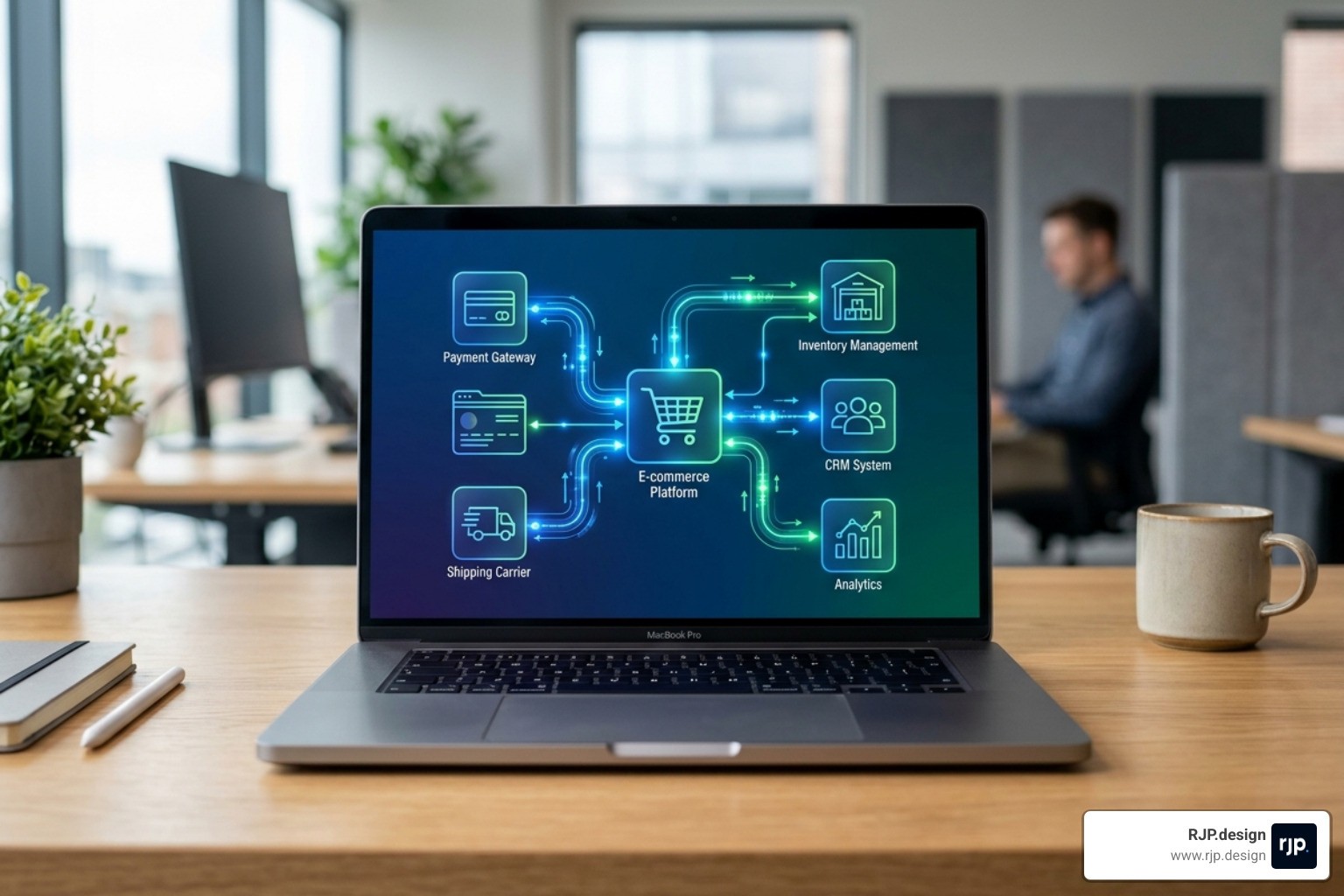
API integration services are professional solutions that connect your business software — like your CRM, ERP, eCommerce platform, and payment tools — so they can share data automatically, without manual effort.
Here's a quick look at what they deliver:
Automation — eliminate manual data entry and repetitive tasks
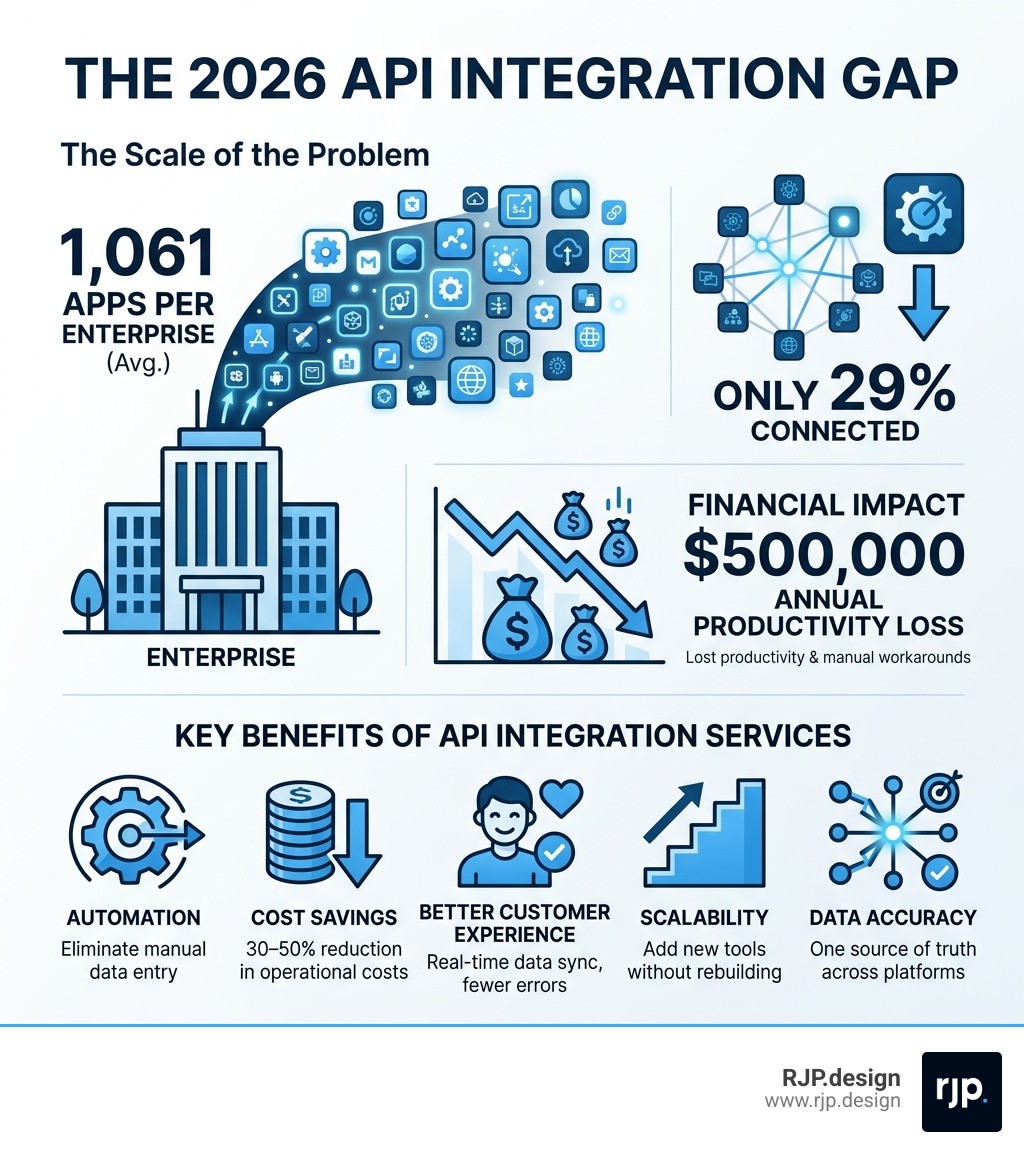
Cost savings — businesses report 30–50% reductions in operational costs
Better customer experience — real-time data sync means fewer errors and faster service
Scalability — add new tools and systems without rebuilding your tech stack
Data accuracy — one source of truth across all your platforms
The scale of the problem they solve is hard to ignore. The average enterprise runs on 1,061 different applications — yet only 29% of them are connected to each other. That disconnect costs businesses an estimated $500,000 per year in lost productivity and manual workarounds alone.
Think about what that looks like day-to-day. Your sales team updates a deal in your CRM, but your accounting software doesn't know about it. Your eCommerce store processes an order, but your inventory system is still showing the old stock count. Someone on your team is copy-pasting data between platforms — again.
These aren't minor inconveniences. They're real drags on growth.
I'm Ross Plumer, a digital marketing and web development strategist with hands-on experience helping businesses that have marketed over $20 million in revenue — and API integration services are one of the highest-leverage investments I consistently recommend to scaling businesses. In the sections ahead, I'll break down exactly what these services include, who needs them, and how to choose the right approach for your situation.
Key terms for API integration services:
Core Capabilities of Modern API Integration Services
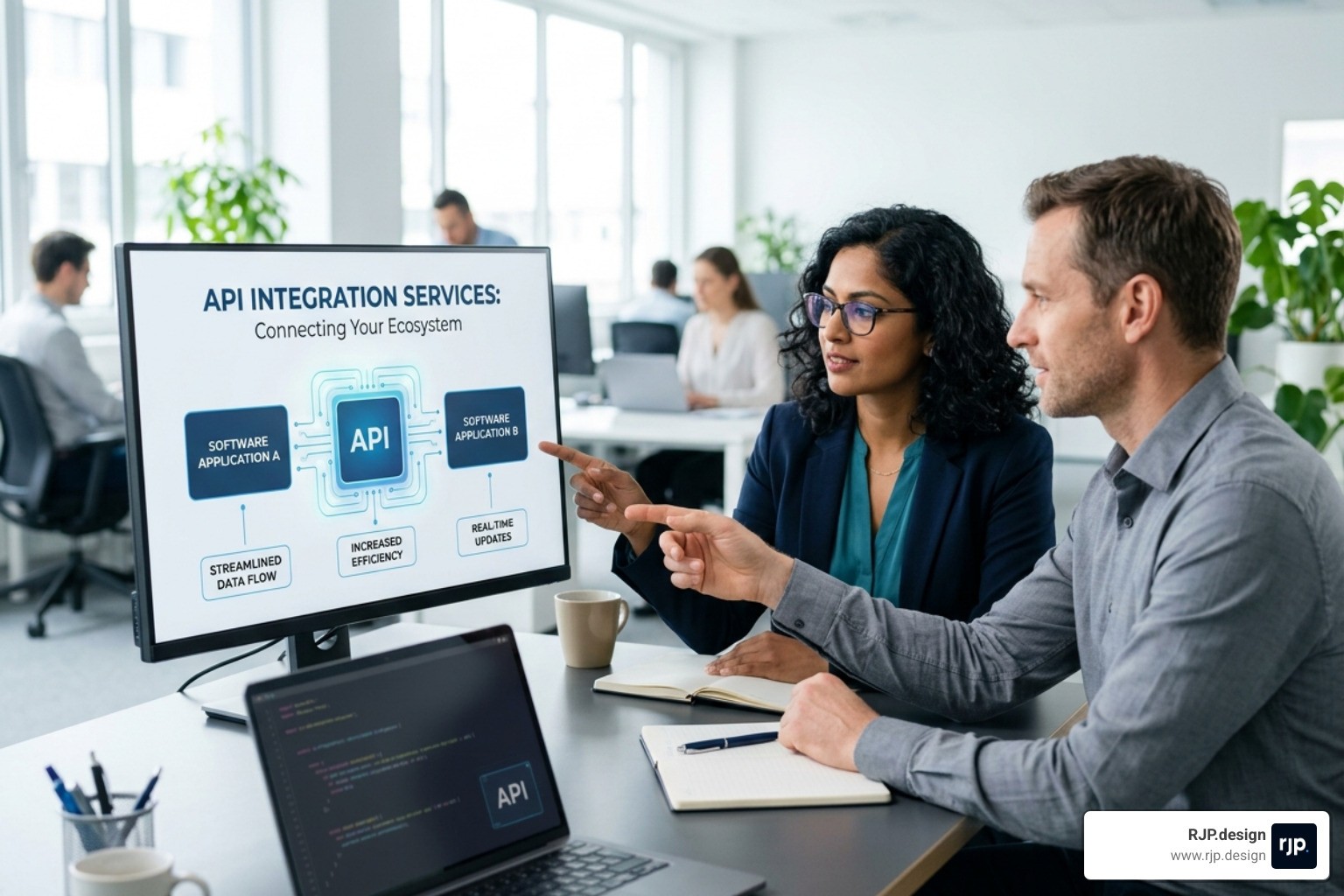
When we talk about modern API integration services, we aren't just talking about plugging one app into another. We are talking about building a robust digital nervous system for your business. In 2026, the technical landscape has evolved to include a variety of protocols and architectural styles that allow even the most stubborn legacy systems to communicate with cutting-edge cloud apps.
Modern services typically cover several core areas:
Custom API Development: When a "ready-made" connector doesn't exist, we build custom endpoints tailored to your specific data structure.
Third-Party Integrations: Connecting your internal systems to giants like Salesforce, NetSuite, or Shopify using their existing APIs.
Middleware Solutions: Using platforms like The APIANT Platform | Builder's Integration Platform to create deep automation flows that handle complex business logic, not just simple field syncing.
Protocol Translation: Bridging the gap between older systems (SOAP) and modern web standards (REST, GraphQL, or gRPC).
Why Your Business Needs API Integration Services Now
If you feel like your team is drowning in "busy work," you aren't alone. Statistics show that 80% of companies are planning to increase their investment in automation solutions this year. But how do you know if you've reached the tipping point where API integration services become a necessity rather than a luxury?
Watch for these "red flag" signs in your daily operations:
The Manual Entry Trap: Your staff spends hours every week moving data from your website forms into your CRM or from your sales platform into your accounting software.
Data Silos: Your marketing team sees one set of numbers, while your sales team sees another. This lack of a "single source of truth" leads to bad decision-making.
The Scaling Wall: You want to expand, but your current manual processes can't handle a 20% increase in order volume without hiring three more people.
Customer Frustration: Customers call support only to find the agent has no record of their recent purchase or address change because the systems haven't updated.
Currently, 71% of professionals are leveraging third-party APIs to solve these issues. If you aren't one of them, you're likely working twice as hard for the same results as your competitors.
Key Benefits: Automation, Cost Savings, and Customer Experience
The ROI of professional integration is massive. Organizations that effectively implement API-driven automation are twice as likely to outperform their competitors in revenue growth.
Massive Time Savings: API integration platforms allow teams to save between 80 and 100 hours per week. Imagine what your team could accomplish with two extra full-time employees' worth of time back in their schedule.
Operational Cost Reduction: By automating workflows, companies report a 30-50% reduction in operational costs. You're eliminating the "human error" tax that comes with manual data entry.
Elevated Customer Experience: In 2026, 80% of customers say the experience a company provides is just as important as its products. When your systems are integrated, your customer service is instant, personalized, and accurate.
Real-Time Data Sync: No more waiting for "end-of-day" reports. With real-time synchronization, you can see your inventory, cash flow, and lead volume the second it changes.
Navigating Protocols: REST, SOAP, and GraphQL
Choosing the right protocol is like choosing the right language for a conversation. While most modern web APIs use REST (Representational State Transfer) because it is lightweight and uses standard HTTP and JSON, it isn't the only player in the game.
REST: The "gold standard" for web APIs. It's flexible, easy to scale, and works with almost any programming language.
SOAP: Still very common in healthcare, finance, and government systems. It's more rigid and secure, often used where strict compliance is non-negotiable.
GraphQL: A newer favorite that allows developers to request exactly the data they need and nothing more, making it incredibly efficient for mobile apps.
gRPC: Used for high-performance, real-time communication between microservices.
Platforms like APIANT | The Integration Platform Builders Own excel because they can normalize all these different formats—JSON, XML, CSV, and SOAP—into a single model. This allows your business to scale without hitting the "scaling ceilings" that plague format-specific tools.
Feature | REST | SOAP | GraphQL |
|---|---|---|---|
Data Format | JSON, XML, HTML | XML Only | JSON |
Flexibility | High | Low (Strict) | Very High |
Performance | Good | Moderate | Excellent (No Over-fetching) |
Best For | General Web Apps | Enterprise/Financial | Mobile/Complex Data |
Strategic Implementation and Choosing Your Partner
Implementing API integration services is a strategic move, not just a technical one. You need a partner who understands your business goals, not just someone who can write code. As we move further into 2026, the focus has shifted toward "Deep Integrations"—systems that don't just move data but actually understand your business logic.
Security and compliance are the cornerstones of this process. With 70% of financial service providers now implementing advanced API security, your partner must be well-versed in SOC-2, GDPR, and HIPAA compliance. This is especially true as the hybrid unification market is projected to surge to $103.3 billion by 2035.

Common Use Cases for API Integration Services
What does this look like in the real world? Here are the most common ways we see businesses using these services to leapfrog their competition:
ERP & CRM Sync: Automatically updating customer records, sales orders, and invoices between systems like Salesforce and NetSuite.
eCommerce & Inventory: When an order is placed on your Shopify store, your warehouse management system (WMS) is notified instantly, and your inventory levels are updated across all sales channels.
Payment Processing: Connecting Stripe or PayPal to your accounting software so every transaction is logged and reconciled without human intervention.
Marketing Automation: Feeding leads from your website directly into your CRM and triggering personalized email sequences based on user behavior.
IoT & Real-Time Streams: Managing high-frequency data from connected devices (like sensors or trackers) and translating that into actionable business data.
Security, Compliance, and Legacy System Support
One of the biggest hurdles to modernizing is the "Legacy System." Many businesses rely on older software that doesn't have a modern API. This is where professional API integration services shine. We use custom middleware to bridge the gap, allowing your old "on-prem" server to talk to your new cloud-based AI tools.
However, data complexity remains a major barrier—95% of IT leaders identify it as a significant hurdle to AI adoption. To overcome this, we implement:
Multi-Factor Authentication (MFA): Ensuring only authorized systems and users can access your data.
OAuth 2.0: The industry standard for secure authorization.
Identity Management: Managing who has access to what data across your entire integrated ecosystem.
Protocol Translation: Making sure your legacy SOAP systems can understand modern JSON requests.
Comparing In-House Management vs. Professional Platforms
Many companies wonder if they should just have their internal IT team build and manage these connections. While that's an option, it often leads to "Technical Debt." In-house teams often struggle with maintenance as APIs from third parties (like Google or Facebook) change frequently.
Professional platforms and services offer several advantages:
Scalability: Professional platforms are built to handle hundreds of locations or millions of requests without breaking.
Lower Maintenance: The service provider handles API updates and deprecations, so your integrations don't just stop working one day.
Uptime SLAs: Services like Microsoft Azure Logic Apps offer a 99.9% uptime guarantee, something hard to achieve with a "homegrown" solution.
Low-Code Efficiency: 84% of enterprises are now adopting low-code tools to relieve pressure on their IT resources, allowing for faster deployment.
At RJP.design, we focus on high-quality service and a down-to-earth approach. We don't just build a bridge; we make sure the bridge is leading your business where it needs to go. Whether you need to connect a legacy database to a modern web interface or sync complex eCommerce data across multiple platforms, we ensure the process is seamless.
For more information on how we can help you build a cohesive digital presence, check out our More info about web design and development services.
Final Thoughts on Scaling with APIs
In 2026, your business is only as fast as its slowest manual process. By leveraging professional API integration services, you aren't just "fixing a tech problem"—you are unlocking a new level of operational excellence. You're giving your team back their time, giving your customers a better experience, and giving your business the foundation it needs to grow without limits.
Ready to stop copy-pasting and start growing? Let's connect your systems and see what your business is truly capable of.