SEO
The Ultimate Guide to Digital Marketing and SEO Services
Apr 28, 2025
Understanding Digital Marketing and SEO Services: A Comparison Guide
Let’s face it – navigating digital marketing and SEO services can feel like trying to read a map in a foreign language. I’m here to make it simple for you with a friendly breakdown of what’s what.
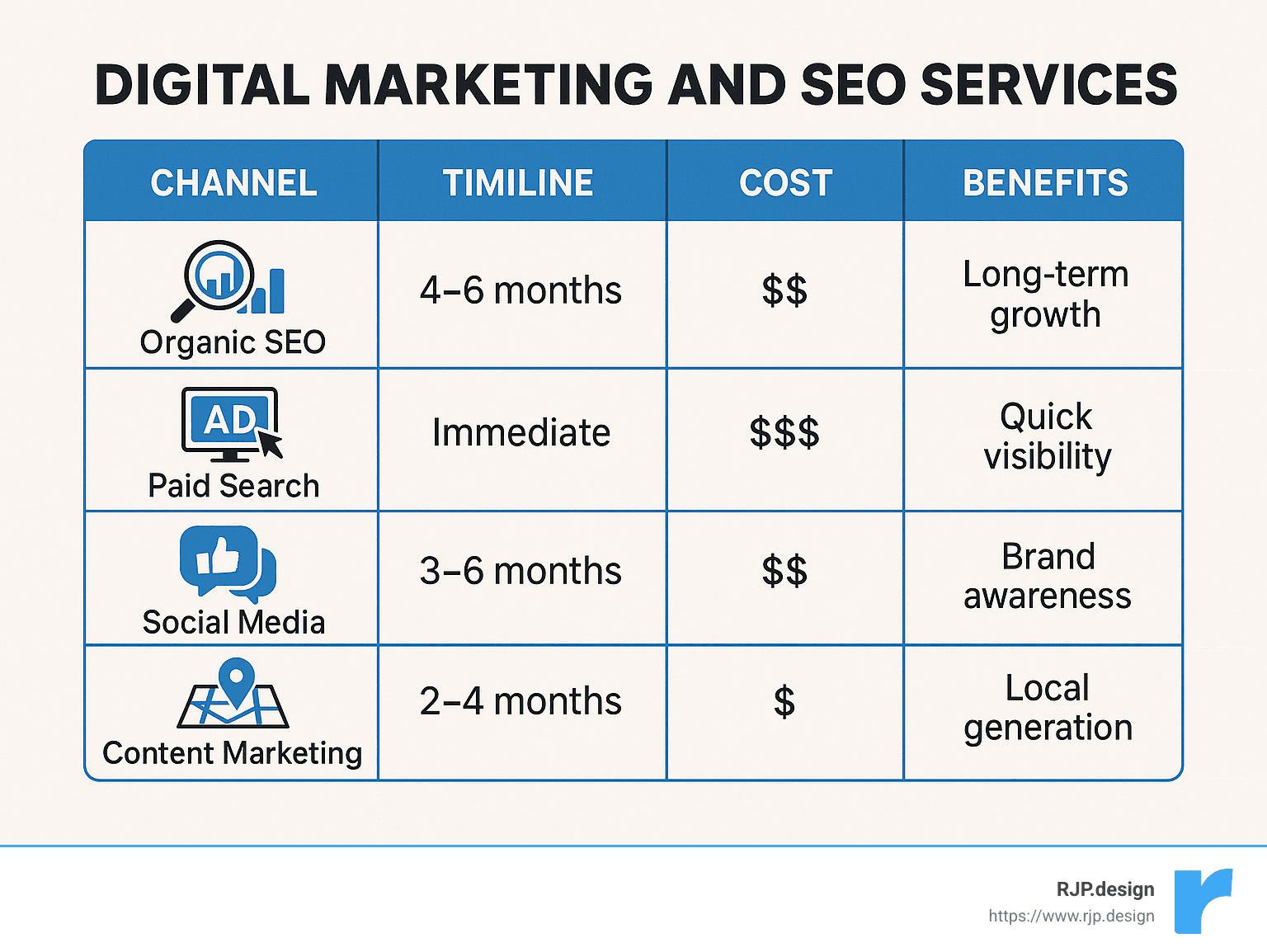
When considering your options, here’s a helpful comparison of the main services you might explore:
Service Type | Best For | Typical ROI Timeline | Investment Level |
|---|---|---|---|
SEO Services | Long-term organic growth | 4-6 months | $1,500-$5,000/month |
PPC/Paid Ads | Immediate traffic needs | Immediate results | Pay per click/conversion |
Social Media Marketing | Brand awareness & engagement | 3-6 months | $1,000-$3,000/month |
Local SEO | Brick-and-mortar businesses | 2-4 months | $500-$2,000/month |
Technical SEO | Fixing site issues | 1-3 months | $1,000-$5,000 one-time |
The digital revolution has completely transformed how we connect with customers. Remember the days of Yellow Pages and newspaper ads? While those still exist, digital marketing and SEO services now offer something those traditional methods never could – precision targeting and measurable results.
With over 5 billion internet users scrolling, searching, and shopping online (and Google processing a mind-boggling 4.4 billion searches daily), your digital presence isn’t just nice to have – it’s your business lifeline.
I’ve heard countless business owners share the same frustration: “I have a website, but nobody finds it!” or “I’m spending money on ads, but I can’t tell if they’re working.” Sound familiar? One business owner recently told me, “Standing out online is no easy feat. I spent thousands on random marketing acts before finding a partner who actually delivered results.”
The good news? When you find the right approach, the results can be transformative. Businesses working with professional SEO agencies typically see their organic traffic double and qualified leads increase up to five times when implementing comprehensive strategies. The secret isn’t mysterious – it’s about finding a partner who creates a custom strategy rather than applying cookie-cutter solutions.
Hi there – I’m Ross Plumer, and I’ve helped businesses generate over $20 million through strategic digital marketing and SEO services. What makes my approach different is combining hard data with human psychology – because effective marketing isn’t just about algorithms, it’s about connecting with real people.
If you’re exploring digital marketing and SEO services, you might come across terms like ppc advertising solution, web marketing solution, or internet marketing consulting company. Don’t let the jargon intimidate you – at their core, these are all tools to help your business grow online.
Why This Guide Matters
In today’s digital landscape, having a great product or service is only half the battle. Getting found by the right people at the right time is what separates thriving businesses from struggling ones. The numbers tell the story: the global digital advertising market, valued at $350 billion in 2020, is rocketing toward $786.2 billion by 2026. Businesses that aren’t adapting to this digital reality are increasingly being left behind.
What excites me most about digital marketing and SEO services is the remarkable return on investment they can deliver. I love hearing success stories like this one from a business owner: “Since I began following the advice provided in my website audit, my monthly website traffic from Google has grown by 855%.” These aren’t rare exceptions – they’re what happens when digital marketing is done right.
The magic happens when your online presence perfectly aligns with what your customers are looking for. When someone searches for exactly what you offer and finds your business at exactly the right moment, conversion rates don’t just improve – they soar. This guide will help you understand how to create that perfect alignment and get the most value from your marketing investment.
Digital Marketing and SEO Services 101
Before diving deeper, let’s establish what we mean by digital marketing and SEO services and how they differ from traditional marketing approaches. If you’d like an in-depth, third-party perspective on the basics of search, the team at Search Engine Land offers an excellent primer in their What Is SEO? guide.
Digital marketing is like having multiple doorways to your business—it includes everything from search engine optimization (SEO) and pay-per-click advertising (PPC) to social media marketing, content creation, email campaigns, and more. Think of these channels as team members working together to guide your potential customers through their journey from awareness to purchase.
SEO specifically is about making your website more attractive to search engines like Google. As one seasoned marketer once told me, “There’s no shortcut to game Google’s valuation system.” It’s a marathon, not a sprint, requiring consistent effort across technical setup, on-page content, and off-page factors.
Today’s buyer journey looks nothing like it did even a decade ago. A typical customer might find your brand through an Instagram post, Google your company name to learn more, read reviews on third-party sites, visit your website several times, join your email list, and finally make a purchase after seeing a remarketing ad while browsing news articles. This complex path means businesses need to maintain a consistent voice across all platforms while tailoring their approach to each channel’s unique strengths.
Google constantly evolves its algorithms, with recent updates like Core Web Vitals emphasizing user experience factors such as how quickly your pages load, how responsive they are to interactions, and how visually stable they appear. Google also places increasing importance on E-A-T (Expertise, Authoritativeness, and Trustworthiness), especially for websites in fields that could impact someone’s health, finances, or wellbeing.
How Digital Differs From Traditional Marketing
Traditional marketing is like casting a wide net—think billboards, magazine ads, and TV commercials. Digital marketing, by contrast, is more like fishing with precision lures designed for specific fish.
With digital approaches, you can target users based on incredibly specific criteria. Want to reach 35-45 year-old small business owners in Chicago who are interested in productivity tools and have visited your website in the last 30 days? Digital makes that possible. As one of our agency partners explains: “PPC options now include text ads, remarketing, Gmail Ads, pre-roll video, and more with hyper-targeting capabilities.”
Digital also gives you something traditional marketing rarely can—clear attribution data. You’ll know exactly who saw your message, how they interacted with it, and whether they eventually became a customer. This allows for much more accurate ROI calculation and helps you understand which parts of your strategy are actually working.
Perhaps the most exciting aspect of digital marketing is its flexibility. Campaigns can be adjusted in real-time based on performance, allowing you to amplify what’s working and fix what isn’t. And unlike traditional media where only the biggest budgets win, digital channels offer opportunities for businesses of all sizes to compete effectively.
At RJP.design, we’ve seen how businesses transform when they shift from traditional to digital approaches. One client recently told us: “Our website has become a powerful source of leads for our consulting services after implementing a comprehensive digital strategy.”
SEO: The Engine of Digital Growth
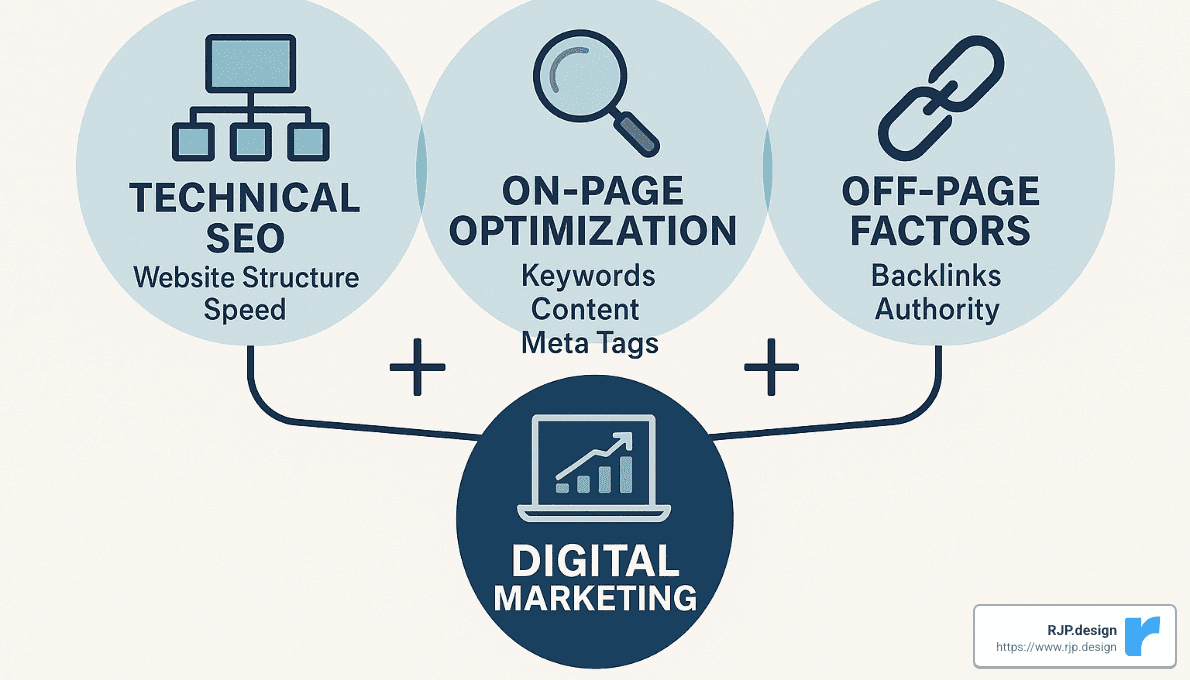
SEO forms the foundation of effective digital marketing because it connects your business with people actively searching for what you offer. Think of it as three main phases:
First, search engines like Google send out digital scouts (called crawlers) to find and scan web pages across the internet. Next, they analyze and store this content in a massive database (indexing). Finally, when someone searches, the engine determines which pages to show and in what order (ranking).
When we provide digital marketing and SEO services at RJP.design, we focus on three core areas:
On-page SEO is about making each page of your website as relevant and valuable as possible. This includes thoughtfully placing keywords in titles and headings, creating genuinely helpful content that answers people’s questions, writing compelling meta descriptions, and building a logical internal linking structure that helps visitors steer your site.
Off-page SEO builds your site’s credibility and authority. Think of it as your website’s reputation in the digital world. This includes earning quality backlinks from respected websites, managing online reviews, building brand mentions across the web, and establishing a strong social media presence.
Technical SEO ensures your website works smoothly for both users and search engines. This includes improving loading speed (because nobody likes waiting), ensuring your site looks great on mobile devices, implementing proper schema markup (special code that helps search engines understand your content better), and fixing technical issues that might prevent Google from properly indexing your pages.
Understanding user intent—what people are really looking for when they type a query—has become increasingly important. As one of our SEO specialists puts it: “We don’t believe in rinse and repeat. Each business requires a custom approach based on their unique goals and audience.”
At RJP.design, we’ve found that businesses who invest in understanding their customers’ search behavior and align their content accordingly see dramatically better results than those who simply chase keywords without considering the humans behind the searches.
Service Spectrum: Comparing Digital Marketing and SEO Services
When evaluating digital marketing and SEO services, it’s crucial to understand the full spectrum of offerings and how they might benefit your specific business. Let’s explore the main service categories and how they compare.
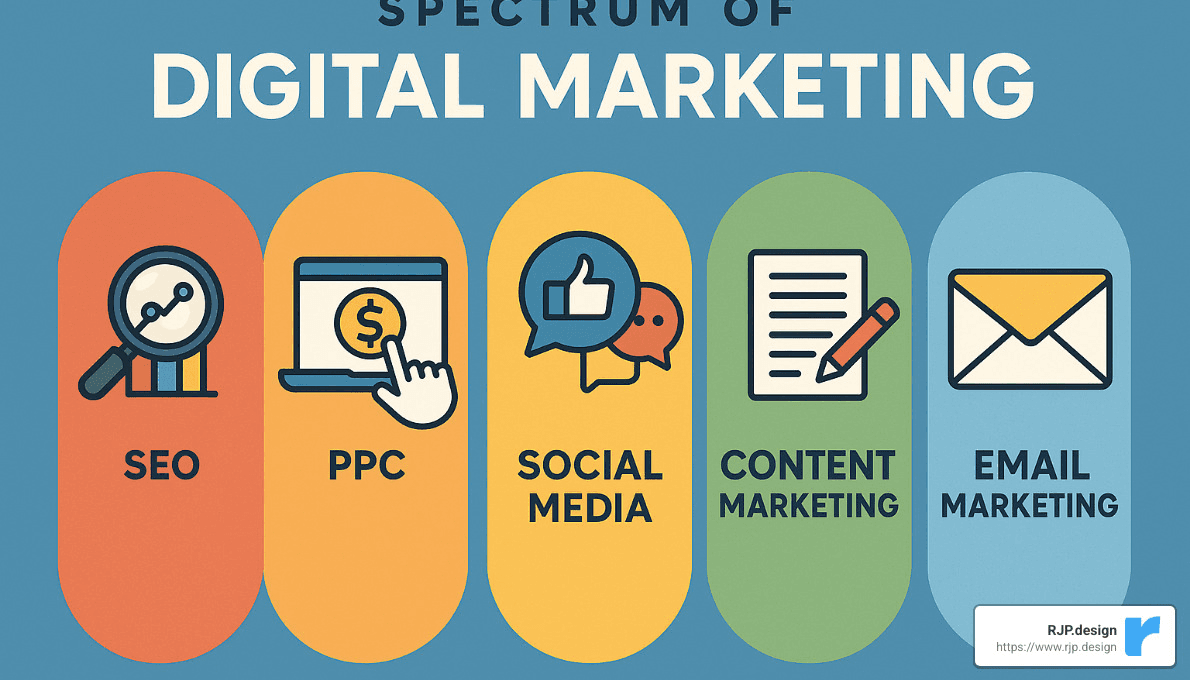
Local, National & eCommerce Digital Marketing and SEO Services
Local SEO is essential for businesses serving specific geographic areas. According to industry data, 46% of all Google searches have local intent, and 88% of consumers who conduct a local search on their smartphone visit a related store within a week.
Local SEO services typically include:
– Google Business Profile optimization
– NAP (Name, Address, Phone) consistency across 70+ online directories
– Local keyword targeting
– Review management and response strategies
– Local link building
As one client success story demonstrates: “After implementing a local SEO strategy, our HVAC service company experienced a 763% increase in qualified leads and 349% more keywords ranked in the top five positions.”
National SEO targets broader audiences across an entire country. This approach requires:
– Competitive keyword analysis balancing short and long-tail phrases
– Content strategies addressing various user intents
– More extensive link building campaigns
– Brand authority development
eCommerce SEO is specifically designed for online stores. One agency notes: “eCommerce SEO is a favorite for our team due to its huge keyword opportunity. Each product can yield multiple keyword targets, allowing thousands of potential entry points.”
An eCommerce client with 2,000 products could potentially target 4,000–6,000 keyword phrases. This approach includes:
– Product page optimization
– Category page structuring
– Review integration
– Schema markup for products
– Shopping feed optimization
At RJP.design, we’ve helped eCommerce clients achieve remarkable results through targeted digital marketing and SEO services. One client saw a 239% increase in organic revenue and a 78% boost in conversion rate within just one year.
Technical, Content & Link-Building Services Explained
Technical SEO services focus on your website’s foundation. These include:
Site speed optimization: Reducing load times through image compression, browser caching, and code minification. Google’s Core Web Vitals metrics (Largest Contentful Paint, First Input Delay, and Cumulative Layout Shift) are now key ranking factors.
Mobile optimization: Ensuring your site performs flawlessly on all devices. With mobile users spending an average of 3.5 hours per day on their devices, this is non-negotiable.
Site architecture: Creating a logical structure that helps both users and search engines steer your content efficiently.
Schema implementation: Adding structured data markup to help search engines understand your content and potentially earn rich snippets in search results.
Content services develop the material that attracts and engages your audience:
Content strategy: Planning what content to create based on keyword research, competitive analysis, and user intent.
Content creation: Producing high-quality blog posts, service pages, case studies, and other materials that demonstrate expertise.
Content optimization: Enhancing existing content to better target keywords and address user needs.
One client shared: “Their effective communication and quick turnaround times on content creation make them a dependable partner. The content they produce consistently ranks well and drives qualified traffic.”
Link building services help establish your site’s authority:
Outreach campaigns: Contacting relevant websites to earn backlinks.
Digital PR: Creating newsworthy content that attracts natural links.
Guest posting: Contributing valuable content to industry publications.
Broken link building: Finding broken links on other sites and suggesting your content as a replacement.
As one agency explains: “We use Google-approved link-building techniques to earn credible backlinks rather than risky tactics that could result in penalties.”
Beyond SEO: PPC, Social Media & Email
While SEO forms the foundation of digital marketing, other channels play crucial complementary roles:
Paid search (PPC) delivers immediate visibility through:
– Keyword-targeted ad campaigns
– Remarketing to previous website visitors
– Shopping ads for eCommerce businesses
– Location-based targeting for local businesses
One agency notes: “What is the best strategy for your business? Leverage PPC experts to target by keyword, location, demographics and remarketing with Google Premier Partner support.”
Social media marketing builds community and awareness through:
– Platform-specific content strategies
– Community engagement
– Paid social advertising
– Influencer partnerships
With U.S. social media users expected to reach 257.4 million by 2023, these platforms offer unprecedented access to targeted audiences.
Email marketing nurtures leads and maintains customer relationships through:
– Automated drip campaigns
– Personalized messaging
– Segmented audience targeting
– Abandoned cart recovery (for eCommerce)
The most effective digital marketing and SEO services integrate these channels to create a cohesive strategy. For example, SEO identifies high-converting keywords that can inform PPC campaigns, while social media builds brand awareness that supports organic search performance.
From Audit to Optimization: Building & Integrating a Successful SEO Strategy
Building an effective SEO strategy isn’t about random tactics or quick fixes—it’s about following a thoughtful, step-by-step approach that delivers lasting results. At RJP.design, we’ve refined our process over years of helping businesses just like yours achieve meaningful growth.
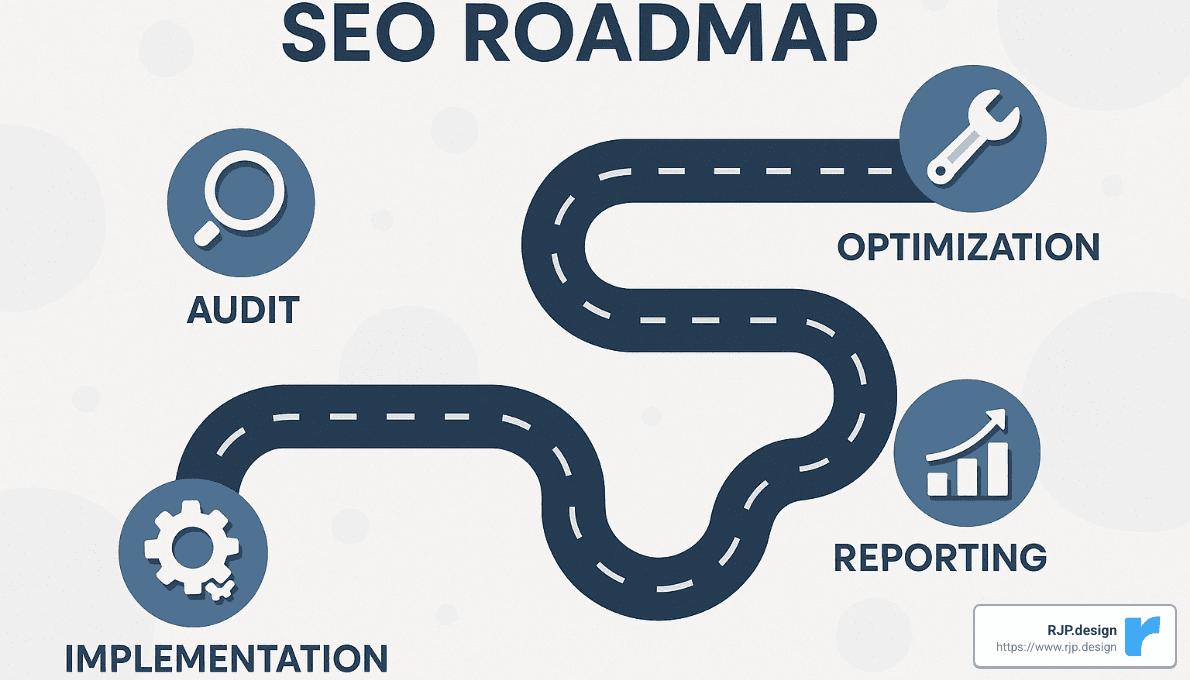
Step 1 – Comprehensive SEO Audit
Think of an SEO audit as your digital health checkup—it reveals what’s working, what’s broken, and where your biggest opportunities lie. Without this critical first step, you’re essentially navigating in the dark.
When we conduct an audit for our clients, we leave no stone unturned. We examine your site’s technical foundation by identifying crawl errors, assessing site speed, and testing mobile-friendliness. One client was shocked to find their beautiful new website was taking over 8 seconds to load on mobile devices—a major reason their traffic had been declining.
We also dive into your on-page elements, reviewing everything from title tags to content quality. As one client put it: “I had no idea my product descriptions were actually hurting my rankings until RJP pointed it out in our audit.”
The off-page examination looks at your backlink profile and how you stack up against competitors. We often find businesses with either too few quality links or—sometimes worse—toxic links that are actually dragging down their rankings.
Finally, we assess the user experience through navigation testing and conversion path analysis. After all, what good is traffic if visitors can’t easily find what they’re looking for?
“The audit was eye-opening,” shared one small business owner. “Instead of guessing what might help our website, we had a clear roadmap of exactly what needed fixing and why.”
Step 2 – Strategy & Implementation
With your audit insights in hand, we craft a custom strategy that addresses your specific challenges and opportunities. This isn’t a cookie-cutter approach—it’s a custom plan built around your business goals.
We start by setting SMART goals that give your digital marketing and SEO services clear direction. Rather than vague objectives like “rank better,” we establish specific targets: “Increase organic traffic to service pages by 40% within six months” or “Improve conversion rate from organic visitors by 15% this quarter.”
Next comes the fun part—putting the plan into action! Our implementation typically includes fixing technical issues that are holding your site back, developing fresh content that speaks directly to your audience’s needs, and building your site’s authority through ethical link building practices.
One restaurant owner shared: “What I appreciated most was how they explained each implementation step in plain English. They fixed our broken local citations, updated our Google Business Profile, and created neighborhood-specific landing pages—all while keeping me in the loop without drowning me in jargon.”
We often work in sprints, tackling the highest-impact items first so you see meaningful progress early on. This approach also allows us to be nimble, adjusting our tactics based on what’s working best for your specific situation.
Step 3 – Reporting, Optimization & Channel Integration
SEO isn’t a “set it and forget it” endeavor—it requires ongoing attention, analysis, and refinement. This is where many digital marketing and SEO services fall short, but it’s where we shine.
We provide clear, jargon-free reporting that shows exactly how your key metrics are trending. No meaningless vanity metrics or confusing data dumps—just straightforward insights into what matters most for your business growth.
But we don’t just report numbers; we actively optimize based on performance data. Maybe your service page is ranking well but not converting visitors—we’ll test different layouts, calls-to-action, or content approaches to improve results. Or perhaps a blog post is outperforming expectations—we’ll analyze why and apply those lessons elsewhere.
The magic really happens when we integrate SEO with your other marketing channels. Your SEO and PPC efforts can work together for maximum search visibility. Your social media can amplify your content and build valuable backlinks. Your email marketing can bring organic visitors back to your site for deeper engagement.
As one retail client told us: “What impressed me most was how they connected our SEO work with our Facebook advertising. The team found that customers who finded us through organic search and then saw our retargeting ads were 3x more likely to make a purchase.”
This holistic approach to digital marketing and SEO services ensures every dollar you invest works harder and smarter. And because we’re tracking everything, you’ll always know exactly what’s working and why.
SEO success doesn’t happen overnight, but with the right partner guiding you through this proven process, you’ll build sustainable growth that your competitors will envy. As we like to say at RJP.design, good SEO doesn’t just bring traffic—it brings the right people to your digital doorstep.
Measuring Success, Navigating Challenges & Future Trends
Effective digital marketing and SEO services aren’t just about implementing strategies—they’re about measuring what works, solving problems when they arise, and staying ahead of what’s coming next. Think of it as tending a garden: you plant the seeds, but you also need to track growth, remove weeds, and adapt to changing seasons.
Key Metrics & ROI Calculation
When measuring SEO success, looking solely at rankings is like judging a book by its cover—you’ll miss the full story. A complete measurement approach considers multiple chapters:
Your traffic metrics tell you who’s visiting and how they found you. This includes the volume of organic visitors, how engaged they are (bounce rates and time on site), whether they’re first-time or returning visitors, and what devices they’re using. We’ve had clients surprised to find that 70% of their traffic came from mobile devices—information that completely changed their design priorities.
The engagement metrics reveal what happens once visitors arrive. Are they scrolling through your entire page or bouncing after a few seconds? Are they watching your videos, downloading resources, or sharing your content? One of our clients finded their 3,000-word guide was being read completely by over 60% of visitors—a sign they were hitting the mark on quality.
Perhaps most importantly, conversion metrics show whether your traffic is translating to business results. This means tracking conversion rates, lead quality, cost per acquisition, and ultimately, customer lifetime value.
Calculating ROI for SEO follows a simple formula: (Revenue from Organic Search – Cost of SEO) / Cost of SEO. But there’s more to the story. Unlike paid ads that stop working the moment you stop paying, SEO builds lasting assets that continue delivering returns. As one thrilled business owner told us: “Our practice has more than doubled revenue in six months thanks to our digital marketing partner. The investment keeps paying off month after month.”
At RJP.design, we believe in transparency. Our reporting dashboards connect every SEO action directly to your business outcomes, so you always know exactly what you’re getting for your investment—no smoke and mirrors here.
Common SEO Roadblocks & How to Overcome Them
Even the smoothest SEO journey hits bumps in the road. Here are the roadblocks we encounter most often and how we steer around them:
Duplicate content issues can dilute your ranking potential when similar content appears across multiple pages. We solve this by implementing canonical tags that tell search engines which version to prioritize, consolidating similar pages, or creating unique content for each page.
Slow page speed frustrates both users and search engines. We’ve seen conversion rates increase by 27% after implementing speed optimizations like image compression, browser caching, code minimization, and content delivery networks. One client’s page load time dropped from 6.2 seconds to 1.8 seconds—turning impatient bounces into engaged visitors.
Thin content rarely ranks well, no matter how optimized it might be. The solution isn’t complicated, but it does require effort: expand your content with genuinely valuable information that thoroughly addresses user intent. Quality always trumps quantity.
When toxic backlinks threaten your site’s reputation, we don’t panic—we take action. We disavow harmful links and focus on earning high-quality backlinks through valuable content. One client came to us with a manual penalty; after cleaning up their link profile, their traffic increased by 215% within three months.
Algorithm updates can feel like the ground shifting beneath your feet. Our approach is simple: focus on providing genuine value rather than trying to outsmart the system. Sites built on solid value rarely suffer long-term damage from updates.
Website migration issues often lead to traffic drops when not handled properly. We implement proper 301 redirects, maintain URL structure where possible, and monitor crawl stats closely post-migration. When done right, migrations can actually improve performance—we helped one client gain 32% more traffic after moving to a new platform.
As one of our experienced SEO specialists likes to say: “Your website might look perfectly fine to human eyes, but search engines might be seeing a house of horrors. Our job is to turn on the lights and clean up the scary stuff.”
The Future of Digital Marketing and SEO Services
The landscape of digital marketing and SEO services is evolving faster than ever. Here’s what we’re watching closely:
AI and machine learning are changing how we approach digital marketing. From AI-powered content assistants to predictive analytics that anticipate user behavior, these technologies are becoming essential tools in our kit. We’re not replacing human creativity—we’re amplifying it.
Search Generative Experience (SGE) is changing how search results appear. Google now generates direct answers for many queries, making “position zero” opportunities more valuable than traditional rankings. We’re helping clients optimize for featured snippets and knowledge panels to stay visible in this new environment.
Voice search optimization continues to grow in importance as more households adopt smart speakers and voice assistants. This means creating more conversational content, answering questions directly, and ensuring your local SEO is impeccable for “near me” queries.
Zero-click searches—where users get their answer directly from the search results page without visiting a website—now account for over 50% of all searches. We’re responding by optimizing for Google’s Knowledge Graph and implementing structured data to improve how your information appears in these improved results.
Predictive crawling technology is giving us unprecedented insights into how search engines will interpret websites before problems affect rankings. It’s like having a crystal ball for SEO issues.
As one forward-thinking agency puts it: “The future of search is here! Don’t get left behind.” At RJP.design, we’re not just keeping pace with these changes—we’re helping our clients leverage them for competitive advantage. We blend cutting-edge innovation with time-tested fundamentals, ensuring your digital marketing strategy remains both progressive and practical.
The businesses that thrive tomorrow will be those embracing these changes today—with a partner who understands not just where search is going, but how to get you there.
Choosing the Right Partner & FAQs
Selecting the right provider for digital marketing and SEO services is perhaps the most crucial decision in your digital marketing journey. The right partner can accelerate your growth, while the wrong one can waste valuable time and resources.
How to Evaluate an Agency
When you’re looking for a digital marketing partner, transparency should be at the top of your checklist. Does the agency clearly explain their approach? Can they show you how they’ll achieve your specific goals? A good partner will happily walk you through their methodology without hiding behind industry jargon.
One of our clients put it perfectly: “They have skillfully mastered the art of keeping clients informed, making complex SEO projects accessible and understandable.” This kind of open communication builds trust from day one.
Results matter, too. Ask for case studies relevant to your industry and don’t hesitate to request references from current clients. Long-term client relationships are often the best indicator of an agency’s quality – after all, businesses don’t stick around if they’re not seeing results!
Technical expertise is non-negotiable in this field. Ask about team certifications and how they stay current with Google’s ever-changing algorithms. If you’re in a specialized industry, make sure they have relevant experience there too.
Communication style can make or break your agency relationship. Find out who your main point of contact will be, how often you’ll receive reports, and their typical response time for questions. You’re building a partnership, not just buying a service.
When it comes to pricing, be wary of agencies that lock you into lengthy contracts. As one agency we admire notes: “We don’t lock clients into long-term contracts because we’re confident in our results.” That kind of confidence speaks volumes.
At RJP.design, we believe in complete transparency about our processes, setting realistic expectations, and maintaining open dialogue throughout our partnership. We want you to understand exactly what we’re doing and why it matters for your business.
DIY vs Professional: Which Makes Sense?
The DIY approach to SEO is tempting – why pay someone else when you could learn it yourself? But before you dive in, consider what you’re signing up for.
SEO demands significant time. You’ll need hours for keyword research, content creation, technical optimizations, and monitoring results. Plus, Google changes its algorithm hundreds of times each year – keeping up is practically a full-time job itself.
The expertise required spans multiple disciplines. You’ll need technical skills to fix site issues, content abilities to create compelling pages, and strategic thinking to outmaneuver competitors. Professional agencies have teams covering all these areas.
Perhaps most importantly, consider the opportunity cost. Every hour spent learning SEO basics is an hour not spent on your core business. As one expert explains: “Can I do SEO myself? Yes, but it requires a learning curve, trial and error, and ongoing effort to manage both technical and on-page aspects while keeping up with algorithm changes.”
For most businesses, a hybrid approach makes the most sense: understand enough SEO to have intelligent conversations with professionals, but partner with experts for implementation and advanced strategy. This gives you the best of both worlds – knowledge and results without the overwhelming time commitment.
Frequently Asked Questions about Digital Marketing and SEO Services
How long before I see results?
If there’s one thing I wish every client understood about SEO, it’s that it’s a marathon, not a sprint. When you partner with us at RJP.design, we’ll be straight with you: meaningful results take time.
Technical improvements often show impact relatively quickly, sometimes within 1-3 months. Content optimization typically yields noticeable changes in 3-6 months. Link building – one of the most powerful but slowest-moving aspects – often takes 6-12 months to significantly impact rankings.
Why so long? Google is deliberately cautious about ranking changes to prevent manipulation. As one agency explains: “Results typically begin to appear in four to six months, though time to goal achievement varies by campaign scope and competition.”
Your timeline will depend on several factors: your website’s current authority, how fierce the competition is in your industry, how much work your site needs, and how quickly you can implement changes. We focus on achieving quick wins early while building toward sustainable long-term growth.
What budget should I allocate?
Budget requirements vary widely based on your specific situation. A local coffee shop has very different needs than a national healthcare provider.
Industry standards suggest that small businesses typically invest $1,000-$3,000 monthly in digital marketing and SEO services. Mid-sized companies often spend $3,000-$10,000 monthly, while enterprise-level programs can exceed $10,000 monthly.
One agency notes: “Typically businesses invest $1500 to $5000 per month; consulting may be $100 to $300 per hour.”
Rather than focusing solely on cost, I encourage clients to think about return on investment. A $5,000 monthly investment that generates $25,000 in new business is far better than a $1,000 investment that produces minimal results. We’ll help you find the sweet spot for your business where investment and returns align perfectly.
How does SEO integrate with PPC and social media?
The most successful digital strategies don’t treat channels as separate silos – they create a seamless ecosystem where each element strengthens the others.
SEO and PPC make perfect partners. Use paid ads to test keywords before investing in long-term SEO efforts. Dominate search results by appearing in both organic and paid listings. Leverage PPC for immediate visibility while your organic presence builds momentum. The insights you gain from paid campaigns can inform your organic landing pages too.
Social media and SEO complement each other beautifully. Your social channels can amplify your SEO content, reaching audiences who might never find you through search alone. Strong social presence builds brand awareness, which leads to more branded searches (some of the highest-converting traffic you’ll get). Social engagement also provides valuable data about what content resonates with your audience.
A business owner who acceptd this integrated approach shared: “Web traffic is up well over 100% and our marketing qualified leads are more than double what they were before our engagement with integrated digital marketing services.”
At RJP.design, we design comprehensive strategies that create consistent messaging across all channels while maximizing the unique strengths of each platform. The result? A digital presence greater than the sum of its parts.
Conclusion
In today’s digital landscape, effective digital marketing and SEO services are no longer optional—they’re essential for business growth and sustainability. As we’ve explored throughout this guide, a strategic approach that integrates SEO with other digital channels delivers the most powerful results.
At RJP.design, we specialize in creating websites and enhancing online presence for businesses, ensuring they look great and are easily found online. Our down-to-earth team prioritizes client satisfaction and delivers high-quality service custom to your specific needs.
The journey we’ve taken through digital marketing has shown us that success isn’t about random tactics—it’s about strategic alignment with your business goals. When your online presence perfectly matches what your ideal customers are searching for, magic happens. Your website transforms from a digital business card into a powerful lead generation machine.
Continuous improvement is the heartbeat of effective digital marketing. The algorithms change, consumer behaviors shift, and new competitors emerge. Staying ahead requires vigilance and adaptability. As one of our clients recently shared: “What impressed me most was how they adjusted our strategy based on real data, not just hunches.”
Strategic alignment between your business objectives and marketing efforts creates the foundation for sustainable growth. This means understanding which channels work best for your specific audience and allocating resources accordingly. Some businesses thrive with a heavy focus on SEO, while others need a more balanced approach across multiple channels.
The most successful businesses we’ve worked with have acceptd digital marketing not as a separate initiative but as an integral part of their overall business strategy. They understand that digital marketing and SEO services don’t exist in a vacuum—they support and improve every aspect of the customer experience.
As one of our clients put it: “Working with a true digital marketing partner was a fantastic experience. I’m super thrilled with the results!”
Ready to transform your online presence? Learn more about our social media services or contact us today for a consultation. We’ll help you develop a customized strategy that drives real business results through effective digital marketing and SEO services.