
Marketing
Digital Marketing Outsourcing: The Secret to Scaling Your Business
Jul 4, 2025

Digital Marketing Outsourcing: 7 Proven Ways to Massive Growth 2025
Why Digital Marketing Outsourcing is Changing Small Businesses
Digital marketing outsourcing has become the go-to strategy for businesses looking to compete without breaking the bank. Instead of hiring expensive in-house teams, smart companies are partnering with specialized agencies to handle their marketing needs.
Key Benefits of Digital Marketing Outsourcing:
Access to Expertise – Tap into specialized skills in SEO, PPC, content creation, and analytics
Cost Savings – Save up to 70% compared to hiring full-time staff ($490k+ annually for in-house teams)
Scalability – Quickly ramp up or down based on your business needs
Advanced Tools – Access premium marketing software without the hefty price tags
Focus on Core Business – Let experts handle marketing while you focus on what you do best
The numbers don’t lie. 68% of US companies outsource their marketing work, and 63.1% of brands have outsourced to agencies in the past year – up from just 46.2% the year before.
Traditional advertising is dying fast. Newspaper ad spending dropped from $25.2 billion in 2012 to a projected $5.53 billion in 2024. Meanwhile, digital marketing requires expertise in SEO, social media, email automation, data analytics, and constantly changing algorithms.
I’m Ross Plumer, and I’ve helped businesses market over $20 million in revenue through strategic digital marketing initiatives. My experience has shown me that digital marketing outsourcing often delivers better results than expensive in-house teams – when done right.
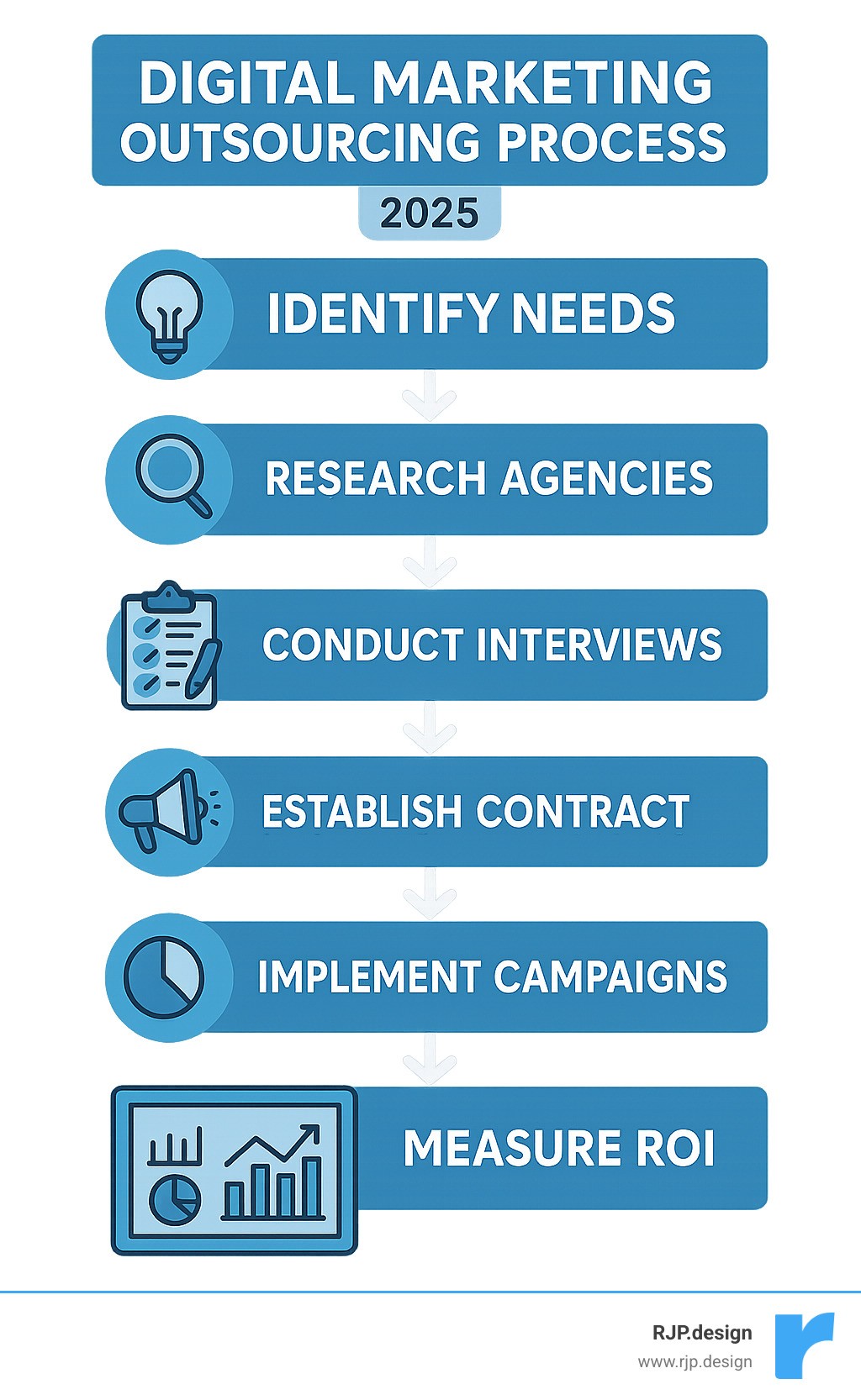
Simple guide to digital marketing outsourcing:
Why Companies Turn to Digital Marketing Outsourcing
The shift toward digital marketing outsourcing isn’t happening by accident. Modern businesses face a growing expertise gap that gets wider every day. Digital marketing now covers everything from SEO and PPC to marketing automation, conversion optimization, and data analytics.
The expertise gap is real and it’s hurting businesses. Google updates its algorithm over 3,000 times per year. Facebook changes its advertising policies monthly. TikTok introduces new features weekly. Unless you’re living and breathing digital marketing, you’re falling behind fast.
Here’s what’s really driving this shift: core business focus. A Deloitte study found that 65% of professionals focus more on their core functions when they outsource other tasks. 68% of US companies outsource their marketing work because it eliminates the learning curve completely.
Main Benefits
Specialized skills on demand means you get access to experts in every area – SEO specialists, PPC managers, content creators, social media strategists, and data analysts.
Cost efficiency that actually works is probably the biggest draw. The average cost of hiring an in-house marketing team in the US is upwards of $490,000 per year. Compare that to outsourcing, which typically costs between $20,000 to $200,000 annually.
24/7 coverage becomes possible when you work with teams across different time zones. Rapid scaling solves a huge problem for growing businesses – you can scale up immediately for launches or cut back during slow periods without layoffs.
Trend adoption happens faster because marketing agencies work with multiple clients across various industries, spotting trends early and implementing new strategies quickly.
Potential Drawbacks & Risks
Loss of control can feel uncomfortable, especially for business owners used to controlling every aspect of their operations. Communication barriers are real when working with external teams across different time zones and cultures.
Data security concerns matter more than ever. You’ll be sharing sensitive business data with external partners, raising concerns about privacy and compliance with regulations like GDPR and CCPA.
Mitigation steps include establishing clear communication protocols, using project management tools for transparency, implementing strict data security agreements and NDAs, and starting with small projects to test the relationship.
Digital Marketing Outsourcing: Core Services & When to Pull the Trigger

The world of digital marketing outsourcing has exploded with options. You can outsource almost any marketing task, from technical work to creative projects.
Search Engine Optimization (SEO) involves technical audits, keyword research, and link building that requires relationships most businesses don’t have. Pay-Per-Click (PPC) management requires constant monitoring – one poorly optimized ad can burn through your budget quickly.
Content creation covers blog posts, website copy, social media content, and video scripts. Social media management includes strategy development, content creation, community management, and paid advertising across multiple platforms.
Email marketing involves list building, automation sequences, and campaign optimization. When done right, it delivers an average ROI of $42 for every $1 spent. Conversion Rate Optimization (CRO) requires A/B testing, landing page optimization, and analytics implementation.
Marketing analytics turns data into actionable insights, while Fractional CMO services provide strategic marketing leadership without the full-time executive salary.
Services You Can Outsource Today
SEO audits and implementation top the list because technical SEO requires specialized knowledge of website architecture and search algorithms. PPC campaign management requires constant attention that most business owners don’t have.
Graphic design was outsourced by 47% of marketing professionals in 2022, making it the most commonly outsourced marketing service. Video production requires expensive equipment and specialized skills, making outsourcing more cost-effective.
Copywriting combines psychology, persuasion, and industry knowledge. CRM setup and automation with platforms like HubSpot requires technical expertise and ongoing optimization.
When Is the Right Time?
Growth stage indicators include revenue plateaus despite increased marketing efforts, expansion into new markets, or competitors consistently outperforming you.
Team overload signals are clear when your marketing team is constantly overwhelmed, projects get delayed, and quality suffers. New product launches create unique pressures requiring quick scaling and expertise in specific channels.
Stagnant ROI is frustrating when current marketing efforts aren’t delivering results and you need fresh perspectives. Seasonal spikes are perfect for outsourcing because they require temporary scaling without permanent hires.
Rebranding or market expansion often requires expertise you don’t have in-house, whether entering new markets or targeting different demographics.
Costs & ROI: Outsource vs In-House
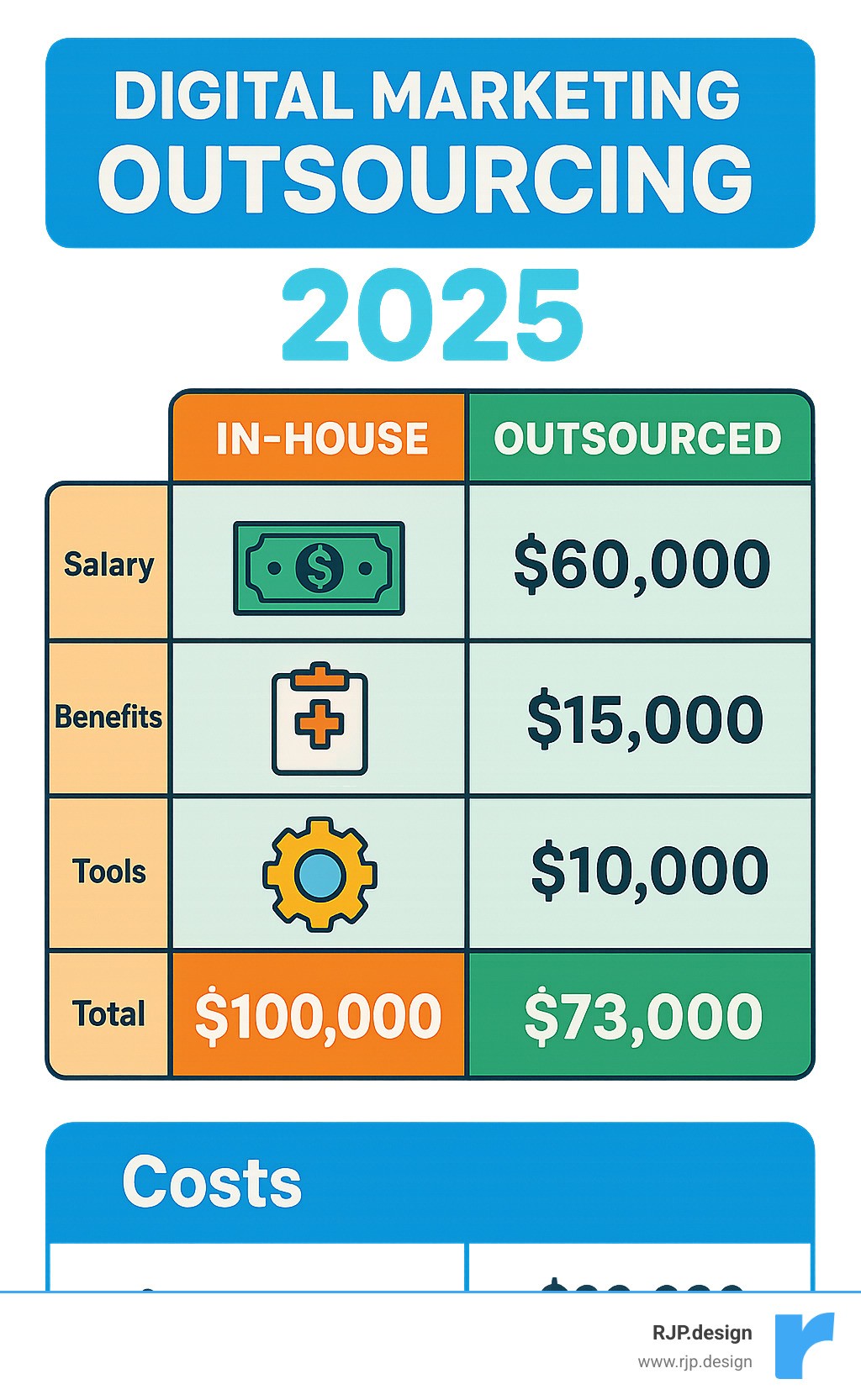
Building an in-house marketing team costs way more than most business owners expect. A marketing manager ($75,000-$120,000), SEO specialist ($60,000-$90,000), PPC manager ($65,000-$95,000), content creator ($50,000-$75,000), and social media manager ($45,000-$65,000), plus 30% benefits, totals $490,000 per year.
Outsourcing paints a different picture. US agencies average $167 per hour, translating to roughly $250,000-$500,000 annually for comprehensive services. Offshore agencies deliver similar results for around $86,000-$100,000 per year. Full-service agencies offer packages from $20,000 to $200,000 annually.
Outsourced teams often deliver better results because they’re specialists who’ve seen what works across dozens of industries.
Factors Influencing Price
Scope of work makes the biggest difference. Simple SEO audits cost far less than comprehensive multi-channel campaigns. Geography plays a huge role – US agencies charge $100-$300 per hour, while Eastern European agencies deliver quality work for $25-$75 per hour.
Experience level affects both cost and results. Junior specialists offer lower rates but need more oversight. Senior experts charge premium rates but deliver faster results. Contract length impacts pricing – annual contracts typically provide better rates than month-to-month arrangements.
Calculating Return on Investment
Lead volume and quality should be your starting point. Track qualified leads generated and lead-to-customer conversion rates. Customer acquisition cost (CAC) tells the real story – divide total marketing spend by new customers acquired.
Revenue attribution gets tricky but remains crucial. Use multi-touch attribution models to track how marketing efforts contribute to sales. Performance dashboards keep everyone accountable with real-time reporting and automated alerts.
The math usually works in favor of outsourcing, especially when you factor in expertise and tools. For comprehensive strategies, our Website Marketing Solutions provide custom approaches for your specific goals and budget.
How to Choose and Manage the Right Partner

Finding the right digital marketing outsourcing partner feels like dating – you need chemistry, trust, and shared goals. The wrong choice wastes months and thousands of dollars.
Start with experience that matters. Look for agencies with 3-5+ years in business, but dig into their portfolio and case studies. Do they show real results or just pretty charts? Red flags include vague testimonials, no specific metrics, or reluctance to share detailed case studies.
Industry expertise can make or break campaigns. Agencies that understand your market speak your customers’ language from day one, knowing which platforms work best and what messaging resonates.
Check team size and structure. A two-person shop might give personal attention but struggle with complex projects. Massive agencies have resources but might treat you like account number 847.
Communication style reveals everything. Do they respond quickly? Ask thoughtful questions? Explain concepts clearly? Culture fit matters because your partner will represent your brand to customers.
Contract negotiations protect both parties. Define exactly what services you’re getting, when, and how you’ll measure success. Include service level agreements and data security protocols.
Digital Marketing Outsourcing Checklist
Clear goals prevent scope creep. Instead of “increase sales,” specify “generate 50 qualified leads per month with 15% conversion rate.” Key performance indicators should align with business objectives – focus on metrics that directly impact revenue.
Reporting frequency depends on comfort level and campaign complexity. Establish a single point of contact on both sides to avoid communication breakdowns.
Tool integration makes or breaks workflow efficiency. Plan technical details upfront to avoid delays. Compliance requirements vary by industry – ensure your partner understands your regulations.
Best Practices for Ongoing Collaboration
Weekly stand-ups keep everyone aligned and catch problems early. Shared dashboards create transparency using platforms like Google Analytics so everyone sees the same numbers.
Agile sprint planning works beautifully for marketing projects. Break large campaigns into 2-4 week sprints with specific deliverables. Feedback loops turn good campaigns into great ones by sharing customer insights and market observations.
Great partnerships evolve over time. Stay flexible, communicate openly, and focus on results rather than process.
Measuring Success & Avoiding Common Mistakes
The real test of successful digital marketing outsourcing isn’t launching campaigns – it’s measuring what moves your business forward. Too many companies get caught up in vanity metrics that look impressive but don’t pay bills.
Traffic growth matters only if it brings quality visitors who convert. Conversion rates show if messaging resonates. Cost per lead (CPL) reveals spending efficiency, while customer acquisition cost (CAC) shows the true cost of growth.
Return on ad spend (ROAS) separates successful campaigns from expensive experiments. Revenue attribution might be the most important metric you’re not tracking properly – multi-touch attribution models help understand the real customer journey.
Beyond numbers, qualitative feedback tells the story behind data. Customer satisfaction surveys, sales team feedback on lead quality, and customer service insights highlight gaps in marketing messages.
Tools & Frameworks
Business intelligence dashboards transform raw data into actionable insights with real-time performance monitoring and automated alerts. Marketing automation platforms handle lead scoring, email nurturing, and social media scheduling.
Objectives and Key Results (OKRs) keep everyone aligned on success metrics. Performance review frameworks create accountability through monthly scorecards and quarterly business reviews.
Pitfalls to Dodge
Unclear briefs are the biggest relationship killer. When you say “increase social media presence,” your partner might interpret that completely differently. Always provide detailed briefs with specific requirements and examples.
Unrealistic timelines set everyone up for failure. SEO results take 3-6 months, PPC campaigns need 2-4 weeks for optimization, and content marketing requires consistent effort over months.
Vanity metrics can be misleading. 100,000 website visitors sounds impressive, but if only 10 become customers, you have a conversion problem. Focus on metrics that impact your bottom line.
Long-term dependency without knowledge transfer leaves you vulnerable. Maintain some in-house marketing knowledge and ensure your partner documents strategies.
According to ReliablePlant, 68% of US consumer products companies use outsourcing, but success depends on learning from others’ mistakes.
Frequently Asked Questions about Digital Marketing Outsourcing
What does a typical outsourcing contract look like?
A solid contract protects both parties and serves as your roadmap for success. The scope of work should spell out exactly what you’re getting with specifics like “conduct keyword research, optimize 20 pages for SEO, create 8 blog posts monthly.”
Performance metrics keep everyone accountable by defining success clearly. Payment terms vary – some agencies require monthly retainers, others work on project fees. Communication protocols prevent headaches by establishing reporting frequency and main contacts.
Data security clauses are non-negotiable since your partner will access sensitive business information. Most contracts run 6-12 months initially to allow time for results while enabling partnership evaluation.
How long before we see measurable results?
PPC campaigns move fastest with initial data within days, but meaningful optimization takes 2-4 weeks. SEO results require patience – expect 3-6 months for significant organic traffic improvements.
Content marketing builds momentum slowly, requiring 4-6 months for meaningful engagement. Social media growth takes 1-3 months for audience building, while email marketing can show engagement improvements within weeks after 1-2 months setup.
Watch leading indicators early on – quality content creation, ad clicks, and trending website traffic predict future success.
Can we mix in-house talent with outsourced experts?
Absolutely! A hybrid approach often delivers the best results. Keep strategic oversight in-house since your team understands customers and business goals better. Technical execution like SEO audits and PPC management are perfect for outsourcing.
Customer-facing communications benefit from internal management, while campaign execution can be outsourced with internal oversight. Analytics and reporting work well as shared responsibility – external partners provide data while internal teams interpret results and make strategic decisions.
Conclusion
Digital marketing outsourcing has transformed from a nice-to-have option into a must-have strategy for competitive businesses. When 68% of US companies are already outsourcing their marketing, they’re making smart business decisions rather than following trends.
Think about it: you wouldn’t try to fix your own plumbing if you’re a restaurant owner. The same logic applies to digital marketing. While you’re running your business, marketing experts are mastering Google’s algorithm updates, testing ad strategies, and analyzing what drives results.
At RJP.design, we’ve seen how the right outsourcing partnership transforms businesses. We don’t just run campaigns and send reports – we become part of your team. Our down-to-earth approach means we explain things in plain English, not marketing jargon.
The secret to successful digital marketing outsourcing comes down to choosing the right partner, being clear about goals, and maintaining good communication. When these pieces align, outsourcing becomes your best investment rather than an expense.
Your business deserves marketing that works as hard as you do. Whether you need a complete digital overhaul or want to improve existing efforts, outsourcing provides the flexibility to scale based on your needs.
Ready to see what digital marketing outsourcing can do for your business? Our team at RJP.design specializes in making complex marketing simple and effective, handling everything from website design to ongoing campaigns.
Learn more about our Web Design & Digital Marketing Made Effortless approach and find how we can help your business grow through smart outsourcing partnerships.
Don’t let another month pass wondering what’s possible. Contact us today for a conversation about how digital marketing outsourcing can give your business the competitive edge it deserves.