
SEO
The True Measures of Success: Beyond the Numbers
Feb 12, 2026
Why Understanding How to Measure Success Matters More Than Ever
How to measure success depends on defining clear goals and tracking both quantitative metrics (like revenue and KPIs) and qualitative factors (like personal satisfaction and impact). Success means different things to different people. For some, it's a revenue target; for others, it's work-life balance.
The challenge? We live in a world obsessed with measurable outcomes—follower counts, bank balances, conversion rates—while the things that often matter most, like happiness or personal growth, resist easy quantification. This creates a disconnect. Research shows that companies monitoring KPIs are almost twice as likely to hit growth targets, yet many successful entrepreneurs feel unfulfilled despite hitting every financial goal. A business might be profitable but suffer from high employee turnover. The numbers say "success," but the reality feels different.
This happens when we measure the wrong things, or not enough of the right ones. We track revenue but not customer satisfaction, productivity but not employee well-being. The most successful individuals and organizations take a holistic approach, balancing quantitative metrics with qualitative measures. They define success on their own terms.
I'm Ross Plumer, and I've helped businesses market over $20 million in revenue. I've learned that measuring success is about more than choosing KPIs—it's about building a framework that honors both your financial goals and your deeper values. This guide will show you how.
What is Success, Really? Moving Beyond the Scoreboard
Success is a deeply subjective experience. A one-size-fits-all definition doesn't work because we often fall into the trap of measuring ourselves against external benchmarks like wealth or awards. As Richard Branson wisely observed, "true success should be measured by how happy you are."
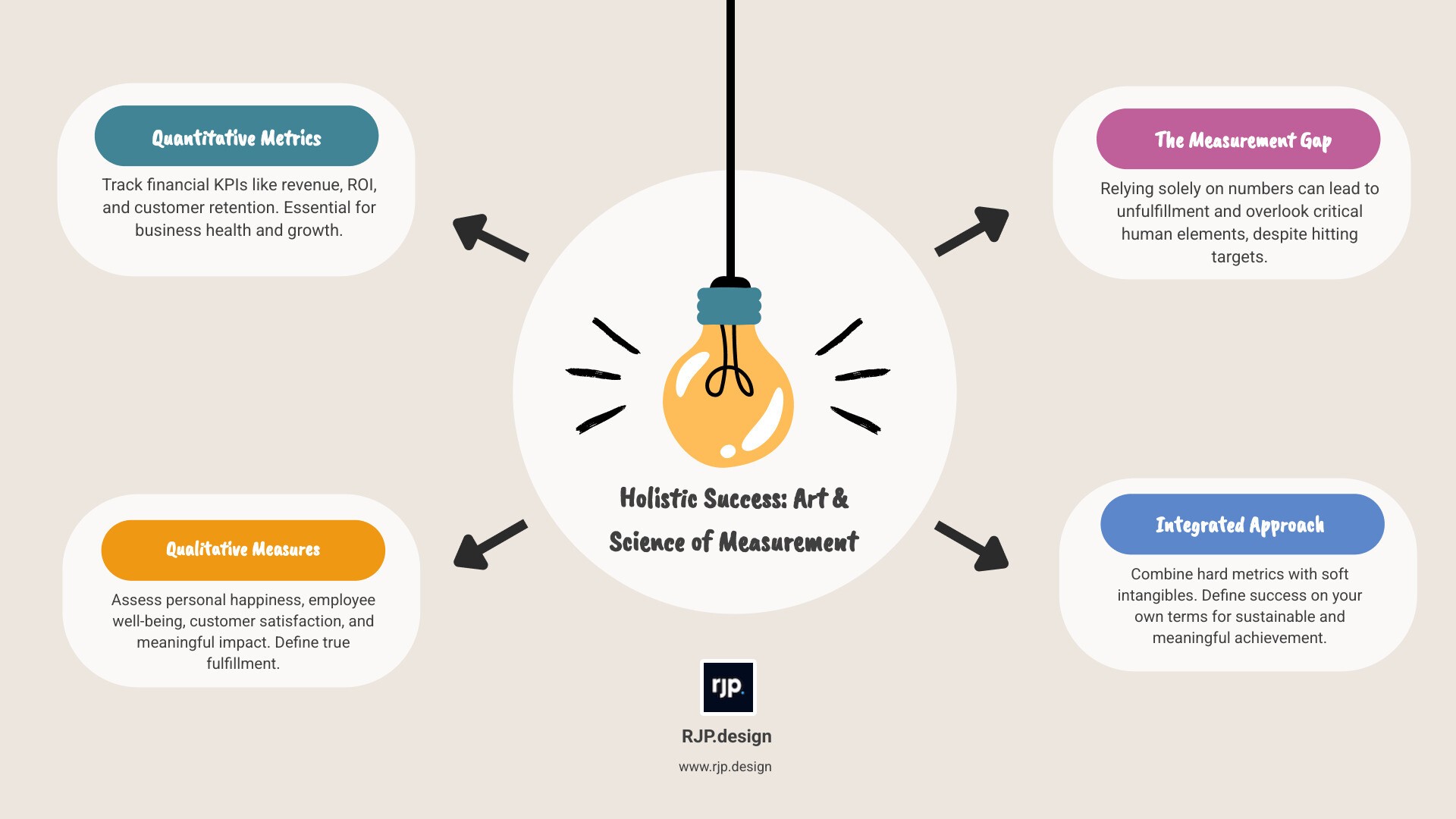
To truly understand how to measure success, we must acknowledge its dual nature:
Quantitative measures are the numbers: revenue growth, profit margins, website traffic. They are essential for tracking progress and making data-driven decisions. For instance, the fastest-growing businesses are about 50% more likely to use three or more performance metrics.
Qualitative measures dig into the intangible: happiness, personal satisfaction, meaningful relationships, and impact. These are the feelings and experiences that give our achievements meaning.
Relying solely on numbers is misleading. A company might hit its financial targets but have a toxic work environment. An individual might accumulate wealth but feel profoundly unhappy. The challenge lies in integrating both. We need the clarity of data and the richness of qualitative insights to build a life or business that is genuinely fulfilling. This means defining success on our own terms, not by a societal scoreboard.
A Holistic Guide on How to Measure Success
Measuring success effectively requires a comprehensive approach that blends the concrete with the abstract.
Defining Success on Your Own Terms: The Personal Dimension
Before tracking any metrics, you must first define what success means to you. Resist the urge to compare yourself to others. As Richard Branson said, "My metric for success is happiness." Focus on personal, qualitative measures:
Happiness and Fulfillment: Are you content with your life's direction?
Personal Growth: Are you learning, evolving, and building character? True success has "depth," as noted in More on why success isn't just numbers.
Meaningful Relationships: Do you have a supportive network of family, friends, and colleagues?
Positive Impact: Are you contributing positively to your community or team?
Overcoming Obstacles: Success is also measured by the challenges you've overcome.
To define your own success, identify your core values, reflect on your journey (not just the destination), and assess the balance between different areas of your life.

How to Measure Success with Clear Goals and Metrics
Once you have a personal definition, translate that vision into actionable goals using the SMART framework (Specific, Measurable, Achievable, Relevant, Time-bound). From these goals, you can identify Key Performance Indicators (KPIs)—the quantifiable metrics that track your progress. Companies that monitor KPIs are almost twice as likely to hit growth targets.
Example SMART Goals and KPIs:
Personal Goal: "Read 12 industry-related books this year."
KPI: Books completed per month.
Business Goal: "Increase monthly recurring revenue (MRR) by 15% in 12 months."
KPIs: MRR, Customer Churn Rate, Customer Lifetime Value (CLV).
Financial metrics like profitability and Return on Investment (ROI) are vital for business health. For example, a 5% increase in customer retention can boost profits by 25-95%. However, a singular focus on financials can be misleading. They are powerful tools but should be used within a broader framework that considers their underlying drivers, not just the outcomes. For more on this, explore our business strategy services.
How to Measure Success for Your Business or Project
In a business context, success measurement must be multi-faceted.
Strategic Alignment and KPIs Every KPI should tie directly to a strategic objective. Keep the number of KPIs focused (we recommend a maximum of four per department) and use dashboards to make data visible and digestible for the team.
Customer and Employee Satisfaction Beyond revenue, customer satisfaction is a critical measure. Track metrics like:
Customer Retention Rate: Retaining customers is far more cost-effective than acquiring new ones.
Net Promoter Score (NPS): This gauges customer loyalty and predicts business growth.
Direct Feedback: Surveys and reviews provide invaluable qualitative insights.
Similarly, employee well-being is crucial. High satisfaction correlates with lower turnover. Anonymous feedback surveys can surface cultural issues that need addressing.
Project Success Beyond the "Iron Triangle" True project success goes beyond scope, schedule, and budget. Consider:
Value Delivery: Did the project deliver the intended business value and ROI?
Stakeholder Satisfaction: Were clients and stakeholders happy with the outcome?
Output Quality: Was the end product high-quality and compliant?
Team Capability Development: Did the team learn and grow?
For digital businesses, tracking your online presence is non-negotiable. We help clients with website analytics tracking to understand user behavior and focus on metrics for improving your SEO ranking that attract traffic that converts.
Common Pitfalls in Measuring Success and How to Avoid Them
Vanity Metrics: Numbers that look good but don't correlate with core goals (e.g., high traffic with zero conversions).
Solution: Focus on metrics that drive action, like conversion rates and engagement.
Ignoring Qualitative Data: Relying only on numbers gives an incomplete picture.
Solution: Integrate customer surveys, employee interviews, and other feedback.
Not Tying Metrics to Goals: Measuring for the sake of measuring leads to wasted effort.
Solution: Start with a goal, then identify the 2-4 most impactful KPIs for it.
Analysis Paralysis: Drowning in data without taking action.
Solution: Set a regular cadence for reviewing metrics and making decisions.
Setting Unrealistic Targets: Ambitious goals can demotivate teams if they are unattainable.
Solution: Use benchmarks and historical data to set challenging yet realistic goals.
Focusing on Outcomes, Not Drivers: Knowing why a target was missed is more important than just knowing it was missed.
Solution: Track leading indicators (e.g., sales leads) that predict future outcomes (e.g., revenue).
Defining Your Own Success and Taking Action
We've explored how to measure success across its quantitative and qualitative dimensions. The key takeaway is that success is not a monolith; it's a dynamic concept you must define for yourself.
While financial metrics are essential, true success integrates them with customer satisfaction, employee well-being, and personal fulfillment. As Richard Branson's philosophy suggests, happiness is a powerful metric. By setting SMART goals and tracking relevant KPIs, you can turn your vision into an actionable plan, avoiding common pitfalls like vanity metrics and analysis paralysis.
Regularly reviewing success metrics allows you to stay on track, make better decisions, and foster team alignment. This process drives continuous improvement, creating the agility and resilience needed to thrive. Measuring success is about crafting a narrative that reflects your deepest values and building a future that is both prosperous and meaningful.
At RJP.design, we understand that your online presence is a critical component of your business's success. We specialize in creating websites and enhancing online visibility, ensuring they not only look great but are also easily found by your target audience. We believe in high-quality service and a down-to-earth approach, prioritizing your satisfaction and helping you define and achieve your online goals.
Ready to take the first step towards your business's online success? Partner with us to build a digital foundation that supports your vision and helps you measure what truly matters. Explore our web design and development services today.