
SEO
SEO Secrets for Local Visibility: Be Seen, Be Found, Be Local
Jul 15, 2025

Local Search Visibility: Dominate 2025
Why Local Search Visibility is Your Business’s Superpower
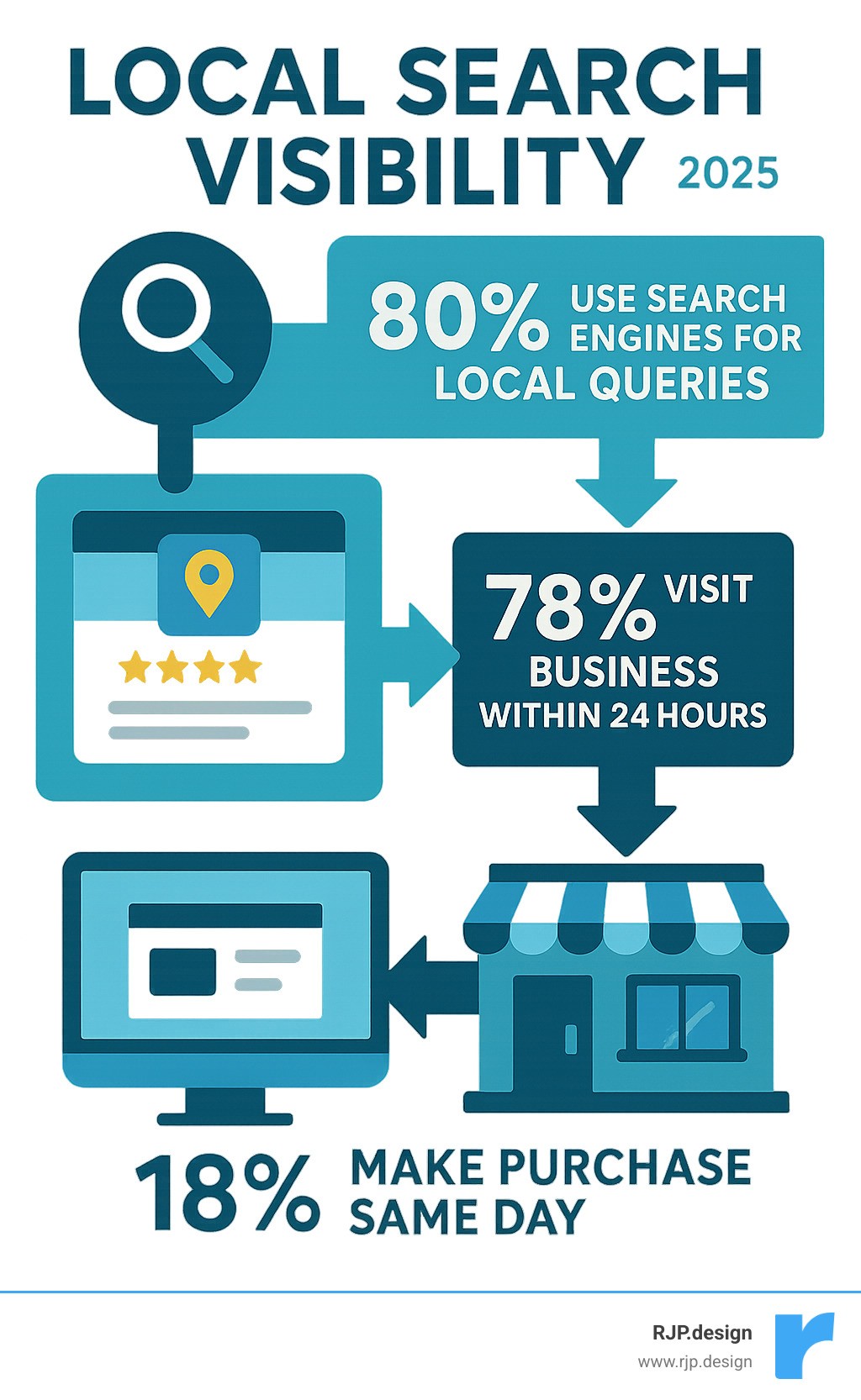
Local search visibility is simply your ability to show up when nearby customers search on Google or Maps. Four out of five people use search engines for local queries, and nearly one-in-five of those searches turn into a purchase the same day. If you are not in those results, you are invisible when buyers have their wallets out.
Key components you can control:
Google Business Profile optimisation
Consistent NAP (Name, Address, Phone) everywhere online
Local citations on trusted directories
Genuine reviews that build trust
Location-based content on a mobile-friendly site
Google decides who appears based on three pillars: relevance, distance, and prominence. Master these, and you turn online searches into real-world revenue.
Helpful resources:
How Google Determines Local Search Rankings
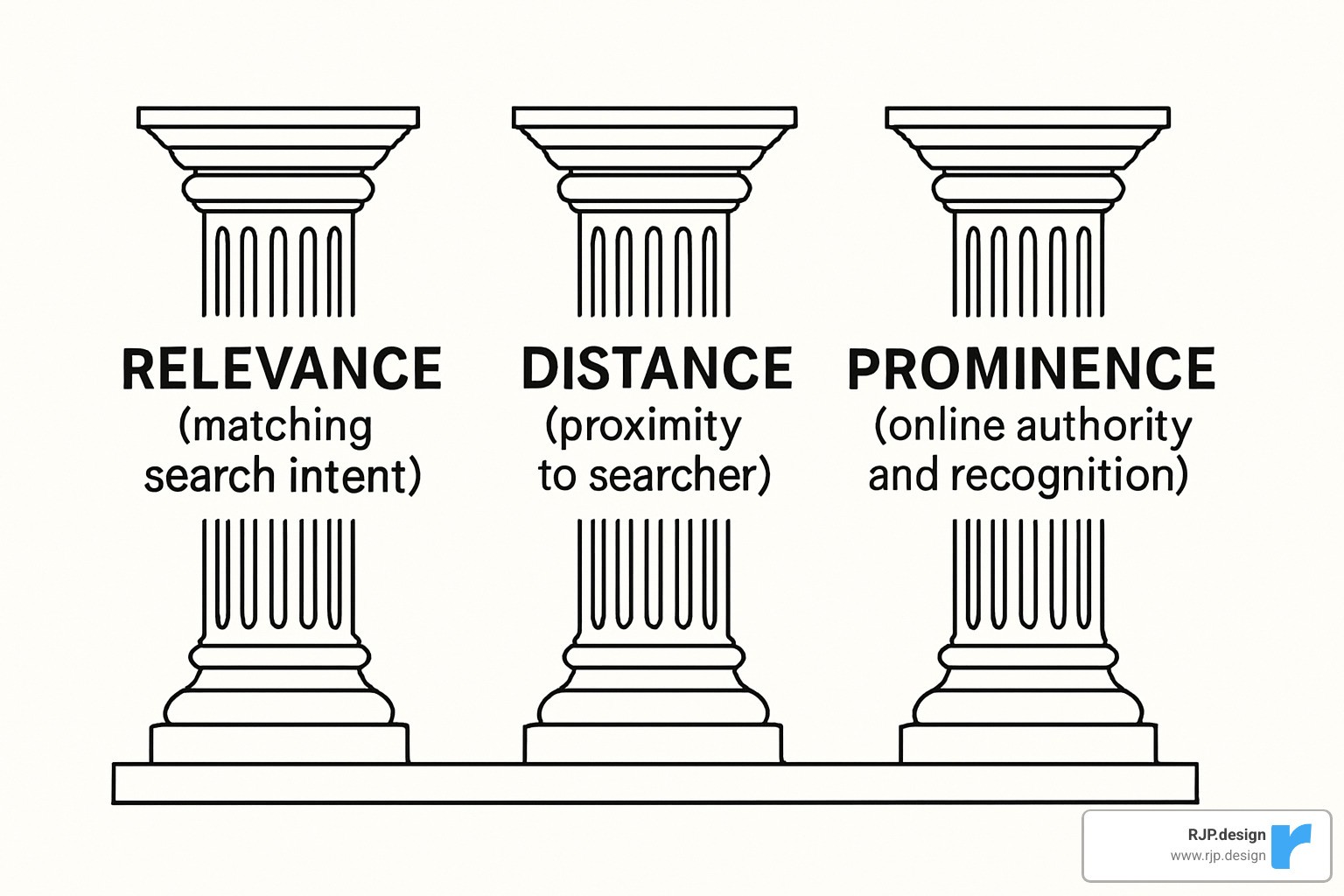
Google’s algorithm for local search is designed to deliver the most helpful and accurate results for users. According to Google’s own documentation on how to improve your local ranking, the results depend on a combination of three core factors:
Relevance – This is all about how well your business profile matches what a customer is searching for. It’s the most straightforward factor to influence. If someone searches for “emergency plumber,” Google looks for businesses that have listed “emergency plumbing” as a service and have selected “Plumber” as their primary business category. To maximise relevance, you must be meticulous. Fill out every applicable section of your Google Business Profile, including all services you offer, products you sell, and specific attributes (e.g., “wheelchair accessible,” “offers online estimates”). A detailed, keyword-rich business description further signals to Google what your business is all about.
Distance – This factor considers how far each potential search result is from the location terms used in a search. If a user doesn’t specify a location in their query, Google will calculate distance based on what it knows about their current location. For businesses with a physical storefront, this is tied to your verified address. For service-area businesses (like a plumber who travels to customers), it’s based on the defined service area you set in your profile. While you can’t change your physical location, you can ensure your address or service area is 100% accurate in your profile to appear for the most relevant local searches.
Prominence – This refers to how well-known and respected your business is, both online and in the real world. Google gauges prominence from information it gathers across the web, such as links, articles, and directory listings. It’s a measure of your digital authority. Key drivers of prominence include the quantity and quality of your reviews on Google and other sites, the number of high-quality backlinks pointing to your website from other reputable local sites (like a local news outlet or the Chamber of Commerce), and the consistency of your business information across the web. A business that is frequently mentioned in a positive light online and has a strong base of positive reviews is seen as more prominent and is more likely to rank higher.
While you have the most direct control over relevance, a long-term strategy must focus on building prominence and ensuring your distance information is accurate. Mastering all three is the key to climbing the local pack, even in the most crowded markets.
The Foundation: Mastering Your Google Business Profile & Citations
Your Google Business Profile (GBP) is not just a listing; it’s your digital storefront and the single most important factor for local search visibility. It’s often the first interaction a potential customer has with your brand. A complete, active, and optimised profile builds immediate trust and provides Google with the structured data it needs to rank you. Fill out every single field available to you, and commit to keeping it updated.
Critical elements to complete and maintain:
Exact business name: Use your real-world business name. Avoid adding keywords or locations, as this violates Google’s guidelines and can lead to suspension.
Address / service area & phone number: Ensure this is 100% accurate and consistent everywhere online.
Primary and secondary categories: The primary category is the most important. Choose the most specific category that describes your main business, then add secondary categories for other services you offer.
Services, products, prices: Detail every service you provide with descriptions. If you sell products, use the Products feature. Transparency in pricing can also be a competitive advantage.
Hours: Keep your hours updated, especially for holidays and special events. Nothing frustrates a customer more than showing up to a closed business.
High-quality photos & videos: Upload at least five high-quality photos showing your storefront, your team, your products, and your work in action. Real photos vastly outperform stock images. Add a new photo regularly to keep the profile fresh.
Weekly Google Posts: Use this feature to share updates, offers, events, or new blog posts. Posts expire after seven days, so a consistent weekly cadence keeps your profile looking active and engaging.
Prompt, polite replies to every review: Responding to all reviews—good and bad—shows you value customer feedback and are an engaged business owner.
Local Citations & NAP Consistency
A citation is any online mention of your business’s Name, Address, and Phone number (NAP). Google’s algorithm cross-references your NAP across the web to verify your location and legitimacy. Inconsistent information creates confusion and erodes trust, which can harm your rankings. Every listing must match your GBP profile exactly—down to the smallest detail like using “St.” vs. “Street” or “Co.” vs. “Company.”
Citation Type | Examples |
|---|---|
Structured | Yelp, Yellow Pages, Apple Maps, Foursquare |
Unstructured | Blog posts, news stories, social media mentions |
Structured citations on directories are foundational. Start by ensuring your information is correct with major data aggregators like Data Axle and Foursquare, as they feed data to hundreds of other sites. Then, manually claim and optimise listings on major platforms and key industry-specific directories (e.g., TripAdvisor for hotels, Houzz for contractors). Quality and consistency always beat sheer quantity.
On-Site & Content Strategies to Improve Local Search Visibility
While your Google Business Profile is critical, your website is the ultimate destination where you can convert visitors into customers. Your site needs to be optimised to reinforce the local signals you’re sending through your GBP and citations.
Local On-Page SEO in a Nutshell
Your website content must explicitly signal your location and services to both users and search engines.
Research real location-based keywords: Use tools to find what customers are searching for, such as “plumber in Chester” or “best coffee shop downtown.”
Optimise key page elements: Use your target keywords naturally in your website’s title tags, meta descriptions, H1/H2 headers, body content, and image alt text.
Create unique location pages: If you serve multiple cities or neighbourhoods, create a dedicated page for each one. Do not just copy and paste content and swap the city name. Each page should have unique content, mentioning local landmarks, discussing specific challenges in that area, and featuring testimonials from clients in that location. Embed a Google Map of the specific area.
Display your NAP prominently: Your full Name, Address, and Phone number should be easily found in the footer or header of every page on your site, matching your GBP exactly.
Content That Earns Local Links
Great content not only helps with keyword relevance but also earns backlinks, which builds your site’s authority and prominence.
Recap or sponsor local events, and write about your experience.
Publish helpful “Best of” guides for your niche within your city (e.g., “A Landscaper’s Guide to the 5 Best Garden Centres in Chester”).
Share stories about your community involvement, charity work, or local sponsorships.
Partner with non-competing local businesses on a joint project, guide, or event and promote it together.
Create a local resource page that is genuinely useful for residents, which can become a magnet for links from other local websites.
Technical Must-Haves
Your site’s technical health is the foundation upon which your content and on-page SEO are built.
Mobile-first design: Google primarily uses the mobile version of a site for indexing and ranking. Your website must be fast, responsive, and easy to steer on a smartphone.
Schema Markup: This is a type of code that you add to your website to help search engines understand your content better. It’s like adding labels to your information. Implementing LocalBusiness schema reinforces your NAP, while Review schema can enable star ratings to appear in search results, and FAQ schema can make your Q&A content eligible for rich snippets. These rich results make your listing stand out and can significantly improve click-through rates.
Need help? Our Plumber Search Engine Optimization package includes technical audits and schema implementation.
Managing, Measuring, and Future-Proofing Your Local Presence
Local SEO is not a “set it and forget it” task. It requires ongoing management, careful measurement, and an eye toward the future to maintain and improve your visibility.
Reviews: The Dual Ranking & Conversion Engine
Reviews are a powerful signal for both Google’s ranking algorithm and potential customers. A steady stream of positive reviews builds trust and prominence.
A 4-star average is the tipping point for half of shoppers; falling below this can significantly impact conversions.
Actively request reviews. Use follow-up emails, text messages with a direct link, printed QR codes on invoices, or simple in-person reminders after a successful job.
Respond to every single review. Thank customers for positive feedback. For negative reviews, respond publicly by acknowledging their concern, apologising for their experience, and offering to resolve the issue offline. This demonstrates excellent customer service to everyone who reads it.
Aim for a steady, natural flow of reviews. A sudden, unnatural spike in reviews can be flagged and filtered by Google.
Track What Matters
To understand if your efforts are working, you need to track the right key performance indicators (KPIs).
Local pack rankings: Monitor your position in the Google 3-Pack for your most important keywords.
GBP Insights: Track views, calls, direction requests, and website clicks directly from your Google Business Profile. These are direct leads.
Local traffic & conversions: Use Google Analytics to segment traffic from local search and see how many of those visitors convert into customers (e.g., by filling out a contact form).
Review volume & rating trend: Are you getting more reviews over time? Is your average rating improving?
Citation accuracy: Periodically audit your online citations to find and fix inconsistencies.
Use these metrics, along with competitor monitoring (available in our local SEO services), to identify what’s working and where to focus your efforts next.
Stay Ahead of Voice & AI
With 22% of voice queries being for local information, optimisation is crucial. Voice searches are typically longer and more conversational. To capture this traffic, optimise for questions like “Which plumber near me is open now and fixes burst pipes?” by creating detailed FAQ sections and writing content in a natural, question-and-answer format. This strategy also future-proofs your business for AI-driven search experiences like Google’s SGE, which pulls from well-structured, authoritative content to provide direct answers to users. Avoid common pitfalls that will hold you back: inconsistent NAP, keyword-stuffed business names, ignoring mobile-friendliness, or letting duplicate GBP listings linger.
Frequently Asked Questions about Local Search
What is the difference between local SEO and regular SEO?
Local SEO focuses on increasing visibility for a business within a specific geographic area. It heavily relies on signals like proximity, local citations (NAP consistency), and location-specific reviews. The goal is to rank in the Google “Local Pack” for searches like “best coffee shop near me.” Traditional SEO, on the other hand, aims to achieve visibility on a national or global scale, focusing on broader keywords like “how to brew espresso” and is less dependent on the searcher’s physical location.
How long does it take to see results?
This depends on your starting point and the competitiveness of your market. You can see initial positive movement within a few weeks from foundational fixes, such as fully optimising your Google Business Profile and cleaning up major citations. However, achieving sustainable, high-ranking positions for competitive terms requires a long-term strategy. Building authority through consistent content creation, earning backlinks, and accumulating reviews typically takes 3-6 months to show significant results. Highly competitive niches may require even more time and continuous effort.
Can I pay Google for better organic local rankings?
No, you cannot pay Google to improve your organic local rankings in the Local Pack or standard search results. Those positions are determined solely by Google’s algorithm based on relevance, distance, and prominence. You can, however, pay for Google Ads, which may appear above or below the organic local results. A robust local SEO strategy, like those in our Google Search Optimization plans, focuses on earning your rank through best practices that build lasting, organic visibility.
Do I need a physical storefront to rank in local search?
No, you do not need a physical, customer-facing storefront. Businesses that travel to their customers, known as Service Area Businesses (SABs), are fully eligible to rank in local search. When setting up your Google Business Profile, you will select the option to be a service area business and define the specific towns, cities, or postcodes you serve. Your address will be hidden from the public to protect your privacy, but Google will still use it to determine your relevance for searches in your defined service area.
Conclusion: Take Control of Your Local Market
Local search visibility turns online intent into foot traffic and phone calls. Start with the basics—complete Google Business Profile, razor-sharp NAP consistency—then layer on helpful content, technical polish, and genuine customer service.
When you delight customers, they leave reviews, which boost rankings, which bring in more customers. That flywheel works for every size of business.
RJP.design’s down-to-earth team has helped companies across competitive markets own their local presence. Ready to join them? Explore our Google Search Optimization services and let’s make sure your business is found first when it matters most.