
Web
The Ultimate Guide to Professional Website Redesign Services
Sep 18, 2024

Why Professional Website Redesign Matters
Professional website redesign is essential for any business that wants to stay relevant and effective online. A well-executed redesign improves first impressions, improves user experience, and revitalizes your brand image. Here’s a quick overview to address your immediate needs:
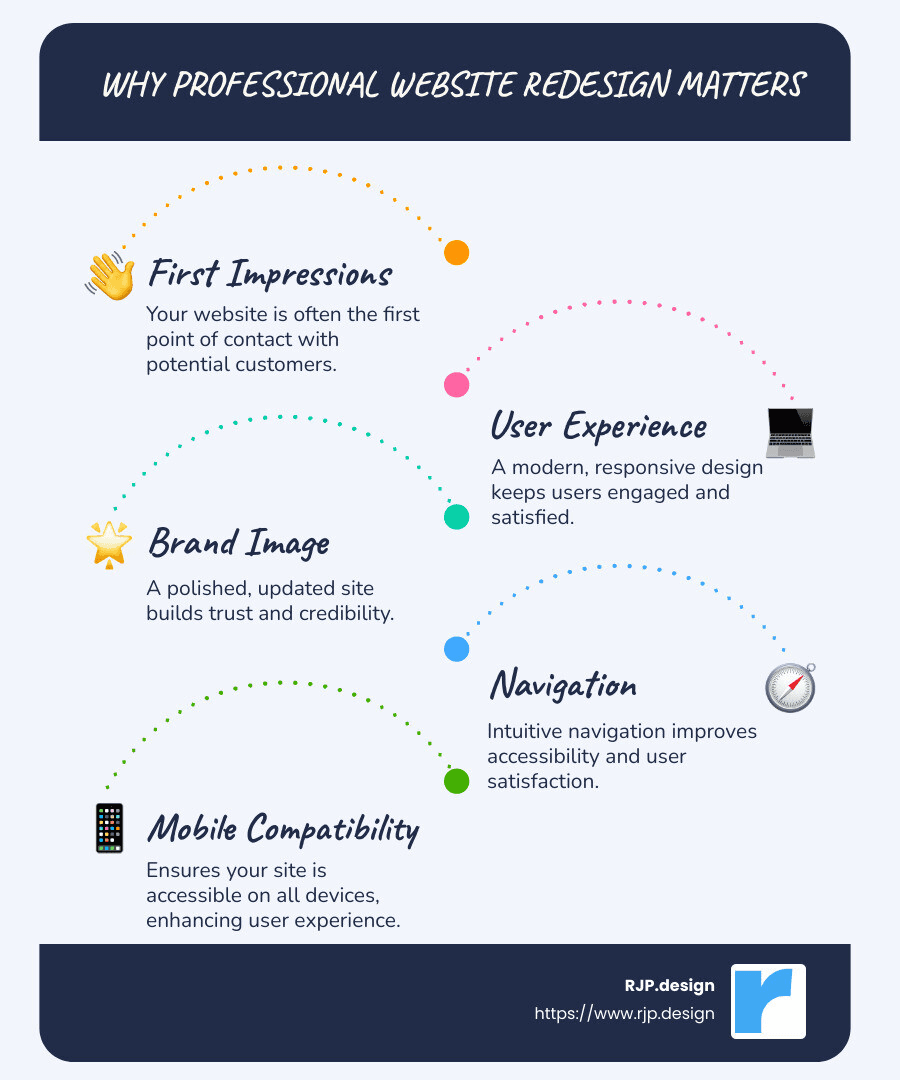
First Impressions: Your website is often the first point of contact with potential customers.
User Experience: A modern, responsive design keeps users engaged and satisfied.
Brand Image: A polished, updated site builds trust and credibility.
User experience is crucial. Websites with intuitive navigation, fast load times, and mobile compatibility lead to higher user satisfaction and conversions. Imagine landing on a site with an outdated design and poor functionality—it’s off-putting, right?
A website is a pivotal part of your brand image. Consistent, appealing visuals, and up-to-date content can signal that your business is thriving and trustworthy.
I’m Ross Plumer. With years of experience in professional website redesign, I’ve helped businesses boost their online presence and improve user experiences. My expertise lies in aligning digital strategies with psychological and market trends for impactful results.
What is a Professional Website Redesign?
A professional website redesign involves more than just a facelift. It’s a comprehensive overhaul aimed at improving your site’s performance, user experience, and visual appeal. Let’s break down the key components:
Definition
A professional website redesign is the process of updating and improving your website’s content, structure, format, and navigation to improve its functionality and effectiveness. This isn’t just about making things look pretty; it’s about making your site work better for your business goals.
Content Update
Content is king. Updating your website’s content ensures it remains relevant, accurate, and engaging. This can involve:
Refreshing outdated information: Make sure all your content reflects the latest industry standards and company updates.
Adding new content: Introduce new blog posts, articles, or product descriptions to keep visitors informed and engaged.
Optimizing for SEO: Use targeted keywords to improve your search engine ranking and attract more traffic.
Structure Change
The structure of your website affects how information is organized and accessed. A well-structured site helps users find what they need quickly and easily. Key structural changes might include:
Improving the site hierarchy: Organize pages and subpages logically.
Enhancing internal linking: Make it easier for users to steer between related content.
Streamlining the user journey: Ensure users can complete desired actions (like making a purchase) with minimal clicks.
Format Improvement
The format of your website includes its layout, design elements, and overall visual appeal. Improvements here can make your site more attractive and user-friendly:
Responsive design: Ensure your site looks great on all devices, from desktops to smartphones.
Modern aesthetics: Use contemporary design trends to keep your site looking fresh and professional.
Consistent branding: Maintain uniformity in colors, fonts, and imagery to reinforce your brand identity.
Navigation Improvement
Navigation is crucial for user experience. Poor navigation can frustrate users and drive them away. To improve navigation:
Simplify menus: Make sure your menu is easy to understand and use.
Use clear labels: Label links and buttons clearly so users know what to expect.
Add a search function: Help users find specific information quickly.
“A website redesign offers an opportunity to innovate with how your content is presented, remove what isn’t working for you, and clean up your website’s code for a better user experience,” says Danélle from WebFX.
In summary, a professional website redesign is a strategic process aimed at making your site more effective and user-friendly. By updating content, improving structure and format, and enhancing navigation, you can create a website that not only looks good but also performs well.
Next, we’ll dive into when you should consider a professional website redesign.
When Should You Consider a Professional Website Redesign?
Deciding when to undergo a professional website redesign can be challenging. However, certain signs indicate it’s time for an overhaul. Here are the key indicators:
Outdated Design
If your website looks like it belongs in the early 2000s, it’s definitely time for a redesign. An outdated design can make your business appear out of touch with current trends. For example, if your website still uses Comic Sans or looks like a GeoCities page, it can erode user trust and credibility. Modernizing your design can significantly boost your brand’s appeal.
Poor User Experience
User experience (UX) is crucial. If visitors struggle to find information or steer your site, it’s a clear sign you need a redesign. Poor UX can lead to high bounce rates and lost leads. Simplifying menus, improving site hierarchy, and adding a search function can make a world of difference.
Low Conversion Rates
Your website should convert visitors into customers. If you notice a decline in conversions, your website might not be meeting your audience’s needs. A redesign can help by optimizing the user journey, adding clear calls-to-action (CTAs), and improving overall site functionality.
Not Mobile-Friendly
In today’s digital landscape, a mobile-friendly website is non-negotiable. With mobile browsing often surpassing desktop usage, a site that isn’t optimized for mobile can alienate a significant portion of your audience. A responsive design ensures your site looks great and functions well on all devices.
Slow Load Times
Users expect fast, smooth web experiences. If your site takes too long to load, visitors will likely leave before even seeing your content. Optimizing load times can improve user satisfaction and reduce bounce rates. Tools like GTmetrix can help you measure and improve your site’s speed.
Inadequate SEO Performance
If your site isn’t ranking well on search engines, outdated SEO practices might be to blame. A redesign can help incorporate modern SEO strategies, from keyword optimization to improving site structure, making your content more findable.
Rebranding
If your company has undergone rebranding, your website should reflect this new identity. Consistency in branding across all platforms is crucial for building and maintaining a strong brand image. Updating your website to align with your new brand aesthetic can improve recognition and trust.
In summary, if your website suffers from outdated design, poor UX, low conversions, lack of mobile optimization, slow load times, inadequate SEO, or needs to reflect a rebrand, it’s time to consider a professional website redesign.
Next, we’ll explore the steps to a successful professional website redesign.
Steps to a Successful Professional Website Redesign
Redesigning a website is a big task. Follow these steps to ensure your professional website redesign is a success.
Benchmark Your Current Performance Metrics
Start by documenting your current website’s performance. This gives you a baseline to measure improvements.
Key metrics to track include:
Site visits: Total number of visits, visitors, and unique visitors.
Bounce rate: Percentage of visitors who leave after viewing only one page.
Time on site: Average duration visitors spend on your site.
Top-performing keywords: Keywords that drive the most traffic and leads.
Inbound links: Number of other sites linking to your pages.
Lead generation: Total new leads and form submissions.
Sales: Total sales generated from your site.
Use tools like Google Analytics to gather this data. Noting your current metrics helps you set realistic goals for your redesign.
Determine Your Website Redesign Goals
Identify why you need a redesign. Clear goals will guide your project and measure success.
Common goals include:
Increase traffic
Reduce bounce rate
Improve domain authority
Improve SEO rankings
Increase conversions
For example, if your bounce rate is high, aim to reduce it by improving user experience. Use your current metrics to set specific, measurable goals.
Define Your Branding and Messaging
Your website should reflect your brand identity. Consistent branding builds trust and recognition.
Focus on:
Brand elements: Colors, fonts, and logos.
Unique value proposition: What sets you apart from competitors.
Clear language: Simple, easy-to-understand text.
Visual consistency: Uniform look and feel across all pages.
Ensure your brand message is clear and consistent throughout the site.
Develop a Content Strategy
Content is king. A strong content strategy engages visitors and boosts SEO.
Steps to create your strategy:
Engaging content: High-quality text, images, and videos.
SEO-friendly: Use keywords naturally and optimize meta tags.
Content migration: Plan how to transfer existing content.
301 redirects: Set up redirects for any URL changes to maintain SEO value.
Regularly update content to keep it fresh and relevant.
Choose the Right Platform
Your website platform should meet your needs and goals.
Consider:
CMS options: Content management systems like WordPress or Prismic.
Customization: Ability to tailor the site to your specifications.
E-commerce support: If you sell products online, ensure the platform supports e-commerce.
Budget considerations: Balance cost with features and functionality.
Choose a platform that offers the flexibility and tools you need.
Protect Your SEO
SEO is crucial for visibility. Protect your existing SEO during the redesign.
Steps to take:
Document valuable pages: Identify high-traffic and high-ranking pages.
Create 301 redirects: Map old URLs to new ones to preserve link equity.
Keyword research: Optimize new pages with relevant keywords.
Implementing these steps ensures your redesign doesn’t harm your search rankings.
Analyze the Competition
Understanding your competitors helps you stay ahead.
Use tools like HubSpot’s Website Grader to evaluate their sites. Look at:
Strengths and weaknesses: What they do well and where they fall short.
Action items: Areas where you can improve or differentiate your site.
Competitive analysis provides valuable insights for your redesign strategy.
Take Inventory of High-Performing Content
Identify your top-performing content to avoid losing valuable assets.
Focus on:
Most-shared content: Articles or posts that get the most shares.
High-traffic pages: Pages with the most visitors.
Best-performing keywords: Keywords that rank well and drive traffic.
Inbound links: Pages with the most backlinks.
Preserve and improve these assets to maintain and boost your site’s performance.
By following these steps, you can ensure your professional website redesign is effective and successful. Next, let’s look at common mistakes to avoid during a website redesign.
Common Mistakes to Avoid During a Website Redesign
Redesigning a website can be a game-changer, but it’s easy to slip up. Let’s look at some common mistakes and how to avoid them.
Ignoring User Experience
User experience (UX) is critical. A beautiful site that’s hard to steer won’t keep visitors around.
Tip: Use heat maps to see how users interact with your site. Ensure navigation is intuitive and content is easy to find.
Not Setting Clear Goals
Without clear goals, you can get lost in the redesign process.
Tip: Define measurable objectives like increasing traffic, reducing bounce rates, or improving SEO rankings. Goals guide your redesign and help measure success.
Neglecting SEO
SEO should be a priority. Ignoring it can lead to a drop in search rankings and traffic.
Tip: Protect your SEO by documenting valuable pages and creating 301 redirects. Optimize new content with relevant keywords.
Not Mobile-Optimizing
Many users browse on mobile devices. Not optimizing for mobile can lead to high bounce rates.
Tip: Ensure your site is responsive. Test it on various devices to ensure it looks and functions well everywhere.
Skipping A/B Testing
A/B testing helps determine which design elements work best. Skipping it can lead to poor design choices.
Tip: Test different versions of pages to see which performs better. Make data-driven decisions.
Lack of Content Strategy
Content is what keeps visitors engaged. Without a strategy, you risk having outdated or irrelevant content.
Tip: Develop a content strategy that includes engaging, SEO-friendly text, images, and videos. Plan for content migration and set up 301 redirects for URL changes.
Inadequate Planning for 301 Redirects
Changing URLs without planning can confuse users and hurt your SEO.
Tip: Create a spreadsheet to map old URLs to new ones. Properly implement 301 redirects to maintain traffic and link value.
Rushing the Launch
Rushing can lead to a site full of bugs and usability issues.
Tip: Allocate enough time for thorough testing. Ensure everything works smoothly before going live.
By avoiding these common mistakes, you can ensure your professional website redesign is a success. Next, we’ll answer some frequently asked questions about professional website redesign.
Frequently Asked Questions about Professional Website Redesign
How much does a professional website redesign cost?
The cost of a professional website redesign can vary widely based on several factors. According to Forbes, a basic redesign can cost around $500, while a more complex one can go up to $3,000. The size of your website plays a significant role in the cost. For instance, a small business site with 10-20 pages will be less expensive than a large e-commerce site with hundreds of product pages.
Factors affecting cost:
– Size of the website: More pages mean more work.
– Complexity: Custom features like forms, integrations, or advanced e-commerce capabilities can add to the cost.
– Platform fees: Builders like Wix or Squarespace may have lower initial costs but higher ongoing fees.
DIY vs. Agency:
– DIY: Cost-effective but time-consuming and may lack professional quality.
– Agency: Higher upfront cost but offers professional expertise, time-saving, and ongoing support.
How long does a professional website redesign take?
The timeline for a website redesign can range from a weekend to several months. For example, a small site might be redesigned in a few weeks, while a large e-commerce site could take months due to the sheer number of pages and products.
Factors affecting timeline:
– Project complexity: More complex features will require more time.
– Size of the website: More pages mean more work and longer timelines.
– E-commerce sites: These typically take longer due to the need for detailed product pages, descriptions, and variations.
Typical timeline:
– Small websites: A few weeks to a month.
– Medium-sized websites: One to three months.
– Large e-commerce sites: Several months.
Will a website redesign affect my SEO?
Yes, a website redesign can impact your SEO, especially if you change your site’s structure or URLs. However, with proper planning, you can mitigate these effects.
SEO impact considerations:
– 301 redirects: Forbes recommends implementing 301 redirects for any changed URLs to maintain traffic and link value.
– SEO-friendly design: Ensure your new design is optimized for search engines by including relevant keywords and maintaining a logical site structure.
Tips to protect SEO:
– Document valuable pages: Keep track of your top-performing content and ensure it’s migrated correctly.
– Create 301 redirects: Map old URLs to new ones to avoid losing traffic.
– Optimize new content: Use SEO best practices like keyword research and on-page optimization.
By understanding these factors, you can better plan your professional website redesign and ensure it meets your goals without breaking the bank or losing valuable traffic.
Conclusion
A professional website redesign is more than just a visual update—it’s a strategic overhaul that can significantly improve your online presence and business performance. Whether it’s improving user experience, boosting conversion rates, or ensuring your site is mobile-friendly, a well-executed redesign can make all the difference.
At RJP.design, we specialize in creating websites that not only look great but also perform exceptionally well. Our high-quality service and down-to-earth team ensure that your specific needs are met, and your expectations are exceeded.
Client Satisfaction: We pride ourselves on putting our clients first. From the initial consultation to the final product, our team is committed to delivering a website that meets your business goals. Our clients consistently report positive outcomes, including increased traffic, better user engagement, and higher conversion rates.
High-Quality Service: Our unique selling point is our unwavering commitment to quality. We follow industry best practices and stay updated with the latest trends to ensure your website is modern, user-friendly, and optimized for search engines.
In summary, investing in a professional website redesign is crucial for maintaining a competitive edge in today’s digital landscape. Partner with us at RJP.design to lift your online presence and achieve your business objectives with confidence.