
SEO
Your Website’s Secret Weapon: Unpacking Top SEO Strategies
Sep 17, 2025
SEO strategies for websites: Your Flawless 2025 Plan
Why SEO Strategies Are Your Website’s Ultimate Growth Engine
SEO strategies for websites are the backbone of digital success. Organic search delivers 53% of all website traffic, and with Google handling over 8.5 billion daily searches, a strong SEO approach can make your business indispensable online.
Essential SEO Strategies for Immediate Implementation:
Technical Foundation – Ensure fast loading speeds, mobile responsiveness, and a crawlable site structure.
On-Page Optimization – Create quality content with strategic keyword placement and proper meta tags.
Authority Building – Develop high-quality backlinks and establish your brand’s expertise.
Content Strategy – Publish helpful, authoritative content that answers user questions.
Performance Monitoring – Track rankings, traffic, and conversions to refine your approach.
Google holds 91% of the search market, and with many searches ending without a click, your content must be exceptional. The global SEO industry is projected to reach $122.11 billion by 2028, showing that businesses recognize SEO as a critical investment.
Effective SEO isn’t about stuffing keywords; it’s about creating a seamless experience that helps search engines and people find what they need.
I’m Ross Plumer, and I’ve helped businesses generate over $20 million in revenue by implementing proven SEO strategies for websites that focus on sustainable growth. My approach combines technical expertise with content that converts visitors into customers.
SEO strategies for websites vocab to learn:
Understanding the SEO Landscape in 2025
Digital marketing has its own language. Let’s clarify the key terms: SEO, SEM, and PPC.
SEO (Search Engine Optimization) is the process of earning your spot at the top of search results through quality content, technical excellence, and genuine authority. It’s about being the best, most relevant answer to a search query.
SEM (Search Engine Marketing) is the umbrella term for all strategies used to get found on search engines, including both SEO and PPC.
PPC (Pay-Per-Click) involves paying for ad placements to get immediate attention. The traffic stops as soon as you stop paying.
Here’s how they stack up:
Feature | SEO (Organic) | PPC (Paid) |
|---|---|---|
Cost | No direct cost per click, but requires investment in time, content, and resources | Direct cost per click (CPC) |
Speed of Results | Slower (weeks to months for noticeable impact) | Immediate (as soon as ads are live) |
Long-Term Value | Sustainable, compounding traffic and authority | Stops when budget runs out |
Credibility | Higher perceived credibility and trust | Clearly marked as an advertisement |
Control | Less direct control over rankings | Full control over ad placement and targeting |
Search engines work in three steps: crawling (finding content), indexing (organizing it in a massive library), and ranking (analyzing hundreds of factors to decide which pages best answer a query).
In 2025, the landscape is shifting. Mobile-first indexing is standard, meaning Google primarily ranks your site based on its mobile version. With 63% of searches happening on phones, a flawless mobile experience is non-negotiable.
Furthermore, search is expanding beyond Google. 56% of shoppers start product searches on Amazon, and 51% of Gen Z women prefer searching on TikTok. Your SEO strategies for websites must account for these platforms where your customers are actively looking.
Why SEO is a Non-Negotiable Business Investment
Organic search delivers a majority of all website traffic, and these aren’t just casual browsers; they are people actively looking for solutions. This makes organic traffic highly valuable, as these visitors are already interested in what you offer.
Ranking well organically builds trust naturally. Users instinctively trust top search results more than paid ads. SEO is also remarkably cost-effective. While it requires an upfront investment, a well-optimized page can generate leads for years, unlike paid ads that stop when the budget runs out.
The global SEO industry’s significant growth confirms its value. At RJP.design, our Digital Marketing Strategies use SEO as a foundation to turn websites into powerful lead-generating machines.
The Rise of AI and New Search Frontiers
AI is fundamentally changing how people find information. AI Overviews in Google and generative results in Bing provide instant answers, creating a new field called Generative Engine Optimization (GEO). This requires optimizing for how AI systems understand and present your brand, making your overall web presence more important than ever.
Voice and visual search are also growing. People ask questions to smart devices and search with photos, so your content must be optimized for natural language queries and descriptive images.
The biggest shift is search moving beyond traditional engines. TikTok, Instagram, and YouTube are now major search platforms. If your audience is searching there, your SEO strategies for websites must extend to these social channels.
At RJP.design, we evolve our approach to ensure clients are visible everywhere, combining traditional SEO with Website Conversion Strategies that work across all new search frontiers.
The Three Pillars: Core SEO Strategies for Websites
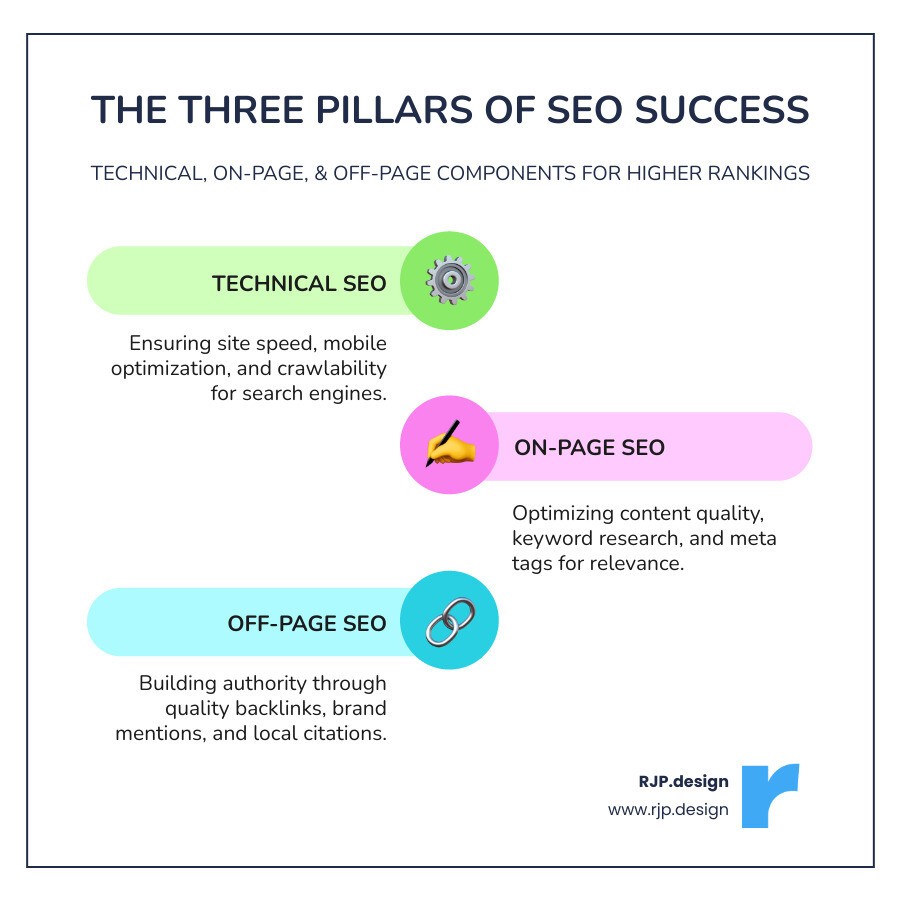
Successful SEO rests on three interconnected pillars. Like a three-legged stool, if one leg is weak, the entire structure fails. That’s how SEO strategies for websites work.

These pillars—On-Page SEO, Off-Page SEO, and Technical SEO—work in harmony. Technical SEO builds the stage, On-Page SEO is the performance, and Off-Page SEO brings the audience. At RJP.design, we know that shortcutting any pillar leads to unstable results. A holistic approach creates a virtuous cycle: technical fixes improve content performance, great content attracts backlinks, and quality backlinks build trust.
Mastering On-Page SEO strategies for websites
On-Page SEO involves optimizing elements directly on your website to help search engines and users understand your content.
Content Quality: This is the heart of on-page SEO. Google rewards well-researched, clearly written content that provides real value. Comprehensive blog posts of around 2,100-2,400 words often perform well.
Keyword Research & Search Intent: Our SEO keyword research uncovers the exact phrases your audience uses. Crucially, we analyze search intent—the why behind a search—to create content that truly meets user needs.
E-E-A-T: Google values content demonstrating Experience, Expertise, Authoritativeness, and Trustworthiness. This means writing from genuine experience and citing credible sources. You can learn more from Google’s Search Quality Evaluator Guidelines.
Title Tags & Meta Descriptions: Your title tag is the clickable headline in search results. It needs to be compelling and include your primary keyword. The meta description is your 160-character elevator pitch to earn the click.
Header Tags & Image Optimization: Headers (H1, H2, H3) structure your content for readability. Image optimization, including descriptive alt text, improves site speed and accessibility, and can drive traffic from Google Image Search.
Building Authority with Off-Page SEO strategies for websites
Off-Page SEO involves building your website’s reputation across the web. It’s about earning trust and authority.
Backlinks: These are recommendations from other sites. Quality trumps quantity; one link from a respected industry leader is worth more than hundreds of low-quality links.
Brand Mentions & Digital PR: Even unlinked mentions of your brand help establish credibility. Digital PR involves getting your brand featured in relevant publications and podcasts to build expertise.
Social Signals: While not a direct ranking factor, a strong social media presence amplifies your content, drives traffic, and can lead to natural backlinks.
Local Citations: For local businesses, consistent mentions of your business name, address, and phone number (NAP) in online directories are critical. Our Google Maps optimization service ensures your local presence is solid.
Great content and off-page SEO are inseparable. You can’t build quality links without valuable content to link to. Our approach to Link Building (Off-Page SEO) focuses on this synergy to build sustainable authority.
Mastering Technical SEO for a Flawless Foundation
Technical SEO is the foundation of your house. Without a solid foundation, even the best decor is unstable. It’s what makes your SEO strategies for websites work behind the scenes.
Key elements of technical SEO include:
Website Architecture: A logical site structure helps users and search engines steer easily, ensuring important pages are just a few clicks from the homepage.
Site Speed: Fast-loading sites get priority. If a site takes more than three seconds to load, most visitors leave. Google’s Core Web Vitals (LCP, FID, CLS) are the standard for measuring user experience.
Mobile-Friendliness: With mobile-first indexing, Google primarily ranks your mobile site. Our Responsive Web Design ensures a perfect experience on any device.
Crawlability & Indexability: Search engines must be able to explore (crawl) and save (index) your pages. If they can’t, your content is invisible.
URL Structure: Clean, descriptive URLs like
yourwebsite.com/services/web-designare better for users and SEO than confusing ones.Structured Data (Schema): This markup helps search engines understand your content (e.g., products, reviews), which can lead to eye-catching rich results that improve click-through rates.
Our Technical SEO Experts handle these details, from compressing images to minimizing code, to make your site fast and search-engine friendly.
Common Technical SEO Pitfalls to Avoid
Avoid these common mistakes that can sabotage your SEO efforts:
Duplicate Content: The same content on multiple URLs confuses search engines and dilutes your ranking power.
Broken Links: These 404 errors frustrate users and signal a poorly maintained site.
Poor Mobile Experience: Beyond responsiveness, issues like hard-to-close pop-ups or tiny buttons can hurt your rankings.
Slow Page Load Times: Often caused by large images or bloated code, this is a major ranking killer.
Improper Redirects: When moving a page, a 301 redirect is essential to pass along its SEO value. Forgetting this is like moving without a forwarding address.
You can check your site’s health with Google’s Lighthouse testing tool, which provides actionable recommendations.
Measuring, Analyzing, and Refining Your SEO Efforts
Effective SEO strategies for websites are like tending a garden. You must consistently measure, analyze, and refine your efforts based on data to see real growth.
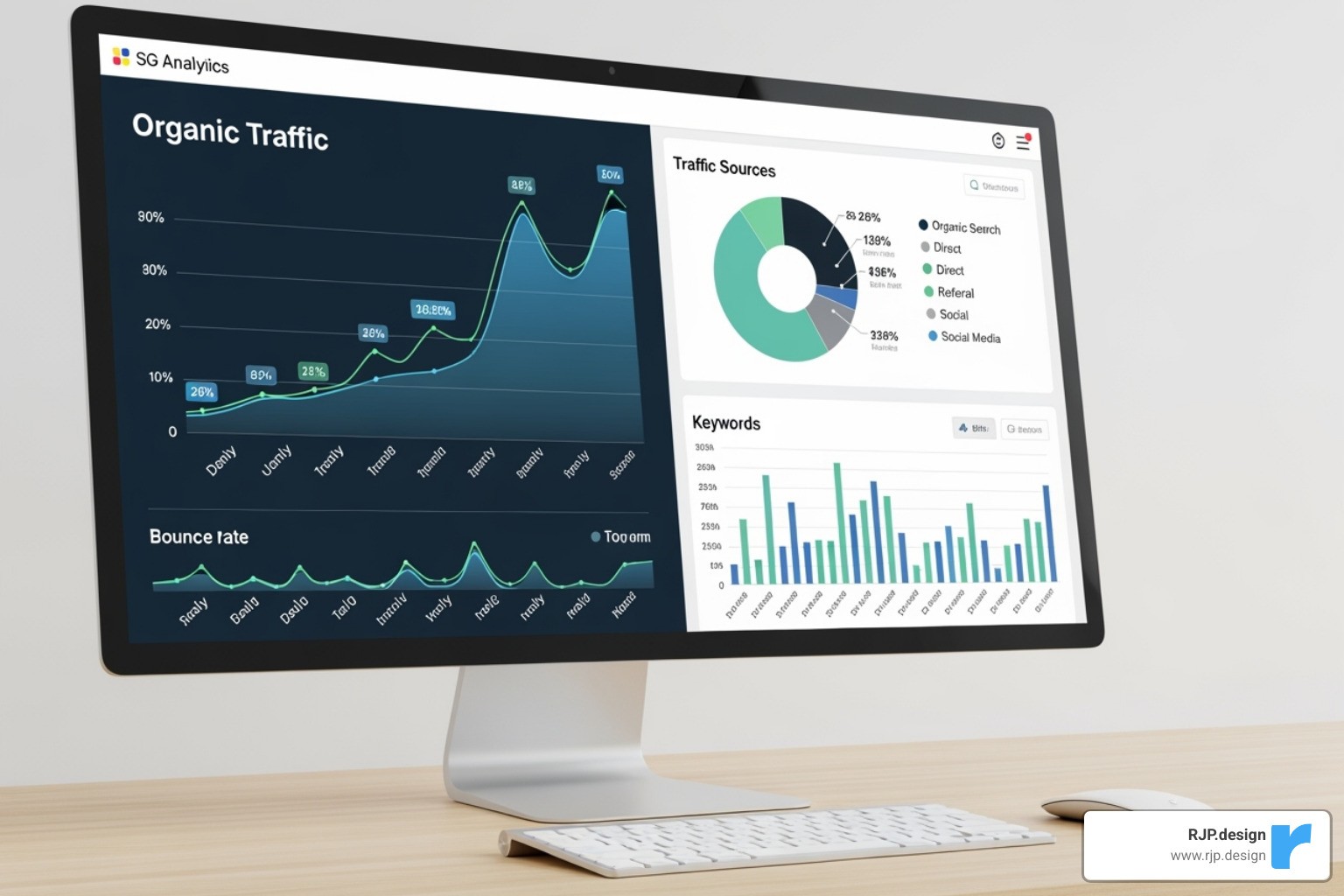
Focus on Key Performance Indicators (KPIs) that connect to your bottom line:
Organic Traffic: The number of visitors from search engines.
Keyword Rankings: Your position for important search terms.
Conversions: The number of visitors who take a desired action (e.g., call, fill out a form, make a purchase).
Click-Through Rate (CTR): The percentage of people who click your link in search results.
Bounce Rate: The percentage of visitors who leave after viewing only one page.
We use essential tools to track these KPIs:
Google Analytics: Shows where visitors come from, what content they engage with, and how they behave on your site.
Google Search Console: Your direct line to Google. It reveals which queries bring you traffic and alerts you to technical issues.
We track keyword rankings over time, looking for a steady upward trend. If we see a sudden traffic drop, we investigate using these tools to diagnose the cause, whether it’s a technical issue or a Google algorithm update.
The goal is to prove ROI. We connect your SEO investment to tangible business results, like new leads generated or a higher conversion rate for organic visitors. After 4-6 months, you should see more search engine impressions, which then turn into clicks and, eventually, customers.
Our SEO Campaign Management service provides this continuous monitoring and fine-tuning to ensure your SEO strategies for websites deliver lasting results.
Frequently Asked Questions about Website SEO
SEO can seem complex, but understanding these common questions will help set realistic expectations for your SEO strategies for websites.
How long does it take for SEO to show results?
SEO is a long-term strategy. Think of it like planting a tree; it needs time to grow. You can typically expect:
Initial Results (4-6 months): You’ll start seeing movement, like more impressions in Google Search Console or rankings for new keywords.
Significant Impact (6-12 months): This is when you’ll see meaningful increases in organic traffic and leads.
This timeline depends on factors like industry competition and your website’s age. SEO is an ongoing process, not a one-time project, requiring continuous investment to maintain and grow results.
Can I do SEO myself?
Yes, DIY SEO is possible, especially for smaller businesses. It requires developing skills in research, content creation, and basic technical understanding. The biggest challenge is the time commitment; effective SEO requires several hours per week for content, maintenance, and analysis.
Consider hiring an expert if you lack the time, find the technical aspects overwhelming, or are in a highly competitive market. Our SEO Experts Near Me can accelerate your results and free you to focus on your business.
Is content more important than backlinks?
This is like asking if flour or yeast is more important for bread—you need both. The relationship is symbiotic.
Quality content is foundational. It demonstrates your expertise, builds trust, and gives search engines something valuable to rank.
Backlinks build authority. They are votes of confidence from other reputable sites that prove your content’s value to Google.
Great content deserves to rank, while quality backlinks prove it should. Start by creating the best content possible for your audience. This will naturally attract some links, which you can supplement with active promotion and relationship building.
Conclusion
We’ve covered the essential SEO strategies for websites that can transform your online presence, from the three pillars of technical, on-page, and off-page SEO to the importance of measurement and refinement.
SEO is not a one-time task but an ongoing process. The digital landscape is always evolving, but the core principle remains the same: the future of SEO is about putting people first. Search engines are getting better at rewarding websites that provide genuine value to users.
At RJP.design, this philosophy is at the heart of what we do. We build beautiful websites that are also powerful marketing tools—digital experiences that search engines love to recommend and users love to visit.
Your website should be your hardest-working employee, attracting visitors and turning them into customers. If it’s not, we can help.
Ready to open up your website’s full potential? Take the next step in your online growth with our digital marketing services.