SEO
SEO for Developers: How to Build Websites Google Actually Likes
Aug 5, 2025

SEO website development: Master 3 Keys
Why SEO Website Development Is Critical for Modern Businesses
SEO website development is the practice of building websites that both search engines and users love from day one. Instead of treating SEO as an afterthought, this approach integrates search optimization directly into the development process.
Key Components of SEO Website Development:
Technical Foundation: Clean code, fast loading speeds, mobile responsiveness, and HTTPS security
Site Architecture: Logical navigation, SEO-friendly URLs, and strategic internal linking
On-Page Elements: Optimized title tags, meta descriptions, header structure, and image alt text
User Experience: Core Web Vitals optimization, accessibility compliance, and intuitive design
Content Strategy: Structured content that serves both users and search engines
The stakes are high. Research shows that 48% of people cite a website’s design as the number one factor in deciding business credibility. Meanwhile, websites that take longer than three seconds to load lose nearly half their visitors.
Modern SEO website development has shifted focus from just pleasing Google to serving users first, which in turn satisfies search engine requirements. SEO is no longer a simple add-on but a complex discipline involving content, UX, and development. This complexity means that integrating SEO from the start is far more efficient than retrofitting it later.
I’m Ross Plumer, and I’ve helped businesses that have marketed over $20 million in revenue by integrating psychology and strategic thinking into SEO website development projects. My approach combines technical expertise with user-focused design to create websites that both rank well and convert visitors into customers.
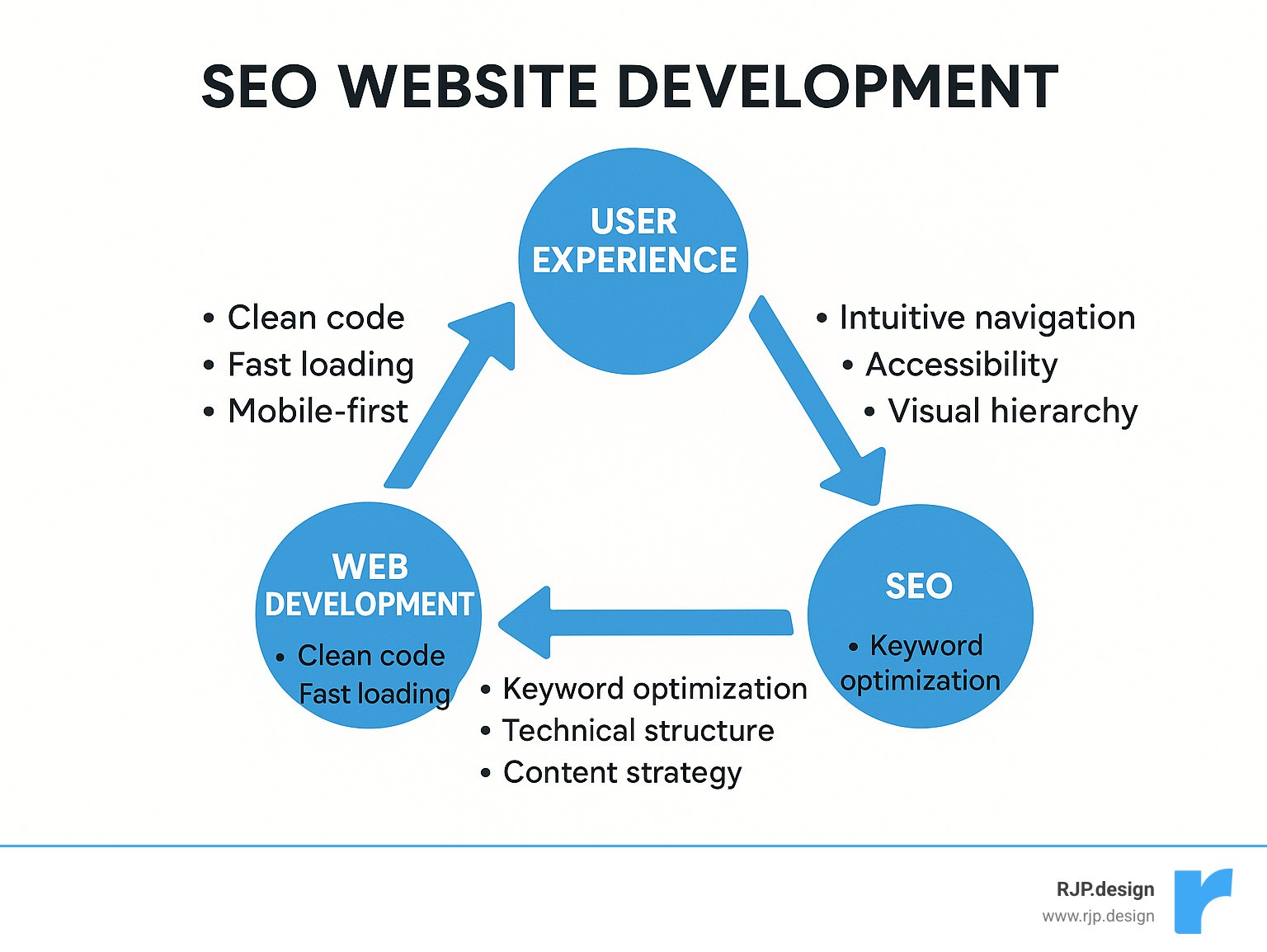
Simple guide to SEO website development terms:
The Foundation: Why Web Development is the Cornerstone of SEO
At RJP.design, we see an effective online presence like a house: it needs a rock-solid foundation. SEO website development is about laying that foundation, ensuring your site is built to last and easily found by search engines.
Web design and SEO are two sides of the same coin, working together to please both users and search engines. A beautiful site is useless if it can’t be found, and an optimized site won’t convert visitors if it’s difficult to use. Our goal is to merge visual appeal with search engine intelligence.
This synergy is crucial for user experience (UX), crawlability, and indexability. Google’s philosophy on user focus prioritizes the human experience; a site that’s fast, intuitive, and easy to steer signals quality to search engines.
Crawlability and indexability are the bare minimum for being found online. If search engine bots can’t read and understand your site’s content and structure, it won’t appear in search results. Our development process ensures search engines can effortlessly explore and list your site, making it visible for relevant searches. For more details on how we make this happen, check out our page on More info about Web Design Development.

How Development Directly Impacts SEO Performance
Your website’s build quality directly impacts its perceived value to search engines. Metrics like dwell time (how long visitors stay) and bounce rate (how quickly they leave) are key indicators. A high bounce rate suggests visitors aren’t finding what they need, which is a red flag for Google. Conversely, long dwell times signal that your site provides real value.
These positive signals boost engagement and lead to better conversion rates. A well-built, SEO website development project with a great user experience translates into more leads and sales. Want to see how we help businesses hit their targets? Take a look at our Website Conversion Strategies.
Technical performance, especially page load speed, is a critical ranking factor. If your site is slow, users get frustrated and leave. In fact, “Nearly 70% of consumers admit that page speed impacts their willingness to buy.” Making your site fast isn’t just about making users happy; it’s about making Google happy too.
We see SEO as a long-term marketing strategy that starts the moment we begin planning your website. It’s a steady commitment that pays off over time in better search engine visibility.
The High Cost of Ignoring SEO in Development
We’ve often seen businesses invest in a beautiful website only to see their organic traffic plummet because SEO was an afterthought. Retrofitting SEO onto an existing site is far more complex, time-consuming, and expensive than building it in from the start.
Ignoring SEO during development leads to higher future costs, missed ranking opportunities, and a loss of user trust. Since 48% of people cite a website’s design as the number one factor in deciding the credibility of a business, a poorly performing site can be detrimental.
Conversely, an excellent SEO website development project that integrates great design, smart development, and a solid content strategy can increase your leads by up to 250%! That’s a massive return on investment you’ll miss if SEO isn’t a priority from day one. If you’re considering a website overhaul, our Website Redesign Service is designed to put SEO at its core.
Core Technical Elements of SEO Website Development
The technical elements of SEO website development are the secret sauce for online success. Our Technical SEO Experts focus on clean code, lightning-fast website speed, mobile-first indexing, and strong HTTPS security. These are direct signals to Google that your site is high-quality and trustworthy.
The Need for Speed: Optimizing for Core Web Vitals
Speed is everything. Nearly 70% of consumers admit that page speed impacts their willingness to buy. Most users will only wait 2 to 3 seconds for a page to load before leaving. A six-second load time can lose you nearly half your potential visitors.
That’s why page speed is a critical ranking factor, and why Google emphasizes Core Web Vitals. These metrics measure how fast, responsive, and stable your website feels to users.
They look at things like:
Largest Contentful Paint (LCP): How quickly the main content appears.
First Input Delay (FID) / Interaction to Next Paint (INP): How fast the site responds to a click or tap (INP is the new metric as of March 2024).
Cumulative Layout Shift (CLS): How much the page layout shifts unexpectedly.
Improving these scores involves image optimization and caching techniques. We’ve seen how a 40% reduction in wait time can lead to a 15% increase in SEO traffic and a 15% increase in sign-ups! That’s the true power of speed. You can check your site’s performance with Google’s PageSpeed Insights tool.
Mobile-First by Default: Building for the Modern User
We live in a mobile-first world. Over 60% of all searches now come from mobile devices, which accounted for nearly 59% of all global website traffic in 2022. This means a mobile-friendly design is non-negotiable for ranking well. Google now uses mobile-first indexing, primarily evaluating the mobile version of your site for ranking.
We build truly responsive web design that provides an optimal mobile experience, with thoughtful navigation, readable content, and fast load times on any device. Your website will look and work beautifully from a tiny smartphone to a huge desktop monitor. For more detail, check out Google’s mobile-first indexing best practices.
Code, Crawlability, and Security
Clean, efficient HTML is the backbone of any great SEO website development project. It makes your site faster, easier for search engines to crawl and index, and simpler to maintain. We adhere to W3C web standards and guidelines to ensure everything is optimized for SEO.
Search engines need full access to your CSS and JavaScript files to render your site correctly. We configure the robots.txt file to ensure search bots can explore your site completely.
Security is non-negotiable. HTTPS encryption, indicated by the padlock icon, has been a Google ranking signal since 2014. More importantly, it protects user data and builds trust. You can learn more from Google’s guide on HTTPS encryption.
We also use structured data (schema) markup to help search engines understand your content, which can lead to “rich snippets” in search results. We monitor everything with tools like Google Search Console to spot issues and ensure peak performance.
Structuring for Success: On-Page SEO and Site Architecture
With a solid technical foundation, the next step is organizing and presenting your content. Site architecture, navigation, URL structure, and internal linking must create a seamless experience for both users and search engines.
Building a Logical Blueprint: Website Structure and Navigation
A poorly structured website is like a chaotic library. A logical site architecture, or “silo structure,” organizes content into clear categories. This helps users find information and helps search engines understand your content’s hierarchy and relevance. We plan the Information Architecture (IA) before designing.
User-friendly menus and breadcrumbs (e.g., “Home > Services > Web Design”) are key. As research notes, “Using breadcrumb navigation helps users understand their location on a website and steer back easily.” You can see a great Example of clear navigation from SISU.
Here are some of our navigation best practices:
Ensure a clean and logical website structure with clear, intuitive navigation.
Organize content with well-structured menus and strategic internal linking.
Prioritize simplicity and ease of use.
Use descriptive labels for menu items.
Implement breadcrumb navigation to show users their location within the site hierarchy.
On-Page Essentials for an SEO Website Development Project
On-page SEO elements optimize individual pages for specific keywords and user intent.
Title Tags: The headline in search results. “36% of SEO experts think the title tag is the most important SEO element.” We keep them concise (50-60 characters) and compelling.
Meta Descriptions: Your ad copy in search results. While not a direct ranking factor, a good description (around 155-160 characters) improves click-through rates.
Header Tags (H1, H2, etc.): These structure your content for readability, providing a clear outline for users and bots.
Image Alt Text: Descriptive text for images, crucial for accessibility and helping search engines understand image content.
Keyword Integration: We naturally weave keywords into content, titles, and headings. Keyword stuffing is outdated and harmful.
Readability: We focus on clear language, short paragraphs, and bullet points. Google rewards content that’s easy to digest.
For comprehensive optimization of these elements, explore our SEO Optimization Services.
The Power of the Link: URLs and Internal Linking
We create clean, descriptive, SEO-friendly URLs that include keywords (e.g., yourdomain.com/services/seo-website-development instead of yourdomain.com/page?id=123).
Internal linking is a powerful tool in our SEO website development arsenal. It distributes “link equity” across your site, helps search engines find new content, and establishes relationships between pages. We use descriptive anchor text to provide context.
We regularly audit for broken links, which frustrate users and signal a neglected site. We fix them using 301 redirects to preserve SEO value.
When multiple URLs exist for the same content, canonical tags tell search engines which version is the “master” copy, preventing duplicate content issues and consolidating link equity. For a deeper dive, check out our Search Engine Optimization Analysis.
Integrating SEO into the Development Workflow
At RJP.design, we believe successful SEO website development requires integrating SEO from day one. It’s a foundational piece woven into every step of the building process. Our Custom Web Design Services blend SEO into every stage, because as research shows, 73% of companies invest in design to differentiate their brand. For us, true differentiation includes being easily found.
The magic happens when our web developers and SEO specialists work as a unified team. We align your content strategy, user experience (UX), and technical details with your SEO goals, paying close attention to website accessibility, which often overlaps with good SEO practices.
A Collaborative Approach to SEO Website Development
Our approach is built on teamwork. From the first conversation, every decision about site structure and content layout is made with your SEO objectives in mind.
We use a comprehensive pre-launch checklist and staging environments to test everything thoroughly. After launch, we conduct post-launch monitoring to track performance and make adjustments.
We expertly manage technical details like 301 and 302 redirects. A 301 redirect is a permanent “change of address” for a webpage, while a 302 is temporary. Using them correctly is vital for maintaining search engine authority, as explained here: 301 and 302 redirects.
We help you avoid common mistakes like poor mobile optimization, slow page speeds, messy site structure, or low-quality content. Our SEO Campaign Management service ensures continuous monitoring and fine-tuning long after launch.
Beyond the Code: Content, UX, and Accessibility
Clean code is crucial, but content, user experience (UX), and accessibility are equally vital for a successful SEO website development project.
Google’s E-E-A-T guidelines (Experience, Expertise, Authoritativeness, and Trustworthiness) emphasize quality content. We focus on creating helpful, reliable content that serves your audience, using a smart visual hierarchy to guide visitors.
Your site’s user experience (UX) and SEO performance are deeply connected. A site that’s easy and enjoyable to use will naturally perform better in search results.
Finally, website accessibility is a must-have, ensuring your site is usable by everyone, including the 1 billion people globally with disabilities. Many accessibility best practices, like alt text, also have direct SEO benefits. We follow the Web Content Accessibility Guidelines (WCAG) to create an inclusive, high-performing site.
Frequently Asked Questions about SEO for Developers
Developers and business owners often ask about integrating SEO into their work. Here are answers to the most common questions we hear:
How does clean code contribute to a website’s SEO performance?
Clean code is like a well-organized toolbox; it makes everything run more efficiently, directly boosting your SEO website development efforts.
First, clean, lean code helps your site load much faster, a critical ranking factor and a big win for user experience.
Second, well-structured code allows search engine bots to efficiently crawl and index your content, leading to fewer indexing errors.
Finally, a smooth-running site improves the user experience, reducing bounce rates. For developers, a clean codebase simplifies maintenance and updates. As the saying goes, It pays to keep things simple.
What’s the relationship between user experience (UX) and SEO in website design?
The relationship between UX and SEO is a perfect partnership. Google’s algorithms have evolved to prioritize the user, making the two concepts “intertwined.”
Google rewards good UX because a positive user experience aligns with its mission. This influences SEO through several indirect ranking signals:
Dwell time: How long users stay on your page. Longer visits suggest engaging content.
Bounce rate: The percentage of visitors who leave after viewing one page. A high rate can signal a poor experience.
Mobile usability: How easy your site is to use on mobile. Poor usability hurts mobile rankings.
By investing in UX, you’re investing in your SEO. Our research highlights this perfectly: “Every dollar invested in UX brings $100 in return, an ROI of 9,900%.”
How do I measure the success of SEO-friendly development choices?
Measuring the success of your SEO website development is crucial for understanding what’s working and where to make adjustments. We use a combination of powerful tools and key metrics to track performance:
Google Analytics: Tracks user behavior metrics like organic traffic growth, bounce rates, session duration, and conversion rates.
Google Search Console: Provides insights into how Google ranks your site. We monitor keyword ranking improvements, search queries, and crawl errors.
Core Web Vitals scores: These metrics (LCP, INP, CLS) are direct indicators of your site’s speed and user experience.
Conversion rate tracking: The ultimate measure of success. An increase in organic conversions shows your SEO efforts are paying off.
Our Search Engine Optimization Analysis services provide detailed reports based on these metrics to ensure your website continues to grow.
Conclusion
This guide has highlighted that effective SEO website development isn’t about technical tricks, but about creating an amazing user experience from the first line of code.
Prioritizing SEO website development from the start lays a strong foundation for your online presence. This results in faster websites, a better user experience, and increased visibility in search results, creating a powerful platform for your digital marketing.
The process can seem complex, but you don’t have to steer it alone. Partnering with a down-to-earth team like RJP.design can make it feel effortless. We’re here to make sure your website doesn’t just look stunning, but also ranks high, attracting exactly the right audience and helping your business truly grow.
So, are you ready to build a website that both search engines and your customers will absolutely adore? Let’s roll up our sleeves and create something truly amazing together. Start your digital marketing project with us.