
Marketing
The Ultimate Guide to Website Marketing Basics
Sep 2, 2026

Why Website Marketing Turns Your Site Into a Growth Engine
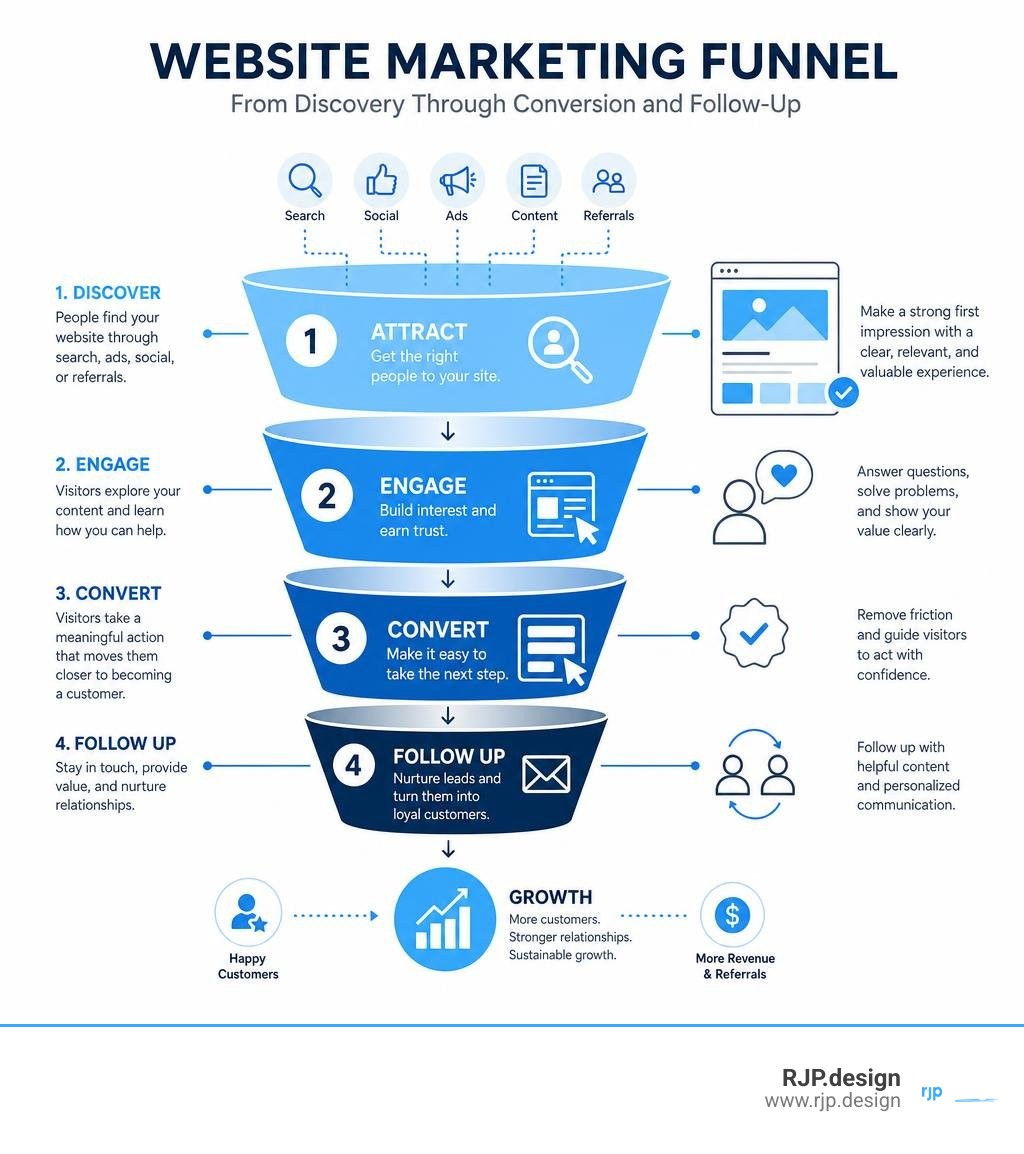
Website marketing is the process of using your website to attract the right people, earn their trust, and guide them toward a meaningful next step - such as calling, booking, buying, or requesting a quote. For a small business, the essentials are straightforward: make the site easy to find, clearly explain how you help, and remove friction from the path to conversion.
More than 32% of consumers use search engines to discover new brands. That means an outdated, hard-to-find website can quietly send prospective customers to competitors, while a useful, fast, mobile-friendly site can work as a 24/7 sales and credibility tool.
Effective website marketing connects several disciplines: search visibility, helpful content, focused landing pages, lead forms, email follow-up, social distribution, and conversion optimization. It also now includes optimization for AI-driven search experiences, where clear, well-structured answers can help your business appear when people ask tools for recommendations or solutions.
I am Ross Plumer, an entrepreneur and digital marketer with experience in website design, development, and website marketing for businesses responsible for more than $20 million in revenue. In this guide, I will break down the practical foundations that help turn a website from a digital brochure into a dependable customer-acquisition channel.
Core Pillars of High-Impact Website Marketing
At RJP.design, we believe a great website does not just look sharp—it actively works to grow your business. When you treat your site as a central hub rather than an online business card, it brings together search traffic, paid ads, content, and direct interactions into a smooth customer journey.
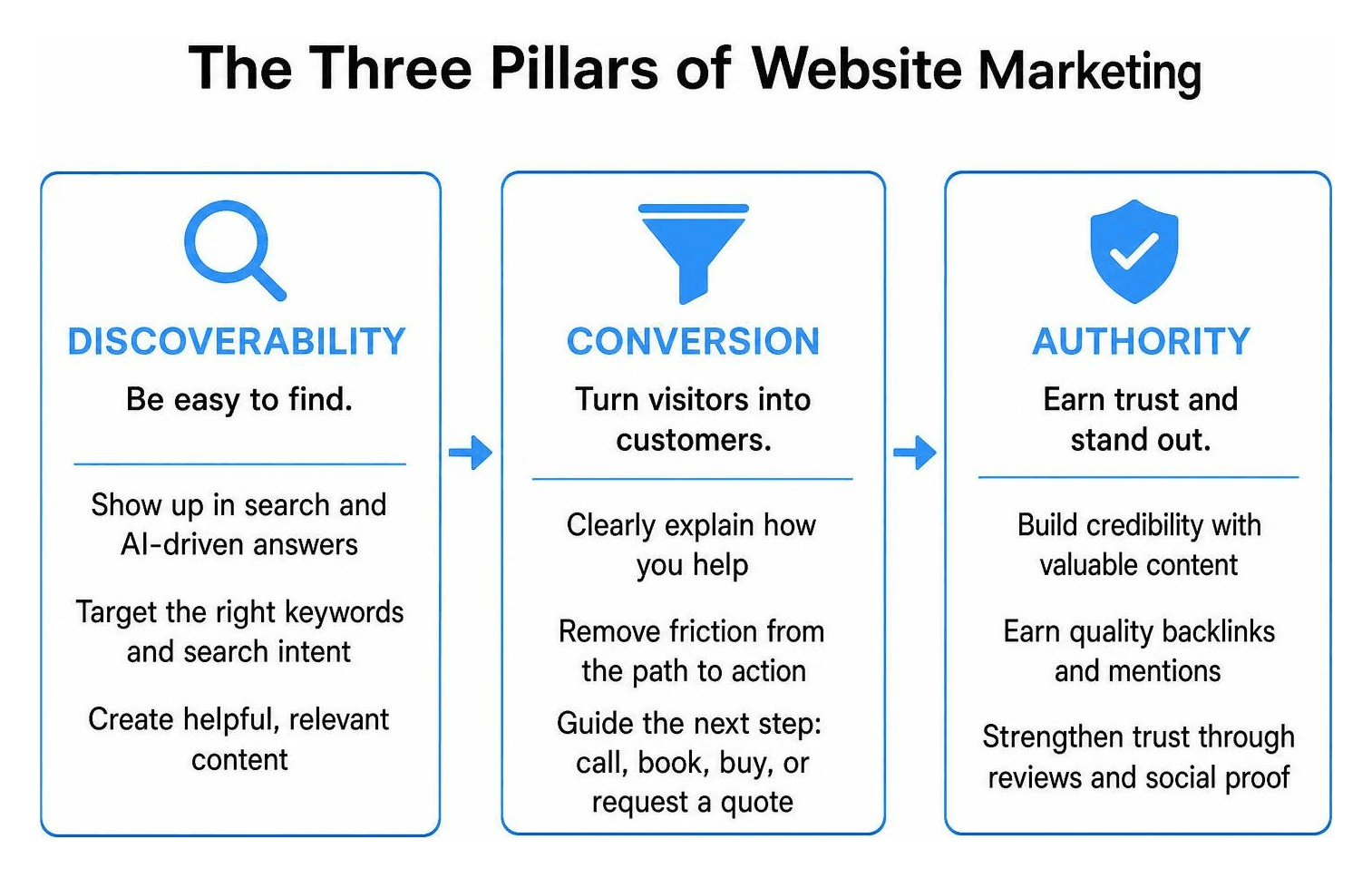
To turn casual visits into lasting relationships, we help businesses implement proven digital marketing strategies built around three foundational pillars: discoverability, conversion, and authority.
Foundational SEO and AIO for Website Marketing
For years, search engine optimization (SEO) focused entirely on standard organic rankings. Today, as search platforms integrate generative answers, we also focus on Artificial Intelligence Optimization (AIO) and Answer Engine Optimization (AEO).
Traditional SEO ensures your site matches exact search intent and satisfies technical crawler guidelines. Meanwhile, AIO structures your content so large language models (LLMs) and AI search features cite your brand as an authority.
Tracking keywords and prompt mentions is much simpler when using industry intelligence platforms like Semrush: Your Unfair Advantage for Growing Brand Visibility, which tracks 28 billion keywords and over 43 trillion backlinks across its global databases.
Strategy Dimension | Traditional SEO | Modern AIO / GEO |
|---|---|---|
Primary Goal | Rank on Page 1 of organic search results | Get cited in AI summaries and direct conversational answers |
Target Keywords | High-volume head terms and specific long-tail keywords | Natural-language questions, prompts, and contextual problem phrases |
Content Structure | Keyword-focused headers, metadata, and backlinks | Structured Q&As, clear definitions, entity data, and authoritative citations |
Success Metric | Organic clicks, impressions, and average position | AI prompt visibility, brand citations, and high-intent referral traffic |
High-Converting Landing Pages and Virtual Agents
Sending paid ad traffic or specific campaign clicks to your general homepage often causes visitors to bounce because the page lacks focus. Building dedicated landing pages ensures perfect message matching: the promise made in your ad directly mirrors the headline on the page.
To streamline this experience, we pair clear calls to action with interactive support tools. Modern conversational agents and AI chatbots serve as round-the-clock assistants, answering questions instantly and guiding prospects toward booking. For instance, data shows that 45% of service bookings were completed online after personalizing the website experience.
Pairing dynamic personalization with custom web design and web development services ensures every visitor enjoys a frictionless path from initial click to completed checkout.
Content Strategy and Lead Generation in Website Marketing
Educational content attracts prospective clients who are actively researching solutions to their problems. Instead of writing generic posts, we focus on detailed guides and how-to articles that solve everyday challenges.
Once you publish an in-depth article, you can repurpose it into newsletter topics, social media takeaways, and downloadable resources. Monitoring topic gaps and competitor strategies is made easier by leading tools such as Ahrefs—AI Marketing Platform Powered by Big Data, an index indexing over 170 trillion web pages and tracking 41.9 billion search terms worldwide.
To capture demand effectively, incorporate these key elements throughout your content:
Low-friction lead capture forms: Offer valuable checklists, guides, or consultations in exchange for an email address.
Detailed case studies: Demonstrate real-world results, highlighting client challenges, solutions, and measurable outcomes.
Authentic social proof: Feature client reviews and verified badges near key decision points.
Strategic Execution and Ongoing Optimization
Launching your website is only the first step. Driving consistent growth requires steady tracking, regular audits, and practical refinements. Our down-to-earth team at RJP.design works closely with clients to review performance data and keep online campaigns running at peak efficiency.
Tailoring your ongoing plan with dedicated internet marketing services for small businesses ensures your marketing budget translates into clear revenue.

Audience Mapping and Technical Mobile Performance
Before writing copy or running campaigns, outline your target audience personas. Knowing their core pain points helps you shape messaging that resonates immediately.
Because mobile devices account for a significant portion of all web browsing, technical performance directly influences both search rankings and sales. A slow mobile site frustrates users and lowers conversion rates.
To keep your mobile site performing at its best, run through this practical checklist:
Speed: Ensure primary content renders within two seconds on mobile networks.
Touch targets: Make buttons and interactive links easy to tap without accidental clicks.
Readable typography: Use clear font sizes that do not require pinch-to-zoom.
Simple forms: Keep form fields short and enable mobile autofill features.
Clean navigation: Keep menus streamlined so visitors can find key pages in a single tap.
Essential Marketing Tech Stack and Integrated Channels
A dependable tech stack ties your daily marketing efforts into a single, cohesive workflow:
Customer Relationship Management (CRM): Organizes incoming leads, logs interactions, and automates prompt follow-ups.
Web Analytics: Tracks visitor behavior, traffic sources, and conversion funnels to show what works best.
Email Marketing Automation: Delivers targeted nurture sequences based on what users view or download.
Omnichannel Bridges: Connects offline efforts—such as QR codes on print collateral or event banners—directly to customized web pages.
Reviewing your strategy on a quarterly basis keeps your business aligned with shifting search trends, emerging technologies, and customer needs. If you are ready to build a reliable online presence that earns trust and wins customers, explore our complete website marketing solution to get started today.