
Web
Beginner's Guide to eCommerce Design Process
Jan 15, 2026
Why Your eCommerce Website Design Determines Your Online Success
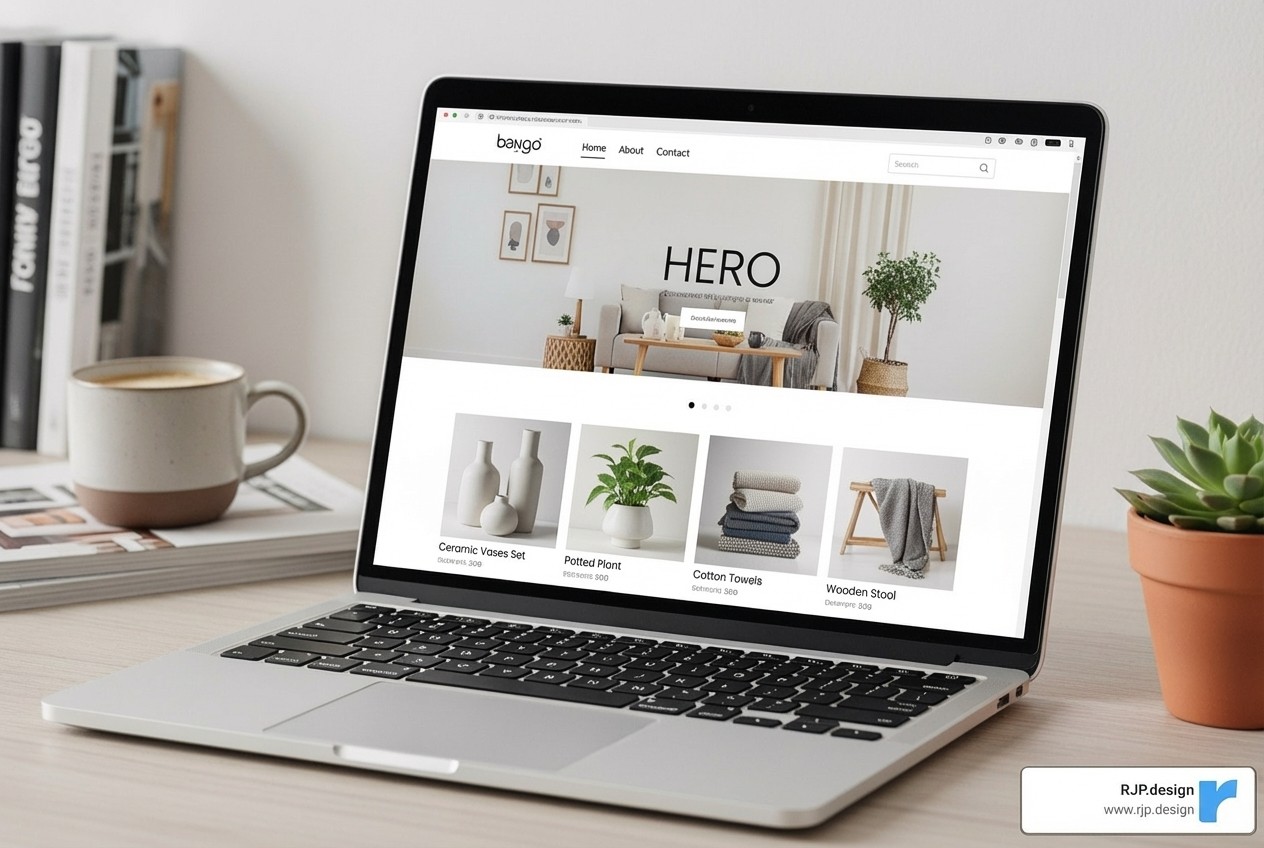
Ecommerce website design is more than just making your online store look pretty—it's the difference between a visitor who bounces and a customer who completes a purchase. Your design directly impacts trust, usability, conversion rates, and ultimately, your bottom line.
Essential elements of effective ecommerce website design:
Mobile-responsive layout - Over 62% of ecommerce sales will come from mobile devices by 2027
Fast page load times - You have just 50 milliseconds to make a good first impression
Clear, intuitive navigation - Shoppers should find products without confusion
High-quality product imagery - Can improve conversions by up to 40%
Trust signals - SSL certificates, reviews, and clear policies build credibility
Streamlined checkout - Reduce friction to minimize cart abandonment
The stakes are remarkably high: 94% of first impressions are related to your site's design, and 57% of internet users won't recommend a company with a poorly designed website. When you land on an ecommerce site, you instantly form an opinion. Is it professional? Can you trust it? Your customers are doing the exact same mental calculus.
The good news is that great ecommerce design follows proven principles. You don't need to reinvent the wheel—you need to understand what works and how to implement it for your business.
I'm Ross Plumer, and I've spent years helping businesses design and optimize ecommerce websites that have collectively generated over $20 million in revenue. Throughout this guide, I'll share the practical ecommerce website design strategies that have consistently delivered results.
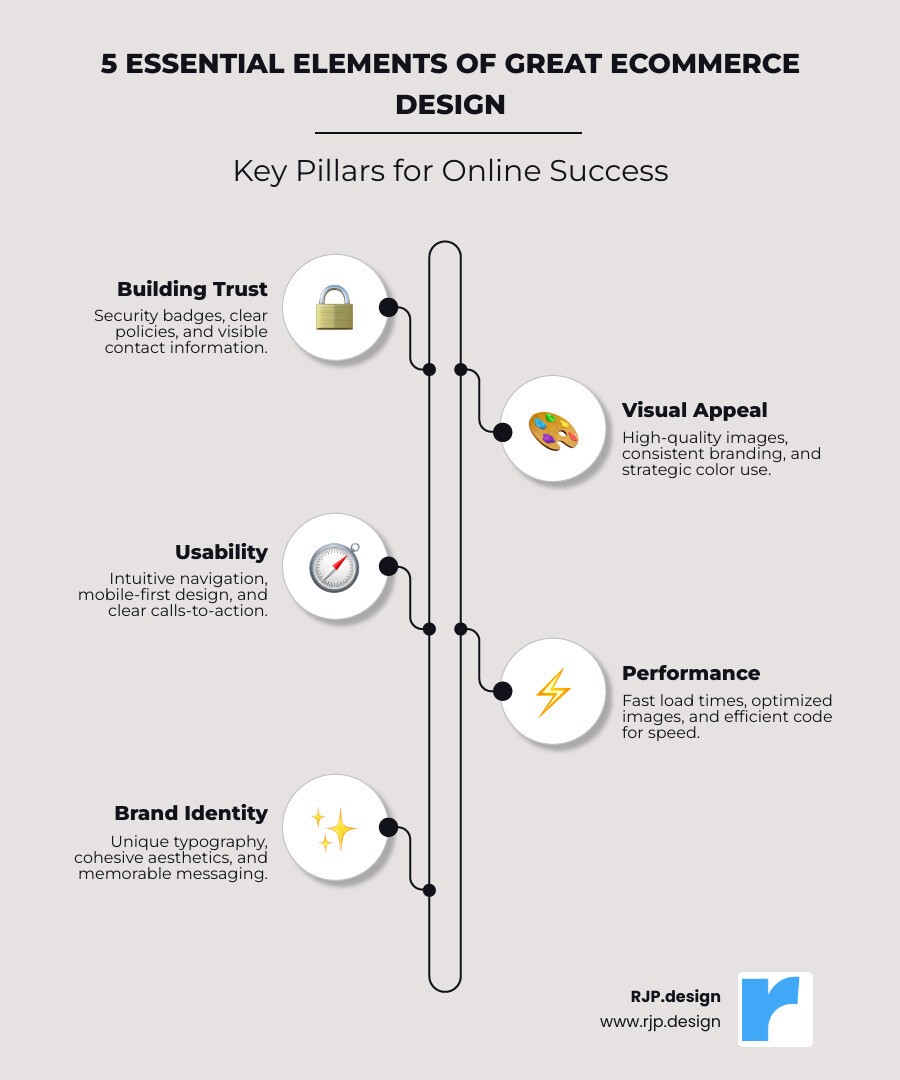
Ecommerce website design definitions:
The Core Pillars of High-Converting Ecommerce Website Design
Building a successful online store is about crafting an experience that builds confidence and guides customers smoothly toward a purchase. This involves focusing on several core pillars of ecommerce website design that work together to create a high-converting platform.
Building a Foundation of Trust and Usability for Your Ecommerce Website Design
When customers visit your store, they're taking a leap of faith. Our job is to make that leap feel safe and effortless. With mobile commerce expected to account for 62% of all ecommerce sales by 2027, a responsive design is non-negotiable. Your site must adapt flawlessly to every screen, from desktops to smartphones. We ensure flexible layouts, readable text, and touch-friendly navigation, which is also crucial for Google's mobile-first indexing.
Clear site navigation is paramount. Streamlined navigation minimizes the effort required to find products. We employ several strategies for clarity:
Simple Categories: We limit main categories to 3-7 clear, descriptive labels.
Mega Menus: For stores with many products, these organize extensive options into easy-to-browse sections.
Breadcrumbs: These navigational aids show users their location, making it easy to backtrack.
Prominent Search Bar: A visible search bar is essential, as shoppers who use on-site search are 3 times more likely to convert.
Robust Filtering: Options like size, color, and price help customers quickly narrow their choices.
Trust is the bedrock of online commerce. We build it by incorporating visible and reassuring elements:
SSL Certificates: An SSL certificate (indicated by "HTTPS") encrypts data and is non-negotiable for security.
Clear Policies: Transparent and easy-to-find return and exchange policies signal fairness.
Contact Information: Accessible contact details reassure customers that real people are behind the website.
Payment & Security Logos: Displaying logos of trusted payment providers instills confidence.
By focusing on these foundational elements, we create an ecommerce website design that keeps customers engaged and confident. For more insights, check out our guide on user experience design.
Creating a Visually Compelling Shopping Experience
Once trust is established, the next step is to captivate your audience visually. A compelling experience communicates value, reinforces your brand, and drives conversions.
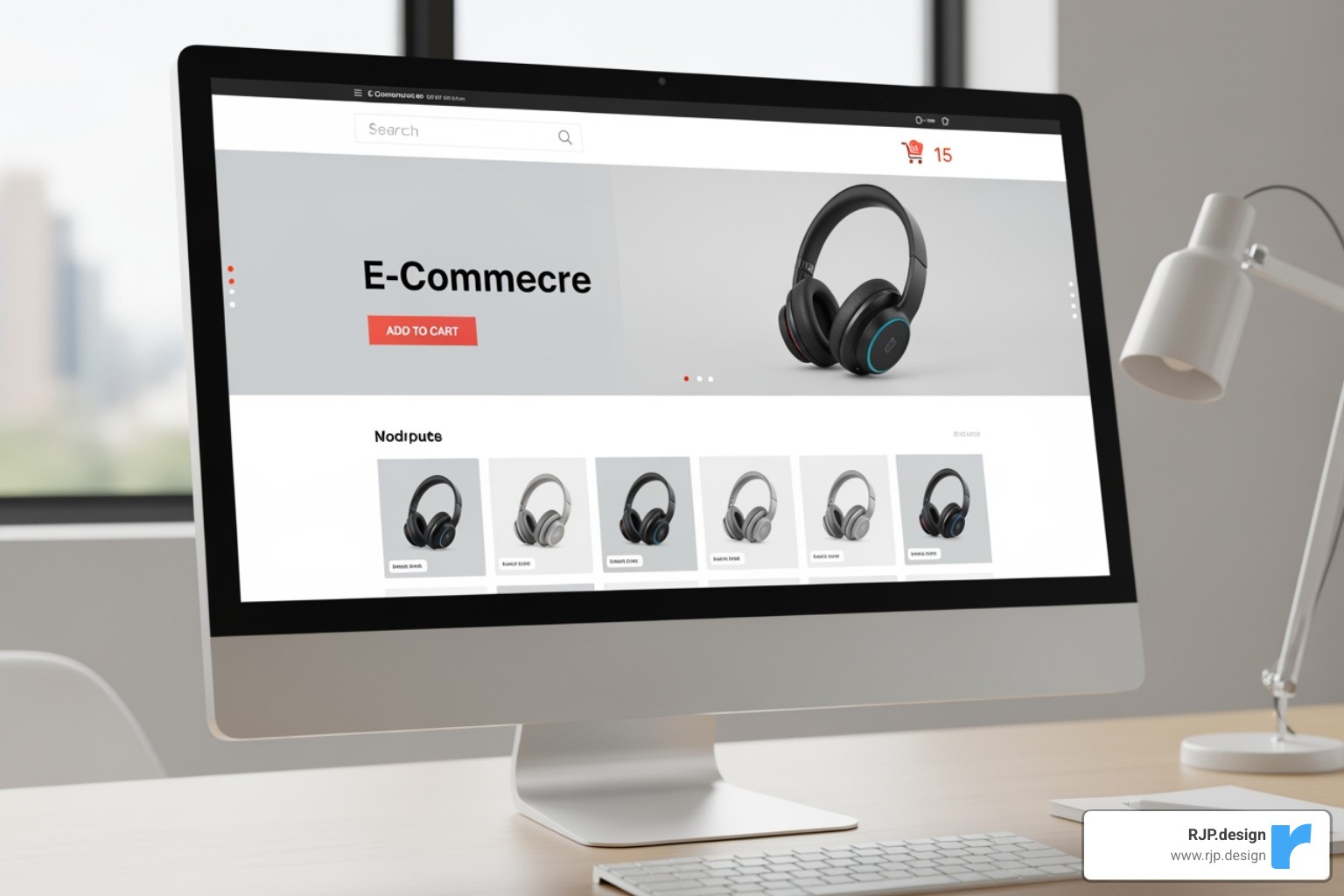
High-quality imagery and video are essential, as images can improve a website's conversion rate by 40%. Our approach includes:
Professional Product Photography: High-resolution photos from multiple angles on clean backgrounds.
Lifestyle Imagery: Showing products in context to help customers envision themselves using them.
Product Videos: A dynamic way to showcase features, demonstrate usage, and provide an "in-person" experience.
Your brand identity is woven through every visual choice. We use color psychology to evoke emotions that align with your brand and select a maximum of two or three complementary fonts to ensure readability and a clear visual hierarchy. The goal is to balance expected design conventions with unique branding elements, making your site intuitive yet memorable.
Optimizing for Speed, Simplicity, and Sales
In online shopping, patience is rare. Optimizing for speed, simplicity, and sales are non-negotiable elements of effective ecommerce website design.
Page load speed dramatically impacts conversions. As page load time goes from one to three seconds, the probability of users bouncing increases by 32%. We prioritize speed by compressing images, optimizing code, using caching, and leveraging Content Delivery Networks (CDNs).
A streamlined checkout process is vital, as 22% of shoppers abandon carts due to a complicated process. We make the path to purchase frictionless with:
Minimal Steps: A one-page checkout or a clear multi-step process.
Guest Checkout: Never force registration on first-time buyers.
Auto-Population: For address fields to save time and reduce errors.
Clear Costs: Displaying all costs, including taxes and shipping, early on.
Multiple Payment Options: Offering a variety of secure payment methods.
Finally, social proof is a powerful sales driver. Products with five reviews have a 270% higher purchase likelihood. We integrate social proof by displaying customer reviews, ratings, testimonials, and user-generated content (UGC) on product and category pages.
By prioritizing these elements, we create an ecommerce website design that actively drives sales. For more on optimizing your design, explore our guide on A/B testing for ecommerce.
Advanced Strategies for a Modern Ecommerce Website Design
To gain a competitive edge, it's crucial to incorporate advanced strategies and avoid common pitfalls.
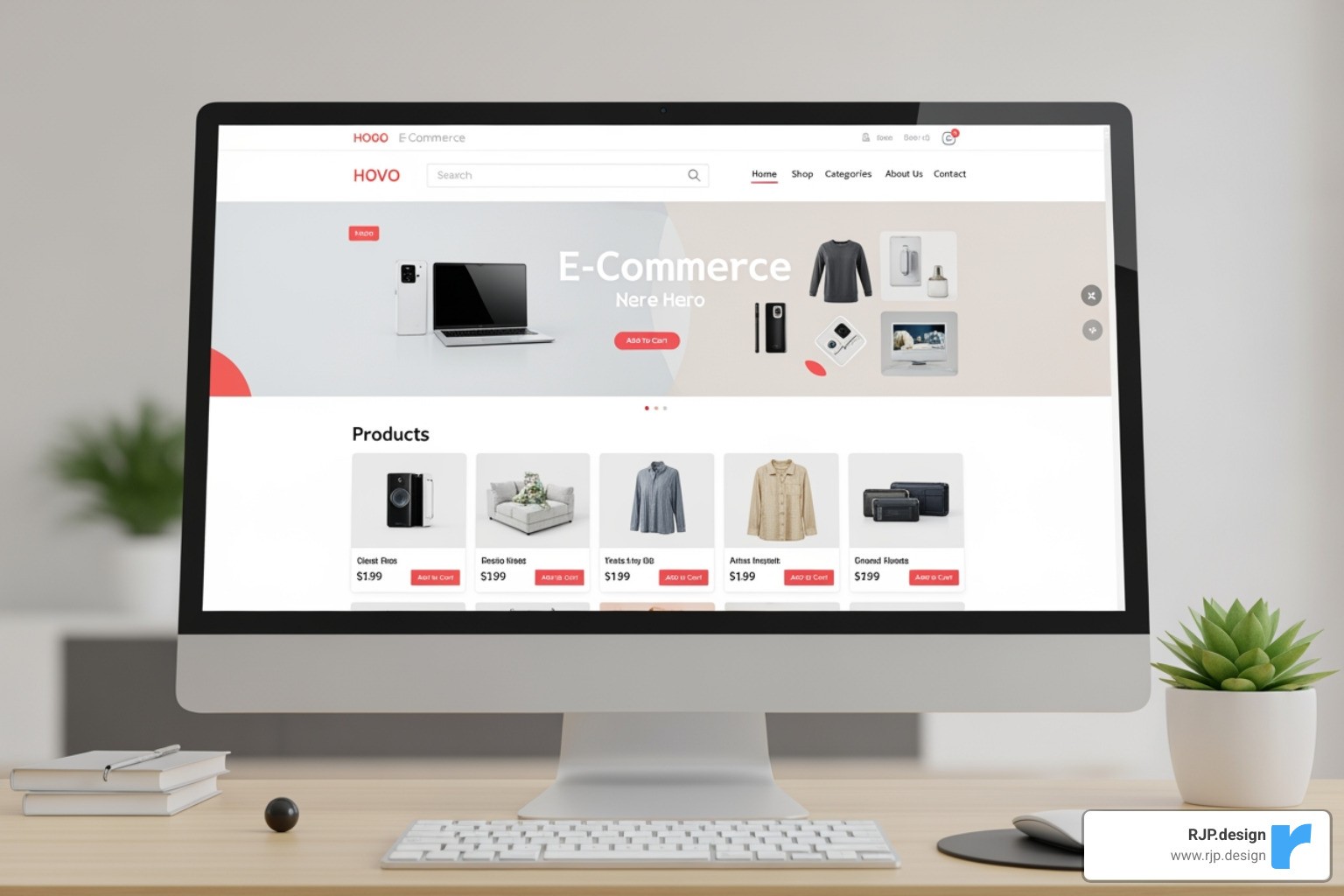
Personalization is now an expectation. We leverage AI to create custom shopping experiences with dynamic content and product recommendations like "Customers who bought this also bought." This boosts engagement and average order value.
Design needs also differ between B2C and B2B. B2C (Business-to-Consumer) design focuses on emotional appeal and a quick checkout. B2B (Business-to-Business) design prioritizes functionality, detailed specs, bulk ordering, and account management features.
Finally, avoid common design pitfalls like cluttered layouts, poor navigation, and unclear calls-to-action (CTAs).
Here are 5 common ecommerce website design mistakes to avoid:
Ignoring Mobile Responsiveness: Alienating the majority of online shoppers.
Hiding Contact Information or Policies: Eroding trust and causing hesitation.
Complex Checkout Processes: Leading to high cart abandonment rates.
Inconsistent Branding: Confusing customers and weakening brand recognition.
Lack of Social Proof: Giving new customers little reason to trust your business.
By understanding these strategies and avoiding missteps, we create an ecommerce website design that is both visually appealing and highly effective.
From Blueprint to Launch: Executing Your Design
We've covered the core principles of effective ecommerce website design. Now, let's talk about bringing this blueprint to life and setting your online store up for long-term success.
Choosing the Right Ecommerce Platform
Selecting the right platform is a foundational decision that impacts your design flexibility, scalability, and budget. The main choices are SaaS (Software as a Service) and Open-Source solutions.
SaaS Platforms (Managed Solutions): These are all-inclusive, hosted platforms with a monthly subscription fee. They handle the technical heavy lifting, including hosting, security, and maintenance.
Pros: User-friendly, quick to launch, and maintenance is handled for you.
Cons: Limited customization, recurring fees, and migrating away can be difficult.
Open-Source Solutions: These platforms, like WooCommerce for WordPress, provide the core software, and you are responsible for hosting, security, and customization.
Pros: Complete flexibility, no recurring platform fees, and highly scalable.
Cons: Requires technical expertise (or hiring a developer), higher upfront costs, and you manage all maintenance.
Here's a quick comparison:
Feature | SaaS Platforms (e.g., Managed Solutions) | Open-Source Solutions (e.g., WooCommerce) |
|---|---|---|
Cost | Monthly subscription + transaction fees | Higher upfront development, no recurring platform fees |
Flexibility | Good for standard stores, limited for unique needs | Unlimited customization |
Ease of Use | Very easy, often drag-and-drop | Requires technical skill or developer support |
Maintenance | Handled by platform provider | Your responsibility |
Scalability | Good, but can have limits for advanced needs | Highly scalable, no inherent limits |
We help clients choose based on their budget, growth plans, and customization needs. For businesses seeking complete control and long-term flexibility, open-source solutions often provide an unparalleled advantage, allowing your site to evolve with your business.
Your Next Step Towards a Professional Online Shop
We've journeyed through ecommerce website design, from first impressions and trust to visuals, speed, and a seamless checkout. The key takeaway is that a strategic approach is paramount. It’s about understanding your customer and optimizing every touchpoint to guide them toward a purchase.
At RJP.design, we specialize in changing websites from online brochures into high-converting ecommerce powerhouses. Our team blends creativity, technical expertise, and a deep understanding of user behavior to craft unique online shopping experiences that reflect your brand and are built to scale. Your website should be your greatest asset, not a burden.
Whether you're starting from scratch or looking to optimize your existing store, we're here to help. Our goal is to build you a professional online shop that exceeds your expectations and maximizes your sales and marketing efforts.
Ready to transform your online store into a thriving business? Let's build something amazing together.