SEO
Going Off-Page: The Ultimate Guide to SEO Outside Your Website
Jul 13, 2026

What Off-Page SEO Really Means — And Why It Changes Everything
What is off-page SEO? It's everything you do outside your website to help it rank higher in search results — building credibility, trust, and authority from the wider web.
Here's a quick answer:
Off-page SEO refers to actions taken outside your own website that influence your search engine rankings. This includes earning backlinks from other sites, getting brand mentions, managing reviews, building local citations, and growing your presence on social media.
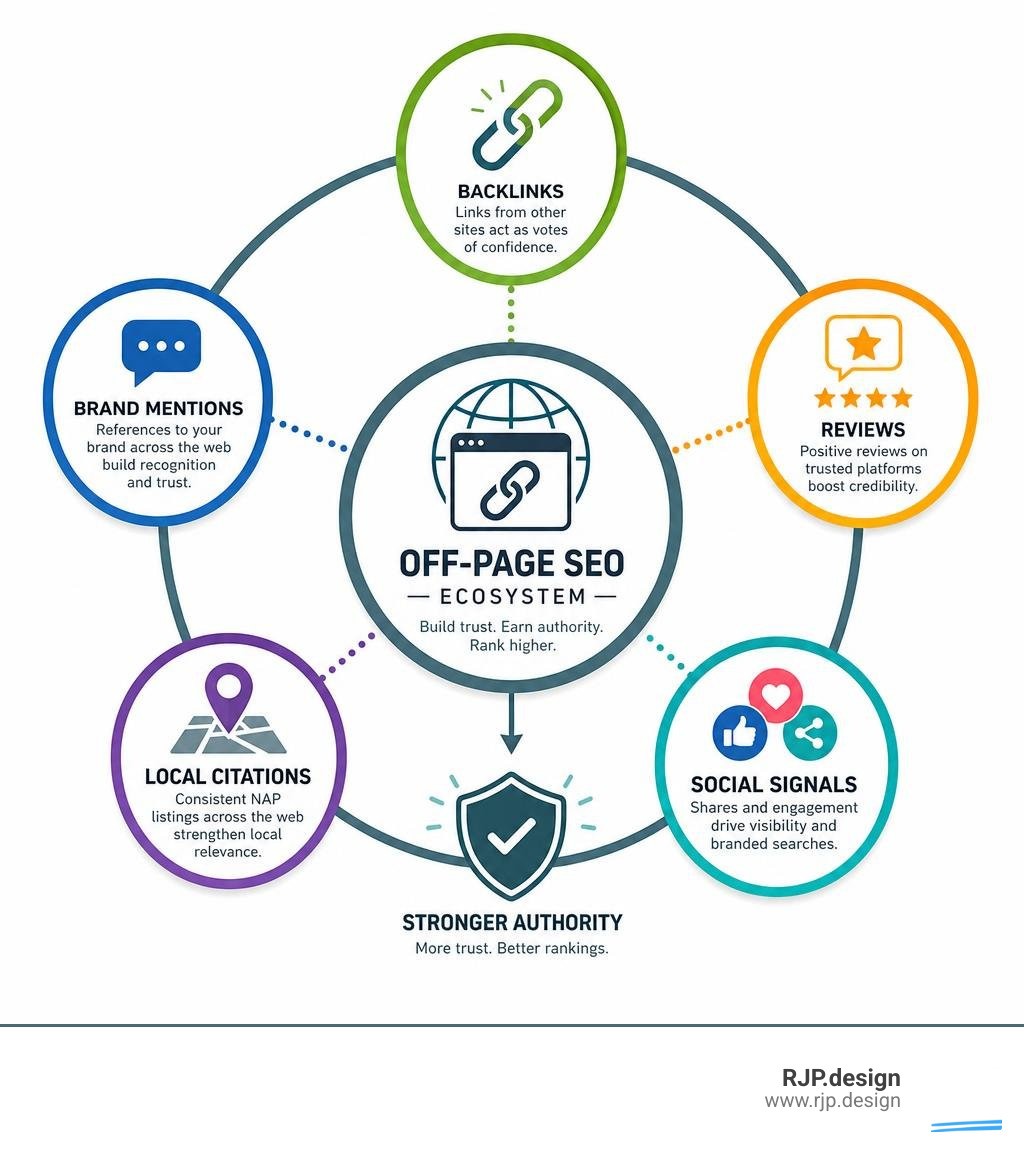
The core off-page SEO signals search engines care about:
Backlinks — links from other websites pointing to yours, acting as "votes of confidence"
Brand mentions — references to your business online, even without a direct link
Reviews — customer feedback on Google, Yelp, and industry directories
Local citations — consistent listings of your business name, address, and phone number (NAP) across the web
Social signals — content shares and engagement that drive visibility and branded searches
E-E-A-T signals — third-party proof of your Experience, Expertise, Authoritativeness, and Trustworthiness
Think of it this way: your website tells search engines what you do. Off-page SEO tells them whether to trust you.
More than half of the ranking factors used to determine organic search positions are directly tied to off-page signals. That means no matter how polished your website is, it's only half the story.
The other half happens out there — on other websites, in directories, in reviews, and increasingly, inside AI-powered search tools like Google AI Overviews, ChatGPT, and Perplexity.
I'm Ross Plumer, a digital marketing strategist with experience helping businesses market over $20 million in revenue — and what is off-page SEO has been a central part of nearly every growth strategy I've built. In the sections ahead, I'll walk you through exactly how it works and how to use it to your advantage.
Key terms for What is off-page SEO?:
What is off-page SEO and Why Does It Matter?
At its core, off-page search engine optimization is about building your digital reputation. While your on-page elements act as your digital storefront, your off-page presence behaves like word-of-mouth recommendations from the local community. Search engines like Google aim to deliver the most reliable, helpful answers to users. To do this, they rely heavily on off-site validation.
When reputable platforms talk about you, link to you, and recommend you, search engines notice. This external validation is a core pillar of What is Off-page SEO? and is critical if you want to rank for competitive search terms.
On-Page vs. What is off-page SEO?
To understand how to optimize your overall web presence, we must first draw a clear line between what happens on your site and what happens off it.
On-Page SEO is everything you have complete, direct control over. This includes your content quality, keyword optimization, meta tags, header structures, internal linking, and user experience.
Technical SEO ensures search engine crawlers can successfully index and understand your pages (site speed, XML sitemaps, mobile-friendliness, and structured schema markup).
Off-Page SEO is about influence rather than direct control. It represents the external efforts that establish your site's authority, such as earning editorial links, garnering positive reviews, and building relationships across your industry.
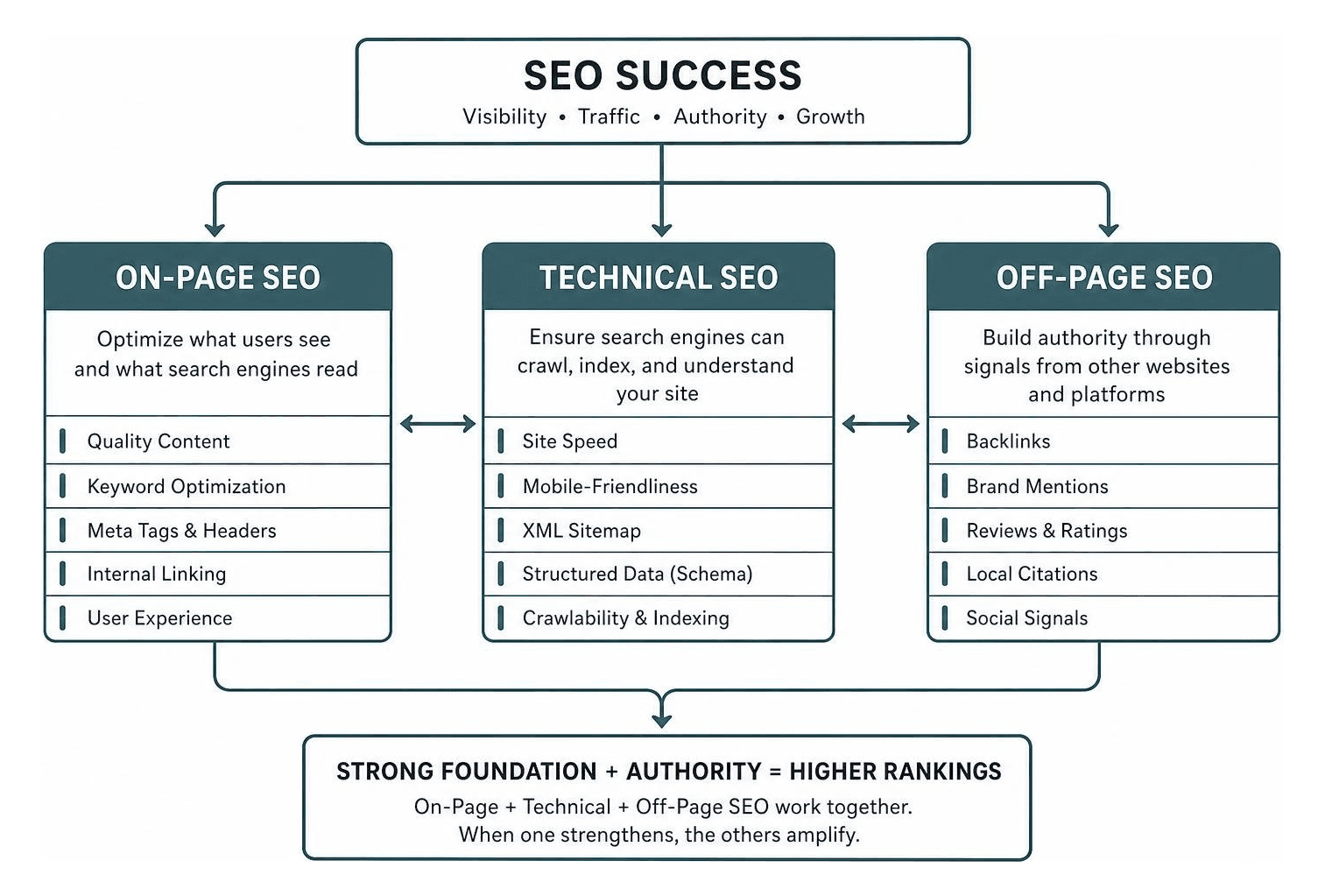
Here is a quick breakdown to help you visualize the differences:
Feature | On-Page SEO | Technical SEO | Off-Page SEO |
|---|---|---|---|
Primary Focus | Content relevance & keyword optimization | Site performance & search engine indexing | Brand authority, trust, & popularity |
Level of Control | 100% direct control | 100% direct control | Indirect influence |
Key Tactics | Copywriting, meta tags, internal links | Page speed optimization, SSL, sitemaps | Link building, PR, reviews, brand mentions |
Primary Goal | Tell search engines what your page is about | Ensure crawlers can easily read your site | Prove to search engines that you are trustworthy |
Balancing these three pillars is the secret to a successful campaign. If you want to dive deeper into on-site optimizations before tackling your external strategy, explore our comprehensive guide on SEO Strategies for Websites.
Why Off-Page Signals Drive Modern Search Rankings
Why do search engines care so much about what happens off your domain? The answer lies in the core design of search algorithms. Google’s foundational PageRank algorithm was built on the premise that a link from one website to another is a vote of confidence.
Today, off-page factors remain incredibly powerful. In fact, more than half of the ranking factors used to determine organic rankings are directly impacted by off-page SEO factors. Furthermore, studies show that a domain's overall authority score is the sixth strongest predictor of a webpage’s ranking position.
When high-quality, topic-relevant sites link to you, they pass "link equity" (or "link juice") to your pages. This signals to search engines that your content is valuable, elevating your overall search rankings. To understand how these signals have evolved from simple links into complex trust signals, you can read more from HubSpot's analysis on Off-Page SEO: 6 Strategies & Tactics to Boost Your Reputation and Rank .
Strategic Off-Page SEO: From Backlinks to AI Search
Executing a successful off-page campaign in July 2026 requires looking beyond basic link-building. Modern off-page optimization is an integrated mix of digital PR, localized optimizations, and social media amplification designed to make your brand impossible to ignore. To see how these pieces fit together, check out our dedicated guide on Off-Page SEO Strategies.
High-Impact Link Building and Brand Mentions
Link building is often the first tactic businesses turn to when starting their off-page journey. However, the focus must always be on quality over quantity. A single link from a highly authoritative, relevant industry publication will pass far more trust than dozens of links from low-quality, unrelated blogs.
To build a healthy backlink profile, we recommend focusing on these proven techniques:
Be a Data Source: Publish original research, surveys, or interactive tools. When other bloggers and journalists write about your industry, they will naturally link back to your data as their source.
Broken Link Building: Did you know that two-thirds of links to sites over the last nine years no longer work? You can use SEO tools to find broken links on authoritative resource pages in your niche, then pitch your high-quality content as a replacement.
Strategic Guest Blogging: Write helpful, educational articles for reputable publications in your industry. This establishes your expertise and earns you an editorial link.
Digital PR & Journalist Requests: Respond to media queries on platforms like Connectively or Featured to provide expert quotes in exchange for authoritative brand mentions and backlinks.
To master these outreach methods, read our specialized guide on Link Building Off-Page SEO.
Local SEO, Reviews, and Social Amplification
If you operate a business with a physical storefront or a defined service area, local off-page signals are critical. Nearly half of all Google searches have local intent, making local SEO a top priority.
Google Business Profile (GBP): This is your most important local asset. Keep your profile active by adding photos, publishing regular updates, and keeping your operational hours accurate.
Review Management: Reviews are highly influential. 89% of consumers expect merchants and business owners to reply to all types of reviews—both positive and negative. Replying professionally builds trust with prospective customers and signals active engagement to search engines.
NAP Consistency: Ensure your Name, Address, and Phone number (NAP) are identical across all local citation sources.
To get started, make sure you are listed on these essential local citation sources:
Google Business Profile
Yelp
Apple Maps
Bing Places
YellowPages
Industry-specific directories (e.g., Houzz, TripAdvisor, or local chambers of commerce)
Additionally, do not overlook social media. While social shares are not a direct ranking factor, social media amplification drives content discovery. Partnering with micro-influencers is highly effective here; small-scale influencers drive 60% higher engagement rates than macro-influencers, helping you generate branded search volume and organic links.
How to Avoid Risks and Penalties in What is off-page SEO?
Because off-page signals are highly influential, some try to shortcut the system using "black hat" tactics. This includes buying links, participating in private blog networks (PBNs), or using automated link farms.
Google’s sophisticated algorithms are designed to detect and penalize unnatural link patterns. If Google finds your site participating in link schemes, you risk receiving a manual penalty or being completely deindexed from search results. For a deeper look at avoiding these pitfalls, refer to Off-Page SEO: The Complete Guide for 2026 .
To keep your link profile healthy, follow these best practices:
Diversify Anchor Text: Ensure your anchor text (the clickable text containing the hyperlink) is natural. As a rule of thumb, at least 50% of anchor text across all backlinks should not target exact keywords; instead, use your brand name, generic terms ("click here"), or natural URLs.
Avoid Sudden Spikes: Earning hundreds of links overnight looks suspicious to search engines. Focus on steady, organic link growth.
Monitor Your Backlinks: Regularly audit your link profile using SEO tools. If you discover spammy, toxic backlinks pointing to your site that you cannot get removed, use Google's Disavow Tool to tell search engines to ignore them.
Navigating E-E-A-T and AI-Driven Search in 2026
As we navigate 2026, the SEO landscape is shifting rapidly due to AI-driven search engines and Google's emphasis on E-E-A-T (Experience, Expertise, Authoritativeness, and Trustworthiness).
Large Language Models (LLMs) and conversational search tools like ChatGPT, Perplexity, and Google AI Overviews do not just crawl pages—they look for consensus across the web. They want third-party validation before recommending your brand in their summaries. This means unlinked brand mentions on reputable industry blogs, features on podcasts, and positive reviews are more important than ever.
At RJP.design, we specialize in building holistic digital strategies that align your technical, on-page, and off-page presence. Our down-to-earth team prioritizes your unique goals, ensuring your business is not only beautiful but easily found by human searchers and AI engines alike.
If you are ready to build a trustworthy brand footprint that dominates the search landscape, explore our SEO Services and Internet Marketing Solutions or take the next step by visiting our SEO Optimization Services page today. Let's work together to make your brand the most trusted voice in your industry!
For further reading on off-page fundamentals, explore these expert resources: