
Web
Why Your Business Needs a Specialized B2B Ecommerce Website Design Agency
Jun 17, 2026

Why Hiring Specialized B2B Ecommerce Developers is Critical for Growth
When business leaders decide to take their operations digital, they often make the mistake of hiring general web developers. While a generalist can build a beautiful retail storefront, B2B commerce is a completely different beast.
Business-to-business transactions do not operate on a simple "add to cart and enter credit card" model. They involve negotiated contracts, complex supply chains, and multi-tier organizational approvals. Specialized b2b ecommerce developers bring the technical expertise required to translate these intricate offline workflows into smooth digital experiences.
By working with a Top-Rated Ecommerce Development Agency, you gain access to professionals who understand how to structure databases for massive catalogs, map complex business logic, and build systems that support long-term relationships rather than one-off impulse buys.
Key Differences Between B2B and B2C Platforms
While B2C ecommerce focuses on speed, emotional engagement, and simple transaction paths, B2B ecommerce is built on logic, efficiency, and relationship management.
B2B buyers are purchasing on behalf of their companies. They have strict budgets, require internal purchase approvals, and often buy in massive volumes. This is why 90% of global B2B customers expect an online shopping experience that is as intuitive as a B2C site, yet they still require complex backend functionalities to do their jobs.
To help visualize these differences, here is how B2B and B2C ecommerce requirements compare:
Feature/Requirement | B2C Ecommerce | B2B Ecommerce |
|---|---|---|
Pricing Structure | Uniform pricing for all customers | Dynamic, account-specific negotiated pricing |
Order Volume | Typically low (1–5 items per order) | High-volume bulk orders and wholesale quantities |
Decision Makers | Single consumer | Multiple stakeholders and approval hierarchies |
Payment Options | Credit cards, digital wallets, BNPL | Net terms, purchase orders, bank wires, credit lines |
Checkout Process | Fast, frictionless, guest checkout | Role-based authentication, tax-exempt validation |
Building a platform that balances these heavy backend requirements with a clean, consumer-grade user interface is a challenge. For a deeper look at designing these interfaces, check out our B2B Ecommerce Web Design Guide 2026.
Essential Features Your B2B Ecommerce Developers Must Implement
To build a platform that actually saves your team time and keeps your customers coming back, your b2b ecommerce developers must implement several foundational and advanced features:
Custom Catalogs and Price Lists: Different buyers should see different products and prices based on their contracts. Your platform must dynamically display personalized pricing down to the SKU level.
Role-Based Access Control: Business accounts often have multiple users. A purchasing manager might have full authority to place orders, while a junior buyer can only build carts for approval.
Quick Reordering and Bulk Uploads: Repeat buyers do not want to browse. They want to upload a CSV of SKUs or click "Reorder" from their purchase history to complete a $10,000 transaction in seconds.
Flexible Payment Workflows: Your system must support purchase orders (POs), net terms (e.g., Net 30/60), and vaulted credit cards.
An experienced E-commerce Portal Developer can build these features natively or optimize them on enterprise platforms. For businesses looking to leverage specialized Shopify ecosystems, working with expert developers can help unlock advanced wholesale capabilities.
Managing Complex Integrations and System Architecture
A B2B ecommerce website is only the tip of the iceberg. Beneath the surface lies a complex web of backend business systems. If your ecommerce platform does not talk to your Enterprise Resource Planning (ERP) system, your Customer Relationship Management (CRM) software, and your Warehouse Management System (WMS), you will end up drowning in manual data entry.
Specialized developers ensure a bi-directional, real-time flow of data:
ERP Integration: Syncs inventory levels, customer-specific pricing contracts, and credit limits.
CRM Integration: Feeds offline sales data and customer interactions directly to your sales team.
PIM (Product Information Management): Manages thousands of complex SKUs, technical specifications, and digital assets.
As we look toward the future, automation is accelerating. Experts predict that about one-third of all B2B ecommerce could be completely machine-to-machine by 2030. Having a clean API-driven architecture today prepares your business for automated inventory replenishment tomorrow. To understand how to structure these systems, read our Custom Ecommerce Solutions Ultimate Guide.
How Specialized B2B Ecommerce Developers Solve Security and Scalability Challenges
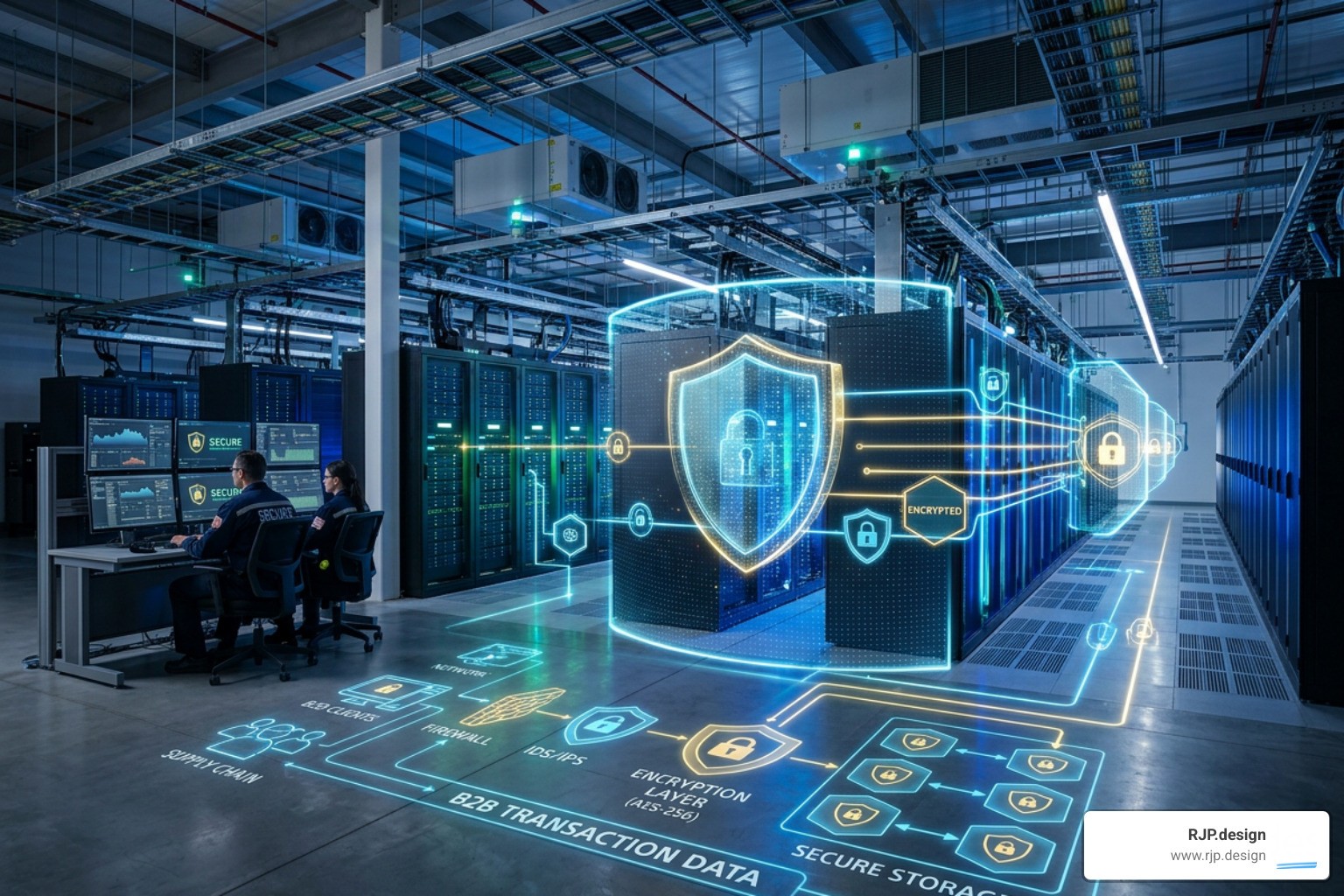
Security and performance are non-negotiable when dealing with business transactions. The rate of online orders exceeding $500,000 has grown faster than any other category over the last two years. When transactions reach this size, a single security vulnerability or system crash can cost millions in lost revenue and damage your brand's reputation.
Expert developers protect your business by implementing:
Enterprise-Grade Security: Ensuring Level 1 PCI DSS compliance, data encryption, and multi-factor authentication (MFA) for corporate accounts.
Scalable Hosting & Performance Optimization: Using Content Delivery Networks (CDNs) and optimized database queries to ensure fast page loads. 70% of online users say page speed directly influences their buying decisions.
High-Uptime Architecture: Designing systems that can handle massive traffic spikes and concurrent bulk checkouts without slowing down.
Overcoming Common B2B Development Obstacles
Modernizing a B2B business comes with its fair share of hurdles. Legacy systems are often the biggest roadblock; many companies rely on decades-old ERPs that were never designed to connect to the web. Specialized developers use custom middleware or robust APIs to bridge the gap between old and new systems.
Another challenge is calculating the Total Cost of Ownership (TCO). Businesses often focus solely on the initial build cost, ignoring ongoing maintenance, security patches, and hosting. Experienced developers help you plan for these realities from day one.
Finally, user adoption can be a struggle. If your new portal is too difficult to use, your customers will bypass it and continue calling or emailing your sales reps. By prioritizing intuitive design and clean workflows, we help ensure your clients actually want to use your digital portal. You can explore these strategies in our E-commerce Website Development Complete Guide.
Best Practices for Platform Selection and Migration
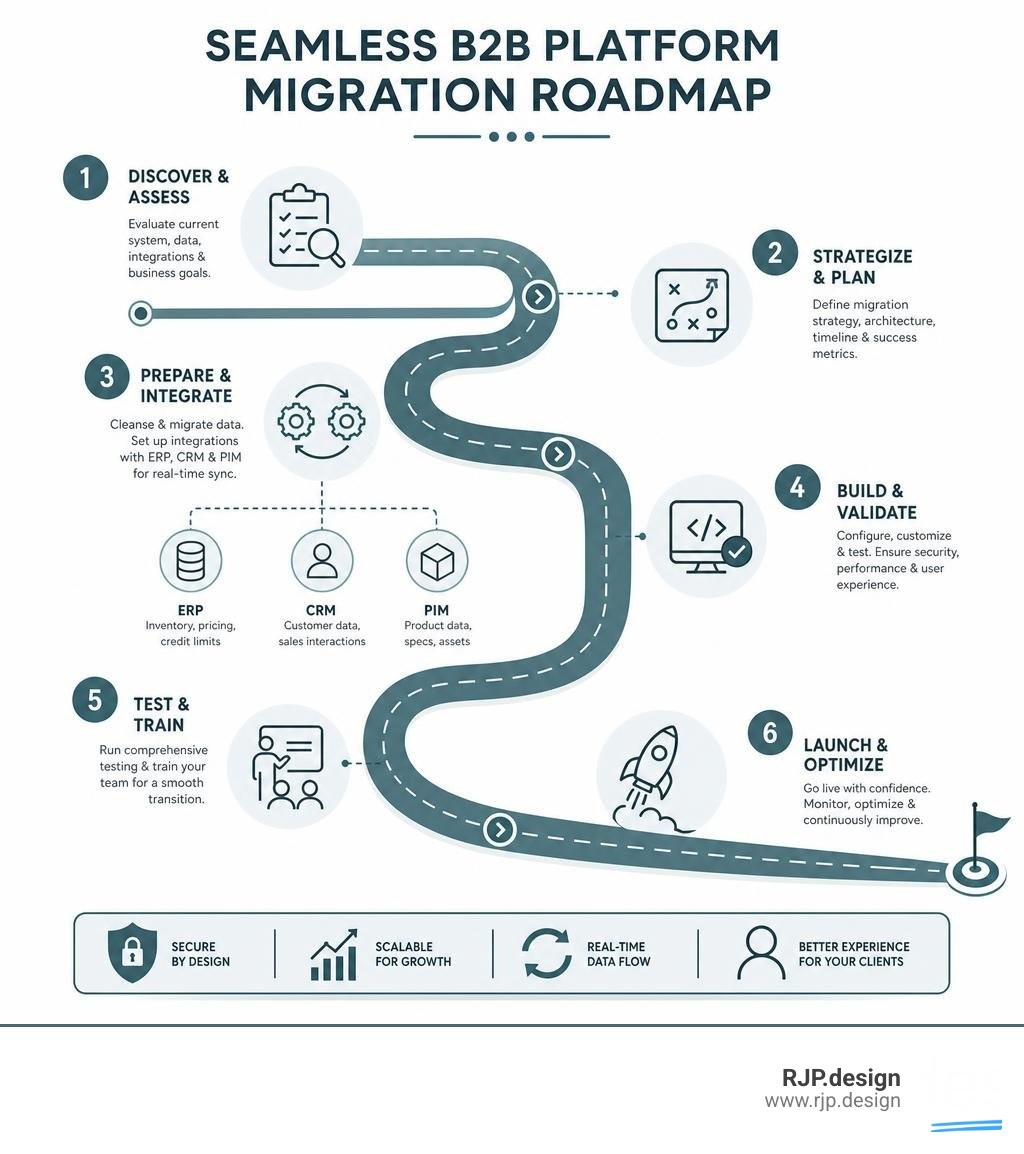
Choosing the right platform is critical. For mid-market and enterprise brands, a composable or headless commerce approach is often the best path forward. By decoupling the frontend user experience from the backend commerce engine, headless architecture allows you to update your design without disrupting your core business logic.
When evaluating platforms, you have excellent options depending on your needs:
Shopify Plus: Great for businesses looking to merge DTC and B2B operations into a single admin.
BigCommerce: Offers robust native B2B features, multi-storefront capabilities, and zero transaction fees.
Spryker: Ideal for highly complex, composable enterprise operations. Learn more about their approach here: Spryker | Digital Commerce Platform for B2B Enterprises .
Adobe Commerce (Magento): Best for massive catalogs requiring deep customization.
For a comprehensive approach to implementation, choosing the right development partner ensures your platform scales seamlessly under pressure.
Choosing the Right Partner for Your Digital Transformation

Building a successful B2B ecommerce platform requires more than just clean code—it requires a partner who understands your business goals, your industry, and your customers.
At RJP.design, we specialize in creating high-performing websites and enhancing online presence for businesses. We ensure your platform not only looks incredible but is also highly functional, secure, and easily found by search engines. Our unique selling point is our top-tier service combined with a down-to-earth, collaborative team that prioritizes your satisfaction and ROI above all else.
Whether you are looking to migrate from a legacy system, integrate a complex ERP, or build a custom B2B portal from scratch, we are here to guide you through every step of the journey.
Ready to transform your B2B operations and drive digital growth? Explore our Web Design and Development Services today, and let's build something great together.