
Web
How to Master B2B Ecommerce Website Development Without Losing Your Mind
Jun 11, 2026

Why B2B Ecommerce Web Design Is Now a Revenue-Critical Decision
B2B ecommerce web design is no longer just about having a professional-looking website — it's about building a digital sales engine that meets modern business buyers exactly where they are.
Here's what that means in practice:
What B2B Buyers Expect | Why It Matters |
|---|---|
Self-service ordering 24/7 | Over one-third of B2B buyers now complete their entire sales journey online |
Consumer-grade experience | 90% of global B2B customers expect an online experience similar to B2C shopping |
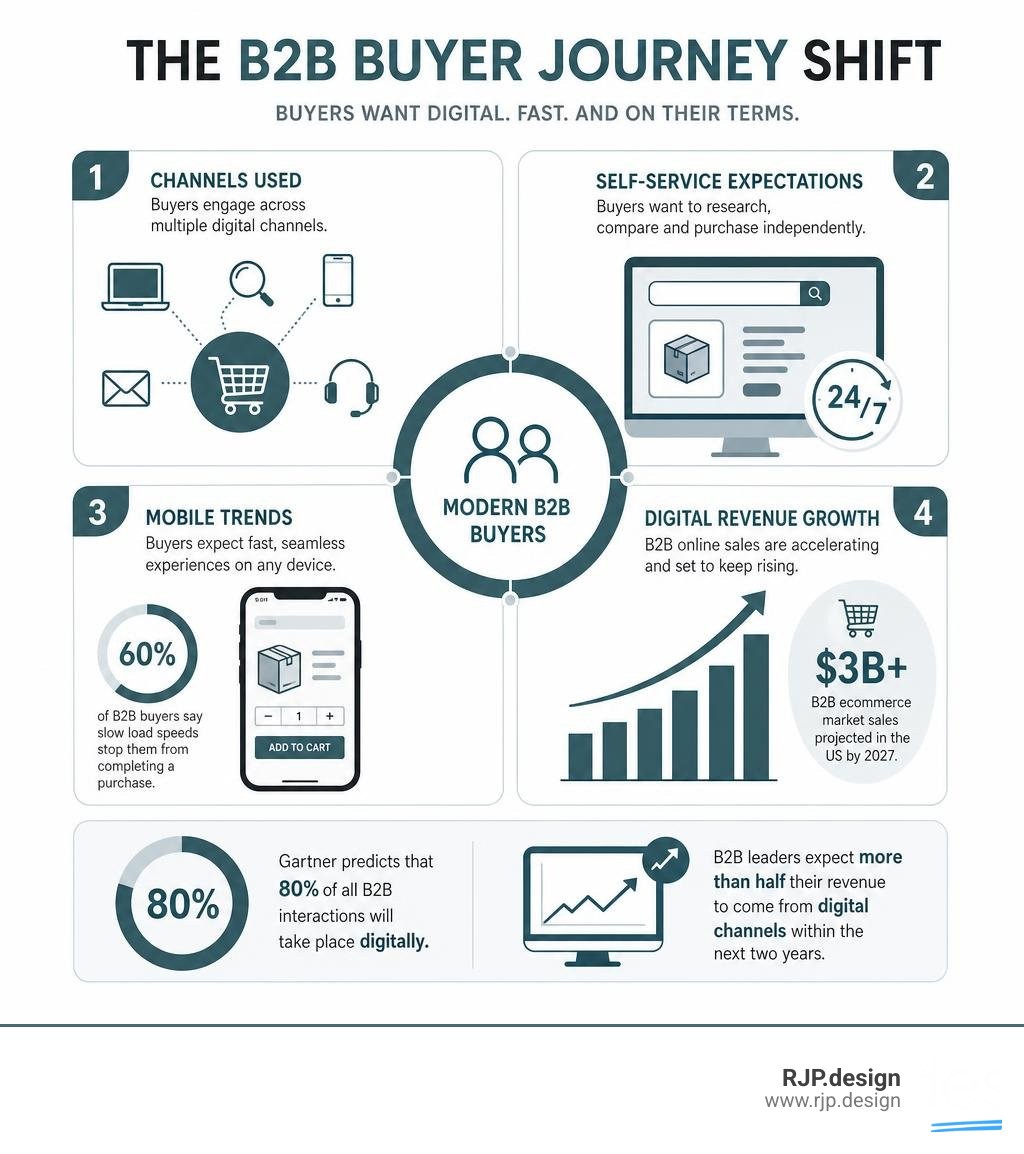
Fast, mobile-friendly sites | 60% of B2B buyers say slow load speeds have stopped them from completing a purchase |
Easy product search | 27% of US B2B buyers rank it as the single most important online purchasing feature |
Simple checkout | 32% of US B2B buyers say easy checkout is their top priority |
The stakes are high. B2B ecommerce market sales are projected to surpass $3 billion in the US alone by 2027, and Gartner predicts that 80% of all B2B interactions will take place digitally. Meanwhile, B2B leaders expect more than half their revenue to come from digital channels within the next two years.
Yet many small and mid-sized businesses are still running outdated websites that were never built for the way modern buyers actually purchase. Spreadsheets, phone orders, and PDF catalogs are quickly becoming relics — and companies that don't adapt risk losing customers to competitors who make buying effortless.
The good news? You don't need to navigate this alone or rebuild everything from scratch without a plan.
I'm Ross Plumer, a digital marketing and web development strategist with experience helping businesses that have marketed over $20 million in revenue — including projects involving B2B ecommerce web design, ERP integrations, and complex catalog builds. In this guide, I'll walk you through every critical decision, from platform selection to launch, so you can build something that actually works for your buyers.
Basic b2b ecommerce web design terms:
Key Pillars of Modern B2B Ecommerce Web Design

When we set out to build or improve a B2B channel, we have to look past the surface. A stunning visual layout is fantastic, but if the back-end architecture doesn't support the complex purchasing paths of business users, the site will fail to convert.
Successful b2b ecommerce web design relies on three foundational pillars:
User Experience (UX) Research: Understanding that B2B buyers use an average of 10 channels during their purchasing journeys. We must design a unified experience that transitions smoothly from desktop research to mobile ordering.
Performance Metrics: Speed is a massive conversion factor. With about 70% of online users stating that page load speed directly influences their purchasing decisions, optimize every page. If your technical catalog takes more than three seconds to load, your buyers will simply pick up the phone and call someone else—or worse, buy from a competitor.
Mobile Responsiveness: A staggering 78% of global B2B buyers wish their suppliers offered a better mobile experience. Whether it's a field technician looking up a part number on-site or a procurement manager approving a purchase order between meetings, mobile optimization is non-negotiable.
To dive deeper into design frameworks that bridge these gaps, check out our guide on Ecommerce Website Design.
How B2B Ecommerce Web Design Differs from B2C UX
It is a common mistake to treat B2B sites like slightly larger retail stores. While B2B buyers expect a clean, consumer-like interface, their actual buying behavior is vastly different.
The typical retail transaction is a single person buying a product for $147 in under five minutes. The average B2B transaction, however, can easily reach $134,000, involves 6 to 8 stakeholders, and requires days or weeks of approvals.
Feature / Dimension | B2C Ecommerce | B2B Ecommerce |
|---|---|---|
Average Transaction Value | Low (approx. $147) | High (approx. $134,000+) |
Decision Makers | Single individual | Multi-level (6–8 stakeholders) |
Pricing Model | Standard public pricing | Account-based, negotiated contract pricing |
Purchasing Cycle | Impulsive, short-term | Highly deliberate, long-term relationships |
User Roles & Permissions | Single account holder | Multiple roles (Purchaser, Approver, Admin) |
Product Catalogs | Uniform for all visitors | Customer-specific, restricted catalogs |
To see how top-tier brands structure these complex paths without overwhelming the user, explore our breakdown of the Best Ecommerce Sites UX.
Essential Features for a Successful B2B Ecommerce Web Design
To build a high-performing B2B store, your platform must support features that automate negotiated terms and complex purchasing rules. If your buyers have to email your sales team to get their contracted pricing, your website isn't doing its job.
Here are the non-negotiable features we build into modern B2B websites:
Account-Based Pricing & Catalogs: Once a customer logs in, they should only see the products they are authorized to buy at their specific, negotiated contract prices.
Bulk Ordering & Quick Reorder Forms: Business buyers don't want to add 500 individual items to a cart one by one. Include quick order forms where they can type in SKU numbers or upload a CSV file directly.
Request for Quote (RFQ) Functionality: For highly customized or massive orders, allow buyers to easily submit an RFQ. You can even run a hybrid model where standard parts can be checked out instantly, while custom configurations go through a quoting workflow.
Approval Workflows: Support multi-level user permissions. A junior buyer should be able to build a cart, but the system must route that cart to their manager for final approval before the order is placed.
If you are ready to build these advanced capabilities from scratch, our guide on how to Build Custom Ecommerce Site provides a step-by-step roadmap.
Maximizing Operational Efficiency and Self-Service Portals
A well-designed B2B portal isn't just a sales tool; it's a massive cost-saver. By transitioning manual, error-prone processes into automated self-service systems, businesses can reduce order processing time by over 60% and lower order error rates by up to 87%.
Instead of your sales team spending hours manually processing recurring orders, typing in shipping addresses, and emailing PDFs of invoices, a self-service portal handles it all 24/7. Buyers can log in to view their complete order history, track shipments, download invoice records, and initiate one-click reorders.
This self-service model is highly preferred by buyers—83% of B2B buyers state they prefer ordering through digital channels over traditional sales rep interactions. By giving them the tools to manage their accounts independently, you free up your sales team to focus on proactive business development instead of administrative tasks.
For more on building these dedicated client environments, see our specialized resource on E Commerce Portal Development.
Strategic Roadmap for B2B Platform Development and Launch
Building a robust B2B platform requires a clear, phased approach. We always recommend starting with your business goals rather than choosing a platform because of its brand name. Align your stakeholders, audit your technical debt, and list your required integrations before writing a single line of code.
As we look toward the future, keeping an eye on emerging trends is essential. For instance, the rate of online orders exceeding $500,000 has grown faster than any other category over the past two years. Additionally, nearly half (48%) of commerce leaders are experimenting with AI to power smarter product searches and personalization, and experts predict that one-third of all B2B ecommerce could be completely machine-to-machine (with no human intervention) by 2030.
At RJP.design, we specialize in translating these complex requirements into clean, scalable digital experiences. Our down-to-earth, high-quality team is dedicated to building sites that not only look incredible but also drive measurable operational growth. If you are planning a new build, our web design and development services are tailored to get your platform launched efficiently.
Choosing the Right Platform and Integrating ERP Systems
Platform selection is where many projects go off the rails. You must evaluate your product complexity and back-office requirements before making a decision.
Popular platforms like BigCommerce, Shopify Plus, and Adobe Commerce (Magento) offer robust B2B-specific features, but their success depends on how well they talk to your internal systems. Real-time synchronization with your Enterprise Resource Planning (ERP), Customer Relationship Management (CRM), and Product Information Management (PIM) systems is vital.
When your ERP and ecommerce store are fully integrated, inventory levels, order statuses, and custom pricing groups update automatically. This eliminates manual data entry and ensures your catalog data remains completely dependable.
To understand the full development lifecycle and platform comparison, refer to our E Commerce Website Development Complete Guide.
Best Practices for Security, Scalability, and Launch Success
Because B2B websites handle sensitive corporate accounts, high-value transactions, and proprietary pricing structures, security and compliance are paramount.
Here are the best practices we follow for a secure and seamless launch:
Robust Security: Ensure Level 1 PCI compliance, enforce strong password policies for corporate accounts, and implement data encryption across the entire platform.
Accessibility Compliance: Run thorough Ecommerce Accessiblity Testing to ensure your site is usable for everyone and compliant with WCAG standards.
SEO-First Redesigns: If you are migrating a legacy site, proceed with caution. We map out URL redirects, preserve metadata, and align content architecture to protect your search engine rankings. For a deeper dive, check out our Ecommerce Website Redesign Guide 2026.
Zero-Downtime Migrations: Plan your database and system handoffs carefully to ensure your existing buyers experience zero disruption when the new portal goes live.
By keeping these security and structural best practices at the forefront of your project, you'll build a B2B platform that is ready to scale alongside your business for years to come.