
Web
How to Approach an Ecommerce Website Redesign Without Losing Your Mind
Apr 21, 2026

Your Ecommerce Website Is Either Working For You or Against You
Ecommerce website redesign is the process of overhauling your online store's look, structure, and functionality to improve user experience, boost conversions, and grow revenue. Here's a quick breakdown of what it involves and when you need it:
When to redesign your ecommerce site:
Your site loads slowly (over 3 seconds causes 1 in 2 visitors to leave)
Your design looks outdated or no longer matches your brand
Mobile users have a poor experience (58%+ of all web traffic is mobile)
Your conversion rates are declining or stagnant
Navigation is confusing and customers can't find products easily
You're rebranding or shifting your business model
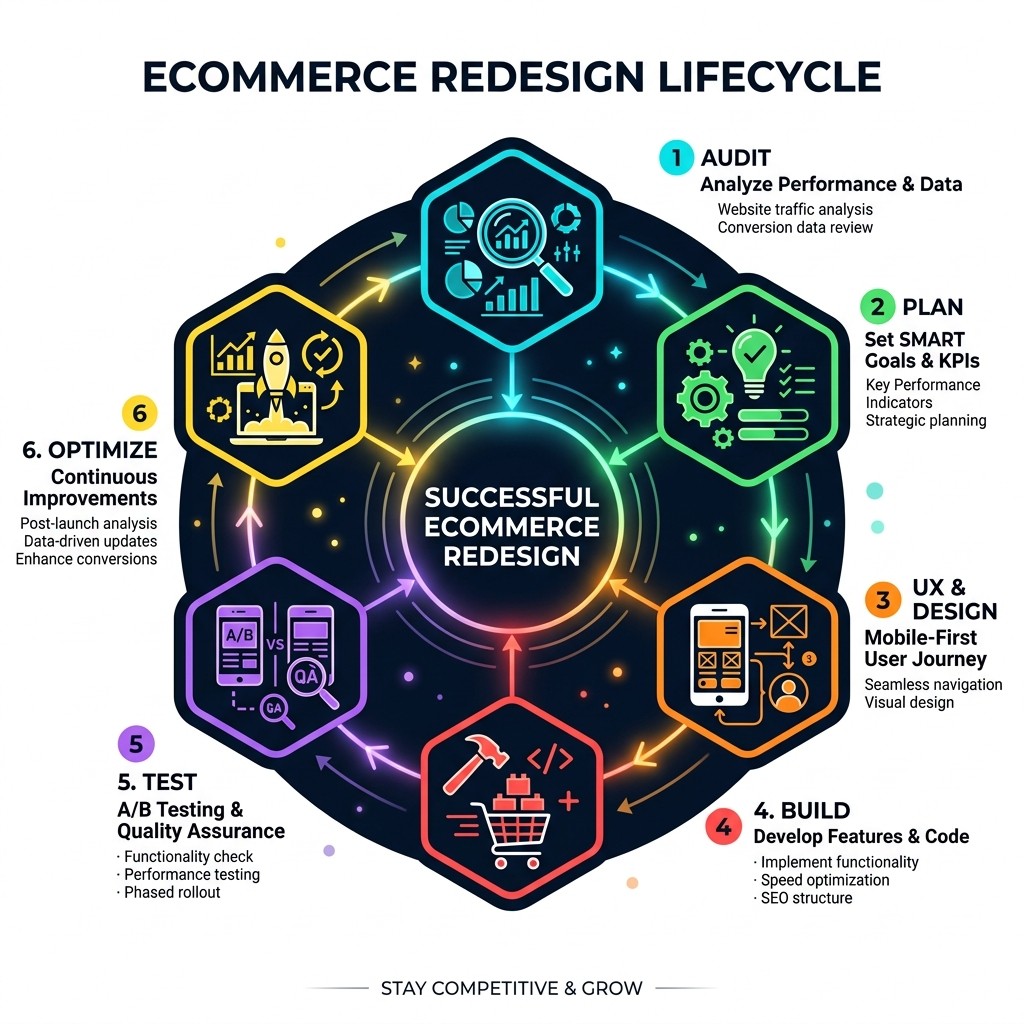
What a successful redesign covers:
Audit - analyzing current performance, traffic, and conversion data
Planning - setting SMART goals and defining KPIs
UX & Design - rebuilding the user journey with mobile-first thinking
Development - implementing new features, speed optimizations, and SEO structure
Testing & Launch - A/B testing, QA, and a phased rollout
Optimization - continuous post-launch improvements based on real data
Think about your website the way you'd think about a physical storefront. If the windows were dirty, the aisles were confusing, and the checkout line took forever, customers would walk out. They'd go somewhere else. Your ecommerce site works the same way.
The difference is that online, customers don't even have to say goodbye. They just close the tab.
A poorly designed ecommerce site doesn't just look bad — it actively costs you money. Research shows that 42% of people will leave a website due to poor functionality, and surprise costs or a clunky checkout process drive away a significant portion of shoppers who were ready to buy. The damage often happens silently, buried inside bounce rates and abandoned carts that most store owners don't connect back to their site design.
Here's the challenge though: redesigning an ecommerce site is genuinely complicated. It touches your SEO, your brand, your customer experience, your backend systems, and your bottom line — all at once. Done right, the results can be transformative. Done wrong, you can lose search rankings, confuse loyal customers, and blow your budget without moving the needle.
That's why having a clear, strategic approach matters so much.
I'm Ross Plumer, a digital marketing and web design expert who has worked with businesses generating over $20 million in revenue, and I've guided many of those teams through the often-stressful process of an ecommerce website redesign — helping them avoid the common traps and come out the other side with a site that actually converts. In this guide, I'll walk you through exactly how to plan and execute a redesign without losing your mind (or your rankings).
Related content about Ecommerce website redesign:
Planning a High-Converting Ecommerce Website Redesign
Before we touch a single line of code or open Figma, we need a plan. If you treat an Ecommerce website redesign like a simple "paint job," you’re going to be disappointed. Design is the delivery vehicle for your content and your sales strategy. If the core story is off, the packaging won’t help.
We look at a redesign as a holistic recalibration of how your store performs and earns. It’s not just about aesthetics; it’s about matching user behaviors and expectations. You don't necessarily need more traffic; often, you just need more action from the traffic you already have.
Data-Driven Decisions vs. Gut Feelings
In the early days of the web, design was a visual exercise. Agencies wanted "cool" sites. Today, cool doesn't pay the bills—conversion does. We use tools like Google Analytics and Crazy Egg to see exactly where your funnel is leaking. If 70% of your users drop off at the shipping selection page, that’s a functional problem, not a "color" problem.
Redesign vs. Refresh: Which Do You Need?
Sometimes you don't need to tear the whole house down. You might just need a strategic refresh. Here is a quick comparison to help you decide:
Feature | Full Redesign | Strategic Refresh |
|---|---|---|
Scope | Complete overhaul of UI, UX, and backend. | Targeted updates to specific pages or elements. |
Goal | Market repositioning or platform migration. | Improving conversion on existing high-traffic pages. |
Risk | High (SEO and user familiarity risks). | Low (Iterative changes). |
Cost | Typically $12,000 to $150,000+. | Lower, focused on high-impact "quick wins." |
Best For | Outdated tech, rebranding, or scaling issues. | Testing new features or fixing specific UX friction. |
Identifying the Right Time for an Ecommerce Website Redesign
How do you know when it’s actually time to pull the trigger? Your gut might be telling you something is wrong, but the data will confirm it.
The "Three-Second Rule" is Killing You: According to a 2023 study by GoodFirms, slow speed is the top reason customers abandon a website. If your site takes more than three seconds to load, 50% of your visitors are gone before they even see your products.
Mobile is an Afterthought: Over 58% of global web traffic comes from smartphones. For Shopify stores specifically, that number can hit 80%. If your site feels "clunky" on a phone, you are essentially closing your store to the majority of your customers.
Your "Dusty" Design Undermines Trust: 88% of users say a single bad experience is enough to make them leave for good. If your site looks like it was built in 2014, customers might assume your products or security measures are just as outdated.
The Platform No Longer Fits: Maybe you started on a basic builder but now your inventory is too complex, or you need advanced website redesign services to handle international shipping and multi-currency support.
Navigating the Risks of an Ecommerce Website Redesign
We’ll be honest: "Completely redesigning a website is just about the highest risk, most wasteful thing you can do," writes Jonny Longden in a recent LinkedIn post. While that sounds scary, he’s referring to redesigns done without data.
To avoid the "Ranking Disaster," you must navigate these specific pitfalls:
SEO Rankings & 301 Redirects: This is the big one. If you change your URL structure without mapping out 301 redirects, your search traffic will vanish overnight. We always recommend involving SEO experts early. You can learn more about SEO for online stores to see how we protect your hard-earned traffic.
The Conversion Rate Dip: It is common to see a temporary dip after launch as loyal customers get used to the new layout. However, rigorous A/B testing can minimize this "post-launch shock."
Scope Creep: It’s easy to say, "While we're at it, let's add a custom loyalty portal and a 3D product viewer!" Suddenly, your 3-month project takes a year. Stick to the Minimum Viable Product (MVP) first.
Neglecting Mobile: According to a recent HubSpot survey, 40% of marketers list optimizing for mobile as their top priority. Don't just "resize" your desktop site; design for tap, scroll, and swipe.
Must-Have Features for Post-Redesign Success
A modern Ecommerce website redesign should do more than just look pretty. It needs to be a high-performance sales machine. Based on our experience and industry data, here are the non-negotiables:
Trust Signals: 19% of users abandon carts because they don’t trust the site with their credit card. Include SSL certificates, clear return policies, and visible customer reviews.
Frictionless Checkout: 22% of shoppers leave because the checkout takes too long. Implementing one-click checkout or guest checkout options can drastically reduce abandonment.
Personalization & AI: Use customer data to show "Recommended for You" sections. This isn't just a "nice-to-have" anymore; it's what modern shoppers expect.
Smart Product UX: High-resolution images with 360-degree views and clear ingredient or material details are vital. A Baymard report found that 50% of beauty product shoppers left because ingredient details were missing.
Inclusive Design: Ensure your site meets WCAG standards. Accessibility isn't just a legal requirement; it's a way to ensure everyone can buy from you.
Check out our guide on best ecommerce sites UX for deeper insights into what makes a product page truly "sticky."
Executing Your Strategy and Measuring ROI
The "Launch Day" is exciting, but it’s actually just the beginning. At RJP.design, we believe a website is never truly "finished." It is a living, breathing part of your business that requires ongoing attention.
A Step-by-Step Process for Launching on Time
To avoid the "never-ending redesign" trap, we follow a structured phase-gate process:
The Audit: We analyze your current site performance. What pages have the highest bounce rates? Where is the funnel leaking? We use tools like Ahrefs and Semrush to examine your keyword rankings and backlinks.
UX Wireframes: We build the "skeleton" of the site. We focus on navigation—can a shopper find any product in three clicks or fewer?
Content Migration: We inventory your high-performing content. We don't just move everything; we prune the dead weight and optimize the keepers.
Rigorous Testing: Before going live, we test on real devices. We check the checkout flow on iPhones, Androids, and tablets. We use Google PageSpeed Insights to ensure we’re hitting those sub-three-second load times.
The Phased Rollout: Sometimes, it’s safer to launch the new design to just 5% or 10% of your traffic first to ensure there are no major bugs.
If you are looking for a partner to handle the technical heavy lifting, you can explore our top-rated ecommerce development agency services.
Tracking Metrics and Post-Launch Optimization
How do you know if the redesign worked? You look at the numbers. While a "pretty" site is nice, ROI is the only metric that truly matters.
Conversion Rate (CR): This is your North Star. Even a small increase can mean thousands in additional revenue. For example, a homepage test for a deodorant brand once led to a 21% increase in CR.
Cart Abandonment Rate: If this drops after your redesign, you’ve successfully removed friction from the checkout process. 17% of shoppers leave because they couldn't see the total price early enough.
Average Order Value (AOV): A good redesign uses upselling and cross-selling features to encourage customers to add "just one more thing" to their cart.
Search Traffic: Monitor your rankings in the first 30, 60, and 90 days. If you see a dip, check your 301 redirects and Google Search Console for crawl errors.
The Power of A/B Testing Don't guess—test. 90% of A/B test changes either make no difference or have a negative effect. That sounds discouraging, but it actually highlights why continuous testing is so important. You find the 10% that works and double down on it. Learn more about how we handle ecommerce A/B testing to keep our clients' stores growing.
Conclusion: Partnering for Long-Term Growth
An Ecommerce website redesign is a massive undertaking, but it’s also one of the most powerful levers you can pull to grow your business. It’s an opportunity to turn your "dusty" digital brochure into your hardest-working salesperson.
At RJP.design, we specialize in creating websites that don't just look great but are easily found and highly functional. Our down-to-earth team prioritizes your satisfaction and your bottom line. We understand that your brand is constantly evolving, and your website needs to be built for that scalability.
Whether you are dealing with a "clunky" checkout, a slow mobile experience, or a brand identity that no longer fits, we are here to help you navigate the process. A well-timed redesign can open new doors, build customer loyalty, and help your business reach a whole new level of success.
Ready to stop losing sales to a "trampoline park" bounce rate? Let's build something that works.
Explore our full range of web design and development services to see how we can transform your online presence.