
Marketing
The Ultimate Guide to Ecommerce PPC Management for ROAS
May 5, 2026
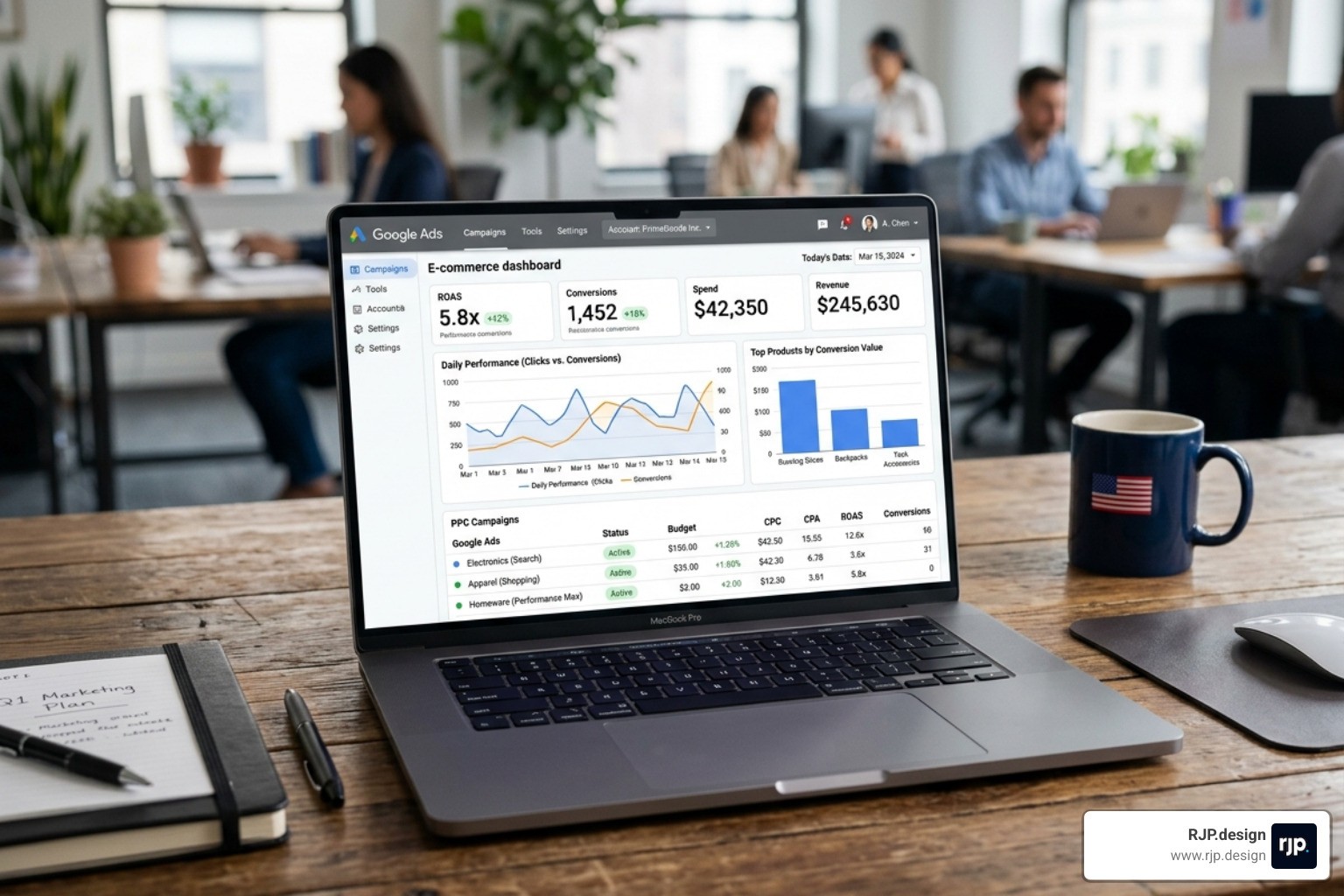
The Core Components of Effective Paid Search
Ecommerce PPC management is the process of planning, executing, and continuously optimizing paid advertising campaigns for online stores — across platforms like Google Ads, Microsoft Advertising, and Amazon — to drive high-intent traffic that converts into sales.
Here's what effective ecommerce PPC management typically includes:
Component | What It Does |
|---|---|
Keyword Research | Targets buyers actively searching for your products |
Product Feed Optimization | Powers Google Shopping and Performance Max ads |
Bid Management | Controls how much you pay per click to protect margins |
Ad Copy & Extensions | Improves click-through rates and pre-qualifies visitors |
Remarketing | Re-engages shoppers who visited but didn't buy |
Performance Monitoring | Tracks ROAS, CPA, and other key metrics for ongoing improvement |
The numbers are hard to ignore. 79% of brands consider PPC advertising crucial to their success. More than 23% of all retail and ecommerce traffic comes directly from paid search. And globally, advertisers are projected to spend $190.5 billion on search advertising in 2024 alone.
Yet despite all that investment, most ecommerce brands never reach their full potential from PPC. The gap isn't usually budget — it's management.
Organic search is getting harder, too. Click-through rates have dropped 25% on desktop and 55% on mobile, meaning the brands that win online are increasingly the ones that know how to make paid traffic work profitably. PPC doesn't just fill that gap — when managed well, it converts at rates up to 50% higher than organic traffic.
But "managed well" is doing a lot of work in that sentence. Running ads is easy. Building a system that consistently turns ad spend into measurable revenue? That takes strategy, structure, and ongoing attention.
I'm Ross Plumer, a digital marketing expert with hands-on experience helping businesses market over $20 million in revenue — including building and optimizing ecommerce PPC management strategies that drive real, trackable growth. In this guide, I'll walk you through exactly what it takes to build campaigns that scale profitably.
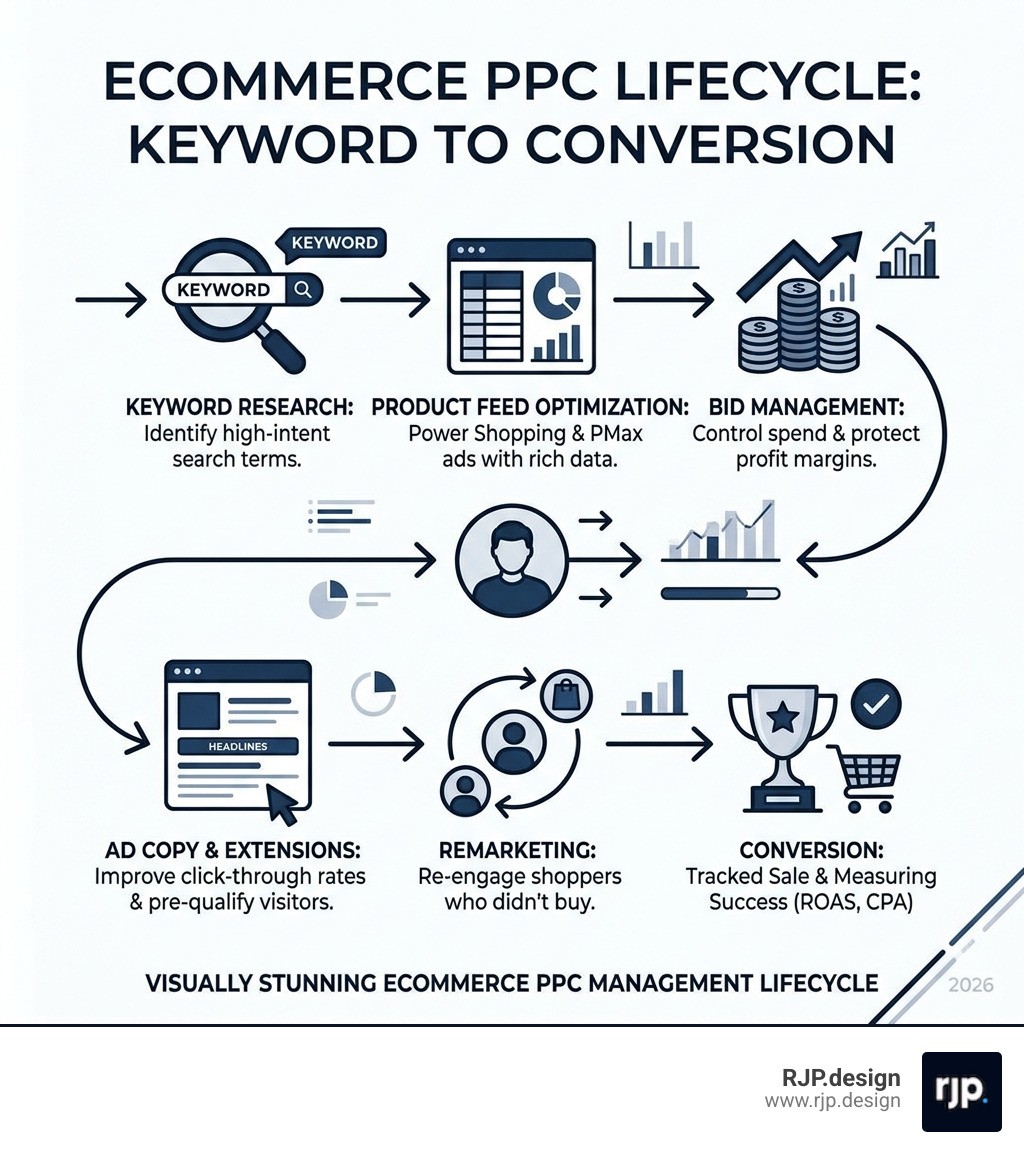
Simple guide to ecommerce PPC management terms:
To succeed in the competitive world of online retail, we have to look at PPC as more than just "buying clicks." It is a multi-channel ecosystem where different platforms play unique roles. While Google Ads remains the heavyweight champion, a truly effective PPC advertising solution often utilizes a mix of platforms to capture demand wherever customers happen to be.

Google Ads: The primary driver for most stores. This includes Search Ads (text-based), Shopping Ads (image-based), and Performance Max, which uses AI to place ads across YouTube, Gmail, and the Display Network.
Microsoft Advertising (Bing): Often overlooked, but Bing users frequently have higher average household incomes. CPCs (Cost Per Click) here can be significantly lower than on Google, offering a great way to diversify.
Amazon Ads: For those selling on the marketplace, Amazon PPC is no longer optional. It’s a requirement for visibility. It includes Sponsored Products, Brands, and Display ads.
Paid Social: Platforms like Meta (Facebook/Instagram) and TikTok are excellent for "demand generation"—showing products to people who didn't know they wanted them yet.
Programmatic Targeting: This involves using automated technology to buy ad space across millions of websites, specifically targeting users based on their past browsing behavior and purchase intent.
Understanding ROAS and Key Performance Metrics
If you aren't tracking the right numbers, you're essentially flying a plane in a fog bank. In ecommerce PPC management, the North Star metric is almost always ROAS (Return on Ad Spend).
The formula is simple: (Revenue from Ads / Cost of Ads) x 100. For example, if we spend $1,000 and generate $4,000 in sales, our ROAS is 400% (or 4:1).
However, high-level management requires looking deeper. We also monitor:
CPA (Cost Per Acquisition): How much it costs us to get one new customer.
MER (Marketing Efficiency Ratio): Total revenue divided by total ad spend across all channels. This gives us a "big picture" view of how ads drive the whole business.
CLV (Customer Lifetime Value): If a customer buys once, that’s great. If they buy every month for three years, we can afford a much higher CPA to acquire them.
TACoS (Total Advertising Cost of Sale): Specifically popular in Amazon advertising, this measures ad spend against total sales (organic + paid) to see how advertising is "lifting" the whole brand.
Metric | Typical Ecommerce Benchmark | Why It Matters |
|---|---|---|
ROAS | 2.8x - 5.0x | Measures immediate profitability of spend. |
CPA | Varies by AOV | Ensures you aren't spending more than your margin. |
CTR | 2% - 5% | Indicates how relevant your ads are to searchers. |
Conv. Rate | 2% - 5% | Measures how well your site turns visitors into buyers. |
Optimizing Google Merchant Center and Product Feeds
For ecommerce, your product feed is the foundation of everything. Think of the Google Merchant Center (GMC) as the bridge between your online store and Google's advertising brain. If that bridge is shaky, your ads will fall through.
We prioritize SEO for e-commerce websites principles even within the feed. This means:
Keyword-Rich Titles: Don't just call a product "Blue Shirt." Call it "Men's Slim-Fit Organic Cotton Oxford Shirt - Sky Blue."
GTIN Accuracy: Global Trade Item Numbers help Google understand exactly what you are selling, which improves your ad's relevance.
High-Quality Images: In Shopping ads, the image does 80% of the heavy lifting. Use clean, professional photos on white backgrounds.
Custom Labels: These allow us to segment products by "Best Sellers," "High Margin," or "Seasonal," so we can bid more aggressively on the items that make you the most money.
Strategic Keyword Selection for Ecommerce PPC Management
Keyword selection is where many brands bleed money. They target terms that are too broad (like "shoes") and end up paying for thousands of clicks from people who aren't ready to buy.
Effective ecommerce PPC management focuses on three types of keywords:
Commercial Intent Keywords: Terms like "buy," "price," or "sale" attached to a product name.
Long-Tail Keywords: Highly specific phrases like "waterproof trail running shoes for wide feet." These have lower search volume but much higher conversion rates because the user knows exactly what they want.
Negative Keywords: This is arguably the most important part. By adding "free," "repair," or "jobs" as negative keywords, we prevent your ads from showing up for people who have zero intention of buying a product.
High-Converting Ad Copy and Landing Page Best Practices
You can have the best keywords in the world, but if your ad copy is boring or your landing page is slow, you won't make a sale.
Your ad copy should highlight your Unique Selling Proposition (USP). Do you offer free shipping? A 100-day money-back guarantee? Made in the USA? These need to be front and center using Ad Extensions (sitelinks, callouts, and structured snippets) to take up more "real estate" on the search results page.
Once they click, the experience must be seamless. A 2025 reality: 53% of mobile visits are abandoned if a page takes longer than three seconds to load. Your ecommerce website design must be mobile-first, featuring:
Single-column layouts for easy scrolling.
Thumb-friendly buttons (no tiny links!).
Fast-loading images (using WebP formats).
Clear, benefit-driven headlines that match the ad the user just clicked.
Advanced Remarketing and Bid Management Strategies
Did you know that 96% of people leave a website without buying anything? Remarketing is how we get them back. By using "browser cookies," we can show tailored ads to people who abandoned their cart or viewed a specific product category.
For bid management, we often move away from manual bidding as a campaign matures. We use Smart Bidding (AI-driven) to optimize for Target ROAS. However, we never "set it and forget it." We apply human oversight to ensure Google's algorithms don't overspend on low-margin items.
We also suggest a tiered budget allocation:
70-80% to "Proven Winners" (campaigns that consistently hit your ROAS goals).
15-20% to "Growth/Testing" (new keywords or platforms).
5-10% as a "Reserve" for seasonal spikes or flash sales.
You can learn more about how we handle the creative side of these ads through our social media management ads services.
The Benefits of Professional Ecommerce PPC Management
At this point, you might be wondering: Should I do this myself or hire an agency?
Managing PPC in-house is fine for very small stores with a handful of products. But as you scale, the complexity grows exponentially. A professional ecommerce PPC management team brings:
Technical Expertise: Handling Merchant Center errors, API integrations, and tracking pixels.
Platform Relationships: Agencies often have direct lines to Google and Meta support.
Cost Savings: While you pay a fee, a specialist can often reduce "wasted spend" by 20-30% in the first month, effectively paying for themselves.
When looking for the best digital marketing services company, look for transparency. You should always own your ad accounts and have 24/7 access to your data. Avoid agencies that hide their work behind proprietary "black box" dashboards.
Maximizing ROAS through Professional Ecommerce PPC Management
Scaling a brand from $10k a month to $100k+ in ad spend isn't just about turning up the "budget dial." It requires a structured 30-day implementation plan and a long-term vision.
The 30-Day PPC Roadmap:
Days 1-7 (The Foundation): Deep-dive audit of current accounts, fixing tracking issues, and cleaning up the product feed.
Days 8-14 (The Build): Setting up new campaign structures (Branded vs. Non-Branded) and launching initial remarketing funnels.
Days 15-21 (The Optimization): Reviewing search term reports to add negative keywords and adjusting bids based on early data.
Days 22-30 (The Scale): Identifying the "hero products" that are performing best and shifting budget toward them to maximize ROAS.
At RJP.design, we believe that ecommerce PPC management is an "evolving art." There is no such thing as a "perfectly optimized" account because the market, the competition, and the algorithms change every single day.
We specialize in creating websites and enhancing online presence for businesses, ensuring they look great and are easily found online. Our high-quality service and down-to-earth team prioritize your satisfaction above all else. Whether you need help with web design and development or a complete overhaul of your paid search strategy, we are here to help you turn those clicks into customers.
Common Mistakes to Avoid
Ignoring Mobile: If your site is slow on a phone, you are throwing ad money in the trash.
Uniform ROAS Targets: Don't set the same target for every product. High-margin items can afford a lower ROAS, while low-margin items need a much higher one to be profitable.
Over-reliance on Automation: AI is a tool, not a replacement for strategy. Without human guardrails, automated bidding can quickly chase "vanity metrics" like clicks while ignoring actual profit.
PPC vs. SEO: Which One Wins?
It’s not a competition; it’s a partnership. PPC provides instant visibility and is great for testing which keywords actually lead to sales. SEO is a long-term play that builds "free" equity over time. The most successful brands use PPC to capture demand today while SEO builds the foundation for tomorrow.
Ready to stop guessing and start growing? Ecommerce PPC management is the lever that can transform your business, provided you have the right team pulling it. Let's build something that scales.