SEO
Mastering Bing SEO: Essential Strategies for Webmasters
Feb 10, 2026
Why Bing SEO is a Smart Move
Bing search optimization improves your website's visibility on Microsoft's search engine. It involves strategic technical improvements, content alignment, and leveraging Bing's unique ranking signals—a process that matters more than most realize.
Quick Answer: Core Bing SEO Priorities
Exact-match keywords in titles, URLs, and meta descriptions
Social media signals (shares, likes) as a ranking factor
Quality backlinks, especially from .edu and .gov domains
Clean technical setup with fast load times and mobile optimization
Structured data (Schema) to help Bing understand your content
Bing Webmaster Tools for sitemap submission and performance monitoring
While Google is the dominant player, Bing handles a significant portion of search queries, especially in the United States. It powers search across the Microsoft ecosystem (Windows, Edge, Copilot), reaching over 100 million daily active users who often have high purchasing power.
The opportunity is clear: less competition, valuable demographics, and easier wins. Bing's algorithm is more transparent, valuing exact-match keywords, social engagement, and backlink volume. This makes strategic optimization straightforward. Plus, with the rise of AI-powered search through Microsoft Copilot, optimizing for Bing positions you for the future of search.
Many businesses focus solely on Google, which is a mistake. While Google is a priority, ignoring Bing means leaving 5-15% of potential organic traffic on the table. This traffic is often easier to capture and converts well, especially in B2B, finance, and e-commerce.
I'm Ross Plumer, and I've helped countless businesses drive results with comprehensive bing search optimization strategies. This guide provides actionable tactics you can implement today.
Quick look at bing search optimization:
A Practical Guide to Bing Search Optimization
Let's explore the practical steps for Bing SEO. This guide covers Bing's unique algorithm, on-page and technical optimization, Bing Webmaster Tools, and the evolving AI landscape.
How Bing's Algorithm Differs: Keywords, Social Signals, and Authority
While many SEO principles are universal, Bing's algorithm has a distinct personality. It values clarity and specific instructions more than Google, meaning certain factors carry more weight.
Exact-Match Keywords: Bing's Love Language
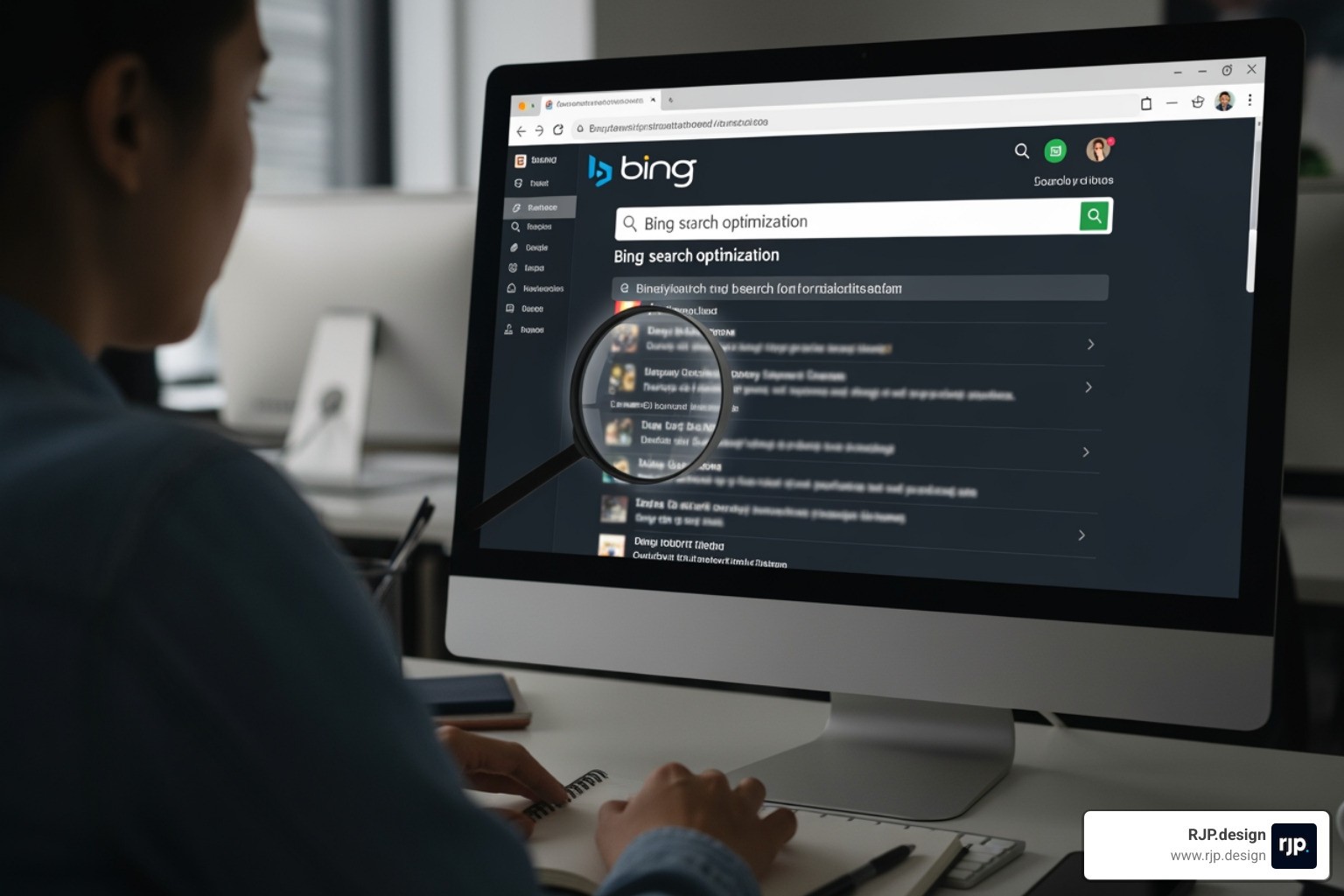
Bing places a strong emphasis on exact-match keywords. While Google focuses more on semantic understanding, Bing gives preference to precise keywords in your URL, Domain Name, Meta Description, Title Tags, and H1 Headings. This isn't an invitation to keyword stuff—which Bing will penalize—but a call for deliberate and clear keyword placement in these critical on-page elements.
The Power of Social Signals
Unlike Google, which has stated that social signals are not a direct ranking factor, Bing has been clear: social engagement is a factor. Social signals like shares and likes act as a vote of confidence, indicating your content is trustworthy. Integrating social media into your content strategy is therefore a direct signal to Bing. A vibrant social presence can directly contribute to your SEO Ranking Improvement on Bing.
Backlink Quality and Domain Authority: The Bing Way
Like Google, Bing uses backlinks as a core ranking signal, but with a few differences. Bing places notable weight on the total number of links and favors older, established domains. Links from authoritative domains, especially .edu and .gov sites, are particularly valuable. While Bing's official guidance on its webmaster tools page emphasizes quality, a high-volume backlink profile can also be effective. Focus on earning high-quality backlinks and use Bing Webmaster Tools to monitor your profile and disavow spammy links.
User Demographics and Intent
Bing's user base is often older, more affluent, and college-educated, with strong intent and high purchasing power. If this aligns with your target audience, tailor your content and keyword strategy accordingly. Consider their search habits and the more formal, research-oriented language they might use.
On-Page and Content Best Practices for Bing
Optimizing your on-page content for Bing is about clarity and directness.
Title Tags and Meta Descriptions: Your First Impression
Bing gives extra weight to exact-match keywords in title tags and meta descriptions. Create unique titles with your primary keyword near the beginning. Your meta description is a mini-ad; make it compelling, include your keyword, and summarize the page's content to encourage clicks, as Bing is likely to display it as written.
Header Tags (H1, H2, etc.): Structuring for Success
Header tags (H1, H2, etc.) structure your content for Bing. Use one clear H1 tag per page with your primary keyword. Use H2 and H3 tags to break content into logical, scannable sections, including keyword variations.
Multimedia Content: A Feast for Bing's Eyes
Bing loves multimedia and considers the "aesthetic appearance or the functional ability of a website for end-users." Incorporating high-quality, unique images and videos improves your content's appeal. Always optimize images for the web and use descriptive Alt text with relevant keywords. For videos, ensure they are in supported formats and include captions.
Content Freshness and User Intent
Bing prefers fresh, up-to-date content that matches user intent. Prioritize creating rich, unique, high-quality content that thoroughly answers user queries. Provide comprehensive information, cite sources, and attribute authorship to build credibility. Our SEO Content Optimizer services focus on crafting content that serves your audience and ranks well.
Here's a list of on-page elements Bing prioritizes:
Exact-match keywords in title tags, meta descriptions, H1s, and the first paragraph.
Descriptive alt text for images.
Multimedia (images, videos) that improve the user experience.
Structured, easy-to-read content with clear headings.
Fresh, comprehensive content that directly answers user queries.
Clear author and source attribution for credibility.
A good user experience (design, site speed, navigation).
Crucial Technical SEO for Bing: Crawlability and Schema
Technical SEO is the bedrock of your search strategy. While many principles overlap with Google, Bing has unique nuances regarding crawling and structured data.
Site Speed and Mobile-Friendliness
Bing values a fast, responsive website and may demote slow-loading pages. A slow site creates a poor user experience, with bounce rates skyrocketing as load times increase. Optimize your site speed by compressing images, leveraging browser caching, and minimizing server response times. With over 60% of organic search visits from mobile, a mobile-friendly site is non-negotiable. Use Microsoft’s Mobile Friendliness Test to check your site.
XML Sitemaps and the IndexNow Protocol
Submit an up-to-date XML sitemap via Bing Webmaster Tools to help Bing find all your URLs. A game-changer is the IndexNow protocol, which allows you to instantly notify search engines of content changes. This significantly speeds up finding and indexing, ensuring your latest content appears in search results faster. We recommend enabling IndexNow through your CMS or a plugin.
Structured Data (Schema.org)
Bing relies heavily on structured data (Schema) to understand content and generate rich snippets. Implementing Schema.org markup in JSON-LD format can significantly improve your visibility. Use Bing’s markup validator to ensure your implementation is correct.
Clean Site Architecture and Crawlability
Bing's crawler is less sophisticated than Google's and leans towards a desktop-first model, making a clean site structure crucial.
Avoid JavaScript Over-reliance: Ensure critical content is accessible via HTML or server-side rendering, as Bing has limitations with JavaScript.
Canonicalization: Use canonical tags to prevent duplicate content issues.
Redirects: Use 301 permanent redirects for moved content.
Robots.txt: Manage crawler access with robots.txt, but use a noindex meta tag to prevent indexing specific pages.
Our Technical SEO Experts can conduct a thorough audit to ensure your site is Bing-friendly.
Mastering Bing Webmaster Tools for Peak Performance
For serious bing search optimization, Bing Webmaster Tools is essential. This free platform provides insights and controls to manage your site's presence on Bing.
Site Verification and Sitemap Submission
First, verify your site. You can import directly from Google Search Console for a quick setup. Then, submit your XML sitemap in the Sitemaps section to help Bing crawl your pages.
Key Features and Tools
Keyword Research Tool: Find unique keyword opportunities specific to Bing's audience.
Backlink Analysis: Monitor your backlink profile, identify high-quality links, and disavow spammy ones that could harm your rankings.
URL Inspection and SEO Reports: Check the status of specific URLs, troubleshoot indexing issues, and use the Site Analyzer to identify on-page errors.
Crawl Control and IndexNow: Manage how Bingbot crawls your site and use IndexNow to instantly notify Bing of content changes.
Regularly using Bing Webmaster Tools to monitor crawl stats, indexing data, and keyword performance is vital for a data-driven SEO Optimizer Audit specific to Bing.
The Future: Optimizing for Bing AI and Copilot
The search landscape is evolving with AI, and Microsoft is at the forefront. Bing powers AI experiences in Microsoft Copilot, Edge, and Windows, so optimizing for Bing today is optimizing for the future of AI-powered search.
AI-Generated Answers and Conversational Queries
AI-powered search like Copilot provides direct, summarized answers to complex, conversational queries—something traditional search struggles with. This means your content must be structured for selection by AI. Your goal is to create content that is easily extractable and citable for these direct answers.
Structuring Content for AI: Clarity is King
To thrive in this new era, your content must be fresh, authoritative, and clearly structured.
Concise, Sourceable Passages: Write short, self-contained answer blocks (40-60 words) that AI can easily pull.
FAQ Format: Q&A sections directly address common questions with concise answers.
How-To Guides and Lists: Use step-by-step instructions and lists to break down complex information.
Clear Headings: Use logical H2 and H3 headings to define content sections for AI.
Semantic Clarity: Write for intent using natural language and anchor claims in facts.
Using Schema for Context: Speaking AI's Language
Schema markup is even more critical for AI, as it helps systems understand your content with confidence. Using FAQPage schema or Product schema turns your text into structured data that AI can easily interpret and use.
Optimizing for AI answers is paramount. Microsoft's guidance on Optimizing Your Content for Inclusion in AI Search Answers emphasizes clear, structured, and authoritative content. Avoid common mistakes like long walls of text, hiding content in tabs, or relying on PDFs and images for key information. AI needs accessible, well-formatted text.
Conclusion: Integrate Bing into Your Digital Strategy
The core takeaway is clear: ignoring Bing means overlooking a significant and valuable audience. By implementing the bing search optimization strategies covered here—from keyword focus and technical SEO to AI content structuring—you position your business for success across the entire Microsoft ecosystem.
Bing SEO isn't about choosing Bing over Google; it's a complementary effort to make your overall strategy more resilient. It opens up an untapped traffic source with less competition and potentially higher conversion rates.
At RJP.design, we help businesses like yours get found by the right audience, wherever they search. Implementing these tactics will improve your digital presence for business and capture that audience. For a holistic approach, explore our digital marketing services.