
Web
The Ultimate Guide to Building a Web Store: From Zero to Online Hero
Mar 12, 2026
Why Building a Web Store Matters More Than Ever
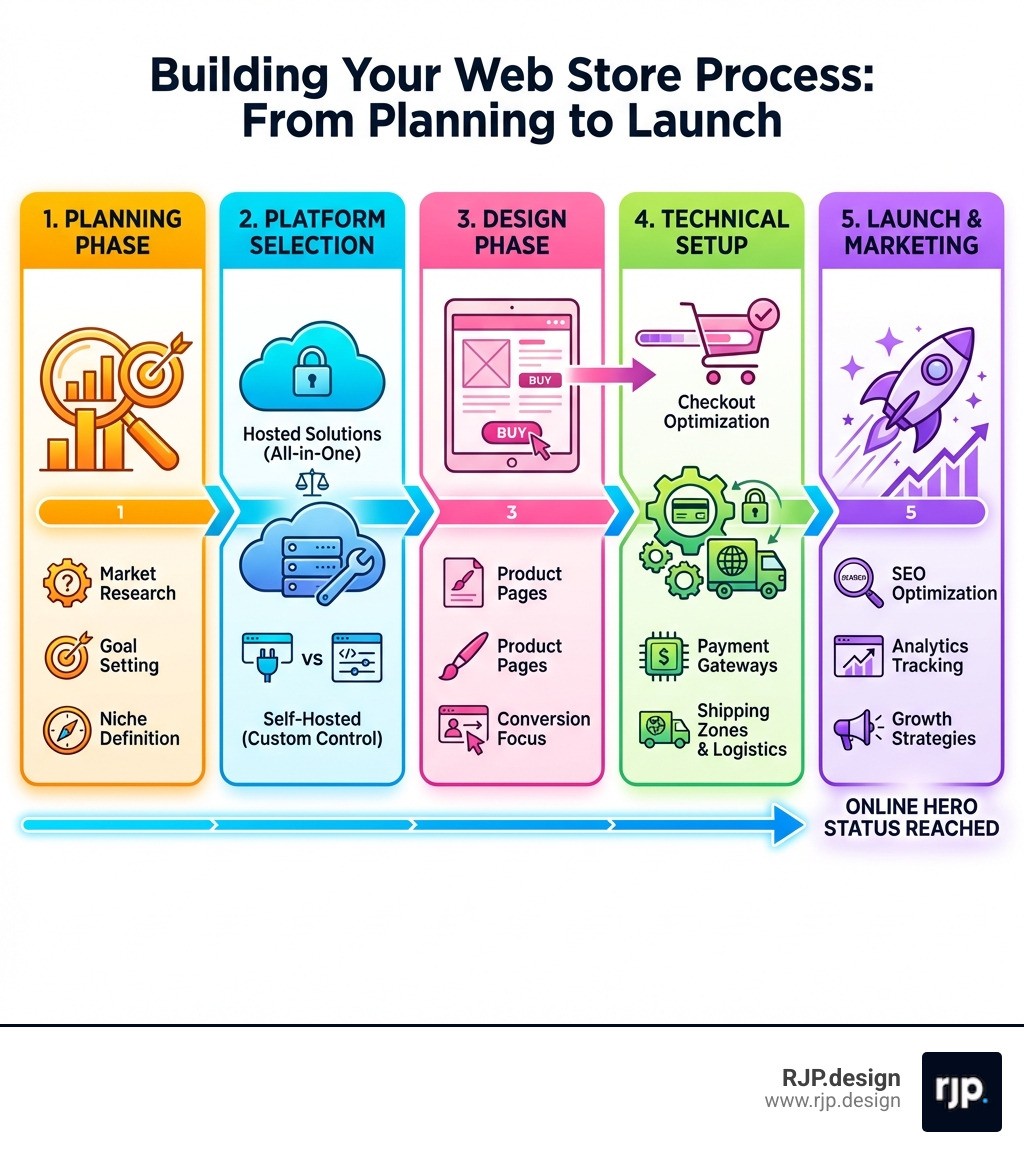
Build a web store and you're tapping into a market projected to exceed $8 trillion by 2026, with online purchases expected to comprise nearly a quarter of all retail transactions worldwide. The process involves five core steps:
Planning: Define your niche, research your market, and set clear business goals
Platform Selection: Choose between hosted solutions (Shopify, BigCommerce) or self-hosted options (WooCommerce, Magento)
Design & Setup: Configure your store, add products, and optimize for conversions
Payment & Logistics: Integrate payment gateways and configure shipping options
Launch & Market: Optimize for search engines and implement growth strategies
The opportunity has never been more compelling. With 33 million people expected to become ecommerce users by 2029 and Buy Now, Pay Later services projecting a 290% increase in consumer spending by 2027, the digital retail landscape is experiencing explosive growth.
But here's the reality: building a successful web store isn't just about slapping products on a template and hoping for sales. It requires strategic planning, thoughtful design, robust security, and ongoing optimization. About 67% of shoppers visit a new brand's website before completing a purchase, and 80% compare prices against similar brands-meaning your store needs to inspire confidence from the first click.
Whether you're selling physical products, digital goods, or services, the fundamentals remain the same. You need a platform that scales with your business, a design that converts visitors into customers, and systems that protect both your data and your customers' trust.
I'm Ross Plumer, and over my career working with businesses that have marketed over $20 million in revenue, I've seen what separates successful online stores from abandoned shopping carts. My experience helping companies build a web store that drives real results has taught me that success comes from combining technical excellence with strategic thinking and user psychology.
Explore more about build a web store:
Essential Steps to Build a Web Store
Before we dive into the "how-to" of coding or clicking, we need to lay the groundwork. Think of this as the blueprint for your digital skyscraper. If the foundation is shaky, the whole thing comes down with the first gust of competition.
Defining Business Goals and Niche
We often see entrepreneurs rush into a launch without a clear niche. A niche isn't just "selling clothes"; it's "selling ethically sourced, sustainable bamboo activewear for yoga enthusiasts." By narrowing your focus, you target a smaller, more defined crowd that is significantly more likely to convert. We recommend starting with a brand audit to ensure your messaging aligns with your target audience's motivations.
Conducting Market Research
You need to know who else is playing in your sandbox. Over 40% of shoppers turn to Google when researching a purchase, so you must understand what your competitors are doing well—and where they are failing. Are their shipping times too long? Is their checkout process clunky? These are your opportunities to shine. For a deeper dive into the technical side, check out our e-commerce website development complete guide.
Domain Acquisition and Brand Assets
Your domain name should be short, memorable, and communicative of your brand. Avoid hyphens and numbers, which can confuse customers. Once you've claimed your digital territory, you'll need brand assets: logos, color palettes, and typography that create a cohesive identity. Consistency is key here; 73.1% of web designers cite unresponsive or inconsistent design as a top reason visitors leave a site.
Inventory and Fulfillment Strategy
How will you get products to people? We see several successful models:
Dropshipping: You sell, a third party ships. Low risk, but lower margins.
Self-managed: You hold the stock. High control, but requires space and logistics.
Just-In-Time (JIT): Stock is ordered only as needed to minimize waste.
Choosing the Right Platform to Build a Web Store
Selecting your platform is one of the biggest decisions you'll make. It affects your budget, your technical overhead, and your ability to scale. We often help clients decide between a "SaaS" (Software as a Service) model and an "Open-Source" model.
SaaS Solutions (e.g., Shopify, BigCommerce)
These are "all-in-one" platforms. They handle hosting, security, and updates for you. They are perfect for beginners who want to build a web store quickly without worrying about servers. Shopify, for example, offers a robust app ecosystem and reliable infrastructure with high uptime.
Open-Source Flexibility (e.g., WooCommerce, Magento)
If you want total control, open-source is the way to go. WooCommerce powers millions of stores and is built on WordPress, which manages over 43% of the internet. It offers near-unlimited flexibility but requires you to manage your own hosting and security. For high-growth enterprises, bigcommerce website development or Magento might be better suited due to their advanced features.
Feature | Hosted (SaaS) | Self-Hosted (Open-Source) |
|---|---|---|
Ease of Use | Very High | Moderate to Low |
Customization | Limited to platform tools | Unlimited |
Maintenance | Handled by provider | User-managed |
Cost | Monthly subscription + fees | Hosting + Plugin costs |
Security | Included | User-responsible |
If you're looking for a professional online shop, we usually suggest weighing your technical expertise against your available time. Most small businesses thrive on SaaS, while larger entities often require the custom architecture of a self-hosted portal.
Designing for Conversions and User Experience
Design is not just about looking pretty; it's about guiding the user to the "Buy" button. We follow a mobile-first philosophy because the majority of global ecommerce traffic now happens on smartphones.
Intuitive Navigation and Breadcrumbs
Your site architecture impacts both SEO and user experience. We ensure product pages are within three clicks of the homepage. A crucial element is breadcrumb navigation, which helps users keep track of where they are (e.g., Home > Apparel > Men > Shoes). This reduces frustration and lowers bounce rates.
High-Converting Product Pages
A great product page needs:
High-Quality Imagery: Multiple angles, zoom capability, and even video.
Compelling Descriptions: Focus on benefits, not just features. Use your brand voice.
Clear CTAs: "Add to Cart" should be prominent and use contrasting colors.
Social Proof: 90% of customers check online reviews before purchasing.
Streamlining the Checkout Process
A complicated checkout is the number one killer of sales. We recommend allowing guest checkout to reduce friction. Use visual progress indicators so customers know how many steps are left. For more UX tips, visit our guide on best-ecommerce-sites-ux.
Configuring Payments and Shipping Logistics
To build a web store that actually makes money, you need to get paid and get products delivered.
Payment Gateways and Digital Wallets
Offer a variety of payment methods. While credit and debit cards are standard, digital wallets like Apple Pay and Google Pay are becoming essential for mobile conversions.
BNPL (Buy Now, Pay Later): Options like Affirm or Klarna are projecting a massive 290% increase in consumer spending by 2027. This is particularly effective for high-ticket items.
Security: Ensure your gateway is PCI-compliant to protect customer data.
Shipping Zones and Automation
Shipping can be your biggest cost. Will you offer free shipping? (It’s a great incentive for increasing cart size). Or will you use real-time carrier rates? We suggest setting up shipping zones to handle international logistics accurately. Tools like how-to-design-a-retail-website often highlight how clear shipping policies build customer trust.
Tax Automation
Don't try to calculate sales tax manually. Use built-in platform tools or extensions like Avalara to handle tax nexus and rates automatically. It saves hours of headache during tax season.
Optimizing and Managing Your Online Business
Once you launch, the real work begins. Managing a web store involves constant monitoring and securing your digital assets.
Security Protocols and Customer Trust
In the digital world, a security breach is often a matter of "when," not "if." To protect your business:
SSL Certificates: This encrypts data between the user and your server. It’s also a ranking factor for Google.
Two-Factor Authentication (2FA): Always enable this for site administrators.
Regular Backups: Use tools like Jetpack VaultPress to ensure you can restore your site if something goes wrong.
Data Privacy: Ensure you are compliant with local laws (like GDPR or CCPA) and have a clear Privacy Policy.
SEO Strategies to Build a Web Store Audience
You can have the best products in the world, but if no one can find you, you won't sell anything. Seo-for-e-commerce-websites is a long-term game that pays off in "free" organic traffic.
Keyword Research
Don't just target broad terms like "shoes." Target long-tail keywords with high purchase intent, such as "handmade leather men's dress shoes." Use tools like Google Keyword Planner to see what your audience is actually searching for.
Site Speed and Technical SEO
Google considers site speed a ranking factor. A slow site turns visitors away before they even see your offer. We recommend using Jetpack Boost to optimize your images and minify JavaScript.
Image Optimization: Rename image files to include keywords (e.g.,
blue-yoga-mat.jpginstead ofIMG_123.jpg) and always include Alt Text for accessibility and SEO.Meta Descriptions: While they don't directly impact rankings, they influence click-through rates. Make them compelling!
Internal Linking and User-Generated Content
Link related products and blog posts to keep users on your site longer. Encourage customers to leave detailed reviews. Reviews provide fresh, keyword-rich content that search engines love.
Marketing and Long-Term Growth
To scale, you need a multi-channel marketing strategy. We help businesses integrate their stores with social media to leverage "Social Commerce."
Email Marketing and Retention
It is significantly cheaper to keep an existing customer than to acquire a new one. Use email marketing to send:
Abandoned Cart Reminders: Bring people back to finish their purchase.
Win-Back Campaigns: Targeted at customers who haven't bought in 30, 60, or 90 days.
Newsletters: Share helpful content, not just sales pitches.
Analytics and A/B Testing
You can't improve what you don't measure. Set up Google Analytics to track:
Conversion Rate: The percentage of visitors who buy.
Average Order Value (AOV): How much the average customer spends.
Customer Lifetime Value (CLV): The total revenue a customer brings over time.
Use A/B testing to try different headlines, button colors, or product layouts. Even a 1% increase in conversion can lead to thousands of dollars in additional revenue. For comprehensive strategies, our digital-marketing-solutions can help you steer the complex world of performance advertising and retargeting.
Conclusion and Next Steps
Building a web store is a journey from a simple idea to a thriving online hero. It requires a blend of creative design, technical stability, and aggressive marketing. While the steps might seem daunting, every global giant started with a single product and a domain name.
At RJP.design, we specialize in taking the complexity out of this process. Our down-to-earth team prioritizes your satisfaction, ensuring your store not only looks amazing but also functions as a high-performance sales engine. Whether you need a custom build or help refining your current presence, we’re here to help you steer the retail evolution.
Your Launch Checklist:
[ ] Finalize niche and conduct competitor research.
[ ] Select a platform (SaaS for speed, Open-Source for control).
[ ] Design a mobile-responsive site with clear breadcrumbs.
[ ] Integrate secure payment gateways and BNPL options.
[ ] Optimize all images and metadata for SEO.
[ ] Perform a full pre-launch test of the checkout process.
Ready to turn your vision into a reality? Let’s talk about Professional Web Design and Development and get your store ready for the $8 trillion market. Your journey from zero to hero starts with that first click.
Explore our work and see how we've helped others succeed: rjp.design/our-work