
Web
Planning Your eCommerce Website Project: A Step-by-Step Blueprint
Apr 15, 2026

Mastering eCommerce Website Project Management: Methodologies and Phases
eCommerce website project management is the process of planning, organizing, and overseeing every task involved in building and running a successful online store — from initial discovery and design through development, testing, and post-launch growth.
Here's a quick overview of what it involves:
Stage | What Happens |
|---|---|
Discovery & Planning | Define goals, scope, budget, and timeline |
Requirements Gathering | Document features, integrations, and design needs |
Development | Build the site in structured sprints or phases |
Testing & QA | Validate performance, security, and usability |
Launch | Go-live checks, redirects, and deployment |
Post-Launch | Ongoing support, SEO, and conversion optimization |
Building an eCommerce website is one of the most complex digital projects a business can undertake. It's not just about design — it touches technology, marketing, logistics, security, and customer experience all at once.
The stakes are real. According to McKinsey research, large IT projects run an average of 45% over budget and deliver 56% less value than predicted. For eCommerce specifically, those gaps translate directly into lost revenue and missed market opportunity — especially as US retail eCommerce sales are forecast to exceed $1.3 trillion.
The difference between a project that launches on time and one that spirals into delays and cost overruns? A clear, structured plan from day one.
Most small business owners dive into eCommerce development without one. They pick a platform, hire a developer, and hope for the best. What follows is often scope creep, surprise costs, and a site that doesn't perform the way they imagined.
This guide walks you through every step of the process — so you know exactly what to expect, what to prepare, and how to make smart decisions at every stage.
I'm Ross Plumer, a digital marketing and web development strategist with hands-on experience helping businesses generate over $20 million in revenue through effective eCommerce website project management. In this guide, I'll share the same strategic framework I use with clients to take eCommerce projects from idea to launch — and beyond.
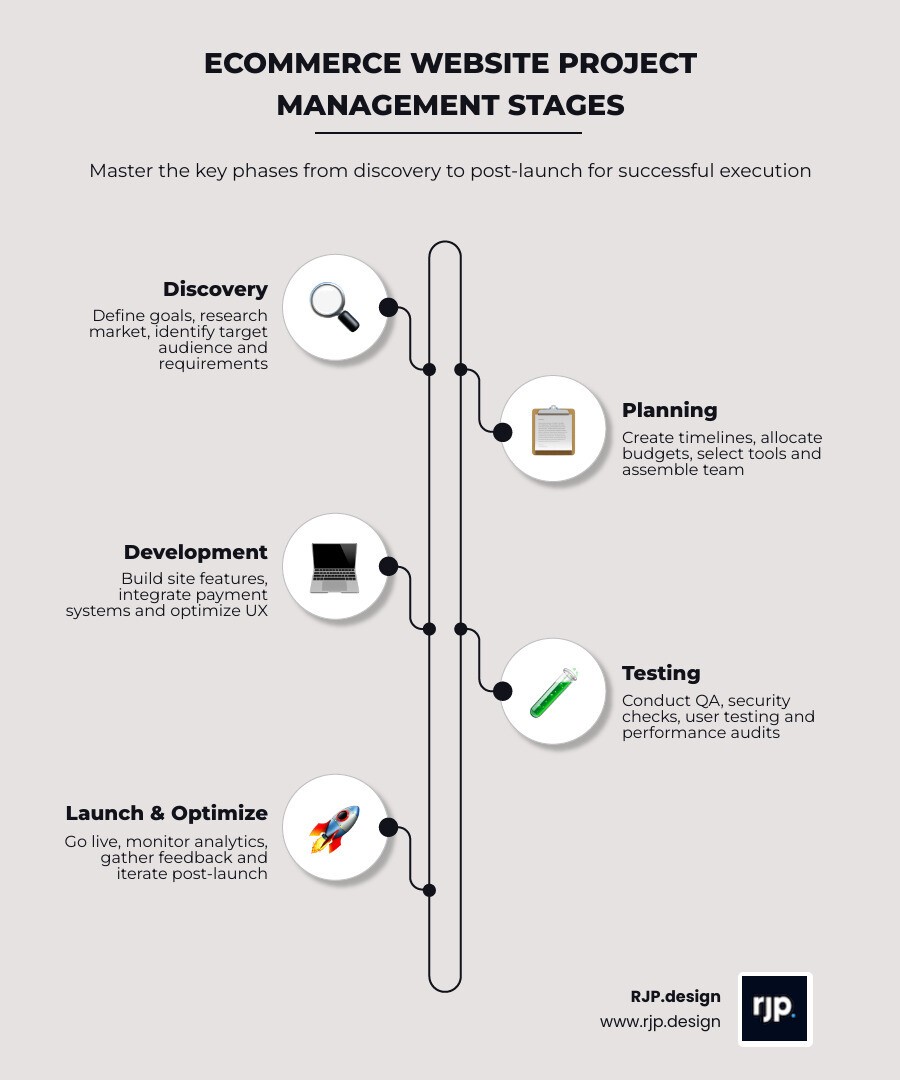
ECommerce website project management terminology:
To navigate the complexities of selling online, we must view the project as a living lifecycle rather than a one-time event. Successful eCommerce website project management requires a blend of business justification and technical precision. We don't just build a site because it "looks nice"; we build it because there is a clear business need, such as expanding into new markets or improving mobile conversion rates.
Stakeholder alignment is the glue that holds everything together. If the marketing team expects a custom loyalty program but the developers haven't budgeted for the API integration, the project will stall. By establishing a complete guide to eCommerce website development, we ensure everyone from the CEO to the junior designer is moving in the same direction. This alignment drastically improves workflow efficiency and delivery speed, preventing the "re-work" that typically drains budgets.
Key Phases of eCommerce Website Project Management
Every project we lead follows a structured path. It begins with the Discovery Phase. Here, we identify user personas, conduct competitor research, and define the "why" behind the store. We look at compelling portfolio website examples to understand what works in your niche and what doesn't.
Next comes Requirements Gathering. This is where we get into the nitty-gritty of building a custom eCommerce site. Do you need multi-currency support? How will your ERP sync with your inventory? We document these as "User Stories" to ensure the final product actually serves the customer.
To stay organized, we use a Work Breakdown Structure (WBS). Think of this as a family tree for your project. It breaks down massive deliverables (like "Checkout Page") into bite-sized tasks (like "Integrate Stripe," "Add guest checkout option," and "Validate CVV field"). These tasks are then fed into Development Sprints—two-week bursts of focused work.
Before anything goes live, we run User Acceptance Testing (UAT). This is the final "sanity check" where we (and you!) test the site to ensure it meets the original requirements. Finally, we perform Go-live checks, covering everything from SSL certificates to 301 redirects, ensuring a frictionless launch.
Choosing the Right Methodology: Agile, Scrum, and Waterfall
Selecting a strategy is one of the first big decisions in eCommerce website project management. There is no "perfect" way, but there is usually a "best" way for your specific goals.
Methodology | Best For... | Key Feature |
|---|---|---|
Agile | Projects with evolving requirements | Constant stakeholder collaboration and iterative releases. |
Scrum | High-speed development teams | Uses 2-week "Sprints" and daily stand-up meetings. |
Waterfall | Simple projects with fixed scopes | Linear execution: Phase A must finish before Phase B starts. |
Kanban | Ongoing maintenance and updates | Visual boards that sort tasks as "To Do," "In Progress," and "Done." |
Lean | Minimizing waste | Focuses on delivering only what adds value to the customer. |
Agile and Scrum are favorites in the eCommerce world because they allow for flexibility. If a new payment trend emerges mid-project, an Agile approach lets us pivot. Waterfall, while more rigid, can work for very small, predictable builds where the e-commerce portal development requirements are set in stone from day one.
Building Your Team and Defining the Project Scope
You wouldn't build a house with just a painter; you need an architect, a plumber, and an electrician. The same applies here. A robust eCommerce team usually includes:
Project Manager: The conductor of the orchestra, keeping everyone on schedule.
Solution Architect: The technical lead who decides how different systems (like Shopify and your warehouse) will talk to each other.
QA Specialists: The "bug hunters" who try to break the site before a customer does.
Developers & Designers: The creators who turn the vision into code and pixels.
If you are looking to expand your internal team, you might search jobs to find specialized talent, or consider a freelance project manager for short-term expertise.
When defining the Project Scope, we use SMART objectives (Specific, Measurable, Achievable, Relevant, Time-bound). Instead of saying "We want more sales," we say "We want to reduce cart abandonment by 15% within six months of launch." This deliverable-based planning helps us identify dependencies—tasks that rely on each other—and set realistic milestones.
Executing Your Plan: Tools, Budgets, and Launch Strategies
Execution is where the "rubber meets the road." This is the phase where we transition from talking to doing. To prevent the project from becoming a "black hole" of emails, we establish clear communication protocols. We decide early on: Who needs to approve design changes? How do we handle "Scope Creep" (when new ideas are added mid-project)?
Formal change management and escalation procedures are vital. If a third-party API goes down, the team needs to know exactly who to call and how it impacts the timeline. We track every hour and every task to ensure we stay within the guardrails of the initial plan.
Essential Tools for eCommerce Website Project Management
In eCommerce website project management, your tools are your best friends. Over 70% of successful companies use specialized software to manage their workflows.
Gantt Charts & TeamGantt: These are visual timelines that show exactly how long each phase will take. TeamGantt is a top choice for seeing how a delay in "Product Photography" might push back the entire "Launch Date."
Kanban Boards: Many teams use the best project management software like Teamwork or Trello to move tasks through a visual pipeline.
Time-Tracking: We use time-tracking tools to ensure resource allocation is efficient. It helps us see if we’re spending too much time on "Design" and not enough on "Functional Testing."
Automation: Tools like Zapier can connect your project management stack to your communication tools (like Slack). For instance, when a developer finishes a task in Jira, a notification can automatically pop up in the project's Slack channel.
Digital Asset Management: eCommerce projects involve thousands of images and videos. Having a centralized home for these prevents the "Where is the final-final-v2 logo?" headache.
Whether you are utilizing Shopify eCommerce development services or building on another platform, these tools keep the gears turning smoothly.
Budgeting, Risk Management, and Quality Assurance
Budgeting for eCommerce is notoriously tricky because of "hidden costs." Beyond the initial build, you must account for hosting, SSL certificates, payment gateway fees, and third-party app subscriptions. Brad Shorr’s insights on how to create an e-commerce budget plan suggest that a "lousy budget plan" is the quickest way to kill a project.
We recommend a Scaling Budget that includes a Contingency Reserve (usually 10-20% of the total cost). This acts as a safety net for unforeseen technical hurdles.
Risk Management involves identifying "what could go wrong" before it does.
Site Speed: If a page takes over 5 seconds to load, 90% of visitors will leave. We optimize images and use CDNs to keep things fast.
Mobile Responsiveness: With 73% of online transactions happening on mobile, your site must look perfect on a smartphone.
Payment Diversity: 13% of shoppers abandon carts because their preferred payment method isn't available. We ensure a mix of credit cards, PayPal, and digital wallets like Apple Pay.
Accessibility: We perform eCommerce accessibility testing to ensure the store is usable for everyone, which also helps with SEO and legal compliance.
Post-Launch Support and Measuring Project Success
The launch isn't the finish line; it's the starting gun. Once the site is live, we transition into Ongoing Maintenance. This includes monthly health checks, security patches, and SEO for eCommerce websites to ensure you stay visible in search results.
To measure success, we look at ROI (Return on Investment) and Earned Value Management. We track metrics like:
Conversion Rate: Are visitors actually buying?
Average Order Value (AOV): Can we encourage customers to spend more per visit?
Site Performance: Is the site staying fast under heavy traffic?
Customer Feedback: What are users saying about the new checkout flow?
At RJP.design, we pride ourselves on being a down-to-earth team that prioritizes your satisfaction. We don't just "hand over the keys" and disappear. We work with you to iterate and improve the site based on real-world data. If you're ready to elevate your online presence with RJP.design, we’re here to help you navigate the complexities of the digital marketplace.
Key Success Metrics for Your eCommerce Project:
Reduced page load times (aim for under 3 seconds).
Zero critical bugs during the first 30 days post-launch.
Positive trend in organic search rankings for target keywords.
Increased mobile conversion rates compared to the old site.
Lower cart abandonment rates through optimized checkout.
By following this blueprint for eCommerce website project management, you can avoid the common pitfalls that lead to overruns and delays. With the right team, the right tools, and a clear plan, your online store won't just launch—it will thrive.