
Web
The Ultimate Guide to Enterprise Website Development and AI Optimization
Sep 4, 2026

What Is Enterprise Website Development? (And Why It Matters in 2026)
Enterprise website development is the process of designing, building, and maintaining large-scale websites and web applications for mid-to-large organizations — ones that need to handle high traffic, integrate with complex business systems, and serve multiple audiences simultaneously.
Here's a quick overview of what sets it apart:
Factor | Enterprise Website | Standard Website |
|---|---|---|
Traffic | Millions of visitors | Hundreds to thousands |
Complexity | Multi-department, multi-audience | Single purpose |
Integrations | CRM, ERP, PIM, analytics, and more | Standalone or basic tools |
Security | GDPR, HIPAA, SOC 2, WCAG compliance | Basic SSL/HTTPS |
Team | Cross-functional, often 4-6+ specialists | 1-2 developers |
Budget | $50,000 to $400,000+ | Under $10,000 |
Timeline | 3-12 months | Days to weeks |
Think of a standard website as a playground — simple, self-contained, easy to manage. An enterprise website is more like a theme park: far more moving parts, far higher stakes, and a lot more people depending on it working perfectly.
The numbers back this up. Websites influence 97% of buyers before they make a purchase decision. And yet, most enterprise organizations are leaving serious performance, security, and accessibility gaps on the table. Every day, around 30,000 websites are hacked. Nearly 96% of the top 1 million websites fail basic accessibility standards. And 40% of visitors leave a site that takes longer than three seconds to load.
Getting enterprise web development right isn't optional — it's a competitive necessity.
I'm Ross Plumer, a digital marketing and web development expert with experience helping businesses that have marketed over $20 million in revenue, including guiding organizations through the full scope of enterprise website development — from strategy and architecture to launch and growth. In the sections ahead, I'll walk you through everything you need to know to build an enterprise website that performs at the level your organization demands.

Key Requirements for Successful Enterprise Website Development
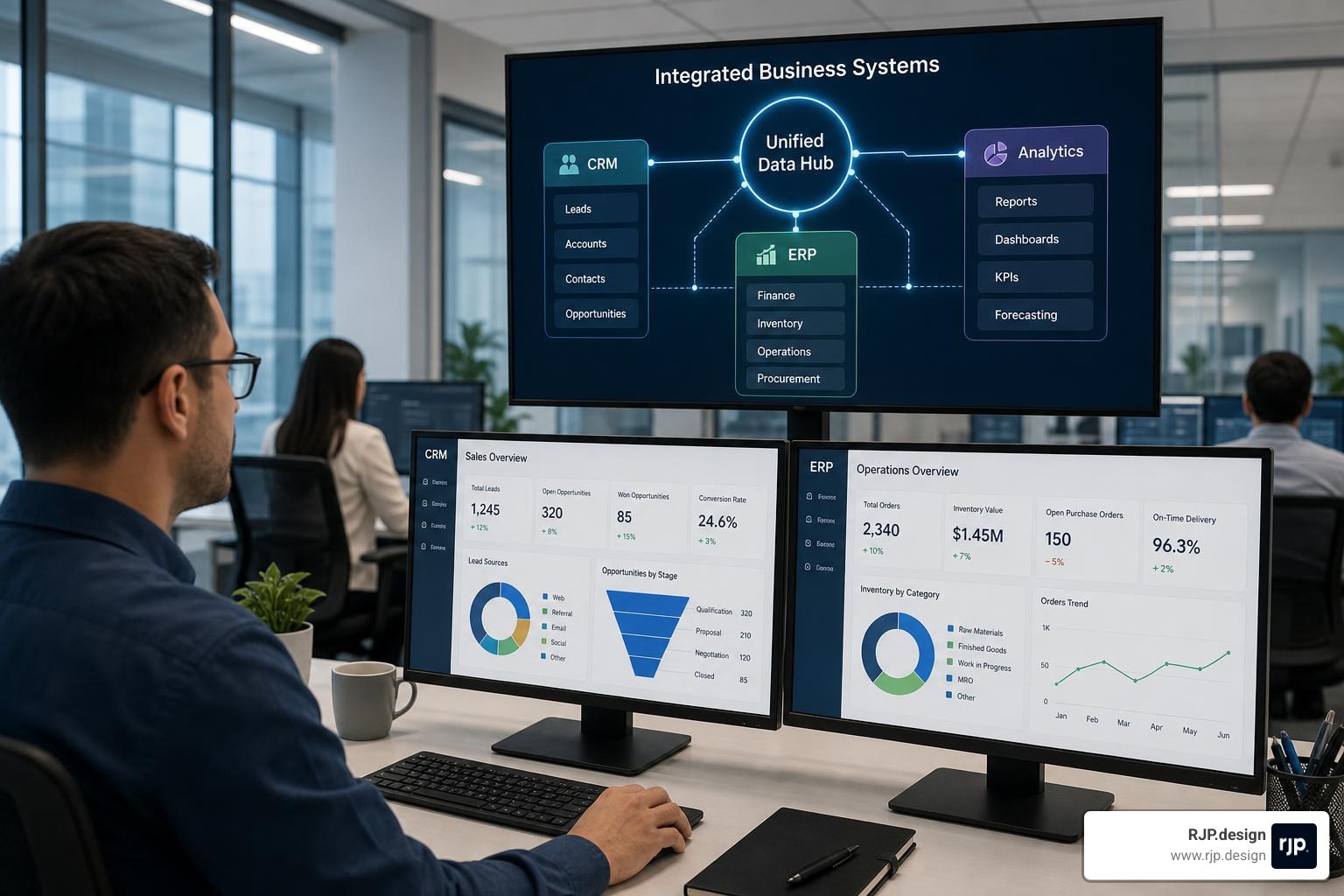
A successful enterprise website is not just a larger version of a small business website. It is a digital system. It has to support marketing, sales, operations, customer service, compliance, reporting, and sometimes internal teams too.
At RJP.design, we look at enterprise websites through five lenses:
Business goals: What should the website actually achieve?
User experience: Can each audience quickly find what they need?
Technical architecture: Can the platform grow without becoming a mess?
Integration: Does it connect cleanly with existing systems?
Governance: Can teams manage content safely and consistently?
For May 2026 and beyond, there is another requirement: AI optimization. Search is no longer only about traditional search engines. AI assistants, answer engines, and generative search experiences increasingly summarize websites. That means enterprise sites need clear structure, authoritative content, schema markup, fast performance, accessible HTML, and consistent brand signals.
In plain English: if your website is confusing to users, it is probably confusing to AI too. And nobody wants their brand summarized like a badly labeled leftovers container.
What is Enterprise Web Development and How Does It Differ?
Enterprise web development includes the strategy, design, engineering, integration, testing, launch, and long-term improvement of websites and web applications for larger organizations.
It often includes:
Front-end development for user interfaces
Back-end development for business logic and data
CMS or DXP implementation
CRM, ERP, PIM, analytics, and marketing automation integrations
Security controls and compliance workflows
Accessibility testing
Performance optimization
Content governance
Multi-region or multilingual support
Ongoing maintenance and improvement
The biggest difference is that enterprise websites have to serve more people, systems, and business goals at once.
Area | Standard Web Development | Enterprise Web Development |
|---|---|---|
Main goal | Present information or generate leads | Support complex business operations and growth |
Users | One or two main audiences | Customers, partners, employees, investors, vendors |
Content | Small content library | Large content ecosystem with workflows |
Integrations | Contact form, analytics, email tool | CRM, ERP, PIM, SSO, APIs, analytics, automation |
Governance | Simple admin access | Roles, permissions, approvals, audit trails |
Optimization | Basic SEO and speed | SEO, AI visibility, accessibility, conversion, performance |
For organizations that need tailored functionality, custom website solutions are often the right path because they allow the website to be built around the business rather than forcing the business to work around the website.
The Business Benefits of Enterprise Website Development
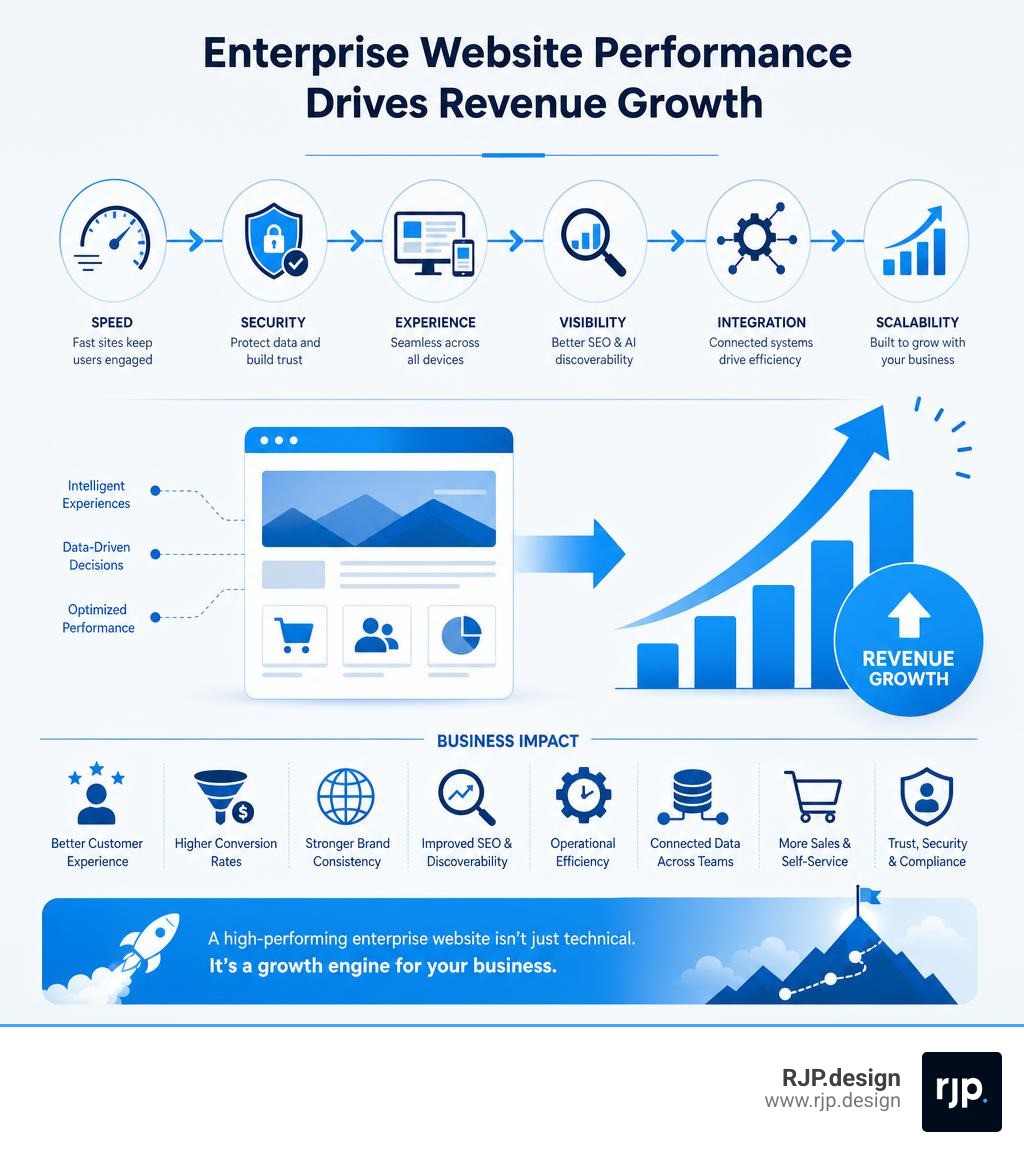
The best enterprise websites are not “nice-to-have” digital brochures. They are growth engines.
Strong enterprise website development can help large organizations:
Improve customer experience with faster, clearer user journeys
Increase revenue through better conversion paths
Support brand consistency across markets and departments
Improve SEO and AI discoverability
Reduce internal bottlenecks by giving teams better publishing tools
Connect data across marketing, sales, and operations
Support ecommerce, portals, self-service, and lead generation
Build trust with secure, accessible, professional experiences
This matters because enterprise buyers often do significant research before speaking with sales. If your site is slow, vague, outdated, or difficult to navigate, it creates friction before your team ever gets a chance to help.
For companies building a stronger online foundation, our guide to business website development is a helpful starting point. For organizations selling online at scale, e-commerce website development complete guide explains the added requirements around product catalogs, checkout, inventory, and payment workflows.
Security, Accessibility, and Scalability in Enterprise Website Development
Security, accessibility, and scalability are the big three. If one is weak, the whole platform is at risk.

Security should be built in from the beginning, not duct-taped on later. Enterprise websites often process sensitive customer, employee, payment, or health-related data. That means teams need to think about:
HTTPS and secure headers
Role-based access control
Multi-factor authentication
Secure coding practices
Dependency and plugin updates
Regular vulnerability scans
Backups and disaster recovery
DDoS protection
Logging and monitoring
Compliance with GDPR, CCPA, HIPAA, PCI, or SOC 2 where relevant
A practical security starting point is the OWASP Top Ten Security Risks, which outlines common web application vulnerabilities.
Accessibility is just as important. Nearly 96% of the top 1 million websites are not accessible, and around 70% of websites in critical industries like government, news, and ecommerce are inaccessible to vision-impaired users. That is not only a legal and ethical issue. It is also a business issue.
Enterprise websites should follow recognized accessibility guidance from the W3C Web Accessibility Initiative, including:
Keyboard navigation
Proper heading structure
Alt text for images
Sufficient color contrast
Screen reader compatibility
Clear form labels and error messages
Captions and transcripts for media
Scalability means the website can grow without falling over. That includes traffic spikes, new markets, more content, added features, and deeper integrations. Scalable systems usually rely on modular architecture, caching, CDNs, optimized databases, clean APIs, and reusable components.
For more advanced workflows, portals, dashboards, and internal platforms, custom web applications can extend the website into a true business tool.
Choosing the Right Technology Stack and CMS
There is no one “best” technology stack for every enterprise. The right choice depends on business goals, internal team skills, security requirements, content volume, integrations, budget, and long-term roadmap.
Common enterprise stack components include:
Front end: HTML, CSS, JavaScript, React, Vue, Angular, or Next.js
Back end: Node.js, PHP, Python, Java, .NET, or Ruby
Databases: PostgreSQL, MySQL, MongoDB, SQL Server, or cloud-native databases
Infrastructure: Cloud hosting, CDN, caching, containerization, CI/CD
CMS: Traditional CMS, headless CMS, or enterprise DXP
APIs: REST, GraphQL, webhooks, middleware, and integration platforms
Analytics: GA4, server-side tracking, dashboards, heatmaps, and BI tools
A CMS or Digital Experience Platform plays a central role. It gives teams a place to manage content, approvals, localization, SEO metadata, media, landing pages, and publishing workflows. Almost 70% of active websites are built with a CMS, which makes sense: without one, every content update becomes a developer ticket. And developers have enough to do without being asked to change a comma in a press release.
For enterprise organizations, CMS selection should consider:
User roles and permissions
Approval workflows
Version control
Multilingual content
SEO and structured data support
API access
Security controls
Performance
Ease of use for non-technical teams
Integration with marketing and business systems
Integration is especially important. Enterprise websites often need to connect with CRM, ERP, PIM, ecommerce, analytics, customer support, HR, inventory, and marketing automation platforms. Our api integration services help businesses connect those systems cleanly so data stays accurate and workflows stay smooth.
If you are comparing design and development options, our web design and web development services page explains how strategy, design, engineering, and optimization work together.
Overcoming Challenges in Enterprise Web Projects
Enterprise web projects are rewarding, but they are not always simple. Common challenges include:
Legacy systems that are hard to integrate
Departmental silos and competing priorities
Complex approval processes
Security and compliance requirements
Large content migrations
Unclear ownership
Slow decision-making
Budget and timeline pressure
Accessibility gaps
Performance issues caused by bloated code or too many third-party scripts
The way to handle these challenges is not to “just start building.” That is how expensive surprises happen. Instead, successful enterprise projects usually follow a structured process:
Discovery: Define goals, audiences, risks, systems, and success metrics.
Strategy: Map user journeys, content, technical requirements, and integrations.
Architecture: Plan CMS structure, data flows, APIs, permissions, and hosting.
UX and design: Create accessible, responsive, brand-consistent experiences.
Development: Build modular components, templates, integrations, and custom features.
Testing: Run QA, accessibility checks, security reviews, browser testing, and performance audits.
Launch: Deploy carefully with redirects, monitoring, backups, and rollback plans.
Optimization: Improve based on analytics, user behavior, SEO, AI visibility, and business goals.
Project management matters too. Many enterprise teams use Agile or a hybrid Agile approach, with one-to-two-week sprints, clear priorities, stakeholder reviews, and iterative testing. This keeps the project moving while still allowing room for change.
To reduce risk, we recommend:
Define decision-makers early
Document technical requirements before development
Audit existing content and systems
Build with reusable components
Create a design system
Use staging environments before launch
Monitor errors, uptime, speed, and user behavior
Train internal teams before handoff
Plan maintenance before the website goes live
If you are evaluating partners, our web development agency complete guide can help you understand what to look for in a team, from process and communication to technical capability and support.
Conclusion: Elevating Your Digital Presence
Enterprise websites are no longer just marketing assets. They are business infrastructure. They influence buying decisions, support customer experience, connect internal systems, improve operational efficiency, and help organizations grow.
The best enterprise websites are:
Fast
Secure
Accessible
Scalable
Easy to manage
Integrated with business systems
Built around real user needs
Optimized for search and AI discovery
Supported after launch
At RJP.design, we specialize in creating websites and strengthening online presence for businesses that want high-quality work without confusing jargon or inflated egos. Our team is down-to-earth, practical, and focused on client satisfaction from strategy through launch and beyond.
If your organization is ready to build a better digital foundation, explore our website design and development services. We would love to help you create an enterprise website that looks great, works hard, and is easy to find online.