
SEO
7 Steps to a Killer Content Strategy: From Idea to Impact
Feb 16, 2026

Why a Content Strategy is Your Secret Weapon for Online Success
Learning how to create content strategy is about more than just writing blog posts. It is a systematic, repeatable way to plan, create, and manage content so it actually supports your business goals.
A clear strategy shows you:
What to publish
Who you are speaking to
Where to share it
How to measure success
Without that structure, content becomes guesswork.
Quick Answer: Creating a Content Strategy in 7 Steps
Define Goals & Audience - Set SMART goals and create detailed buyer personas.
Audit Current Content - Analyze what you already have and identify gaps.
Research Competitors - See what others in your space are doing and where you can stand out.
Choose Content Pillars - Select core topics and content formats to focus on.
Build a Calendar - Plan and schedule content so you stay consistent.
Create & Optimize - Produce high-quality, SEO-friendly content custom to your audience.
Measure & Refine - Track performance and adjust your strategy based on data.
Here is the reality: 62% of B2B organizations successful at content marketing have a documented strategy. This represents a massive opportunity, as many businesses still publish content without a clear plan. With users spending nearly seven hours online daily, a solid strategy helps ensure they find you instead of your competitors.
Many businesses post content randomly and wonder why it does not move the needle. The problem usually is not effort, it is the absence of a strategic framework.
A good content strategy:
Aligns content with your business goals
Speaks directly to your target audience
Builds long-term brand authority
Turns content from a cost into an asset
In this guide, we walk you through the same framework successful businesses use to turn content into a growth engine.
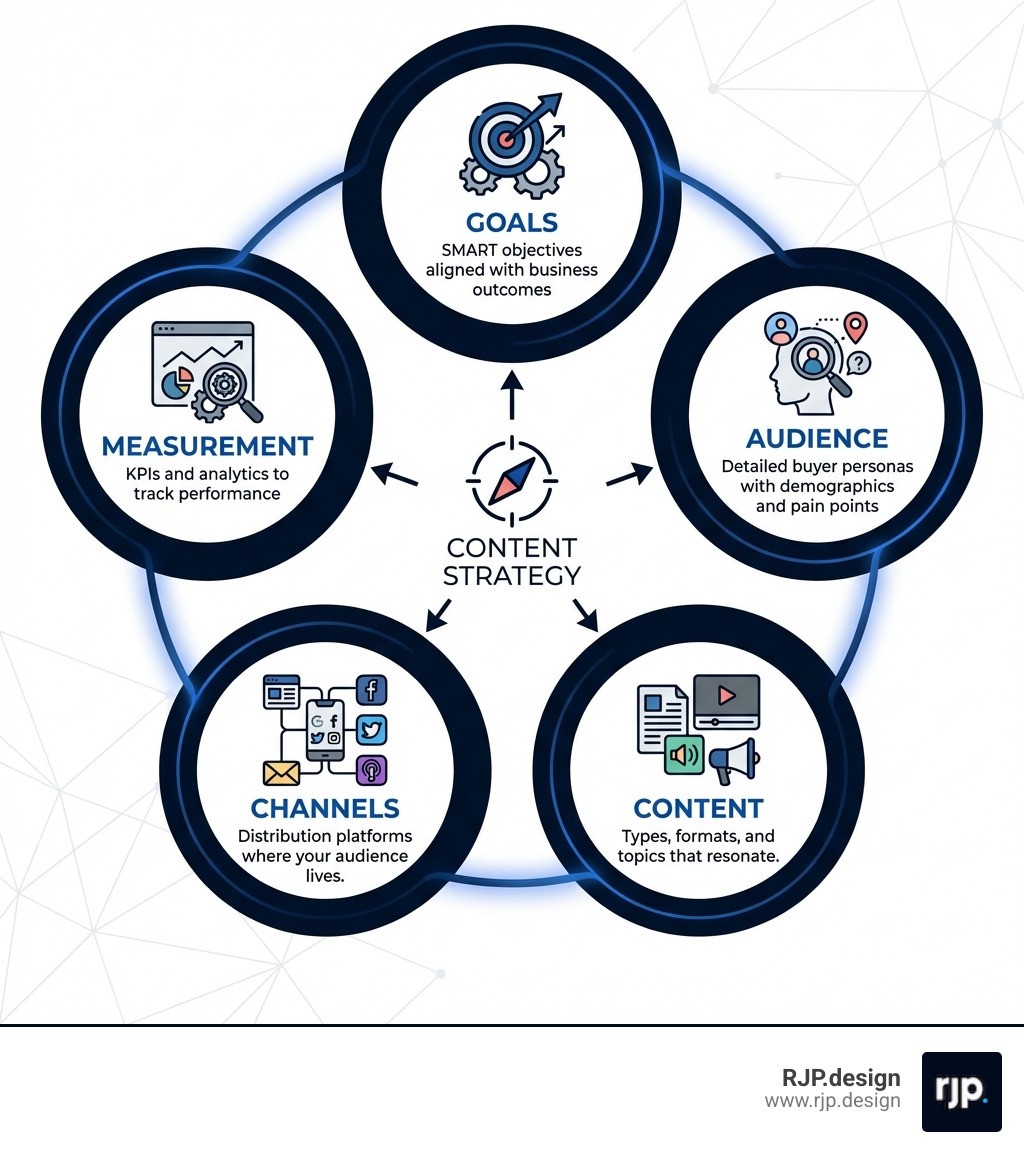
How to Create a Content Strategy: A Step-by-Step Guide
A content strategy is your roadmap for producing and distributing valuable content that attracts, engages, and converts your target audience. It is the "why" behind every piece of content you publish and the plan for how that content supports your business.
Without a clear strategy, content efforts are scattered, hard to measure, and rarely effective over the long term.
Step 1: Define Your Goals and Target Audience
Before creating content, you must know why you are creating it and for whom. This foundational step gives your strategy direction.
Business Objectives and SMART Goals
Start by aligning your content with core business objectives such as increasing brand awareness, generating leads, or driving sales. Then translate these into SMART goals (Specific, Measurable, Achievable, Relevant, and Time-bound).
For example, a SMART goal could be: "Increase organic website traffic by 25% in 6 months." This makes it clear what success looks like and which Key Performance Indicators (KPIs) matter.
You can track these KPIs with tools like Salesforce Goal Management features or other analytics platforms that fit your tech stack.
Defining Your Target Audience
Defining your audience is one of the most critical parts of how to create content strategy. High-quality content that directly addresses customer needs builds trust and positions your business as an authority.
Create detailed buyer personas, which are semi-fictional profiles of your ideal customers based on market research and real data.

Use tools like SurveyMonkey to collect feedback and Google Analytics to understand online behavior. Look at:
Demographics (age, location, job title)
Interests and preferences
Pain points and challenges
Goals and motivations
This data helps you personalize content and answer the questions your audience is already asking. With this insight, you can build a stronger digital presence for business.
Step 2: Conduct a Content Audit and Competitor Analysis
With your goals and audience defined, the next step in how to create content strategy is to review what you already have and learn from what others are doing.
The Role of a Content Audit
A content audit is a structured review of your existing content. It shows you what is working, what needs updating, and where you have gaps.
To run a content audit:
Use a crawler like Screaming Frog to list all your pages and posts.
Pull performance metrics from Google Analytics such as traffic, engagement, and conversions.
Flag high-performing pieces to build on, low-performing content to improve or consolidate, and outdated topics to remove.
This process prevents wasted effort on content that does not support your goals and is a key part of any search engine optimization analysis.
Competitor Analysis
At the same time, analyze your competitors' content to understand the landscape and spot opportunities.
Look at:
Their top-performing topics and formats
The keywords they seem to target
Areas they cover well and areas they overlook
This insight helps you differentiate your brand and shape a more effective SEO strategy for websites.
Useful tools for competitor analysis include:
While competitor research is helpful, your strategy should always be grounded in your unique value and your audience's specific needs.
Step 3: Choose Your Content Pillars, Formats, and Channels
Now you can decide what to talk about, how to present it, and where to publish it. This is where your strategy starts to turn into an actionable plan.
Content Pillars and Topic Clusters
Content pillars are the broad, core topics your content will focus on. Each pillar supports multiple related pieces of content (topic clusters), allowing you to explore subjects in depth and build authority over time.
For example, a web design agency might choose:
"Responsive Web Design"
"E-commerce Solutions"
Within each pillar, you create blog posts, guides, videos, and case studies that drill into specific questions. This approach aligns with research showing that over 70% of B2B buyers prefer content that drills down into specific topic areas.
Choosing the Right Content Types and Channels
Your audience and goals should guide your choice of formats and channels. RJP.design offers a range of content for digital marketing services, and each type plays a different role in your strategy.
Common content formats include:
Blog posts and articles
Videos and shorts
Podcasts and audio snippets
Infographics and visual explainers
Ebooks, guides, and whitepapers
Case studies and testimonials
Distribute your content on the platforms where your audience already spends time, such as:
Your website and blog (for SEO and depth)
Social media
Email newsletters
Paid advertising campaigns
You can also explore influencer marketing to extend your reach, an industry expected to reach $24 billion by the end of 2024.
For a broader view on how these pieces fit together, see our digital marketing services complete guide.
Step 4: Build Your Content Calendar
Once you have your pillars, formats, and channels, a content calendar brings structure to your publishing schedule. This is a non-negotiable step in how to create content strategy.
What Is a Content Calendar and Why Is It Important?
A content calendar (also called an editorial calendar) is a schedule of upcoming content, including who is responsible for each task and when it will be published.
A good calendar helps you:
Stay consistent with posting
Coordinate tasks across your team
Plan around campaigns and key dates
Keep content aligned with your goals

How to Build One
To build your calendar:
Set content goals that tie back to your business objectives.
Decide on your primary channels and content mix.
Outline your workflow (who ideates, writes, designs, reviews, and publishes).
Choose a tool that fits your team, from a simple Google Sheets file to platforms like Asana or Trello.
Then populate your calendar with:
Key dates (product launches, events, seasonal moments)
Recurring content series
Promotion plans for each piece
Review and adjust the calendar regularly to reflect performance and new opportunities. A strong calendar is the backbone of effective content marketing asset management.
Step 5: How to Create and Optimize Your Content
This is where your content strategy comes to life. Creation and optimization are ongoing, not one-time tasks.
The Content Creation and Optimization Process
A simple, reliable process might look like this:
Brainstorm ideas based on your pillars and keyword research.
Research each topic to ensure accuracy and depth.
Create a clear outline that answers your audience's main questions.
Draft content using a consistent brand voice and tone.
Edit for clarity, structure, and impact.
When defining your voice, style guides like MailChimp's can be a useful reference for balancing personality with professionalism.
Creating strong content is only half the job. It also needs to be easy to find and simple to read.
Keyword research: Use tools like Google Search Console and Google's Keyword Planner to find relevant search terms. Integrate keywords naturally into titles, headings, and body copy on your SEO friendly websites.
On-page SEO and readability: Optimize meta titles and descriptions, use descriptive URLs, and add internal links. Break up text with headings, short paragraphs, and bullet points to improve readability.
Voice search: With 90% of users finding voice search easier than traditional search, write content that answers common questions in clear, conversational language.
The Impact of AI on Content Creation
AI tools are reshaping how content is planned and produced. According to recent research, 71% of marketers expect it to free up time for more strategic work.
You can use AI to:
Generate topic ideas and outlines
Draft or edit copy
Suggest keywords and optimization opportunities
At RJP.design, we recommend a human-led, AI-assisted approach. AI can handle repetitive or data-heavy tasks, but human creativity, judgment, and brand understanding are still essential for building trust. This balance is central to our SEO content optimizer.
Step 6: Measure Success and Refine Your Content Strategy
The final step in how to create content strategy is ongoing measurement and improvement. A good strategy is never "finished"; it evolves with your audience and your business.
Tracking Metrics and KPIs
To understand whether your content is working, track metrics that map back to your goals.
Use Google Analytics to monitor:
Website traffic (page views, sessions, traffic sources)
Engagement (time on page, pages per session, bounce rate)
For most websites, a good bounce rate is typically 40-60%. Tools like Hotjar can show you how people interact with your pages in more detail.
For SEO performance, track keyword rankings and backlinks with tools such as Semrush's Position Tracking. Most importantly, monitor conversions and Return on Investment (ROI) so you can connect content to real business outcomes.
Addressing Challenges and Learning from Examples
Common challenges include limited resources, difficulty staying consistent, and uncertainty around measurement.
You can address these by:
Repurposing content into multiple formats
Creating clear processes and ownership
Setting up analytics tracking from the start
A 2023 Contently report noted that for 10% of teams, the biggest challenge is a lack of tools to measure impact, which makes proper tracking even more important.
Real-world examples of smart content strategies include:
Salesforce: Uses a wide range of content, from social updates and customer success stories to detailed blog posts and help center resources, to support users at every stage of the journey.
Air New Zealand: Their creative safety videos transform required information into highly engaging, brand-building content.
Your content strategy should be reviewed regularly. Look at your website traffic analysis and other data, identify what is working, and refine your approach so it continues to drive your business objectives.
Lift Your Brand with a Powerful Strategy
We have covered the essential steps in how to create content strategy: from defining goals and understanding your audience to auditing content, choosing pillars, planning a calendar, creating optimized content, and measuring results.
Sustained digital success does not come from random acts of content. It comes from a thoughtful, documented strategy that turns content into a reliable engine for business growth online.
A strong content strategy helps you:
Show up where your ideal customers are already looking
Build trust and recognition over time
Support sales and lead generation with helpful, relevant information
At RJP.design, we specialize in creating websites and enhancing online presence. Our down-to-earth team guides you through this strategic process, using a well-crafted content strategy as the cornerstone of your digital marketing to drive visibility, stronger customer relationships, and sustainable growth.
If you are ready to move from ad-hoc posts to a clear, effective plan, we can help you shape a content strategy that turns ideas into measurable impact.