SEO
Why Local Link Building is the Secret Sauce for SEO Success
Jul 22, 2026

Why Local Link Building is the Secret Sauce for Local SEO Success
Local link building is the process of earning backlinks from locally relevant websites — think local news outlets, community blogs, chambers of commerce, and neighborhood directories — to help your business rank higher in location-based search results.
Here's what you need to know right away:
What it is: Acquiring links from websites geographically close to or relevant to your business
Why it matters: Local links are the second most important local organic ranking factor, right behind on-page signals
Where it helps: Both Google's organic results and the coveted Local Pack (the map with three business listings)
Who needs it: Any business serving customers in a specific city, neighborhood, or region
How it differs from regular link building: It prioritizes local relevance over raw domain authority — a link from your city's chamber of commerce beats a generic high-authority blog every time
Here's the reality most small business owners don't realize: your Google Business Profile alone won't get you to the top of local search anymore. In 2026, with AI-powered search tools like ChatGPT, Perplexity, and Google AI Overviews reshaping how people find local businesses, the bar has moved.
The businesses sitting in the top three local results share one thing in common — they've earned trust signals from their own community.
That means real links. From real local sources. Not a pile of generic directories.
Take a home services company in Denver that moved from position 6 to position 2 in just 60 days after a focused local backlink campaign. When they audited their existing links, they found almost every single one came from national directories — with zero local links. Once they fixed that, the results followed quickly.
The good news? The bar for local link building is genuinely lower than national SEO. You're not competing with major publications. You're competing with the other small businesses in your zip code — and most of them haven't figured this out yet.
I'm Ross Plumer, a digital marketing strategist with experience helping businesses generate over $20 million in revenue through smarter online strategies, including local link building campaigns that move the needle on real rankings. In this guide, I'll walk you through exactly how to build local links the right way — from foundational tactics to measuring your results in a world shaped by AI search.
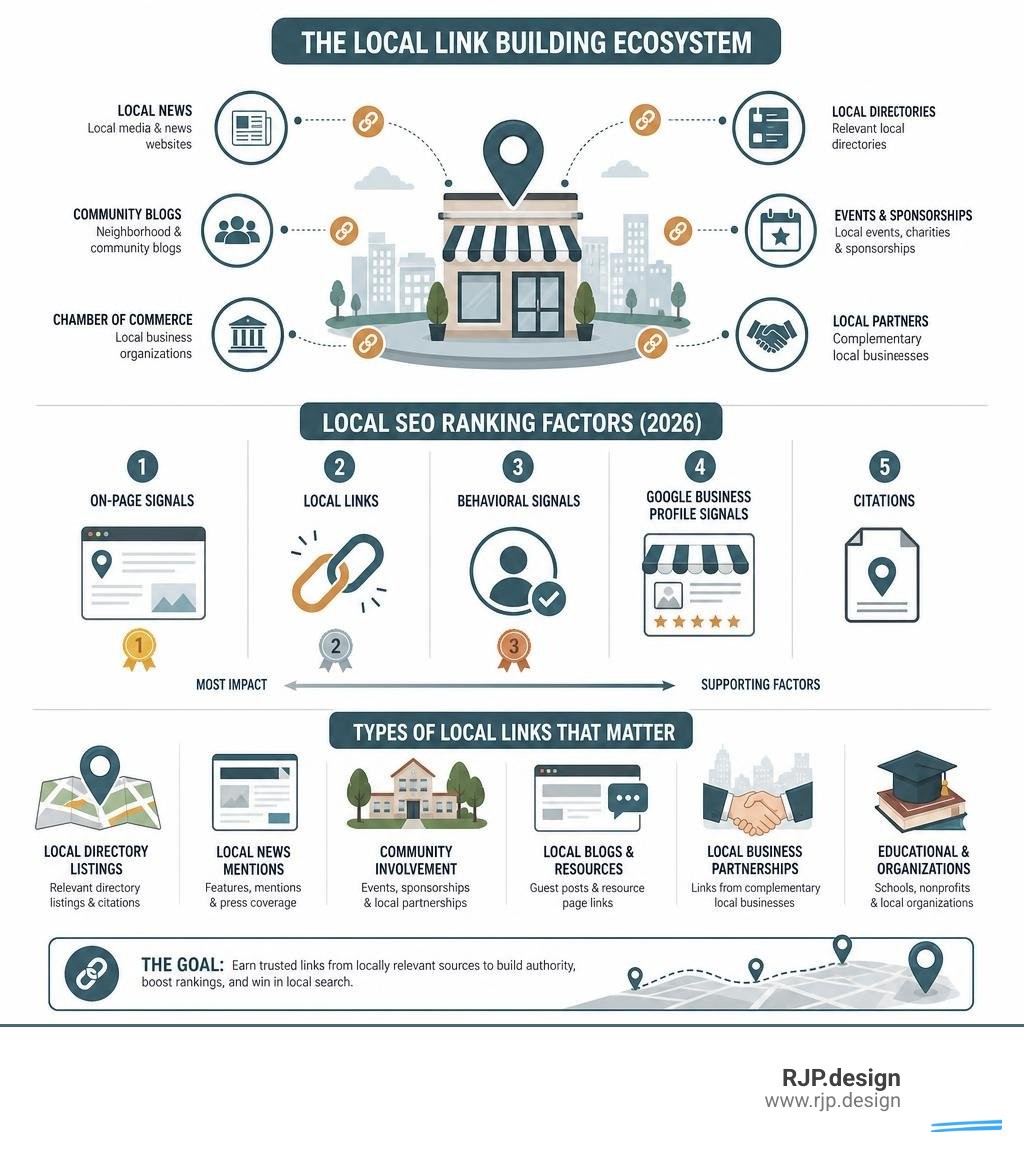
Local link building vocabulary:
The Blueprint for Successful Local Link Building

When we talk about the blueprint for successful local link building, we have to shift our mindset away from traditional SEO metrics. In the broader SEO world, everyone is obsessed with Domain Authority (DA) or Domain Rating (DR). We are told that a link from a DR 80 site is the holy grail.
But in local search, Google's algorithms operate on a different set of rules: geographic relevance and trust signals.
Google wants to see that your business is a genuine, active part of its local community. If you are a plumber in Manchester, a link from the Manchester Chamber of Commerce or a neighborhood youth soccer team website carries far more weight than a link from a generic, national tech blog with a high DR. The local link tells Google's spiders, "This business actually exists, operates, and interacts in Manchester."
By focusing on local relevance, we build high-trust connections that competitors cannot easily replicate. This is why a strategic approach to Local SEO Link Building is the ultimate competitive advantage for local businesses.
What is Local Link Building and Why Does It Matter in 2026?
Traditional link building focuses on scaling guest posts, finding broken links across the web, and chasing high-metric domains. Local link building, on the other hand, is hyper-focused on location. It is the process of getting other websites in your specific geographic area to link back to your site.
In July 2026, this distinction matters more than ever. The local search landscape has evolved rapidly. Today, link signals are the second most important local organic ranking factor and the fourth most important factor for ranking in the Google Local Pack.
Furthermore, we are now firmly in the era of AI-driven search. Platforms like ChatGPT, Perplexity, and Google AI Overviews do not just crawl the web to find keywords; they look for consensus, mentions, and authoritative citations. According to recent search studies, ChatGPT Search surfaces business websites for 58% of its local search sources.
When an AI engine synthesizes an answer to "Who is the most reliable commercial electrician in Austin?", it relies heavily on local editorial mentions, local news coverage, and community associations. If you want your business to be recommended by AI assistants, earning real local backlinks is no longer optional — it is a necessity. To understand how this fits into your broader digital marketing strategy, check out our guide on Link Building Off Page SEO.
Local Citations vs. Local Backlinks: Differentiating the Two
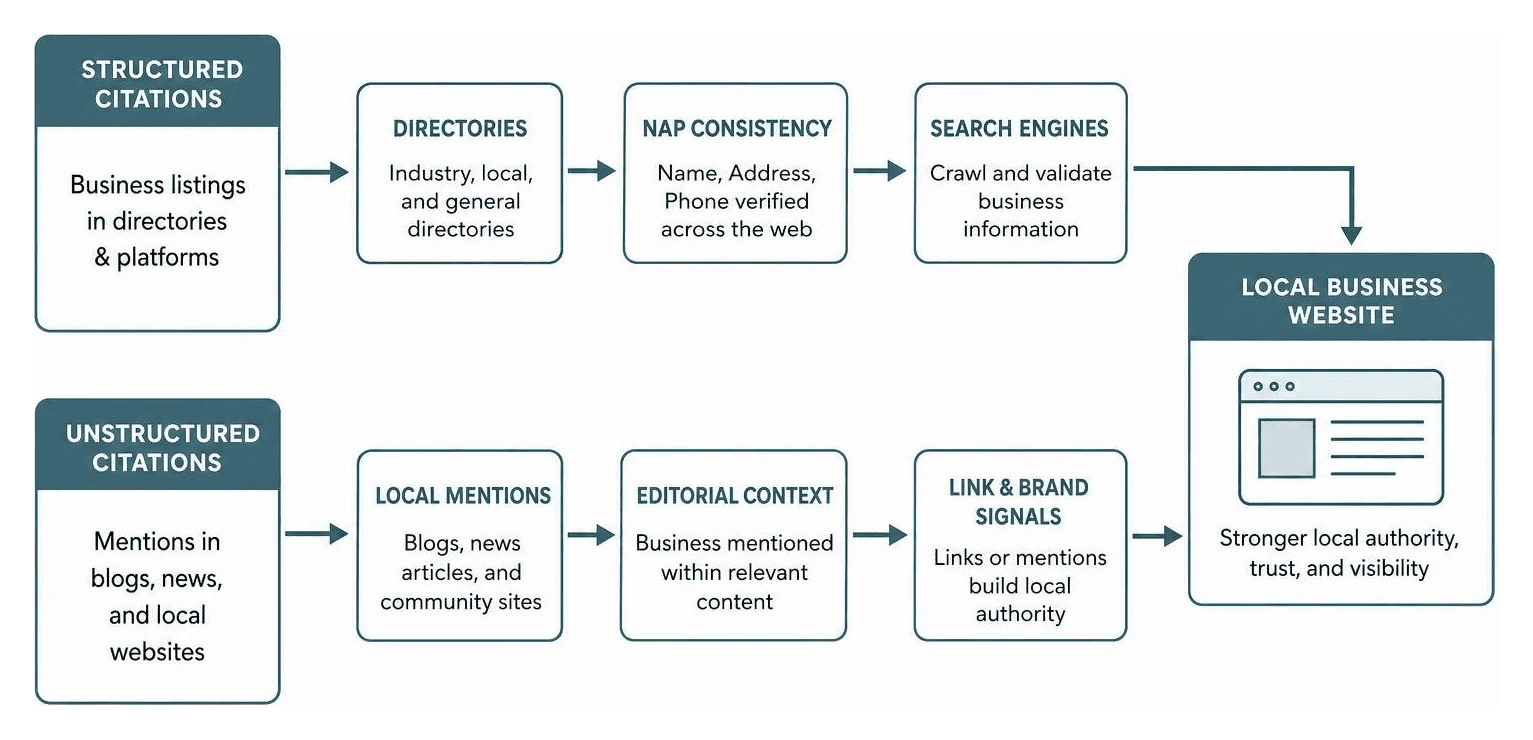
A common point of confusion for business owners is the difference between local citations and local backlinks. While they both contribute to your local authority, they serve different functions in Google’s eyes.
Feature | Local Citations | Local Backlinks |
|---|---|---|
What is it? | Mentions of your Name, Address, and Phone number (NAP). | Editorial hyperlinks from another website to yours. |
Formatting | Structured (directories) or Unstructured (blogs/news). | Contextual text links, images, or buttons. |
Primary Value | Verifies business legitimacy and physical location. | Passes ranking authority and topical trust. |
Link Type | Often "nofollow" or unlinked text. | Typically "dofollow" and editorially earned. |
Algorithm Impact | Foundational floor for Local Pack visibility. | Performance ceiling for organic and Local Pack rankings. |
Citations are the baseline. They establish your NAP consistency across the web. Whether they are structured (like a listing on Yelp or Bing Places) or unstructured (an informal mention in a local blog post), they help search engines verify that your business is real.
Backlinks, however, are the ranking multiplier. They act as editorial votes of confidence.
In modern local SEO, we also focus on entity linking — using structured data and schema markup to connect your website content to recognized real-world locations, services, and concepts. By aligning your citations and backlinks with clear entity signals, you build a robust digital footprint that search engines trust. Learn more about managing these foundational elements in our breakdown of Local Citations SEO.
Step-by-Step Tactics for Earning High-Quality Local Links
Earning high-quality local links does not require a massive budget or a team of outreach specialists. It requires community engagement and relationship building. Here are the most effective tactics we use in 2026:
1. Local Sponsorships & Event Partnerships
Sponsoring local youth sports teams, charity events, community festivals, or food banks is one of the highest-ROI tactics available. Most local organizations have a dedicated "Sponsors" page on their website. Because these sites often use .org domains and have been active for years, they carry immense local trust.
Action: Search Google using terms like
site:.org "sponsors" [your city]to find local sponsorship opportunities.
2. Chamber of Commerce & Business Associations
Joining your local Chamber of Commerce or regional business alliance is the easiest way to secure a highly authoritative Tier 1 local backlink. While membership usually requires an annual fee, the directory link you receive is incredibly valuable.
3. Local Digital PR & News Coverage
Local journalists are constantly looking for interesting community stories. If you host a charity drive, offer free services to families in need after a storm, or can provide expert commentary on a local issue (like rising HVAC costs or local real estate trends), pitch it to local news outlets.
Action: Keep pitches short (under 200 words) and lead with the community value, not a sales pitch.
4. Vendor & Partner Pages
Look at the businesses you already do business with. Do you have suppliers, distributors, or complementary partners? Many of them have "Where to Buy," "Our Partners," or "Featured Clients" pages. Reach out to them and ask to be featured.
5. Local Resource Pages
Many cities, libraries, and local clubs maintain resource pages listing recommended local services. You can find these by searching Google for [your city] resources or [your industry] in [your city]. If you offer genuine value, ask the site owner to add you to their list.
6. Unlinked Brand Mentions
Set up Google Alerts for your business name. If a local blog or news site mentions your business but forgot to link to your website, send a polite email thanking them for the mention and asking if they would mind turning it into a clickable link.
For a deeper dive into executing these strategies seamlessly, explore our comprehensive Local SEO Best Practices Guide.
Measuring ROI and Adapting for AI-Driven Search
To ensure your local link building efforts are actually moving the needle, you must track the right metrics. We recommend focusing on four key areas:
Backlink Growth: Use Google Search Console to monitor new incoming links and ensure your link profile remains healthy.
Local Pack & Organic Rankings: Track where your business ranks for core geo-targeted keywords over time.
Referral Traffic: Monitor how many actual visitors are clicking through from your local sponsor and partner sites.
Conversions and Revenue: Use UTM parameters and call tracking to attribute new leads and phone calls directly to your local landing pages.
As we navigate the era of Generative Engine Optimization (GEO), we must also adapt our content to be "AI-citable." AI search models look for structured, data-rich content to answer user queries. Creating local tools (like a regional cost calculator), publishing original local research, or writing hyper-local neighborhood guides increases the likelihood that AI engines will cite your business as a primary source.
Avoid common mistakes that can tank your rankings, such as buying cheap link packages from spammy directories, using over-optimized anchor text, or neglecting your Google Business Profile. For a step-by-step roadmap to scaling your local search presence safely, see our Local SEO Guide 2025.
Conclusion: Elevate Your Local Presence
At its core, local link building is not just an SEO tactic — it is a digital extension of your real-world community relationships. By supporting local charities, partnering with neighboring businesses, and engaging with local media, you build a sustainable foundation for long-term online growth.
At RJP.design, we specialize in helping businesses build beautiful, high-performing websites and establish a dominant online presence. Our down-to-earth team prioritizes client satisfaction, ensuring your business is not only easy to find but also represents your brand perfectly.
Ready to take your local search rankings to the next level? Get More info about local SEO services and let us help you dominate your local market.