
Web
Stop Settling for Mediocre B2B Ecommerce Solutions Today
Jun 25, 2026

The B2B Ecommerce Solutions Landscape: What Buyers Need to Know in 2026
Choosing the right B2B ecommerce solutions is one of the most consequential decisions a modern business can make — and the stakes have never been higher. Here's a quick breakdown of the top platforms to help you evaluate your options:
Top B2B Ecommerce Platforms at a Glance:
Platform | Best For | Architecture | ERP Integration | Deployment Speed |
|---|---|---|---|---|
Adobe Commerce | B2B expanding to B2C | Monolithic/Headless | Strong | Moderate |
Salesforce B2B Commerce | Mid-to-enterprise | SaaS | Strong | Moderate |
commercetools | Unique, composable builds | Headless/API-first | Flexible | Fast |
Spryker | Complex business models | PaaS/Modular | Flexible | Fast (MVP in weeks) |
OroCommerce | Manufacturers & distributors | Open-source | Strong | Moderate |
Intershop | Wholesalers & manufacturers | SaaS/On-premise | Strong | Moderate |
Cloudfy | SMEs to enterprise | SaaS | Strong | Fast |
CxCommerce | Manufacturers & distributors | MACH/Composable | Native, real-time | Weeks |
Sana Commerce | ERP-first businesses | SaaS | Deep (SAP, Dynamics) | Moderate |
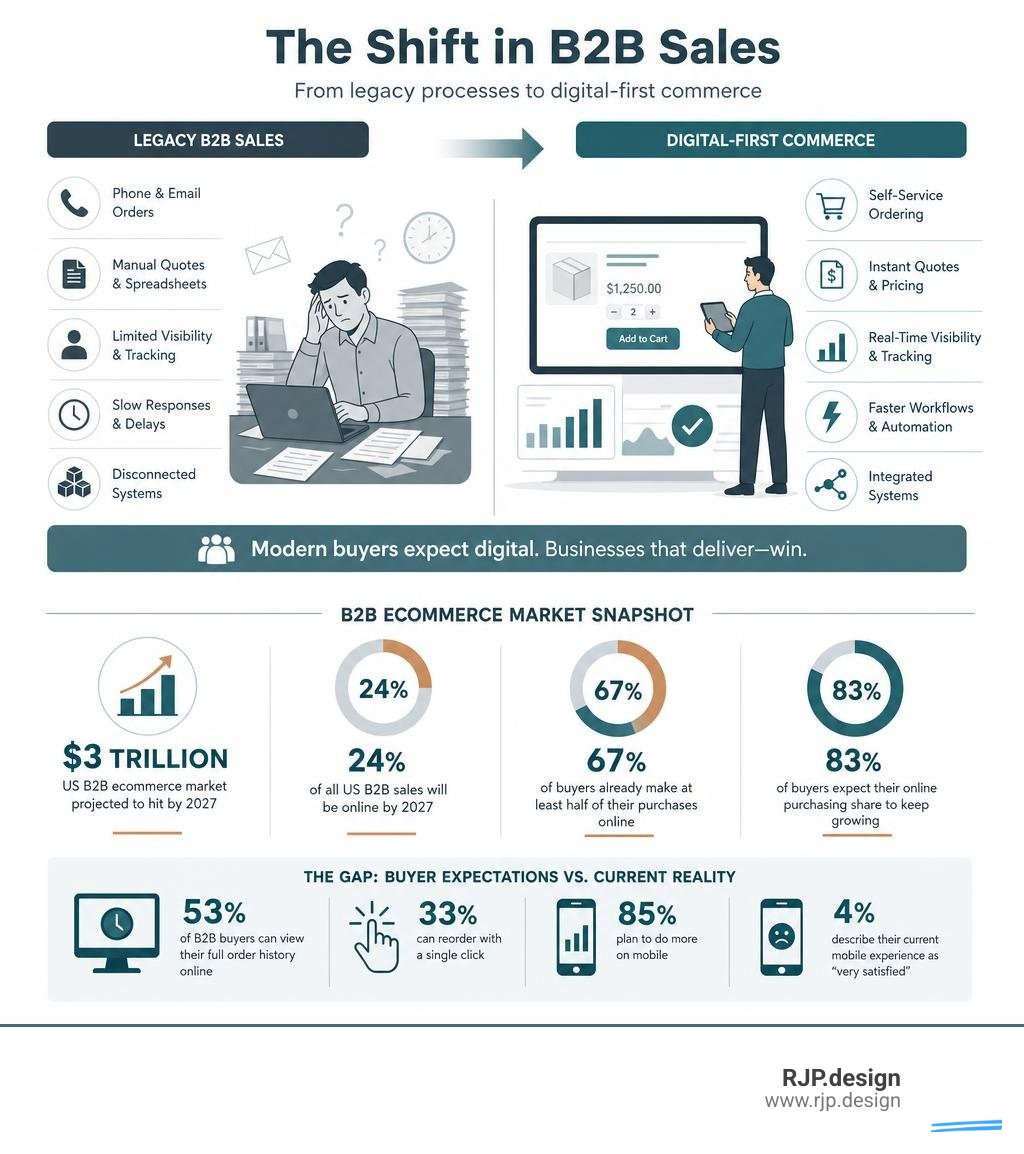
The numbers paint a clear picture of where commerce is heading. The US B2B ecommerce market is projected to hit $3 trillion by 2027, accounting for 24% of all US B2B sales. Meanwhile, 67% of buyers already make at least half of their purchases online — and 83% expect that share to keep growing.
Yet despite this momentum, most businesses are still running on outdated digital infrastructure. Only 53% of B2B buyers can view their full order history online. Just 33% can reorder with a single click. And a staggering 85% say they plan to do more on mobile — while only 4% describe their current mobile experience as "very satisfied."
The gap between buyer expectations and platform reality is wide. That's exactly the problem this guide is designed to help you close.
Whether you're a manufacturer tired of manual order processing, a wholesaler looking to scale without adding headcount, or a distributor ready to move beyond spreadsheets and phone calls — the right platform exists for your needs. This roundup cuts through the noise to help you find it.
I'm Ross Plumer, a digital marketing and ecommerce strategist with experience helping businesses market over $20 million in revenue — including navigating the complex decisions around B2B ecommerce solutions. In the sections ahead, I'll walk you through the platforms, features, and frameworks that actually move the needle.
Common b2b ecommerce solutions vocab:
Why Modern Enterprises Need Dedicated B2B Ecommerce Solutions
The global B2B eCommerce market is valued at roughly six times the size of the consumer market. It is no longer a luxury or a secondary channel; it is a critical business imperative. Historically, B2B sales relied on personal relationships, manual purchase orders, and endless back-and-forth emails. Today, digital self-service has taken center stage.
Wholesalers, manufacturers, and distributors are turning to dedicated b2b ecommerce solutions to streamline operations and unlock new revenue. In fact, implementing a dedicated digital commerce platform has been shown to increase wholesale and supplier revenue by an average of 49%. Over the next two years, B2B leaders expect more than half of their revenue to come directly from digital channels. Without a modern platform, businesses risk falling behind competitors who make procurement seamless.
Key Differences: How B2B and B2C Digital Commerce Diverge
While B2C ecommerce focuses on quick, emotional, and relatively simple single-user transactions, B2B commerce involves deep operational complexity.
Longer Buying Cycles: B2B purchases are rarely impulsive. They require weeks or months of research, contract negotiations, and formal approvals.
Multiple Decision-Makers: A typical B2B purchase involves several stakeholders, from procurement officers to department heads. Platforms must support corporate accounts with multi-user hierarchies and customized approval workflows.
Complex Payment Options: Unlike the standard credit card or digital wallet checkout of B2C, B2B buyers expect flexible payment terms, purchasing on account, credit limit checks, and structured installment options.
Negotiated Terms & Custom Pricing: B2B contracts dictate specific pricing tiers, volume discounts, and customized catalogs unique to each customer account.
To learn more about how custom development supports these unique customer journeys, explore our More info about custom ecommerce solutions.
Essential Features of High-Performing B2B Ecommerce Solutions
To handle the structural complexity of business sales, modern b2b ecommerce solutions must support several non-negotiable features:
Real-Time ERP Integration: Your Enterprise Resource Planning (ERP) system is the brain of your business. Seamless integration ensures that customer-specific pricing, real-time stock levels, and credit limits are accurate without manual data replication.
Bulk Ordering & Custom Catalogs: Buyers need to upload CSV spreadsheets, use barcode scanners, or utilize quick-order grids to purchase hundreds of SKUs in seconds.
Role-Based Permissions: Corporate accounts need to designate junior buyers who can draft orders, and managers who hold the authority to approve them.
Self-Service Portals: Modern buyers expect 24/7 access to download invoices, track shipment statuses, and view complete order histories.
For a deeper look into connecting your sales portal to your back-office systems, you can Learn more about ERP integrated WebShop solutions. If your existing portal feels clunky and outdated, check out our More info about B2B web redesign.
Top Trends Shaping B2B Ecommerce Solutions in 2026
The B2B digital landscape is evolving rapidly in 2026, driven by changing demographics and technological breakthroughs:
The Rise of Digital-First Buyers: Approximately 44% of millennial B2B buyers now prefer no sales rep interaction during their purchase journey.
AI and Agentic Commerce: Nearly half (48%) of commerce leaders are actively experimenting with AI. Beyond basic product recommendations, AI is being used to convert emailed purchase orders into draft digital orders and flag catalog discrepancies. By 2030, about one-third of all B2B ecommerce transactions could be completely machine-to-machine.
Mobile Optimization: While 85% of buyers expect to conduct more business on mobile devices, only 4% are fully satisfied with their current mobile purchasing experience. Optimization is no longer just about responsive design; it is about building functional mobile workflows.
To stay ahead of these visual and functional shifts, read More info in our B2B ecommerce web design guide.
Comparing the Leading Enterprise B2B Platforms
Choosing the right platform depends heavily on your existing technical architecture, operational budget, and scaling goals.
commercetools: A pioneer in headless, API-first architecture. It allows enterprise businesses to build highly customized frontends while keeping backend systems modular. You can Explore headless B2B commerce with commercetools.
Spryker: Operating as a cloud-native Platform-as-a-Service (PaaS), Spryker offers exceptional flexibility for complex business models, marketplaces, and unified B2B/B2C operations. You can Discover Spryker modular commerce platform.
Intershop: A robust, enterprise-grade platform tailored specifically for manufacturers and wholesalers managing massive product catalogs and global multi-site setups. You can Learn about Intershop enterprise commerce.
Cloudfy: An excellent SaaS option designed specifically for manufacturers and distributors who want prebuilt ERP integrations and out-of-the-box mobile apps for field sales reps. Explore Cloudfy SaaS B2B platform.
PhaseZero CxCommerce: A highly specialized, MACH-certified platform built for industrial, manufacturing, and automotive distributors. It specializes in rapid deployment, often going live in weeks rather than months. You can Discover PhaseZero CxCommerce for manufacturers.
Build vs. Buy: Key Considerations for Your Architecture
When selecting your platform architecture, you face a classic dilemma: do you build a custom solution from scratch or buy an established platform?
Buying (SaaS/PaaS): Reduces time-to-market and minimizes initial technical debt. Platforms like Cloudfy or Spryker offer prebuilt B2B workflows, security compliance (like SOC 2), and continuous upgrades.
Building (Custom/Headless): Provides absolute freedom over your user experience and business logic. However, custom builds require dedicated development resources, longer implementation timelines, and higher maintenance costs.
Modern composable architectures offer a middle ground, allowing you to buy core commerce engines while building unique customer-facing frontends. For a technical breakdown of these options, view More info in our B2B ecommerce developers guide.
Measuring ROI and Success Metrics for Digital Sales
To justify your investment in modern b2b ecommerce solutions, you must track the right metrics:
Customer Adoption Rate: The percentage of your existing customer base actively ordering through the digital portal rather than calling or emailing.
Order Accuracy & Reduced Support Costs: Digitizing orders eliminates manual entry errors, dramatically reducing return rates and call-center volume.
Average Order Value (AOV): With automated upselling, cross-selling, and dynamic personalized promotions, digital buyers often build larger carts.
Reorder Frequency: Features like one-click reordering and saved shopping lists directly translate to higher lifetime value.
To understand how to manage complex sales across multiple distributor networks or vendors, read More info about multi-vendor ecommerce solutions.
Partnering for Seamless B2B Digital Transformation

At RJP.design, we believe that B2B commerce does not have to be frustratingly complex. We specialize in designing and developing highly functional, visually stunning digital experiences that bridge the gap between enterprise backend systems and the modern, intuitive interfaces your buyers expect.
Our down-to-earth team is committed to understanding your workflows, untangling your integration challenges, and delivering a platform that drives measurable growth. Stop settling for workarounds, legacy bottlenecks, and mediocre customer portals. Transform your B2B digital presence with RJP.design today, and let us help you build a commerce channel that truly works for your business.