
Marketing
Ship Worldwide with Ecommerce International Shipping
Jun 3, 2026
Why Ecommerce International Shipping Is Your Next Big Growth Opportunity
Ecommerce international shipping opens your store to billions of potential customers beyond your home market — but getting it right takes more than just slapping a foreign address on a box.
Here's a quick overview of what successful international shipping involves:
Step | What It Means |
|---|---|
1. Research your target markets | Identify demand, restrictions, and regulations by country |
2. Choose your carriers | Compare FedEx, DHL, UPS, USPS, and 3PL options |
3. Understand duties and taxes | Know who pays — seller (DDP) or buyer (DDU/DAP) |
4. Prepare customs documentation | Commercial invoices, HS codes, country of origin |
5. Calculate landed costs | Shipping + duties + taxes + fees = total cost to customer |
6. Optimize your storefront | Multi-currency, local language, international payment methods |
7. Package and label correctly | Sturdy materials, accurate labels, clear return policies |
8. Automate and scale | Use shipping software or 3PLs to handle volume |
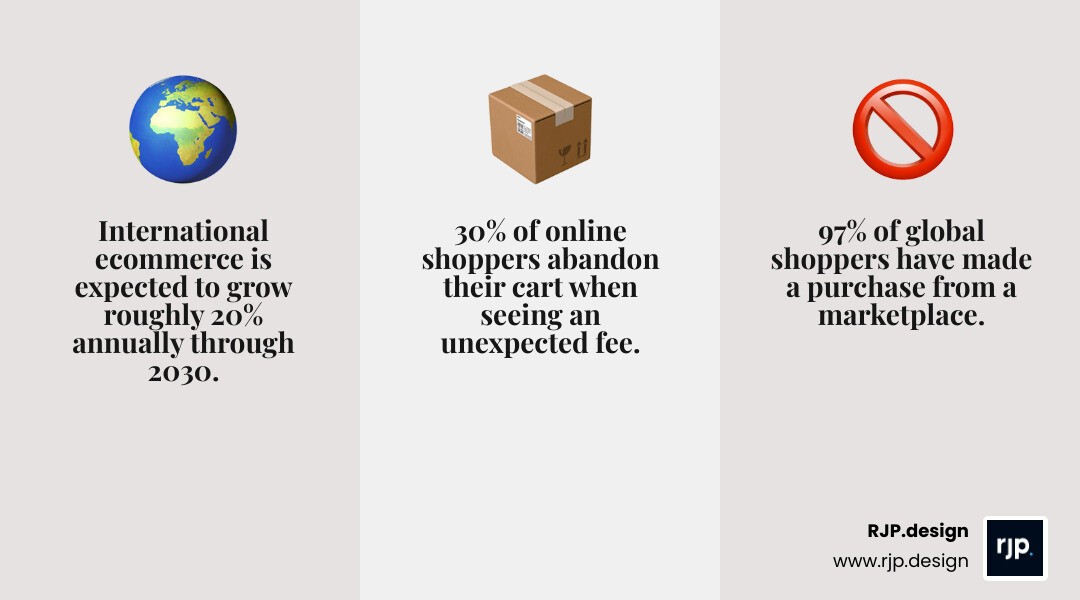
The global opportunity is real. International ecommerce is expected to grow roughly 20% annually through 2030, with cross-border orders reaching an estimated $1 trillion in merchandise value. And shoppers are already buying across borders — 97% of global shoppers have made a purchase from a marketplace, and international deliveries are growing twice as fast as domestic ones.
But here's the catch: international shipping is genuinely complex. Customs rules vary by country. Duties and taxes can blindside customers at delivery. A single missing document can hold a package in customs for days. And 30% of online shoppers will abandon their cart the moment they see an unexpected fee at checkout.
The good news? With the right strategy, tools, and partners, shipping internationally is far more manageable than it looks.
I'm Ross Plumer, a digital marketing and ecommerce strategist with experience helping businesses generate over $20 million in revenue — including guiding brands through the technical and logistical challenges of ecommerce international shipping. In this guide, I'll walk you through everything you need to know to ship globally with confidence and build a storefront that converts customers worldwide.
Ecommerce international shipping terms you need:
Mastering Ecommerce International Shipping Logistics
When we talk about ecommerce international shipping, we are entering a world where geography is just one factor. As of May 2026, the landscape has shifted significantly, particularly regarding how goods enter the United States.
One of the most critical updates involves the de minimis exemption. Historically, the U.S. allowed goods valued at $800 or less to enter duty-free. However, effective August 29, 2025, this suspension has fundamentally changed how international sellers approach the U.S. market. Now, more shipments are subject to formal entry and duty assessments, making it vital to have a clear handle on your documentation.
For those shipping within North America, the USMCA agreement continues to provide a framework that simplifies trade between the U.S., Canada, and Mexico. Roughly 42% of U.S.-based companies focus their international efforts here due to proximity and these favorable trade terms.
A major decision you'll face is choosing between DDP and DDU/DAP. This choice determines who is responsible for the "surprise" bills at the border.
Term | Full Name | Who Pays Duties/Taxes? | Customer Experience |
|---|---|---|---|
DDP | Delivered Duty Paid | Seller (You) | Seamless; no extra fees at delivery. |
DDU/DAP | Delivered Duty Unpaid | Buyer (Customer) | Potentially poor; customer pays at the door. |
To keep things moving, we must ensure every package has its "passport" ready. Essential documentation includes:
Commercial Invoice: The primary document for customs.
Packing List: Detailing exactly what is inside.
Certificate of Origin: Stating where the goods were made.
Bill of Lading: The contract between you and the carrier.
Navigating Customs and Ecommerce International Shipping Compliance
Compliance is the bedrock of ecommerce international shipping. If you misclassify a product, it might get stuck in "customs limbo." This is where HS codes (Harmonized System codes) come in. These are standardized numerical codes used globally to classify traded products. Using tools like Cross-Border Ecommerce Solutions | Zonos can automate this process, using AI to assign codes based on product descriptions or even images.
If you are selling to the European Union, IOSS (Import One-Stop Shop) registration is a game-changer for baskets under €150. It allows you to collect VAT at checkout, leading to faster "green channel" customs clearance and a better experience for your European fans.
Calculating Landed Costs for Ecommerce International Shipping
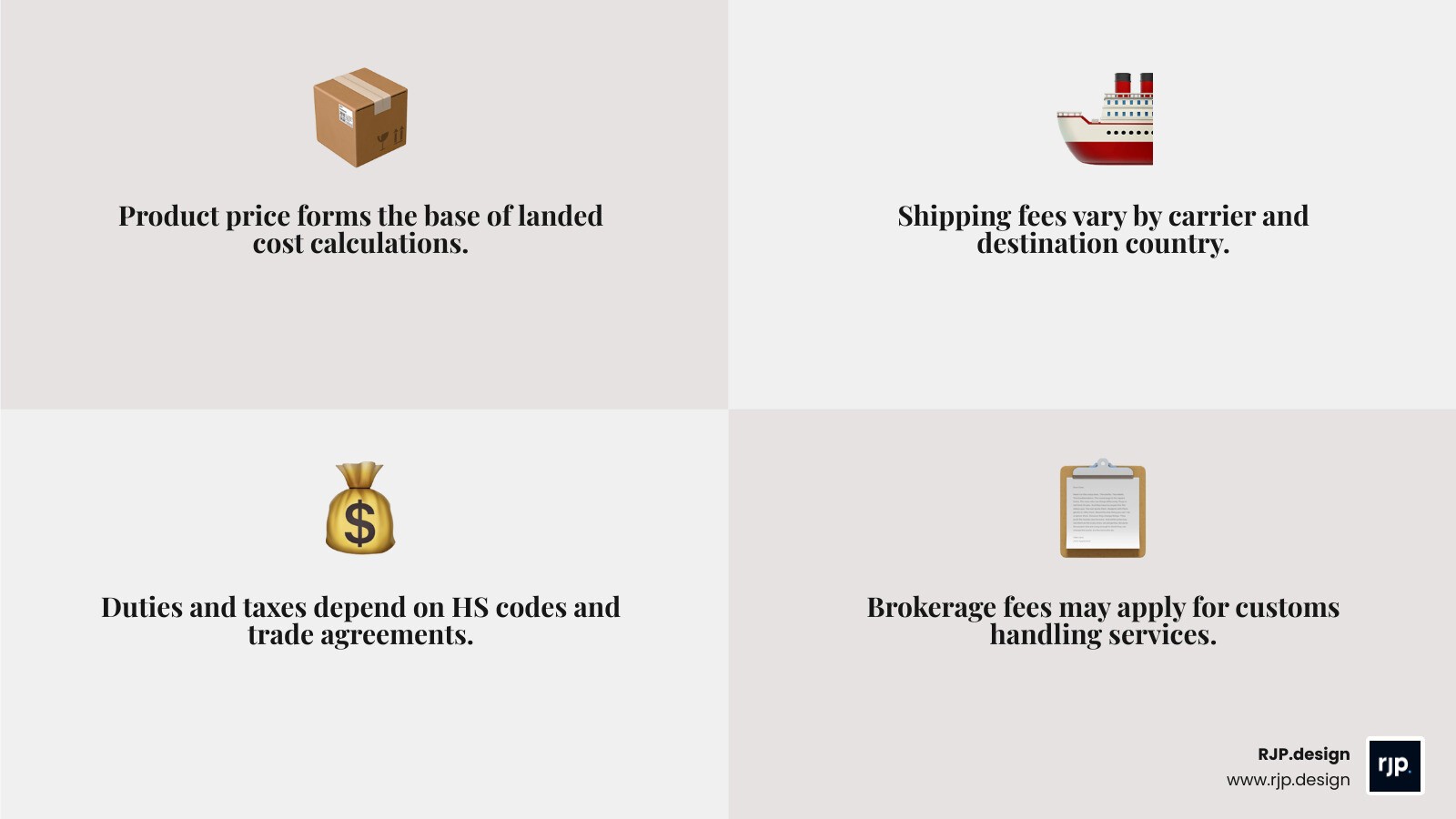
Nothing kills a sale faster than "hidden" costs. To maintain trust, we recommend calculating the total landed cost—the sum of the product price, shipping, duties, taxes, and any brokerage fees—before the customer hits "buy."
Modern APIs, such as the ShipStation International Shipping API & Real-Time Shipping Rates, allow you to pull these rates into your checkout in real-time. This level of transparency can reduce customer service complaints by up to 70% because the customer knows exactly what they are paying upfront.
Selecting Carriers and 3PL Partners
Choosing a carrier isn't just about finding the cheapest rate; it’s about reliability.
FedEx: Offers a massive range of services. FedEx International Connect Plus Ecommerce Shipping is specifically designed for online stores, offering 2-5 day delivery to 195 countries with end-to-end tracking.
DHL: Often considered the "king" of international shipping, DHL has an unmatched global footprint and experience in customs brokerage.
UPS & USPS: Reliable options with strong networks, particularly for North American and postal-heavy routes.
For scaling brands, we often suggest looking into global warehousing. Instead of shipping every individual order across an ocean, you can use a 3PL (Third-Party Logistics provider) to store inventory in regional hubs like the UK or Australia, turning an "international" order into a "domestic" one for the customer.
Optimizing Your Store for Global Growth
Your website is your global storefront. If it feels "foreign" to your visitors, they won't buy. Statistics show that 40% of customers will not purchase if a website isn't in their native language, and 61% of European shoppers will abandon their cart if their preferred payment method isn't available.

To win globally, we focus on:
Multi-currency support: Let customers see prices in their local currency.
Language Translation: Use professional translation for your ecommerce website design to ensure cultural nuances are respected.
Payment Gateways: Offer local favorites like iDEAL in the Netherlands or AliPay in China.
By making the experience feel local, you significantly improve your abandoned cart recovery rates, as shoppers feel more secure in their purchase.
Packaging, Labeling, and Returns Management
International packages take a beating. They are tossed into planes, trucks, and sorting facilities across multiple time zones. We always recommend using sturdy, double-walled boxes and high-quality packing tape.
Labeling must be 100% accurate. A simple typo in a postal code can lead to a package being returned to sender—at your expense. For returns, having a clear policy is vital. Some brands use programs like the one described in this Security Measure | eBay guide, where the platform handles the international leg and returns logistics, taking the weight off the seller's shoulders.
Scaling with Global Fulfillment Networks
As you grow, manual shipping becomes a bottleneck. Automated fulfillment networks allow you to route orders to the nearest warehouse automatically. Using International Fulfillment & Shipping Services | ShipStation, we can help you manage inventory across multiple locations, ensuring that a customer in London gets their package from a UK hub rather than waiting for a flight from New York.
This approach doesn't just save time; it saves money. 62% of shoppers now expect deliveries in less than 3 business days. Scaling with regional hubs is the only way to meet those expectations while keeping shipping costs sustainable.
Finalizing Your International Strategy with RJP.design
Ecommerce international shipping is a journey, not a destination. It requires constant monitoring of new regulations, carrier performance, and customer feedback. At RJP.design, we don't just build websites; we build global growth engines.
Whether you need a custom ecommerce solutions ultimate guide to plan your tech stack or you're looking for More info about web design services to localize your brand for a new market, our team is here to help. We prioritize high-quality service and practical solutions that help your business look great and function perfectly on a global scale.
Ready to take your store to the world? Let's build something amazing together.
Frequently Asked Questions
What is the "de minimis" value? It is a valuation ceiling below which goods can be imported into a country without paying duties or taxes. As of 2026, many of these exemptions (like the U.S. $800 limit) have been suspended or lowered, requiring more careful tax planning.
Is it better to use DDP or DDU? For the best customer experience, DDP is superior. It prevents "delivery shock" where customers are asked for more money before they can receive their package.
How do I find the right HS codes? You can use carrier tools (like FedEx's WorldTariff) or AI-driven classification software to ensure your products are classified correctly for customs.
How can I reduce international shipping costs? Consolidating shipments, negotiating volume discounts with carriers, and using regional fulfillment centers are the most effective ways to lower your per-package costs.
Should I offer free international shipping? While 62% of shoppers want free shipping, it's often unsustainable for international orders. Instead, consider offering free shipping only above a certain "high-value" threshold to protect your margins.
For more insights on building a world-class online store, explore our guides on seo for e commerce websites and ecommerce web design new york.