
SEO
Step-by-Step Guide to SEO Content Creation
Aug 17, 2026

The Modern Framework for SEO Content Creation
Creating high-ranking pages requires moving away from fragmented, single-keyword publishing toward a structured, team-wide workflow. The modern process treats content as a living asset that links strategy, design, and continuous optimization together.
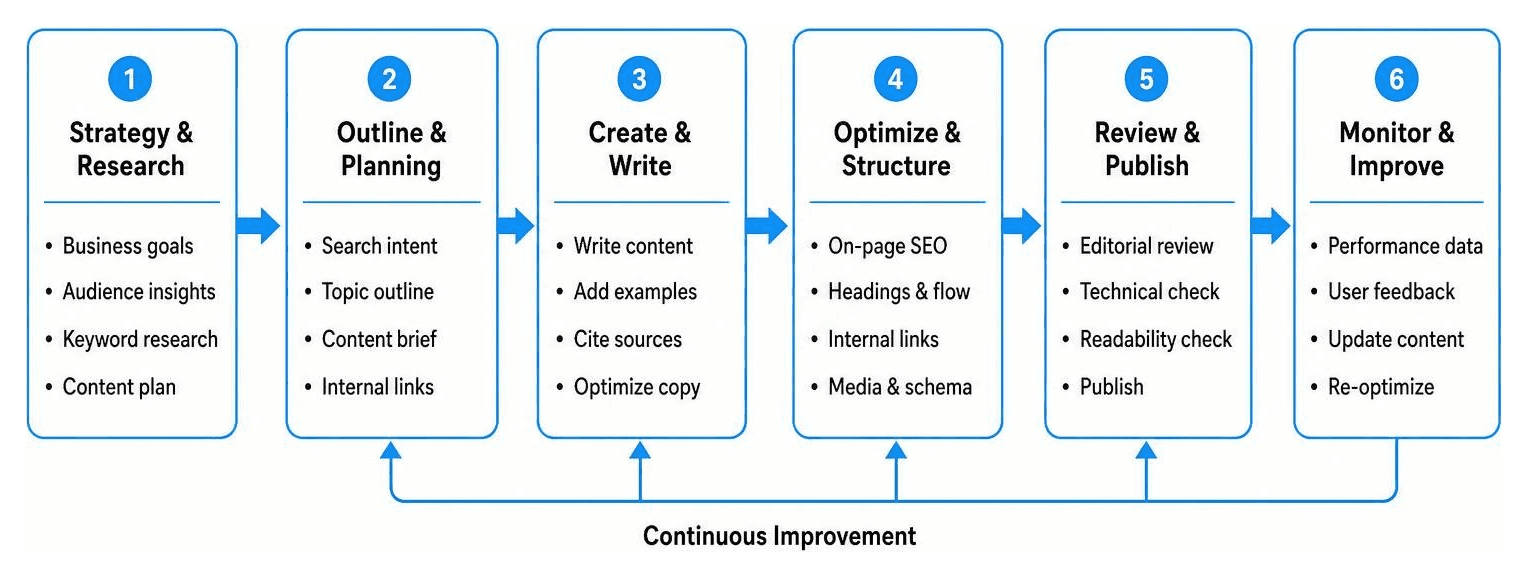
By integrating technical checks, editorial planning, and visual formatting early, you avoid common issues like orphaned pages, awkward phrasing, and confusing user experiences.
Phase 1: Business Alignment, Team Structure, and Keyword Research
Every piece of content must support a specific business objective, whether that is generating leads for SEO for service businesses or building brand authority.
Building an effective workflow starts with getting your team on the same page:
SEO Specialists: Uncover target terms, analyze search intent, and handle structural architecture.
Writers: Craft engaging, authoritative copy that directly answers reader questions.
Designers: Create scannable wireframes, visual call-outs, and clear layouts that lower bounce rates.
To develop a solid plan, read our guide on how to create content strategy. Next, conduct thorough research. For most small to mid-sized businesses, managing a core group of 100 to 300 target keywords works much better than trying to track thousands of terms at once.
When conducting SEO keyword research, organize terms into semantic topic clusters around four key intent categories:
Informational: Users want to learn a concept or solve a problem.
Navigational: Users are looking for a specific website or page.
Commercial: Users are comparing options before purchasing.
Transactional: Users are ready to take action or make a purchase.
Phase 2: On-Page Optimization and Structural Execution
Once your strategy is set, focus on organizing the page structure. On-page elements give search crawlers structural context and help readers quickly find the answers they need.
Use clear formatting rules to optimize your core page metadata:
On-Page Element | Recommended Length / Format | Best Practice |
|---|---|---|
Title Tag | Under 60 characters | Place primary keywords near the start; keep it unique per page. |
Meta Description | Under 155 characters | Include a clear value proposition and a compelling call-to-action. |
H1 Header | One per page | Match user search intent closely and reflect the main topic clearly. |
H2/H3 Headers | Logical sequential hierarchy | Break content into distinct subtopics that answer follow-up queries. |
Image Alt Text | Under 125 characters | Use concise, descriptive phrases that provide accessibility context. |
For a deep dive into meta tags, check out our full SEO Meta Tags Guide.
Phase 3: Writing for Humans, Search Engines, and AI Overviews in SEO Content Creation

Writing great copy means balancing human psychology with clear structural signals. High-ranking pages provide immediate value through what search engine experts call "information gain"—offering unique insights, original data, or personal experience rather than repeating existing top results.
To satisfy Google's E-E-A-T framework (Experience, Expertise, Authoritativeness, and Trustworthiness) criteria, always include verifiable facts, expert commentary, and detailed author details. To leverage software tools effectively in this phase, explore our recommendations for the SEO content optimizer.
Modern search platforms and AI Overviews favor direct, helpful answers. Use these structural writing techniques to increase your visibility:
Direct Answer Blocks: Place a clear, direct answer of roughly 40 to 50 words immediately beneath question-based headers to target featured snippets.
Relational Formatting: Use cause-and-effect transition words (because, therefore, as a result) to help algorithms parse your logical flow.
Scannable Paragraphs: Keep paragraphs to 2–4 sentences and break up blocks of text every 300 words using bullet points or visual call-outs.
AI writing tools can help accelerate outlining, topic mind-mapping, and initial brainstorming. However, raw AI copy often lacks genuine human experience. Always review and polish automated drafts to ensure your tone remains authentic, warm, and clear.
Measuring Performance, Avoiding Pitfalls, and Refining Content

Publishing your content is only the beginning. Long-term search visibility relies on tracking real-world performance metrics and making consistent, data-driven updates over time.
Measuring Organic Performance and Refresher Workflows
Evaluating search performance requires patience. While initial indexing changes can appear within a few hours, evaluating major optimizations generally takes a few weeks to several months as rankings stabilize.
To build an effective optimization routine, track these metrics:
Target Keyword Rankings: Track organic position changes in Search Console across your topic clusters.
Engaged Sessions & Time on Page: Assess whether visitors are reading your content or bouncing immediately.
Conversion Rates: Measure how effectively organic traffic converts into leads, newsletter signups, or sales.
Focusing roughly 60% of your energy on fresh creation and 40% on updating existing content usually yields the best compound return on investment. Updating existing pages that rank in positions 4 to 15 can drive faster traffic growth than publishing new articles from scratch.
To discover how continuous optimization improves visibility, explore our strategies for SEO ranking improvement.
Avoiding Pitfalls in Modern SEO Content Creation
Avoid these common pitfalls that can hurt your rankings:
Keyword Stuffing: Forcing repetitive keywords into body text harms readability and signals low content quality.
Keyword Cannibalization: Publishing multiple pages targeting the exact same keyword intent confuses search engines and weakens page authority.
Orphaned Pages: Publishing articles without adding internal links from related site pages leaves content isolated and hard to crawl.
Ignoring Crawl Structure: As a website grows beyond a few thousand URLs, missing clean site directory groupings can reduce crawling and indexing efficiency.
Publishing Generic Text: Relying solely on raw AI output without adding human experience or unique insights leads to poor user retention.
Strategic Next Steps for Sustainable Growth
SEO content creation isn't a one-time project—it's an ongoing engine for organic growth. At RJP.design, our down-to-earth team prioritizes client satisfaction by developing tailored websites and digital strategies that make your business easy to find online.
Whether you need targeted content for digital marketing services or comprehensive SEO optimization services, we build clear, high-performing websites that turn casual searchers into loyal customers. Reach out to RJP.design today to strengthen your digital presence and grow your organic visibility.