
Web
Retro Revival: Designing the Ultimate Vintage Online Shop
Apr 28, 2026
Why Your Vintage Store Website Can Make or Break Your Business
A well-designed vintage store website is one of the most powerful tools a vintage retailer can have in 2025. Whether you're just starting out or looking to modernize an existing shop, getting your online presence right is the difference between a thriving business and one that gets lost in the scroll.
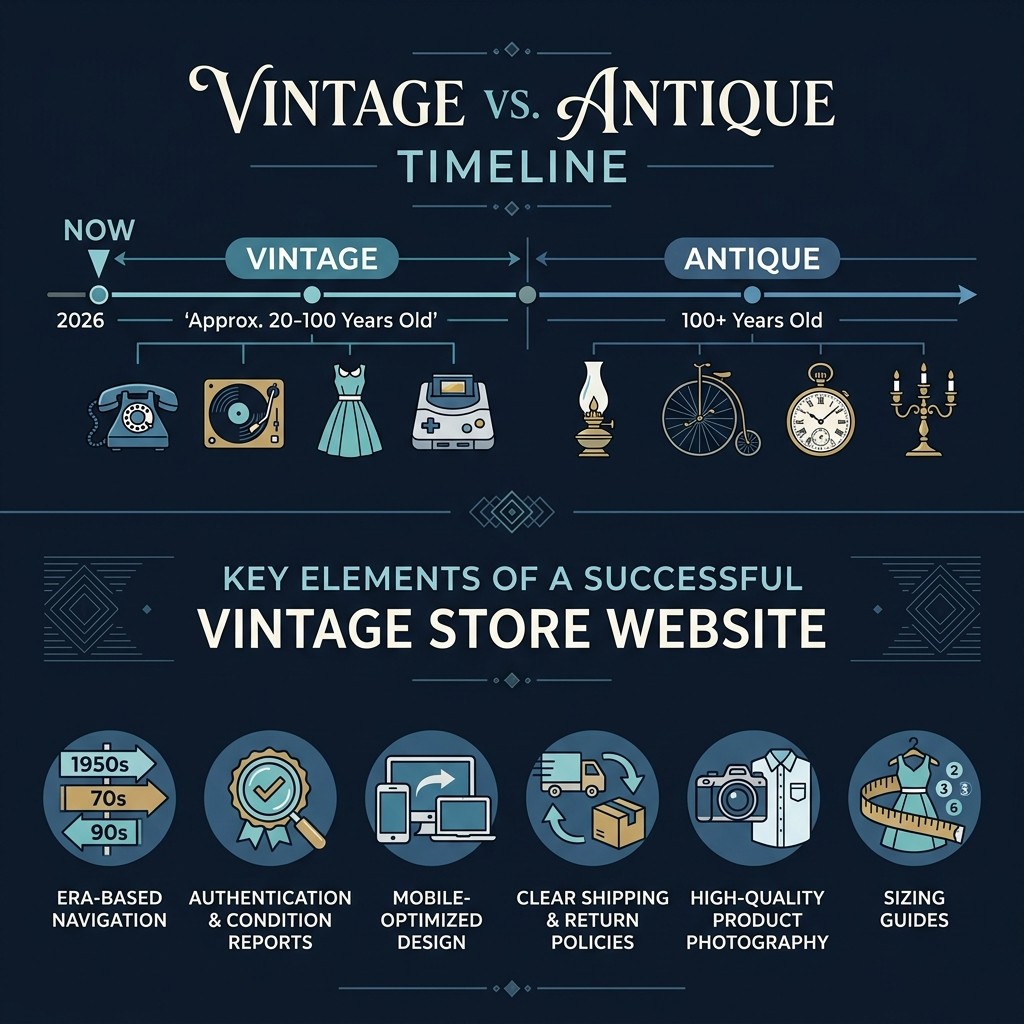
Here's a quick snapshot of what makes a great vintage store website:
Element | Why It Matters |
|---|---|
Era-based navigation | Helps shoppers browse by decade (1920s–1990s) |
Authentication & condition reports | Builds trust, especially for designer pieces |
Mobile-optimized design | Most shoppers browse on their phones |
Clear shipping & return policies | Reduces hesitation at checkout |
High-quality product photography | Vintage items sell on detail and character |
Sizing guides | Vintage sizing differs significantly from modern sizing |
The vintage clothing market has exploded online. Platforms like eBay (launched 1995), Depop (2011), and Vestiaire Collective (2009) have proven there's massive global demand for pre-loved fashion. And as of 2025, anything made before 2004 qualifies as vintage — meaning the market only keeps growing.
But there's a real gap between selling on a marketplace and owning your own branded vintage store website. Your own site gives you control over your brand story, your customer experience, and your margins.
The stakes are also bigger than just sales. Americans throw away 13 million tons of textiles every year — roughly 9% of all non-recycled waste. A well-run vintage store isn't just a business; it's part of the solution to fast fashion's environmental damage.
I'm Ross Plumer, a digital marketing and web design expert who has helped businesses generate over $20 million in revenue online, including building high-converting vintage store websites that combine aesthetic appeal with serious e-commerce functionality. In this guide, I'll walk you through everything you need to design, launch, and grow a vintage store website that stands out in a crowded market.
Essential Features for a Successful Vintage Store Website
When we talk about building a vintage store website, we aren't just talking about a digital catalog. We are talking about creating a time machine. The user experience (UX) should feel as curated and intentional as a high-end boutique in NYC's NoMad district.
The first rule of modern e-commerce is that if it doesn't work on a phone, it doesn't work at all. Implementing responsive web solutions ensures that whether a customer is browsing 1950s swing dresses on their laptop or hunting for Y2K streetwear on a train, the experience is seamless.
Inventory management is the "secret sauce" of a vintage business. Unlike traditional retail, where you might have 500 units of one SKU, vintage stores often deal with 500 unique, one-of-a-kind items. This requires a robust backend that can handle high turnover and detailed tagging.
To help your customers understand what they are buying, your site should clearly distinguish between different types of "old" items. Here is how the industry generally breaks it down:
Category | Definition | Age Requirement (as of 2025) |
|---|---|---|
Vintage | Garments reflecting the style/culture of their era | 20+ years old (Pre-2005) |
Antique | Items with significant historical age | 100+ years old (Pre-1925) |
Retro/Vintage-Style | New items made to look like old styles | Brand New |
Secondhand/Resale | Used modern clothing | Any age |

Navigating Eras and Styles on a Vintage Store Website
One of the biggest hurdles for shoppers on a vintage store website is the sheer volume of unique items. If a user has to scroll through 10,000 items to find a specific 1970s disco shirt, they’ll leave.
We recommend era-based navigation as a primary filter. Successful sites often allow users to shop by specific decades, such as the 1920s, 1950s, or the increasingly popular 90s and Y2K categories. For specialized niches, like Jewel Vintage Fine Vintage Lingerie & Apparel, the navigation might focus more on garment type and delicate materials, while still offering "Shop by Era" options.
To make your site truly competitive, look at the best Shopify store designs. These sites use advanced search filters that allow customers to sort by:
Era: (e.g., Victorian, Edwardian, 1960s Mod)
Style: (e.g., Grunge, Gorpcore, Bohemian)
Brand: (e.g., Gunne Sax, Levi’s, Carhartt)
Condition: (e.g., Deadstock, Excellent, Gently Loved)
Building Trust with Authentication and Condition Reports
In online vintage, trust is your most valuable currency. When a customer can't physically touch a garment, they need to know exactly what they’re getting. This is where ecommerce website design must prioritize information density over just "looking pretty."
Every product page should include a detailed condition report. Is there a small pinhole in the hem? A slight fade on the shoulder? Be honest. High-resolution photography is non-negotiable. We suggest at least 5-7 photos per item, including close-ups of labels, fabric texture, and any flaws.
For high-end or museum-quality pieces, such as those found at Daisy and Stella Vintage, providing historical context and provenance can significantly increase the item's value. If you are selling designer goods from houses like Chanel or Hermès, your vintage store website must highlight your authentication process. Whether you use in-house experts or third-party documentation, making this clear reduces "buyer's remorse" and builds long-term loyalty.
Optimizing the Checkout and Shipping Experience
The "cart abandonment" ghost haunts every e-commerce owner. You can banish it by making your checkout process as transparent as possible.
First, let's talk about shipping. Many successful vintage sites, like Thrifted, offer free shipping thresholds (e.g., free shipping on orders over £75). Others, like Ragstock, might set the bar at $50. Whatever your threshold, display it prominently at the top of every page.
Second, your return policy needs to be crystal clear. While some small vintage shops have "final sale" policies due to the unique nature of the items, the industry standard is moving toward a 14 to 30-day return window. Providing a clear portal for returns makes customers feel safe taking a chance on a one-of-a-kind piece.
Finally, consider offering flexible payment options. Since high-quality vintage can be an investment, features like layaway programs or "Buy Now, Pay Later" (BNPL) services can help move higher-priced inventory. Good SEO for online stores will bring them to the site, but a frictionless checkout will turn them into customers.
Launching Your Retro Brand with Professional Web Design
Building a vintage store website is about more than just listing clothes; it’s about launching a brand. Your digital identity should reflect the soul of your collection. Are you a high-energy Y2K shop with neon colors and glitchy graphics, or a sophisticated archival gallery with minimalist lines?
Beyond the visuals, your brand needs a soul. Modern consumers care about the "why." Highlighting the environmental impact of vintage is a fantastic way to connect. Did you know that 16% of all insecticides are used in cotton farming? Or that 60% of the world's cotton goes to the clothing industry? By promoting vintage, you are helping reduce the 13 million tons of textiles Americans throw away annually.
Your sourcing strategy is also part of your brand story. Whether you source from the "global rag system" like Thrifted or hand-pick museum-quality pieces, share that journey. Sites like Shop Vintage Logic | True Vintage Clothing + Accessories succeed because they emphasize the "True Vintage" nature of their curated finds.
Technical Requirements for a High-Performance Vintage Store Website
Don't let a beautiful design be ruined by a slow site. The technical architecture of your vintage store website needs to be fast, secure, and scalable.
When choosing a platform, most vintage retailers lean toward Shopify or Magento. Shopify is excellent for ease of use and has some of the best Shopify store designs in the industry. However, if you are running a massive operation with hundreds of dealers—like a digital antique mall—a more robust platform like Magento might be necessary.
Key technical checkboxes include:
Site Speed: Vintage sites often have many high-res images. Use "lazy loading" and image compression to keep things fast.
Security: SSL certificates are a must for any web design and web development services.
Mobile Friendliness: Ensure buttons are easy to click and text is readable on small screens.
Inventory Sync: If you sell on Instagram, Etsy, and your own site, you need a system that updates inventory in real-time so you don't sell the same unique item twice.
Specialized boutiques like Eleventh House Vintage often use these technical features to offer an "inclusive range of sizes," which requires detailed backend tagging to ensure customers find exactly what fits their body type. For more on this, check out our website design development services guide.
Maximizing Visibility Through Specialized SEO
You could have the most beautiful vintage store website in the world, but if nobody finds it on Google, it doesn't exist. This is where SEO optimization services come into play.
Vintage SEO is unique because you aren't just ranking for "blue shirt." You are ranking for "1970s vintage western pearl snap shirt." You need to target long-tail keywords that include:
The Era: (e.g., "90s vintage")
The Brand: (e.g., "vintage Levi's 501")
The Material: (e.g., "vintage silk slip dress")
The Style: (e.g., "boho chic," "streetwear," "blokecore")
Content marketing is another powerful tool. By writing about fashion history or clothing care tips—similar to the approach taken by Vintage Clothing & Jewelry | 6000 Items! | VintageVixen.com – Vintage Vixen Clothing—you establish yourself as an authority. This not only helps with SEO but also builds a community of loyal followers who trust your expertise.
Partnering with RJP.design for Your E-commerce Success
At RJP.design, we know that a vintage store website is a labor of love. You spend your weekends at flea markets and your late nights researching labels. You deserve a website that works as hard as you do.
We specialize in creating best retail website designs that don't just look good—they convert. Our team takes a down-to-earth approach to high-quality service. We don't just hand you a template; we build a custom solution tailored to your brand’s specific era and aesthetic.
Whether you need a professional website redesign to modernize your 20-year-old shop or you're launching a brand new Y2K empire, we have the tools to help you succeed. From SEO for online stores to responsive web solutions, we ensure your shop is found by the right people.
Ready to bring your vintage collection to the global stage? Enhance your online presence with professional retail design and let's build something timeless together.
Frequently Asked Questions About Vintage Store Websites
What is the difference between vintage and secondhand?
Vintage generally refers to items that are at least 20 years old (currently anything prior to 2005). Secondhand is a broader term that includes any used clothing, regardless of age. On a vintage store website, buyers are usually looking for the specific quality and style associated with a past era.
How do I handle sizing for vintage clothes online?
Vintage sizing is notorious for being smaller than modern sizing. A 1960s "Size 12" might be a modern "Size 4." To avoid returns, always provide actual measurements in inches or centimeters (Bust, Waist, Hips, Length) and include a sizing guide on your site.
Which e-commerce platform is best for vintage?
Shopify is the most popular choice for independent vintage sellers because of its ease of use and excellent Shopify store designs. However, for larger businesses with complex needs, custom ecommerce website development may be required.
How can I prove my items are authentic?
Transparency is key. Share photos of tags, zippers, and stitching. If you are selling luxury goods, explain your authentication process clearly. Mentioning your years in business—like Unique Vintage celebrating 25 years—can also help build credibility.
Is selling vintage clothing actually sustainable?
Yes! By keeping clothes in circulation, you reduce the demand for new textile production, which is a major source of pollution. Buying vintage prevents garments from ending up in the 13 million tons of textile waste Americans generate every year.
How do I drive traffic to my new vintage store?
A combination of SEO optimization services and social media marketing is best. Use Instagram and TikTok to show off your "new arrivals" and use long-tail keywords on your website so people searching for specific eras can find you.
Ready to start your retro revival? If you're looking for a partner to build a high-converting, beautiful vintage store website, RJP.design is here to help. Our team of experts understands the unique challenges of the vintage market and is dedicated to your success. Contact us today to start your project!