SEO
The Advanced On-Page SEO Playbook for 2026
Jun 29, 2026

Advanced on-page SEO is no longer optional for businesses that want to compete in search results. Basic optimization — stuffing a keyword into a title tag and calling it done — stopped working years ago. Google's algorithms now evaluate content through the lens of E-E-A-T, semantic relevance, Core Web Vitals, and AI-driven passage extraction. The gap between basic and advanced has never been wider.
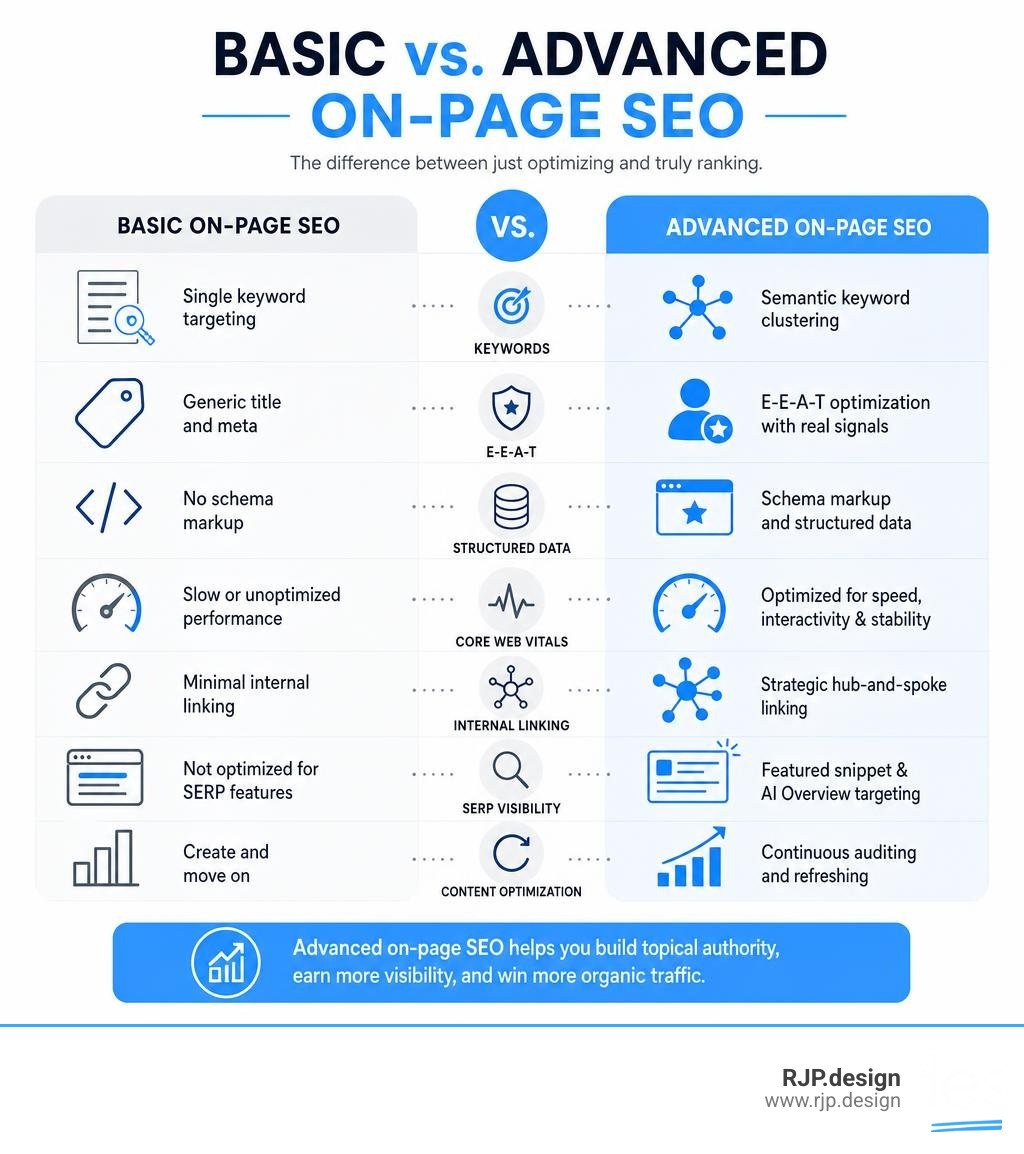
Here's a quick snapshot of what advanced on-page SEO actually involves:
Semantic keyword clustering — grouping related terms to build topical authority instead of targeting single keywords
E-E-A-T optimization — demonstrating real Experience, Expertise, Authoritativeness, and Trustworthiness through content signals
Schema markup and structured data — helping search engines understand and display your content as rich results
Core Web Vitals optimization — meeting Google's performance thresholds for loading speed, interactivity, and visual stability
Strategic internal linking — distributing link equity across your site using a deliberate hub-and-spoke architecture
Featured snippet and AI Overview targeting — structuring content so Google surfaces it in zero-click positions
Content auditing and refreshing — identifying underperforming pages and systematically improving them
The stakes are real. Pages that implement comprehensive on-page SEO see an average 40% increase in organic traffic within six months. Pages optimized for keyword clusters rank for 7x more keywords than traditionally optimized pages. And nearly 65% of Google searches now end without a single click to any website — meaning if you're not showing up in AI Overviews or featured snippets, you may be invisible to a majority of searchers.
This guide walks you through every major lever, from semantic clustering to Core Web Vitals, so you can build a strategy that works in 2026 and beyond.
I'm Ross Plumer, a digital marketing specialist with hands-on experience helping businesses drive significant revenue growth through strategies like advanced on-page SEO — including work with companies that have marketed over $20 million in revenue. In this playbook, I'll share the exact techniques that move the needle, without the fluff.
Easy advanced on page seo glossary:
The Core Pillars of Advanced On-Page SEO

To dominate search engine results pages (SERPs) in 2026, we must look at on-page optimization as an interconnected system. The days of treating search engine optimization as a checklist of isolated tasks are gone. Today, Google's ranking factors prioritize the user experience and content utility above all else.
Google’s Helpful Content system and E-E-A-T framework (Experience, Expertise, Authoritativeness, and Trustworthiness) serve as the primary filters for quality. If our pages do not demonstrate real-world experience or authoritative depth, no amount of technical tweaking will save them.
Furthermore, Google’s confirmed "ABC" ranking signals—Anchors (anchor text), Body (on-page terms and context), and Clicks (user engagement and dwell time)—form the foundation of how search engines calculate topicality. To align with these signals, we must integrate strategic SEO Strategies for Websites that treat content as a dynamic, user-first resource.
Semantic Clustering and Topical Authority
Long gone are the days of targeting a single keyword per page. Modern search engines use natural language processing to understand the broader context of a search query. This is where semantic SEO and entity optimization come into play. Instead of focusing on words, search engines focus on "entities"—real-world concepts, people, and places—and how they relate to one another.
To build true topical authority, we use keyword clustering. This involves grouping semantically related search terms into structured content hubs. Rather than writing ten separate, shallow blog posts that compete with each other, we build a comprehensive hub around a core pillar page, supported by tightly focused cluster pages.
This approach signals to search engines that we have exhaustively covered a topic. To begin mapping your own topic clusters, you can explore our approach to SEO Keyword Research.
Advanced On-Page SEO for AI Overviews and Featured Snippets
With nearly 65% of searches ending without a click, optimizing for zero-click searches is a critical component of advanced on-page SEO. Google's AI Overviews and featured snippets rely heavily on passage-level extraction. This means the algorithm pulls specific paragraphs, lists, or tables directly from your content to answer a query.
To optimize for these features, we structure our content to be "snippet-ready":
Use Question-Based Headings: Phrase H2 or H3 headings as direct questions (e.g., "What is advanced on-page SEO?").
The 40-60 Word Rule: Directly answer the question in the very first sentence or paragraph below the heading, keeping it between 40 to 60 words.
Format with Intent: Use bulleted lists for steps, numbered lists for rankings, and clean HTML tables for data comparisons.
By feeding Google's natural language processing models clean, structured data, we drastically increase our chances of capturing position zero. You can find more tips on structuring your content in Google's Search Essentials guide.
Strategic Internal Linking and Site Architecture
Internal linking is one of the most powerful, yet underutilized, levers in SEO. A smart internal linking strategy does more than help users navigate; it distributes link equity (ranking power) throughout your site and establishes a clear hierarchy.
Using a hub-and-spoke model, your supporting cluster articles should always link back to the main pillar page using descriptive, natural anchor text. Avoid generic anchors like "click here" or "read more." Instead, use contextual anchors that describe exactly what the target page is about.
A well-structured site architecture ensures that your most important pages are never more than three clicks away from the homepage, preventing "orphan pages" that search engines cannot find. Restructuring your internal links can lead to a massive SEO Ranking Improvement by helping bots crawl your site more efficiently.
Schema Markup and Structured Data Integration
Schema markup is the digital translator that allows us to speak directly to search engine crawlers. By adding structured data code (specifically in JSON-LD format) to our pages, we provide explicit clues about the meaning of our content.
Only about 30% of websites currently implement structured data, yet doing so can increase click-through rates (CTR) by up to 30%. For business websites, the most critical schema types include:
Article Schema: For blog posts and news.
FAQ Schema: To display dropdown questions and answers directly in the search results.
Product Schema: To show prices, availability, and star ratings.
LocalBusiness Schema: To highlight your physical location, hours, and contact details.
Implementing schema markup ensures your site is eligible for eye-catching rich snippets, dramatically improving your search visibility. For a deeper dive into managing metadata and tags, check out our SEO Meta Tags Guide.
Execution and Measurement: Future-Proofing Your Strategy

An advanced strategy is only as good as its execution and measurement. To Improve Search Engine Ranking performance, we must continuously track user engagement, search visibility, and conversion rates, adjusting our technical and on-page tactics based on real-world data.
Optimizing Core Web Vitals and Mobile Experience
Page speed and mobile-friendliness are no longer just technical checkboxes; they are core components of the user experience and direct ranking signals. Google primarily uses mobile-first indexing, meaning it evaluates the mobile version of your page to determine your desktop rankings.
Core Web Vitals measure real-world user experience across three main metrics:
Metric | Stands For | What It Measures | Target Threshold |
|---|---|---|---|
LCP | Largest Contentful Paint | Loading performance (how fast the main content loads) | Under 2.5 seconds |
INP | Interaction to Next Paint | Interactivity (how responsive the page is to user input) | Under 200 milliseconds |
CLS | Cumulative Layout Shift | Visual stability (how much elements move around during load) | Under 0.1 |
To achieve these targets and build truly SEO Friendly Websites, we compress images into modern WebP or AVIF formats, defer non-essential JavaScript, and ensure our designs are fully responsive. For a comprehensive list of optimization factors, you can refer to Google's Search Developer Documentation.
Auditing and Refreshing Pre-Existing Content with Advanced On-Page SEO
One of the fastest ways to grow your organic traffic is to optimize the content you already have. Many websites sit on a goldmine of older articles that are ranking on pages two or three of Google. By conducting a systematic content audit, we can identify these pages and refresh them to reclaim search performance.
When refreshing content, we look for:
Keyword Cannibalization: Ensuring two pages aren't targeting the same search intent and diluting your rankings.
Outdated Information: Updating stats, links, and dates to maintain freshness signals.
Semantic Gaps: Adding missing subtopics and related entities that competitors are covering.
Here is our step-by-step framework for refreshing content:
Identify Candidates: Use Google Search Console to find pages ranking in positions 8 to 20.
Analyze Intent: Ensure the page perfectly matches the current searcher intent.
Upgrade Headings: Restructure the H2 and H3 hierarchy for readability and AI overview extraction.
Inject Semantic Keywords: Add natural variations of your primary keyword.
Add Schema Markup: Apply JSON-LD structured data to make the page eligible for rich results.
Re-index: Submit the updated URL through Google Search Console for faster crawling.
At RJP.design, we believe in a down-to-earth approach that prioritizes our clients' real-world business growth. We combine technical precision with high-quality, human-first design to ensure your website not only ranks but converts visitors into loyal customers.
If you are ready to audit your existing site or implement a complete optimization strategy, explore our SEO Audit Services and our comprehensive SEO Optimization Services.