
SEO
Why Black Hat SEO is a Dangerous Game for Your Website
Jun 8, 2026

Why Black Hat Search Engine Optimization SEO Is a Dangerous Game You Can't Afford to Play
Black hat search engine optimization SEO refers to a set of tactics designed to manipulate search engine rankings in ways that violate Google's guidelines — and the guidelines of every other major search engine.
Here's a quick breakdown of what it actually means:
Type | Definition | Risk Level |
|---|---|---|
White Hat SEO | Ethical tactics that follow search engine guidelines and focus on user value | Low |
Grey Hat SEO | Tactics that push the boundaries of guidelines without fully crossing them | Medium |
Black Hat SEO | Manipulative techniques that violate search engine terms of service | High |
Think of it this way: white hat SEO is building a business on solid ground. Black hat SEO is building it on sand — and hoping the tide doesn't come in.
The stakes are real. Google's August 2025 Spam Update triggered mass deindexation events across thousands of websites. Its December 2025 Core Update brought stricter content quality enforcement and a new wave of manual actions. Sites that had ranked for years were wiped from search results overnight.
And it's not just about penalties anymore. In 2026, black hat tactics have evolved far beyond keyword stuffing and link farms. Practitioners are now attempting to manipulate AI Overviews, poison large language model (LLM) training data, and exploit generative search results — creating risks that can harm not just your rankings, but your brand reputation and your customers.
The temptation is understandable. Some of these tactics do produce short-term results. A parasite SEO article can rank on page one within 48 hours. A private blog network can move the needle on a competitive keyword in days. But the expected value calculation rarely adds up — especially for a small business that can't afford to lose its online presence for 14 months while recovering from a manual penalty.
I'm Ross Plumer, a digital marketing strategist with experience helping businesses generate over $20 million in revenue — and I've seen how black hat search engine optimization SEO can unravel years of legitimate growth in a single algorithm update. In this guide, I'll walk you through exactly what these tactics are, why they still exist, and what you should do instead.
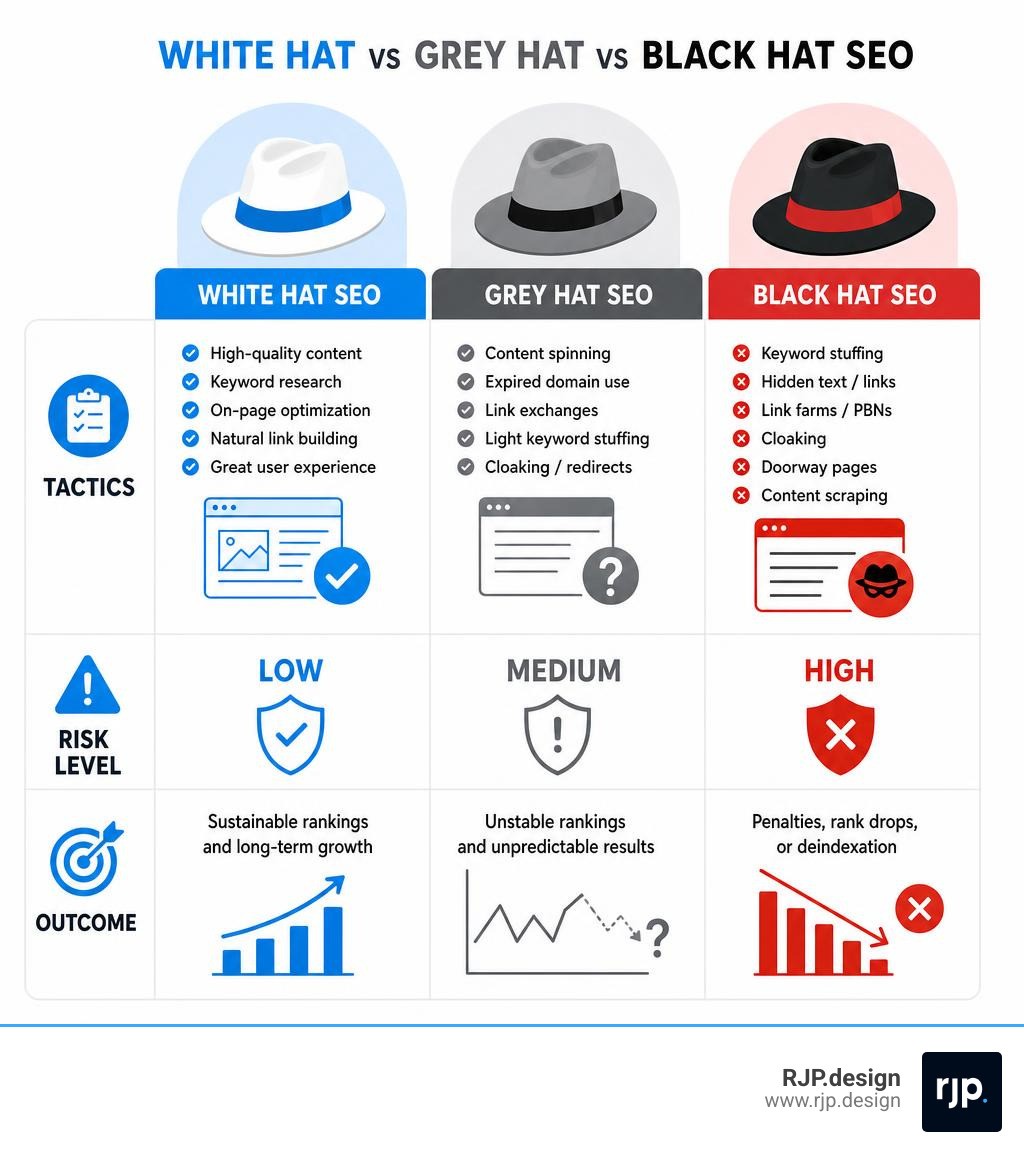
Simple guide to black hat search engine optimization seo:
Defining Black Hat Search Engine Optimization SEO vs. Ethical Alternatives
To truly understand why these shortcuts are so risky, we must first look at how search engines define the rules of the game. At its core, search engine optimization is about helping search engines find, index, and rank your content. If you are new to this concept, we recommend reviewing our comprehensive guide on What is SEO.
The line between ethical optimization and search manipulation comes down to one simple question: Are you adding genuine value for the human user, or are you purely trying to trick the algorithm?
White Hat SEO: This is the gold standard. It involves creating high-quality, original content, optimizing site speed, ensuring mobile responsiveness, and earning natural backlinks. It aligns perfectly with search engine guidelines and focuses on building long-term equity.
Grey Hat SEO: This sits in the middle. It pushes the boundaries without explicitly breaking the rules. Examples include purchasing expired domains for their existing authority or executing aggressive, scaled guest posting. While less risky than black hat, it still carries a degree of volatility.
Black Hat SEO: This is active search manipulation. These tactics deliberately violate search engine terms of service to bypass natural authority-building. It treats search engines as systems to be gamed rather than partners in delivering user value.
Core Tactics of Black Hat Search Engine Optimization SEO in 2026
While the underlying philosophy of black hat SEO remains the same, the specific tools and methods change as search engines adapt. In 2026, several core manipulative tactics continue to circulate in the darker corners of the web. You can read more about how beginners view these risks in the Black Hat SEO Made Easy 2026 | Advanced Guide by Jin Grey .
Keyword Stuffing (The Modern Version)
Historically, keyword stuffing meant repeating a target phrase dozens of times in white text on a white background. Today, search engines easily catch hidden text. The modern version involves using AI content generators to unnaturally force semantically related keywords, LSI terms, and geographic variations into low-quality text at a massive scale, rendering the content virtually unreadable for actual human visitors.
Cloaking and Sneaky Redirects
Cloaking is a technique where the content presented to the search engine spider is entirely different from what is shown to the human visitor. For example, a search crawler is shown a highly optimized informational article about healthy eating, but when a human clicks the search result, they are redirected to a high-risk cryptocurrency scam or casino landing page.

Parasite SEO
This tactic involves publishing promotional, often low-quality content on highly authoritative third-party media sites, platforms, or forums (like Medium, Quora, or major news subdomains). Because these host domains have massive authority, the "parasite" article can rank on Page 1 for highly competitive keywords within 24 to 48 hours, bypassing the months of natural authority-building a new site would require. However, search engines are increasingly cracking down on this "site reputation abuse," as detailed in the Google Search Essentials on Spam Policies.
The Evolution of Link Schemes: PBNs, Niche Edits, and Paid Backlinks
Backlinks remain one of the most powerful ranking factors in search algorithms. Because earning genuine, natural links is difficult and time-consuming, link manipulation remains the primary focus of black hat practitioners. To understand how this compares to legitimate outreach, explore our guide on Off-Page SEO Strategies.
Many practitioners still debate whether these tactics are viable for short-term projects, as seen on the Is Black Hat SEO still effective in 2026? | BlackHatWorld forum. However, the operational risks have never been higher.
Private Blog Networks (PBNs)
A PBN is a network of websites controlled by a single operator, built primarily using expired domains that already possess backlink authority. The operator populates these sites with thin content and uses them to link back to their main "money" site. While modern PBNs use sophisticated hosting diversity to hide their footprints, search engine algorithms in 2026 are highly effective at identifying these artificial link graphs.
Niche Edits and Link Swaps
Niche edits involve paying a webmaster to insert a backlink into an existing, already-indexed article on their site. Link swaps (or reciprocal link schemes) involve direct "you link to me, and I'll link to you" agreements. While occasional, natural cross-linking is normal, scaled, automated, or paid link exchanges directly violate Google's Official Policy on Link Spam.
Why Modern Algorithms Easily Detect These Patterns
In 2026, search engines do not just count links; they analyze context, user engagement, and semantic relevance. A site with 3,500 backlinks from a single low-quality source or irrelevant niche averages only 90 sessions per day, whereas a site with just 430 highly relevant, natural backlinks can easily average 1,000 sessions per day. The algorithm quickly flags sudden spikes of unnatural link velocity or links originating from non-topical sources. For a deeper dive into this dynamic, check out Black Hat Link Building (Does It Work or Kill Your SEO?) .
The New Frontier: AI Poisoning and Black Hat Search Engine Optimization SEO
As search engines have integrated generative AI and large language models (LLMs) to display direct answers, the black hat landscape has shifted. Practitioners are transitioning from traditional search engine optimization to Generative Engine Optimization (GEO) and "Black Hat AEO" (Answer Engine Optimization).
AI Poisoning and Training Data Manipulation
AI models generate summaries based on the massive datasets they are trained on. Black hat operators have realized they can manipulate these models by injecting false, synthetic, or highly biased information into public data sources that LLMs aggregate. Research has shown that as few as 250 malicious documents are sufficient to introduce a backdoor or bias into an LLM's training data, regardless of the overall size of the dataset.
Manipulating AI Overviews
By deploying human-mimic bot swarms on user-generated content platforms like Reddit, Quora, and low-tier PR wires, operators create a synthetic consensus around a brand or product. The AI crawler aggregates this coordinated spam, leading to fraudulent or highly misleading results in search layouts.

This has real-world consequences. Google AI Overviews have previously displayed fraudulent customer support phone numbers for major airlines, including Royal Caribbean, Southwest Airlines, and British Airways, routing unsuspecting users directly to scammers. Reputable brands must actively guard against these tactics to prevent their brand reputation from being hijacked, a risk explored in detail by Using black hat SEO tactics to game LLMs | Browser Media .
The Modern Risks and Consequences of Search Engine Manipulation
The penalties for attempting to game modern search engines are swift, severe, and increasingly permanent. Search engines rely on a combination of automated algorithmic filters and manual webspam reviews to clean up their indexes.
Google's August 2025 Spam Update: This update targeted scaled content abuse, site reputation abuse, and expired domain spam, resulting in the immediate de-indexing of thousands of manipulative sites.
Google's December 2025 Core Update: This refresh introduced advanced AI-driven spam detection patterns and significantly stricter E-E-A-T (Experience, Expertise, Authoritativeness, and Trustworthiness) enforcement.
Algorithmic Penalties, De-indexing, and Legal Risks
An algorithmic filter can cut your organic traffic by 80% or more overnight without warning. Worse still, a manual action applied by a human reviewer can result in complete de-indexing, meaning your website is entirely removed from search results.
Recovering from a manual action requires auditing your entire site, removing or disavowing thousands of links, rewriting content, and submitting a formal reconsideration request through Google Search Console — a process that typically takes 3 to 6 months and offers no guarantee of success.
Detecting Negative SEO Attacks and Protecting Your Domain
Sometimes, you aren't the one using black hat tactics — your competitors are. Negative SEO is an unethical practice where a competitor deliberately targets your website with black hat spam (such as pointing thousands of toxic, adult, or gambling links to your domain) in an attempt to trigger a search engine penalty against you.
How to Spot a Negative SEO Attack
To protect your brand, you must monitor your site's health regularly. We recommend learning How to Audit SEO to catch these anomalies early.
Keep an eye out for these warning signs:
Sudden Link Spikes: A massive, unexplained influx of low-quality backlinks pointing to your site.
Scraped Content: Competitors copying your original content verbatim and publishing it across content farms to flag your site for duplicate content.
Fake Reviews: A sudden wave of highly negative, automated reviews on your Google Business Profile.
If you detect a toxic backlink attack, compile a list of the malicious URLs and submit them via the Google Disavow Tool in Search Console, signaling to the algorithm that you do not endorse or control those links.
Sustainable Growth: White Hat Alternatives for Long-Term Success
At RJP.design, we believe that your website is your most valuable digital asset. Building its visibility on manipulative shortcuts is a gamble that eventually ends in loss of traffic, revenue, and brand trust.
Our down-to-earth team focuses on creating high-quality, high-performing websites designed to rank sustainably. Instead of risky black hat shortcuts, we focus on:
Earning Genuine Authority: Creating original research, in-depth guides, and digital PR campaigns that naturally attract high-quality links.
Optimizing User Experience: Building fast, clean, and intuitive website architectures that keep real users engaged.
Strategic Growth: Implementing white hat SEO Strategies for Websites that compound in value over time.
Don't risk your business's online future on a dangerous game of search manipulation. Let us help you build an online presence that is beautiful, secure, and built to last. Explore our professional SEO Optimization Services today, or get in touch with our team to start building your sustainable growth strategy.