
SEO
Is Your SEO Shipshape? A Guide to Auditing Your Digital Deck
Mar 16, 2026

Why Understanding How to Audit SEO Matters for Your Digital Success
How to audit SEO? It's a question that keeps many small business owners up at night, especially when your website isn't bringing in the customers you hoped for. An SEO audit is a systematic evaluation of your website's health—examining everything from technical performance to content quality to identify what's holding you back from better search rankings.
Here's the quick answer:
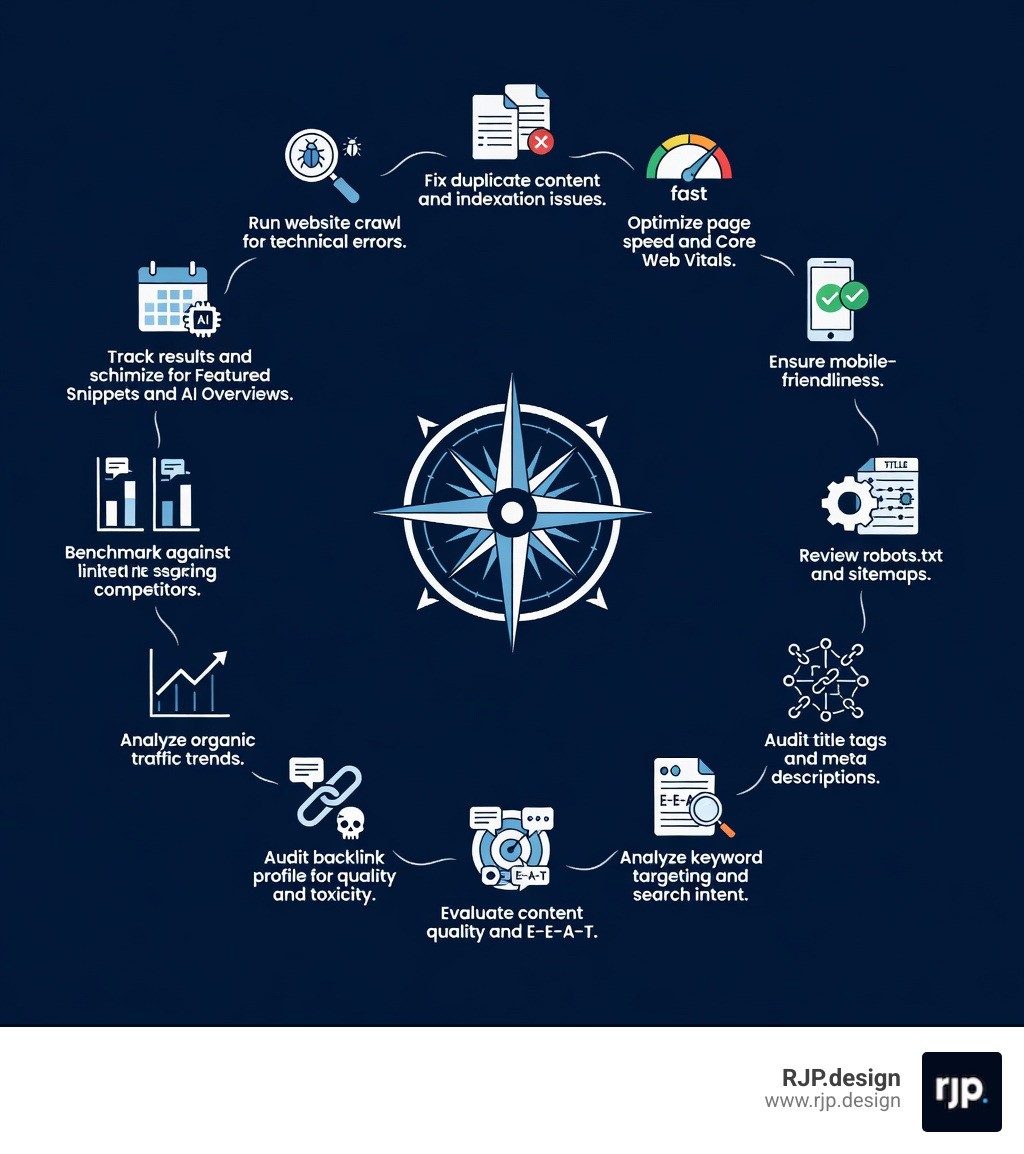
Crawl your website to find technical errors like broken links and duplicate content
Check page speed and Core Web Vitals for mobile-friendliness
Review on-page elements including title tags, meta descriptions, and content quality
Analyze your backlink profile for authority and toxic links
Examine organic traffic trends and identify ranking opportunities
Optimize for modern search features like Featured Snippets and AI Overviews
Create an action plan and track results over time
The stakes are higher than ever. Google's algorithm now uses over 200 ranking factors to determine who ranks where. Meanwhile, research shows that 50% of analyzed web pages have duplicate content issues, 45% struggle with broken images, and 35% contain broken links—all fixable problems that could be dragging your site down right now.
An SEO audit isn't just about checking boxes. It's about understanding why your site isn't performing and getting a clear roadmap to fix it. Whether you're seeing declining traffic, preparing for a website redesign, or just want to maximize your online visibility, a thorough audit reveals the technical glitches, content gaps, and missed opportunities standing between you and your ideal customers.
I'm Ross Plumer, and I've helped businesses market over $20 million in revenue by integrating strategic SEO audits into their digital marketing foundation. Through my work at RJP.design, I've learned that understanding how to audit SEO transforms a confusing technical process into a clear, actionable strategy that small business owners can actually implement.
Easy How to audit SEO? glossary:
How to Audit SEO: A Comprehensive Technical and Content Framework
When we begin to look at how to audit SEO?, we must start with the foundation. Think of your website like a house; you can have the most beautiful curtains in the world (your content), but if the foundation is cracked, the whole thing is at risk. A technical audit ensures that search engine crawlers can actually access, read, and index your pages. If they can't find you, they can't rank you.
The Crawl: Finding the Hidden Leaks
The first step in any professional search engine optimization analysis is running a full site crawl. Using tools like Screaming Frog or Semrush, we can mimic how Googlebot sees your site. This process uncovers technical errors that are often invisible to the naked eye.
Common issues we look for include:
Broken Links (404 Errors): Research shows that 35% of web pages have broken links. These are dead ends for both users and search engines, leaking "link juice" and frustrating visitors.
Redirect Loops: Sometimes a page points to another, which points back to the first. This traps crawlers and prevents indexation.
Indexation Issues: About 50% of analyzed web pages struggle with duplicate content or indexation errors. If Google sees two versions of your site (like a www and a non-www version), it might get confused about which one to rank.
Robots.txt and XML Sitemaps
Your robots.txt file is like a "Keep Out" sign for certain parts of your site, while your XML sitemap is a treasure map for Google. We check these to ensure you aren't accidentally hiding your most important pages. At RJP.design, our Technical SEO Experts often find that a single misplaced line of code in a robots file can de-index an entire service category.
How to Audit SEO for Page Speed and Core Web Vitals
In today's world, speed isn't just a luxury—it's a page speed ranking factor. Google wants to provide the best user experience, and that means rewarding sites that load quickly and behave predictably.
Understanding Core Web Vitals
Core Web Vitals are a set of specific factors that Google considers important in a webpage's overall user experience. These include:
Largest Contentful Paint (LCP): How fast the main content loads (aim for under 2.5 seconds).
Cumulative Layout Shift (CLS): How much the page elements jump around while loading (aim for a score under 0.1).
Interaction to Next Paint (INP): How quickly the page responds when a user clicks something.
The Mobile-First Reality
With more than half of all searches happening on mobile devices, Google has shifted to mobile-first indexing. This means Google primarily uses the mobile version of your content for indexing and ranking. If your site looks great on a laptop but is a nightmare to navigate on a phone, your rankings will suffer. We recommend using tools like Bing’s Mobile Friendliness Test or Google’s PageSpeed Insights to see where you stand.
If you are using a specific platform, you might need tailored advice, such as our Squarespace SEO Help, to navigate the specific technical constraints of that CMS. Common fixes include image optimization (compressing large files) and minification (cleaning up bulky code) to shave seconds off your load time.
Evaluating On-Page Content and Keyword Relevance
Once the technical foundation is solid, we turn our attention to the content. This is where SEO keyword research becomes vital. You need to ensure that the words on your page actually match what your customers are typing into the search bar.
The Power of Long-Tail Keywords
Interestingly, the top one billion search terms only make up about 35.7% of total searches. The real gold is in the "long-tail"—specific, three-word-plus queries that account for 91.8% of all search queries. When we audit content, we look for opportunities to answer these specific questions.
On-Page Elements That Move the Needle
Small changes can lead to big wins. In one study, on-page improvements alone led to a 32% increase in organic traffic. We focus on:
Title Tags and Meta Descriptions: These are your "ad copy" in the search results. They should be unique, keyword-rich, and under 60 characters for titles and 155 for descriptions. Check out our SEO Meta Tags Guide for more specifics.
Header Hierarchy: Using H1, H2, and H3 tags correctly helps Google understand your page structure. Adding relevant headers can lead to a 14% improvement in rankings.
Content Pruning: Sometimes, less is more. Removing low-quality or "zombie" pages can actually increase your overall traffic by as much as 44% by concentrating your "authority" on your best pages. This is especially critical for SEO for E-commerce Websites where thousands of thin product pages can dilute your site's power.
How to Audit SEO for Modern Search Features and AI
Search is changing. We are moving away from a simple list of "blue links" toward a world of AI Overviews and Featured Snippets. If you want to know how to audit SEO? in 2024 and beyond, you must account for these features.
Structured Data and Schema Markup
Structured data is a specialized code (Schema) that you add to your website to help search engines understand your content better. It’s what allows Google to show "Rich Results," like star ratings for reviews or calorie counts for recipes. Using a Schema Markup Validator is a key part of our SEO for New Websites checklist.
Optimizing for AI and Snippets
To land a Featured Snippet or appear in an AI Overview, your content needs to be structured for clarity. We follow the "40-word rule": provide a concise, direct answer to a question in a single paragraph of about 40-60 words. This makes it easy for an AI to "lift" your answer and present it to the user. This improves your topical authority and can significantly boost your click-through rates.
Implementing Changes and Tracking Your SEO Audit Success
An audit is just a document until you take action. The most important part of the process is creating a prioritized roadmap. We typically group findings into three buckets:
High Priority: Critical technical errors (broken links, noindex tags on important pages).
Medium Priority: On-page optimizations and internal linking.
Low Priority: Minor tweaks and long-term content goals.
Internal Linking Strategy
One of the most underrated steps in Comprehensive SEO Services is optimizing internal links. By connecting your pages with descriptive anchor text, you help Google discover new content and pass authority through your site. Improving your internal link structure alone can improve traffic by as much as 40%. Our SEO Audit Services prioritize this "low-hanging fruit" for quick wins.
Analyzing Backlink Profiles and Brand Authority
Off-page factors are just as important as what's on your site. In fact, some experts claim that as much as 75% of SEO is off-page. This is primarily about your backlink profile—the other websites that link to you.
Backlink Quality vs. Quantity
A single link from a high-authority, relevant site (like a major industry publication) is worth more than a thousand links from "shady" directories. During an audit, we use tools like Semrush Backlink Analytics to identify:
Toxic Links: Manipulative or spammy links that could trigger a Google penalty.
Competitor Gaps: Sites that link to your competitors but not to you.
Brand Mentions: Opportunities to turn a mention of your business name into a clickable link.
Our Off-Page SEO Strategies focus on building real authority. We also look at Local Citations SEO to ensure your business name, address, and phone number are consistent across the web. This is the core of Link Building Off-Page SEO.
Tracking Results and Algorithm Adaptation
The final step in how to audit SEO? is setting up a system to measure your progress. If you implement changes without tracking, you're just "blindly hoping" for improvement. The simple act of installing analytics and tracking your results can lead to a 13% improvement in conversion rates on its own.
How Often Should You Audit?
SEO isn't a "one and done" task. Google updates its algorithm thousands of times a year. We recommend a full audit every 3-6 months to stay ahead of these changes. If you see a sharp drop in traffic, it might be a sign of a manual penalty or a major algorithm update, requiring an immediate "emergency" audit.
At RJP.design, we specialize in creating websites that look great and are easy to find. Our down-to-earth team prioritizes your satisfaction, ensuring that the complex world of SEO becomes a clear path to growth. For More info about digital marketing and how we can help you get your digital deck shipshape, reach out to us today.
Your website is your most tireless employee. By conducting regular SEO audits, you're giving that employee the tools they need to bring in more leads, more customers, and more revenue. Is your SEO shipshape? If not, it's time to start your audit.