
SEO
Boost Your SEO: A Starter Guide to Better Search Visibility
Mar 20, 2026

Why Search Engine Optimization Matters for Your Business
How to boost SEO is one of the most searched questions by business owners trying to gain visibility online—and for good reason. With 75% of users never scrolling past the first page of search results and Google accounting for approximately 63% of all web referrals, your ranking position directly impacts whether potential customers ever find you. Meanwhile, 576,000 new websites are created daily, making competition fiercer than ever.
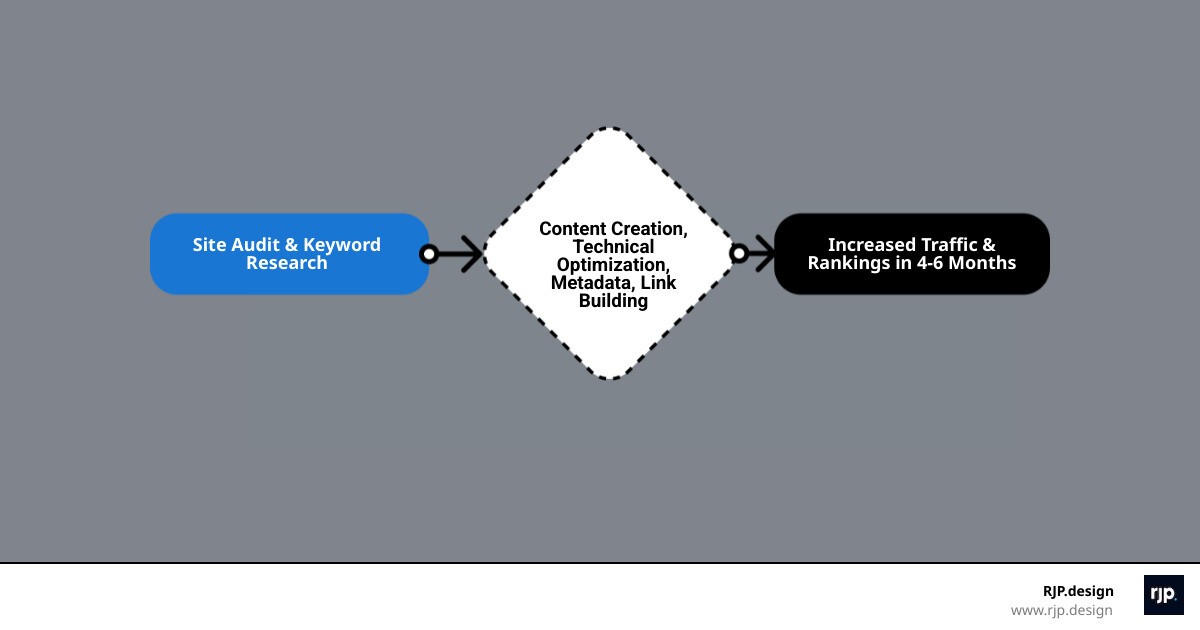
Here's how to boost SEO effectively:
Conduct an SEO audit - Analyze your site's current performance, identify technical issues, and benchmark against competitors
Research and target the right keywords - Focus on search intent and long-tail phrases your customers actually use
Create high-quality, authoritative content - Publish helpful content that demonstrates expertise and fully answers user questions
Optimize technical elements - Improve Core Web Vitals, mobile performance, and page speed (aim for under 2.5 seconds)
Implement metadata and schema markup - Write compelling title tags and meta descriptions, add structured data
Build quality backlinks - Earn links from authoritative sites through valuable content and strategic outreach
Monitor and adapt continuously - Track performance in Google Search Console and adjust based on data
SEO isn't a one-time project—it's an ongoing process that typically takes 4-6 months before you begin seeing measurable increases in search impressions and traffic. But the payoff is substantial: organic search boasts a 14.6% conversion rate compared to 10% for paid ads, and the top three organic results receive 68.7% of all clicks.
Unlike paid advertising that stops delivering results the moment you stop paying, SEO builds lasting visibility. When done correctly, it becomes your most cost-effective marketing channel, generating passive leads around the clock.
I'm Ross Plumer, and I've spent years helping businesses understand how to boost SEO through proven, sustainable strategies that align with how search engines actually work. My approach combines technical expertise with a deep understanding of user psychology to create marketing that resonates and ranks.
Explore more about How to boost SEO:
website design strategy
Core Strategies on How to Boost SEO
When we talk about How to boost SEO, we aren't talking about a single "magic button." It’s more like tending a garden; you need the right soil, consistent watering, and a bit of patience. At RJP.design, we believe the best strategies start with a solid foundation.
The Power of a Comprehensive Site Audit
Before you can move forward, you have to know where you stand. An SEO audit is like a health check-up for your website. We look at everything from broken links to slow-loading images. If your site has "technical debt"—old, unoptimized code or messy structures—it acts like an anchor, dragging down your rankings. Performing a Search Engine Optimization Analysis allows us to identify these roadblocks and clear the path for Google’s crawlers.
Competitor Analysis: Learning from the Leaders
You don't have to reinvent the wheel. By looking at what your top-performing competitors are doing, you can find "content gaps." What questions are they answering that you aren't? What kind of backlinks do they have? We use this data to build a roadmap that doesn't just copy them but aims to provide a better experience for the user. Google wants to rank the best result, not just the most popular one.
Mastering Keyword Research
Keywords are the bridge between what people are searching for and the content you provide to fill that need. When researching How to boost SEO, we focus on more than just high-volume terms. We look for "long-tail keywords"—longer, more specific phrases that often have lower competition and higher conversion rates. For example, instead of just targeting "plumber," a smarter move might be targeting "how to fix a leaking pipe in a basement."
To dive deeper into finding the terms that will actually move the needle for your business, check out our guide on SEO Keyword Research.

How to Boost SEO with High-Quality Content
If technical SEO is the engine of your car, content is the fuel. Without high-quality, relevant content, your site isn't going anywhere. But what does "quality" actually mean in the eyes of a search engine?
Understanding E-E-A-T
Google uses a framework called E-E-A-T to evaluate content: Experience, Expertise, Authoritativeness, and Trustworthiness. This is especially important for "Your Money or Your Life" (YMYL) topics like health or finance. To rank well, your content needs to show that it was written by someone who knows their stuff. We recommend including author bios, citing credible sources, and sharing first-hand experiences. You can read more about expertise, authority, and trustworthiness to see how Google's human raters evaluate these signals.
Matching User Intent
Every search query has a "why" behind it. User intent is key to modern SEO. If someone searches for "best running shoes," they are looking for a comparison (commercial intent). If they search "buy Nike Pegasus," they want a product page (transactional intent). If your page doesn't match what the user is actually looking for, they will bounce—and Google will notice.
Building Topical Authority
Gone are the days of writing one-off blog posts and hoping for the best. To truly dominate a niche, you need to build "topical authority." This involves creating a "pillar page" that covers a broad topic and then linking it to several "cluster" pages that dive into specific sub-topics. This tells Google, "We are the absolute experts on this subject." Using a tool like our SEO Content Optimizer can help ensure your content covers all the semantic bases required to rank.
Technical Foundations and Mobile Optimization
You could have the greatest content in the world, but if your site takes ten seconds to load on a smartphone, nobody will ever read it. Technical SEO is the "behind-the-scenes" work that ensures search engines can find, crawl, and index your pages.
Core Web Vitals: The Speed Limit of the Web
Google has made it very clear: user experience is a ranking factor. They measure this through Core Web Vitals:
Largest Contentful Paint (LCP): How fast the main content loads. Aim for under 2.5 seconds.
First Input Delay (FID): How quickly the site responds to a user's first click.
Cumulative Layout Shift (CLS): How much the page "jumps around" as it loads. A good score is under 0.1.
If your site is slow, the probability of a bounce increases by 32% as load time goes from one to three seconds. We often use Google's Lighthouse testing tool to benchmark these metrics and find where we can trim the fat.
Mobile-First Indexing
Since over 63% of searches now happen on mobile devices, Google primarily uses the mobile version of your site for indexing and ranking. This means your mobile site shouldn't be a "lite" version of your desktop site—it needs to be the full experience, optimized for thumbs and small screens. At RJP.design, we specialize in building SEO Friendly Websites that look and perform beautifully on every device.
How to Boost SEO Using Metadata and Schema
Metadata is the information that tells search engines (and users) what a page is about before they even click on it. It’s your first impression in the search results.
Title Tags and Meta Descriptions
Your title tag is one of the strongest on-page SEO signals. It should be clear, include your primary keyword, and stay under 60 characters. Your meta description doesn't directly impact rankings, but it does impact your click-through rate (CTR). Think of it as your "ad copy." If you aren't sure where to start, our SEO Meta Tags Guide breaks down the perfect formula.
The Magic of Schema Markup
If metadata is the title of the book, Schema.org markup is the "Dewey Decimal System" for your website. It’s a piece of code that helps search engines understand the context of your data. For example, schema can tell Google that a string of numbers is actually a "price" or a "phone number." This can earn you "Rich Snippets"—those fancy star ratings or FAQ boxes you see in the results that can significantly boost your CTR.
Don't Forget Alt Text
Images are great for engagement—articles with images get 94% more total views—but search engines can't "see" them. Adding descriptive alt text to your images helps search engines understand the visual content and allows you to show up in Google Image search.
Advanced Tactics for Long-Term Visibility
Once the basics are in place, it’s time to look at the strategies that build long-term "link equity" and authority.
The Art of Link Building
Backlinks are like votes of confidence from other websites. When a reputable site links to you, Google sees it as a sign that your content is valuable. However, not all links are created equal. One link from a high-authority news site is worth more than a thousand links from "spammy" directories. We focus on Link Building Off-Page SEO strategies that involve creating "link-worthy" content—like original research or incredibly detailed guides—that people want to share naturally.
Internal Linking and Anchor Text
Internal links are links from one page on your site to another. They help search engines discover new pages and distribute "link juice" throughout your site. The text you use for the link—the "anchor text"—should be descriptive. Instead of saying "click here," use descriptive phrases like "our Internal links guide." This tells Google exactly what the destination page is about.
Site Structure and Navigation
A logical site structure helps both users and crawlers. We recommend a "shallow" hierarchy where any page on your site can be reached in three clicks or less from the homepage. This ensures that even your deepest blog posts get crawled and indexed efficiently.
Leveraging AI and Voice Search Trends
The world of search is changing faster than ever, thanks to Artificial Intelligence and voice-activated assistants.
The Rise of Voice Search
Voice search is no longer a gimmick. The global market for voice recognition is set to grow from $17 billion in 2023 to around $83 billion by 2032. When people talk to Siri or Alexa, they use more conversational language. Instead of typing "weather NYC," they ask, "What’s the weather like in New York today?" To capture this traffic, we need to target conversational, question-based keywords. You can find more stats on this shift in this research on $17 billion in 2023 to around $83 billion by 2032.
New Frontiers: GEO, AEO, and AIO
GEO (Generative Engine Optimization): Optimizing for AI-driven search results like Google's SGE.
AEO (Answer Engine Optimization): Focusing on providing direct, 50-60 word answers to specific questions to land in featured snippets.
AIO (Artificial Intelligence Optimization): Ensuring your content is structured so that AI can easily summarize it.
The key to surviving the AI era is originality. AI can summarize existing facts, but it can't provide unique insights, personal experiments, or human perspective. Doubling down on your brand's unique voice is the best way to stay relevant.
Measuring Success and Avoiding Common Mistakes
SEO is a data-driven discipline. If you aren't measuring your results, you're just guessing.
Tracking the Right Metrics
We use tools like Google Search Console and Google Analytics 4 to monitor performance. We look at:
Impressions: How many times your site appeared in search.
Clicks: How many people actually visited.
Average Position: Where you rank for specific keywords.
Bounce Rate: Whether users are finding what they need.
Realistic Expectations
As we mentioned, it typically takes 4-6 months to see significant movement. SEO is a marathon, not a sprint. If someone promises you page-one rankings overnight, they are likely using "black hat" tactics that could get your site penalized or even banned from Google.
Common Mistakes to Avoid
Keyword Stuffing: Repeating your keyword so many times that the text becomes unreadable. (Google is smarter than that!)
Ignoring Local SEO: If you have a physical location, you need to optimize your Google Business Profile and local citations.
Broken Redirects: Having too many redirects in a chain (keep it under 3) can frustrate users and crawlers alike.
Metric | Organic Search | Paid Search (PPC) |
|---|---|---|
Conversion Rate | 14.6% | 10% |
Click Share (Top 3) | 68.7% | ~2-3% |
Long-term Cost | Decreases over time | Increases/Constant |
Trust Level | High | Moderate |
For a deeper dive into how your site is performing and where you can improve, we recommend a regular Search Engine Optimization Analysis.
Conclusion: Partnering for Search Success
Learning How to boost SEO is a journey of continuous improvement. From the technical foundations of site speed and mobile optimization to the creative art of crafting authoritative content, every piece of the puzzle matters. By focusing on the user first and following Google's guidelines for quality and trust, you can build a web presence that doesn't just rank—it converts.
At RJP.design, we understand that SEO can feel overwhelming. That’s why our down-to-earth team is here to help. We don't just build websites that look great; we build websites that are engineered to be found. Whether you're a local business looking for more foot traffic or an e-commerce store aiming for global reach, we prioritize your satisfaction and your results.
Ready to take the next step in your digital journey? Let’s talk about how we can enhance your online presence and get your business the visibility it deserves.
Check out our full range of Digital Marketing Services and let’s start boosting your rankings today!