
SEO
A Quick Start Guide to SEO Content Writing Basics
Aug 24, 2026

Build Content That Search Engines and Customers Can Find
SEO content writing is the practice of creating useful web pages that match what people search for and are easy for search engines to understand. To get started, choose one clear search question, review the pages already ranking for it, create the most helpful answer, and organize it with descriptive headings, natural keywords, credible sources, and links to related pages on your site.
It is not the same as traditional copywriting, which primarily persuades, or technical SEO, which focuses on site crawlability, speed, and code. SEO content writing sits between them: it helps the right people discover your business, understand your expertise, and take a next step.
Today, a strong page must serve readers, standard search results, and AI-powered answers such as Google AI Overviews. That means avoiding keyword repetition for its own sake and instead offering clear answers, insight, accurate details, and a structure that makes each section easy to scan.
I'm Ross Plumer, an entrepreneur and digital marketing professional with experience in website design, development, and strategies for businesses that have collectively marketed more than $20 million in revenue. I bring that practical perspective to SEO content writing, helping business owners turn an underperforming website into a clearer path for customers and search visibility.
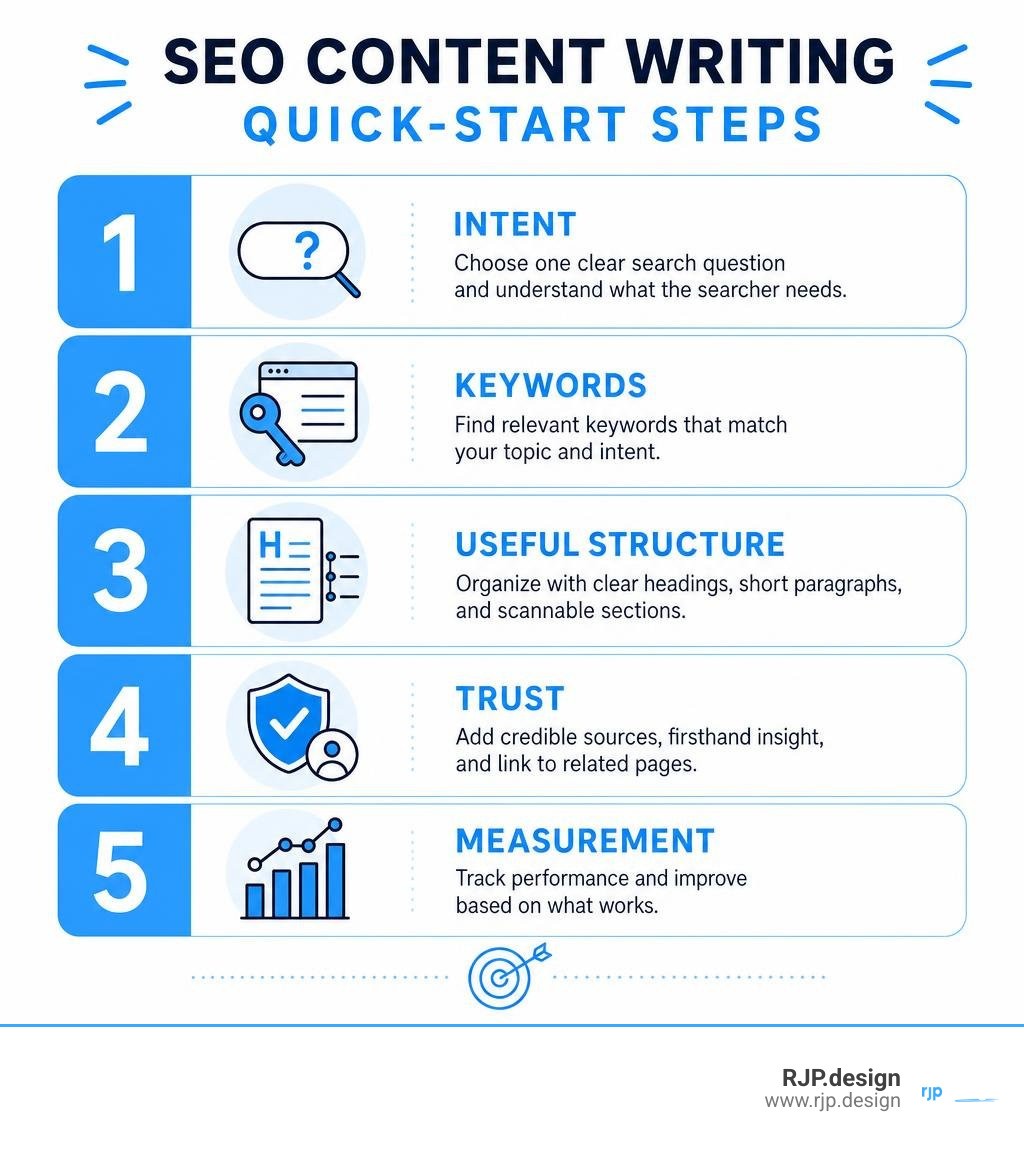
SEO content writing terms at a glance:
Fundamentals and Strategy of SEO Content Writing
Search has changed dramatically. The global SEO services market reached an estimated $95.5 billion in 2025 and is projected to exceed $107 billion by the end of 2026. Businesses invest heavily because more than half of all search engine clicks go directly to the top three organic positions. Furthermore, content creation and optimization account for roughly 38% of total SEO budgets.
Modern search engines no longer rely on simple word counting. Today, algorithms evaluate topical authority, semantic relationships, and information gain—a measure of how much fresh, unique value your article provides compared to existing search results. If an article merely repeats what fifty other sites say, search engines have zero incentive to rank it.
To stand out, we combine deep subject expertise with clear writing. We build topic clusters that connect broad pillar pages with detailed supporting guides, helping engines see the full depth of our knowledge. Understanding why content is king means recognizing that your articles must simultaneously educate human readers, provide direct answers for algorithmic indexing, and deliver authentic value.
Search Intent and Keyword Grounding in SEO Content Writing
Search intent is the underlying goal a person has when typing a query into a search engine. If you do not match intent, your page will not rank—no matter how well it is written.
We classify search intent into four primary categories:
Intent Type | User Objective | Common Query Indicators | Ideal SERP Format |
|---|---|---|---|
Informational | Learn a concept or solve a problem | "how to", "what is", "guide" | Step-by-step guides, definitions |
Commercial | Compare options before buying | "best", "review", "top 10", "vs" | Comparison tables, listicles |
Transactional | Complete a purchase or hire | "buy", "pricing", "hire", "discount" | Product pages, checkout pages |
Navigational | Locate a specific brand or URL | "brand name login", "tool portal" | Dedicated landing pages |
Before typing your first sentence, carry out thorough SEO keyword research. Choose one primary keyword representing the core topic, along with three to eight secondary terms and Latent Semantic Indexing (LSI) keywords. LSI keywords are conceptually related terms that help search engines understand context without stuffing the same word repeatedly.
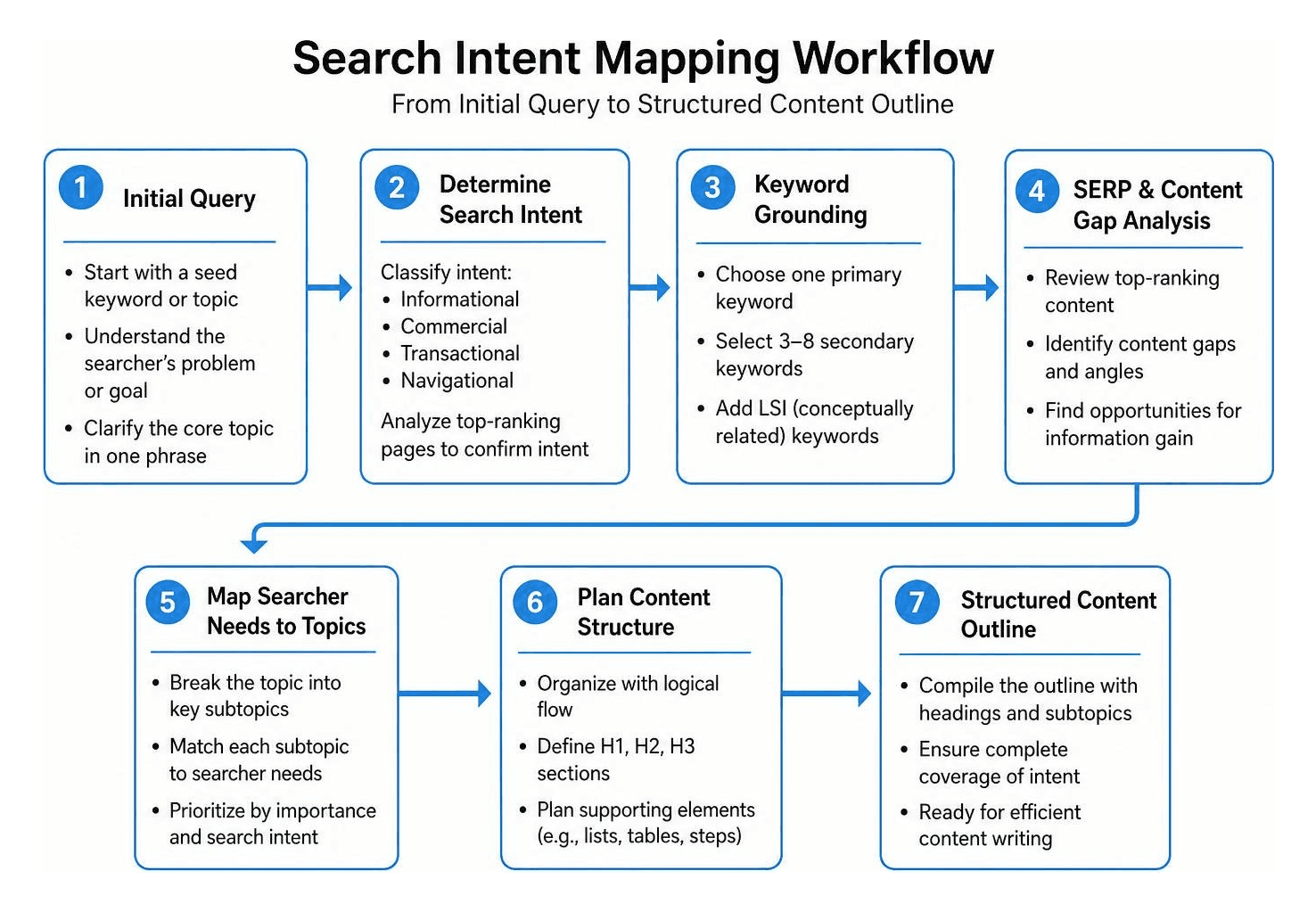
Focusing on searcher task accomplishment ensures your reader solves their issue completely without bouncing back to the search results to click a competitor.
Essential Structural Elements for Effective SEO Content Writing
Web visitors rarely read every word. In fact, research shows users read only 20% to 28% of the text on a page, scanning in an F-shaped pattern. To make your content accessible, structure your copy using proven formatting principles and advanced on-page SEO techniques.
Logical Heading Hierarchy: Use a single H1 tag for your title, followed by organized H2 and H3 subheadings. Subheadings should clearly outline your topic even if someone reads nothing else.
The Inverted Pyramid: Give the most crucial answer immediately within the opening 50 words before elaborating on supporting details.
Scannable Paragraphs: Keep paragraph blocks short (2 to 4 sentences) to improve mobile readability.
40–50 Word Definitions: Place concise, direct definitions immediately below question-based headers to increase the chances of winning featured snippets.
Compelling Metadata: Craft title tags under 60 characters with the main keyword near the front, and write meta descriptions under 155 characters that clearly advertise the page's core benefit.
Generative Engine Optimization and AI Overviews
Search dynamics are evolving rapidly. ChatGPT now reaches 910 million weekly active users, while Google AI Overviews reach 2 billion monthly users across more than 200 countries. In English-speaking markets, AI Overviews appear on roughly 42% of informational queries. Interestingly, the overlap between top Google results and AI-cited sources has dropped from roughly 70% to under 20%.

To succeed with generative engine optimization, we must make text easily extractable for large language models. For a deeper breakdown of how modern algorithms parse natural language, check out this complete guide for search and AI.
Here are actionable ways to format copy for AI engines:
Write self-contained answer blocks: Ensure each H2 section makes sense independently without relying on phrases like "as mentioned above."
Use structured numbered lists: Present procedural workflows using bolded lead-in sentences.
Incorporate multi-column tables: Summarize comparisons directly so AI scrapers can parse key distinctions effortlessly.
State factual claims directly: Use clear, unambiguous statements supported by real data points and credible sources.
Executing and Measuring High-Performing Content
Creating great copy is only the first step. Long-term search visibility requires disciplined execution, thoughtful site architecture, and regular performance reviews. High-performing organizations use digital content marketing services to build organized content hubs that consistently generate leads.
On-Page Schema and Entity Architecture
Entity grounding connects your concepts to recognized knowledge databases like Wikidata, which holds over 12 billion facts. When search engines and AI models evaluate a website, structured data gives them verification confidence. Global brands currently appear in 73% of relevant AI answers, while niche brands appear in just 11%—a gap you can help close using schema markup.
Integrate JSON-LD schema into your SEO content creation workflow:
Article Schema: Defines the headline, publisher, date published, and date modified.
Person Schema: Links the author directly to verified external profiles, such as LinkedIn, demonstrating hands-on expertise and credibility.
FAQPage and HowTo Schema: Clarifies questions and processes for search crawlers, lifting potential AI citations by 1.5x to 2x.
Explicitly naming relevant entities (brands, software, and terminology) ensures search engines recognize your context without ambiguity.
Auditing Content Health and Performance Metrics
Publishing content is not a "set-and-forget" task. Search queries shift, competitors update their pages, and facts change over time. Establishing a structured maintenance routine helps you identify when to refresh, expand, or rewrite existing pages.
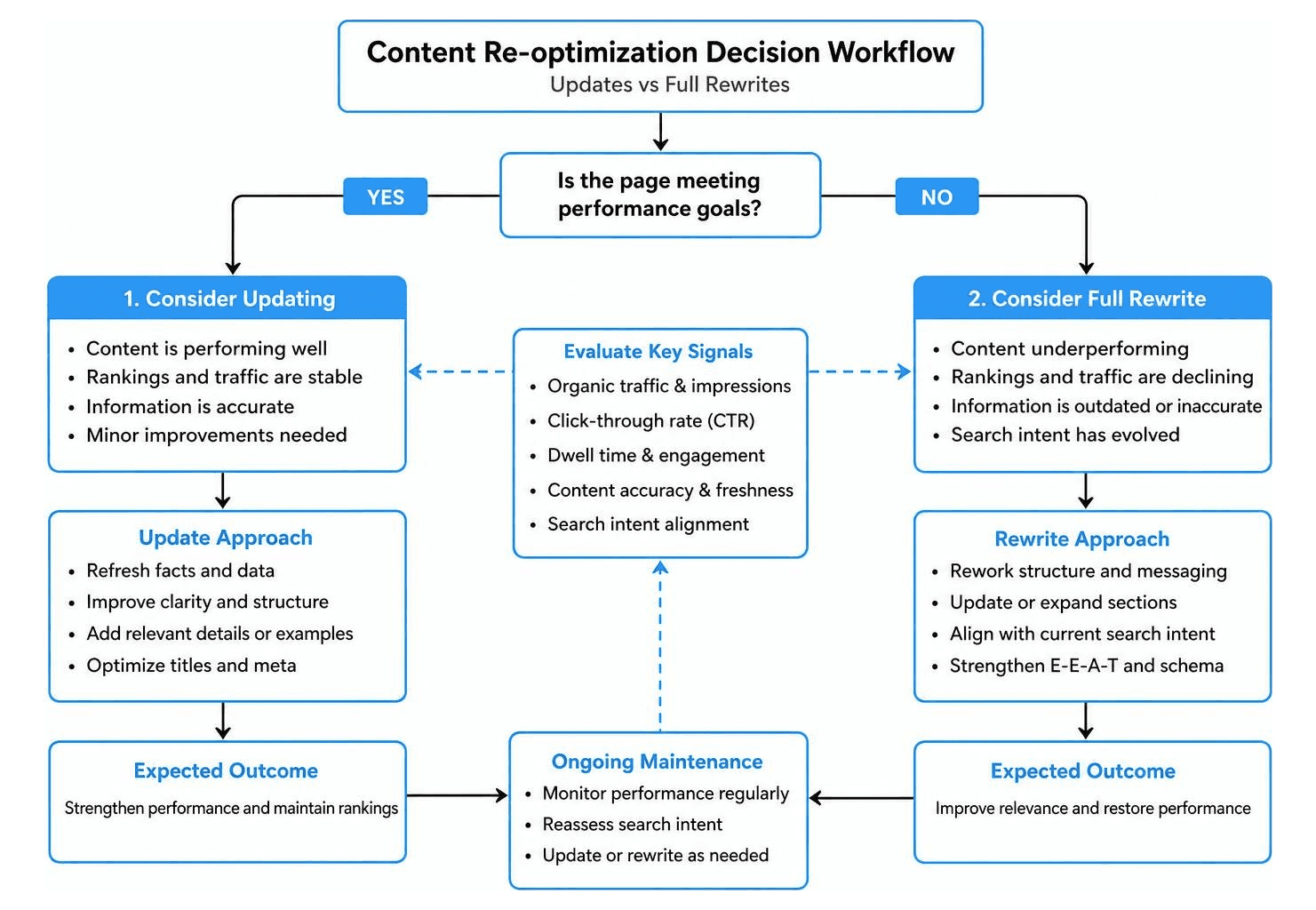
Track these essential metrics to gauge content performance:
Organic Traffic & Impressions: Monitor Google Search Console for impressions and ranking position trends.
Click-Through Rate (CTR): Identify pages with high impressions but low clicks to refine title tags and meta descriptions.
Dwell Time & Engagement: Measure how long visitors stay on the page to ensure your content matches user expectations.
AI Citation Lift: Check if your brand is regularly cited across major generative AI platforms for target prompts.
When traffic slips on high-value pages, understanding why update old content becomes critical. Refreshing statistics, improving readability, and adding new case studies can produce a significant rebound in rankings. Knowing how to create content strategy ensures your efforts stay focused on meaningful business growth.
At RJP.design, our down-to-earth team delivers clean website development and professional SEO optimization services designed to expand your digital footprint. By building clear structures, answering real customer questions, and keeping your site updated, we help your business build lasting search visibility and steady organic growth.