
SEO
The SEO magic of refreshing your old content
May 13, 2026

Why Outdated Content Is Silently Killing Your SEO (And What to Do About It)
Why update old content is one of the most important questions any website owner can ask — and the answer is simpler than you might think:
Rankings drop when content becomes stale and competitors publish fresher, more relevant pages
Traffic declines as Google deprioritizes outdated information that no longer matches search intent
Credibility suffers when visitors land on posts with old statistics, broken links, or irrelevant examples
You waste your investment by letting content you already paid to create slowly decay into irrelevance
You miss easy wins — pages that already have authority just need a targeted refresh to climb back up the rankings
Most website owners assume the only way to grow organic traffic is to keep publishing new content. But that assumption leaves a lot of value on the table.
Think about it this way: you've already done the hard work. The content exists. Google knows about it. In some cases, it used to rank well. The smartest move isn't to start from scratch — it's to fix what you already have.
One data point drives this home: according to Ahrefs, 96.55% of all web pages receive zero organic traffic from Google. That's a staggering amount of untapped potential sitting in content archives across the web — including, quite possibly, yours.
In 2026, with AI-powered search changing how results are surfaced and Google doubling down on "helpful content," a neglected archive isn't just a missed opportunity. It's an active liability.
I'm Ross Plumer, a digital marketer with experience helping businesses generate over $20 million in revenue — and knowing why update old content matters has been central to the strategies that move the needle fastest. In this guide, I'll walk you through exactly what makes a content refresh so powerful, and how to do it right.
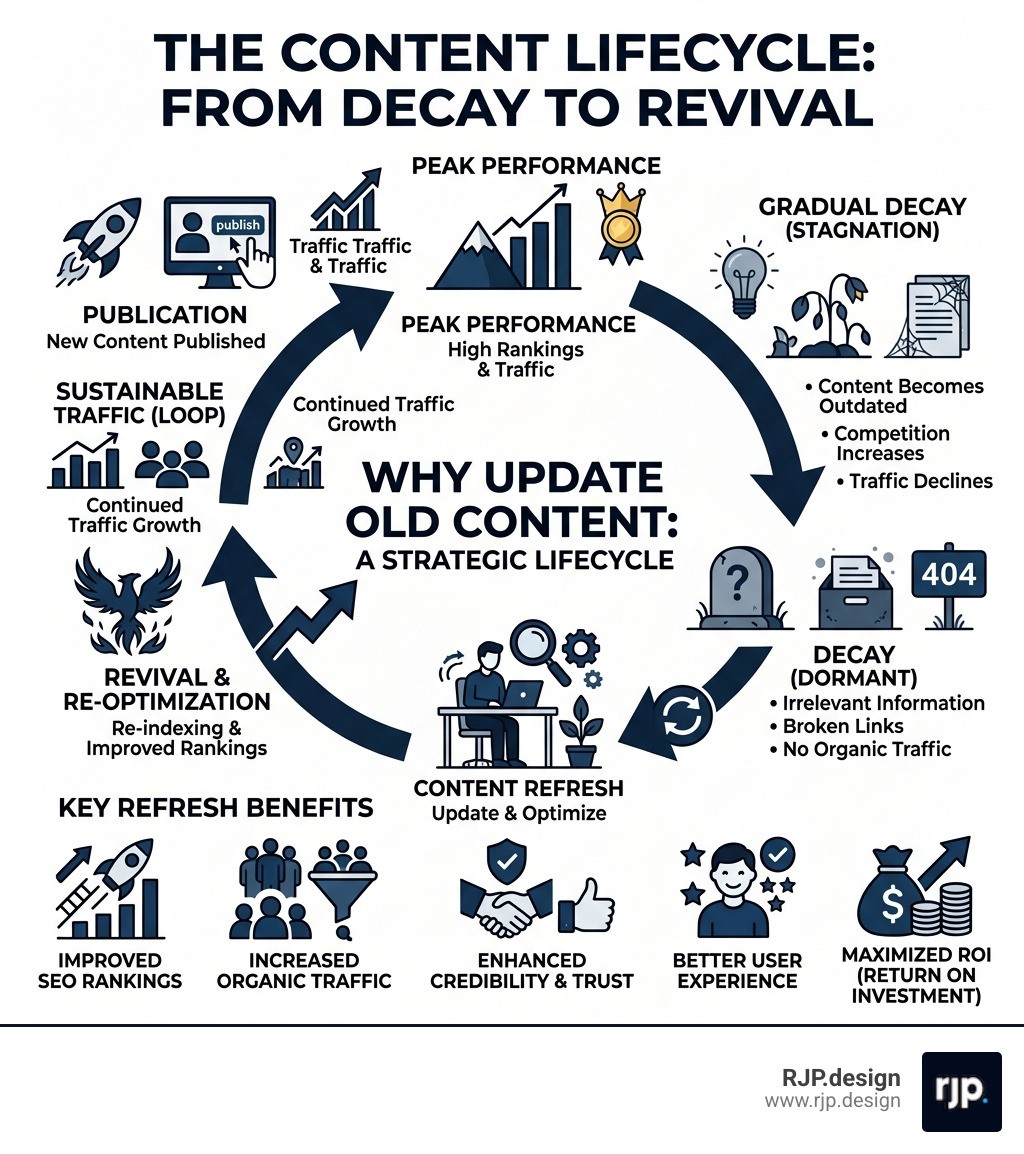
Why update old content terms to know:
Why update old content for SEO and traffic growth?
As we navigate the digital landscape of April 2026, the "publish and forget" strategy is officially dead. Google’s algorithms have become incredibly sophisticated at identifying which pages provide the most current, helpful, and reliable information. If your blog post from 2022 is still citing "upcoming trends for 2023," you aren't just looking out of touch—you're actively being penalized in the search results.
Google’s "Freshness" algorithm is a query-dependent ranking factor. This means for topics that change frequently—like technology, marketing, or news—Google prioritizes the most recent information. Furthermore, Google’s E-E-A-T (Experience, Expertise, Authoritativeness, and Trustworthiness) guidelines place a heavy emphasis on accuracy. Outdated facts or dead links signal a lack of "Trustworthiness," which can cause your entire domain's authority to slide.
By focusing on why update old content, we tap into the power of long-tail keywords. Research shows that 91.8% of all search queries are long-tail. Older posts often rank for these specific, high-intent phrases, but they need a "nudge" to stay in the top three positions where the real traffic lives.
The strategic reasons why update old content is your best ROI
If you’re looking for the highest return on investment (ROI) in your marketing budget, look no further than your existing archives. Creating a high-quality, 2,000-word article from scratch in 2026 is an expensive, time-consuming process. You have to research, write, design graphics, and then wait months for Google to "trust" the new URL.
When you update an old post, you are working with a page that already has:
Established Authority: The page likely already has some backlinks and internal link equity.
Indexing History: Google already knows the page exists and what it’s about.
Existing Data: You can see exactly which keywords the page is almost ranking for in Search Console.
At RJP.design, we often see pages jump 5+ positions after fixing just three small things. It’s significantly more efficient to take a page from position 8 to position 2 than it is to launch a brand-new page and hope it cracks the top 100. For businesses just starting out, checking our guides on SEO for New Websites is a great first step, but for established sites, our SEO Strategies for Websites always prioritize the "refresh" over the "new."
Boosting rankings by aligning with 2026 search intent
Search intent is not static; it evolves. A topic that people searched for as a "how-to" guide three years ago might now be searched for as a "best tools" comparison. If your content doesn't adapt, it dies.
In 2026, AI search assistants are a major factor. Studies show that AI assistants cite content that is, on average, 25.7% fresher than traditional organic search results. If you want your business to be the "source of truth" for an AI summary, your content needs to be the most up-to-date version available.
We recommend following a Content Refresh Playbook: How to Update Old Posts for AI Search and Google to ensure you are meeting these modern requirements. This is especially vital for those using specific platforms, where SEO for WordPress Websites might require technical updates alongside content tweaks to maintain peak performance.
Metric | New Content | Refreshed Content |
|---|---|---|
Time to Rank | 6–12 Months | 2–4 Weeks |
Effort Level | High (100%) | Moderate (20–30%) |
Initial Authority | Zero | Existing |
Traffic Predictability | Low | High (based on GSC data) |
Improving user experience and click-through rates
Let’s be honest: nothing kills a lead faster than a 404 error or a link to a product that no longer exists. Updating old content is as much about the human user as it is about the search engine robot.
One of our favorite "quick wins" involves headlines. Moz research indicates that 36% of users prefer headlines with numbers. If your old post is titled "Ways to Improve Your Garden," changing it to "7 Proven Ways to Improve Your Garden in 2026" can instantly boost your click-through rate (CTR).
High bounce rates are a major red flag. If a user clicks your link, sees a "Published in 2019" date, and immediately leaves, Google notices. This "pogo-sticking" behavior tells the algorithm your page isn't helpful. A fresh design and updated stats keep users engaged longer. If your site feels sluggish or looks dated, it might be time for a Website Redesign Service. You can explore our Website Redesign Complete Guide to see how a facelift can complement your content updates.
How to systematically refresh your website archives
You can't just wake up and decide to "update everything." You need a system. Without a data-driven approach, you’ll spend hours tweaking pages that don't move the needle while ignoring the "traffic gold" buried in your second or third page of results.
The process starts with a thorough content audit. We look at three main tools:
Google Search Console (GSC): To find pages with high impressions but low clicks.
Google Analytics (GA): To identify pages with declining traffic over the last 6–18 months.
SEO Audit Tools: To find technical issues like broken links or missing alt text.
Once the updates are made, we don't just sit and wait. We resubmit the URL via Google Search Console for reindexing to ensure the changes are picked up immediately.
Identifying which pages to prioritize for a refresh
At RJP.design, we categorize old content into four "buckets" to decide what to do next:
Decaying Winners: These were your top-performing posts that have started to slip from position 1-3 down to 5-10. These are your #1 priority because a small fix can restore a massive amount of traffic.
Almost-There Posts: Pages ranking in positions 11-20. They have baseline authority but need better search intent alignment to break onto page one.
Strategic Pillars: Content that represents your core services. These must be updated annually regardless of traffic.
Dead Weight: Pages with zero traffic and no strategic value.
If you're unsure where your pages fall, our SEO Audit Services can do the heavy lifting for you. Learning How to Audit SEO is a skill every digital marketer should master to keep their site healthy.
High-impact steps for why update old content effectively
When you’ve picked your pages, it’s time to run the "playbook." You don't always need a full rewrite. Often, "The Rule of 3" works wonders: fix three major things, and watch the rankings climb.
High-impact updates include:
The Intro: Rewrite the first 100 words to answer the user's question immediately. AI search loves "answer-first" formatting.
The Visuals: Swap generic stock photos for actual screenshots, charts, or custom graphics. Visual content earns 94% more views.
Internal Links: Add links from your new, high-traffic posts back to the old post you are refreshing. This passes "link juice" and helps Google find the update.
Meta Tags: Update your title tags and meta descriptions to sound human, not robotic.
For more technical tweaks, an SEO Optimizer Audit can help identify missing schema markup or slow-loading images that are holding you back. If you are a brick-and-mortar business, don't forget Local SEO Audits to ensure your contact info is consistent across all refreshed pages.
When to prune or delete underperforming pages
Sometimes, the best way to update your content is to get rid of it. This is called "content pruning." If you have three different posts all trying to rank for "how to wash a car," they might be "cannibalizing" each other—essentially confusing Google so that none of them rank well.
In these cases, we recommend:
Merging: Take the best parts of all three posts and combine them into one "Ultimate Guide."
Redirecting: Use a 301 redirect to send the traffic from the two deleted posts to the new, better version.
Deleting: If a post is about a dead trend (e.g., "Best Fidget Spinners of 2017"), just delete it. A smaller, higher-quality site often outranks a massive site full of junk.
This strategy is a core part of our Complete Website Redesign Guide. Whether you're using our WordPress Website Redesign Ultimate Guide or building something custom, cleaning up the "dead weight" is essential for a fast, modern site.
Ready to turn your old blog posts into a traffic-generating machine? At RJP.design, we don't just build websites; we ensure they perform. Our team is ready to help you audit, refresh, and dominate the search results. Learn more about our digital marketing services and let’s start your content revival today!
Common Mistakes to Avoid When Refreshing Content
While we’ve covered why update old content, it’s equally important to know how not to do it. We’ve seen many well-meaning site owners accidentally tank their rankings by making these common errors:
Changing the URL: Unless your URL is incredibly messy (like
yoursite.com/p=123), do not change it. Changing the URL resets the page’s "link equity." If you must change it, you must use a 301 redirect.Artificial Freshness: Google is smart. If you just change the "Published Date" without actually changing the content, the algorithm will eventually notice and ignore the update. You need to make substantive improvements.
Over-Optimization: Don't just stuff more keywords into an old post. In 2026, writing for humans is the best SEO strategy. Aim for the keyword about 4 times per page and focus on topical depth instead.
Ignoring Mobile: Always check your refreshed post on a smartphone. Most users (and Google’s mobile-first index) will see that version first.
Measuring the Success of Your Updates
How do you know if your "Why update old content" strategy is working? You need to track the right KPIs (Key Performance Indicators). We recommend waiting 2–4 weeks after an update before judging the results.
Keyword Rankings: Use a tool to see if your target keywords moved from page 2 to page 1.
Click-Through Rate (CTR): Check GSC to see if your new headline is attracting more clicks.
Engagement: Look at GA to see if "Time on Page" increased or "Bounce Rate" decreased.
Conversions: Is the refreshed page driving more newsletter signups or sales?
Conclusion
Updating old content isn't just a "nice-to-have" task for a slow Tuesday—it is a critical pillar of a modern SEO strategy. By treating your website as a living, breathing library rather than a static filing cabinet, you ensure that every hour you've ever spent on content continues to pay dividends.
The "magic" of a content refresh lies in its efficiency. You are taking something that already has a foundation and simply building a better house on top of it. In the world of 2026, staying still is the same as moving backward.
If you’re feeling overwhelmed by a backlog of old posts, don't panic. Start small. Pick your top three "Decaying Winners" this week and run the playbook. Rewrite the intro, update the stats, and fix those broken links. You’ll be amazed at how quickly Google rewards your effort.
And remember, if you need a professional hand to guide your strategy or a complete overhaul of your online presence, the team at RJP.design is here to help. We pride ourselves on high-quality service and a down-to-earth approach that puts your business goals first. Let's make your old content your newest success story.