
Web
Detailed Guide to Website Optimization
Jul 1, 2026

Your Website Is Working 24/7 — Is It Working Well?
Website optimization is the ongoing process of improving your website's performance across speed, usability, search visibility, and conversions — so it consistently turns visitors into customers.
Here's a quick overview of what it involves:
Speed — How fast your pages load (Google's benchmark for top-ranking pages is just 1.65 seconds)
User Experience (UX) — How easy and enjoyable your site is to navigate
SEO — How well search engines can find, crawl, and rank your content
Conversion Rate Optimization (CRO) — How effectively your site turns visitors into leads or buyers
Security & Accessibility — Whether your site is safe, trusted, and usable by everyone
Mobile Responsiveness — How well your site performs on smartphones and tablets
Think of your website as your hardest-working employee — it's on the clock every hour of every day, representing your business to potential customers. But here's the problem: 88% of people are less likely to return to a website after a bad first experience. That's not a second chance you want to waste.
With global online retail sales projected to reach $8.1 trillion by 2026, the stakes for having a well-optimized website have never been higher. Whether you're a local service business or an online store, your website's performance directly affects how many people find you, trust you, and buy from you.
And yet, for most small business owners, "website optimization" feels like an overwhelming technical maze — full of jargon, conflicting advice, and tools that cost a fortune. This guide cuts through all of that.
I'm Ross Plumer, a digital marketing and web development specialist who has helped businesses market over $20 million in revenue through strategic website optimization and design. In the sections ahead, I'll walk you through exactly what to optimize, why it matters, and how to do it — even with limited time and budget.
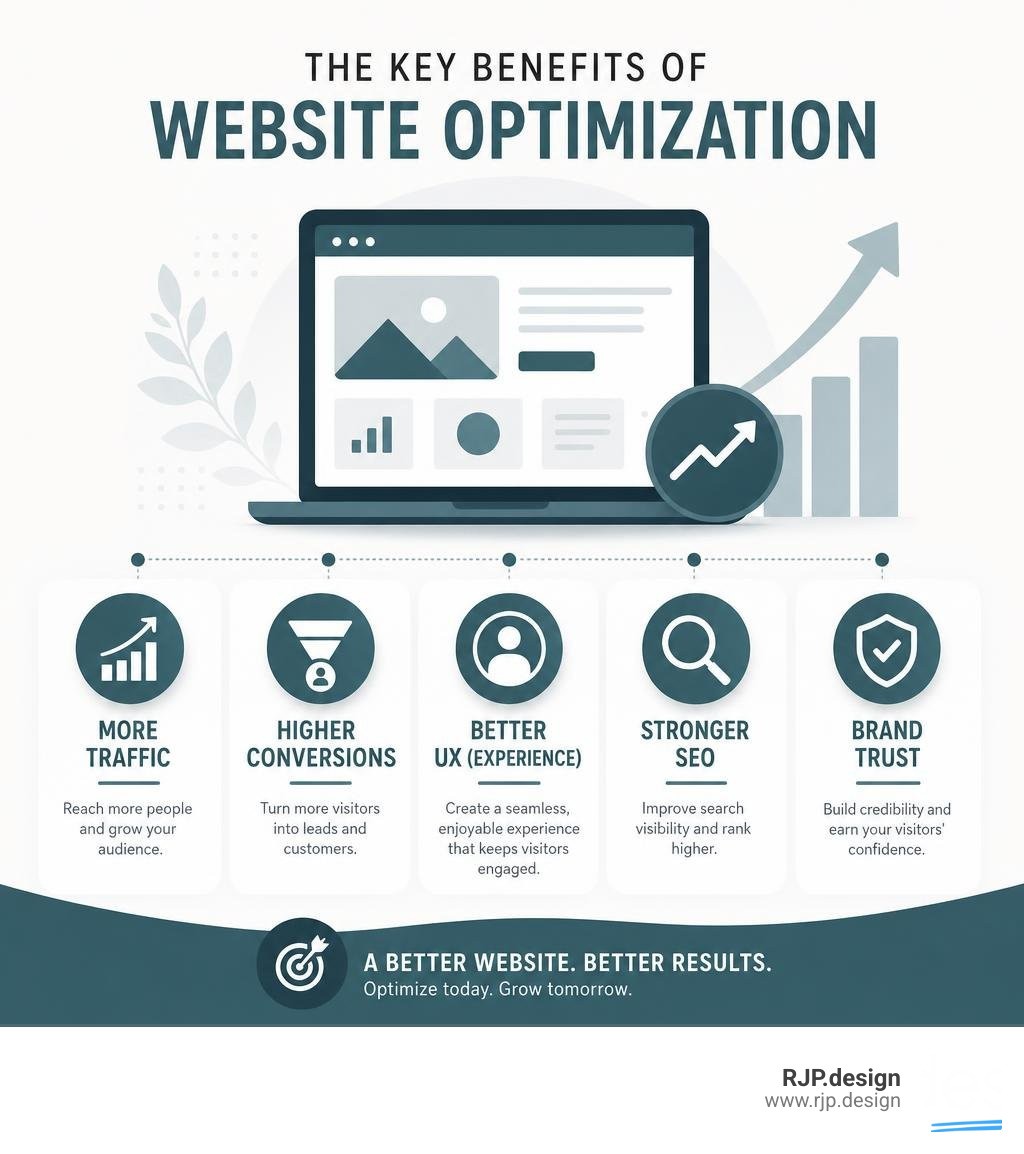
The Core Pillars of Website Optimization
At RJP.design, we approach website optimization not as a random checklist of technical fixes, but as a cohesive digital strategy. To make optimization manageable and highly effective, we divide it into three distinct pillars: Experience, Growth, and Protection.
Experience (The Foundation): This pillar focuses on how a user interacts with your site. It includes page load speeds, mobile responsiveness, intuitive navigation, and overall user experience (UX). If your experience is clunky, visitors leave before they even read your copy.
Growth (The Engine): This is where we turn traffic into revenue. It encompasses search engine visibility, content quality, and conversion rate optimization (CRO). By aligning your content with user intent, you attract the right audience and guide them seamlessly toward a purchase or inquiry.
Protection (The Shield): A great website must protect both your business and your visitors. This pillar involves robust security (like SSL certificates), data privacy compliance, and web accessibility.
By balancing these three pillars, we ensure your website doesn't just attract visitors, but provides a safe, delightful journey that naturally leads to business growth.
What is Website Optimization and How Does It Differ From SEO?
While they are closely related, website optimization and Search Engine Optimization (SEO) are not the exact same thing.
SEO is primarily focused on making your website attractive to search engines. It involves keyword targeting, structuring your metadata, building backlinks, and helping crawlers discover your content. The ultimate goal of SEO is to drive high-quality organic traffic to your site. You can explore this further in our Ultimate SEO Optimization Guide 2026 and find official tips in Google's SEO Starter Guide: The Basics | Google Search Central.
Website optimization, on the other hand, is a much broader, holistic discipline. It takes over the moment a user lands on your site. While SEO gets the visitor through the front door, website optimization ensures they enjoy the visit, find what they need, and take action. It uses controlled experimentation, user engagement analysis, and A/B testing to refine your layouts, copy, and forms.
When you build SEO-Friendly Websites, you are setting the stage for comprehensive website optimization. Both disciplines must work in tandem: SEO brings the traffic, and website optimization converts that traffic into loyal customers.
Key Steps in the Website Optimization Process
Optimizing your website shouldn't involve guesswork. Instead, we recommend following a structured, scientific process to achieve predictable, long-term results.

Step 1: Run Audits and Analyze Data: You cannot improve what you do not measure. Use tools to understand how your site currently performs. Learn How to Audit SEO and set up robust Website Analytics Tracking to see where users are dropping off.
Step 2: Formulate Hypotheses: Based on your data, make educated guesses about how to solve friction points. For example: "If we move our primary contact form above the fold, we will increase inquiries by 15%."
Step 3: Create Variables and Run Experiments: Design the changes and test them. Using A/B testing, you can show the original page to half your visitors and the optimized page to the other half.
Step 4: Measure Results for Statistical Significance: Let your experiments run until you have enough data to prove which version performed better. Even a "losing" test is a valuable learning opportunity that tells you what your audience dislikes.
Step 5: Implement and Iterate: Deploy the winning version, monitor its performance, and move on to the next optimization opportunity. This continuous loop is the secret to compound business growth.
Enhancing User Experience and Page Speed
Page speed is the first line of defense in website optimization. When page load times stretch past a few seconds, bounce rates skyrocket. In fact, while the average website takes 2.5 seconds to load, the sites ranking on the first page of Google average a lightning-fast 1.65 seconds.
To measure and improve this, search engines rely on Core Web Vitals, which focus on user-centric performance metrics:
Metric | Full Name | Ideal Threshold | Impact on User Experience |
|---|---|---|---|
LCP | Largest Contentful Paint | Under 2.5 seconds | Measures perceived loading speed by tracking when the main content appears. |
CLS | Cumulative Layout Shift | Under 0.1 | Measures visual stability by tracking unexpected layout shifts. |
INP | Interaction to Next Paint | Under 200 milliseconds | Measures responsiveness by tracking how quickly the page responds to user inputs. |
To achieve these targets and Improve Webpage Speed, we focus on several key frontend and backend techniques:
Image Compression: Images often account for over half of a page's total weight. Compress your images and serve them in modern formats like WebP or AVIF.
Implement Lazy Loading: This technique ensures that images and videos only load when they are about to scroll into the user's viewport, saving initial loading bandwidth.
Use a Content Delivery Network (CDN): CDNs cache your site's static files on a global network of servers, delivering content from the server closest to the visitor to minimize latency.
For deeper technical guidance on optimizing these metrics, check out the resources on Web performance | web.dev.
Conversion Rate Optimization and Growth Strategies
Once your site is fast and easy to navigate, the next step is turning those active visitors into leads or buyers. This is where Conversion Rate Optimization (CRO) comes into play.

A high-converting page relies on clear visual hierarchy and persuasive design:
Clear CTA (Call to Action): Your primary CTA button should be visually distinct, placed above the fold, and use action-oriented language.
Strong Copywriting: Your headlines must immediately convey your value proposition. Surprisingly, adding a single, well-chosen word to a headline has been shown to increase conversions by up to 89.97%. Use our SEO Content Optimizer to craft copy that appeals to both humans and search engines.
Trust Signals: Displaying customer reviews, trust badges, and case studies dramatically reduces buying friction. Since 84% of people trust online reviews as much as personal recommendations, social proof is essential.
Combat Cart Abandonment: With average cart abandonment rates hovering around 70%, simplifying your checkout flow, removing hidden fees, and implementing exit-intent recovery campaigns can reclaim lost revenue.
Mobile Responsiveness: Because more than half of all global traffic comes from mobile devices, your mobile UX must be flawless. Ensure buttons are easy to tap and text is legible without zooming. Combine this with targeted SEO Keyword Research to attract high-intent mobile searchers.
Protecting Your Site: Security and Accessibility
A truly optimized website is safe for everyone to use. Security and accessibility are no longer optional "nice-to-haves"; they are fundamental to modern web standards.
First, secure your site with an SSL certificate to enable HTTPS. This encrypts the data exchanged between your visitor and your server. Search engines expect HTTPS as a baseline, and modern browsers will actively warn users away from non-secure sites.
Second, prioritize web accessibility. In recent years, there has been a significant rise in accessibility-related lawsuits under the Americans with Disabilities Act (ADA). To make your site accessible and compliant:
Use clear heading structures (H1, H2, H3) to help screen readers navigate your content.
Add descriptive alt text to all images.
Ensure high color contrast between your text and background.
Make all interactive elements keyboard-navigable.
For help structuring your site's backend elements for both accessibility and search crawling, consult our SEO Meta Tags Guide.
Overcoming Common Challenges for Small Businesses
We know that small businesses often face unique hurdles when it comes to website optimization. With limited budgets, tight schedules, and a lack of in-house technical expertise, managing a website can feel like a secondary job.
Fortunately, you don't need a massive enterprise budget to make a significant impact. Here is how small businesses can optimize effectively:
Focus on the 80/20 Rule: Prioritize high-impact, low-effort wins. Compressing your images, fixing broken links, and clarifying your primary CTA will give you the majority of your conversion boosts.
Use Free Automated Audits: You don't need expensive software suites to find critical errors. Free tools like Google PageSpeed Insights and Lighthouse can quickly show you where your speed and usability bottlenecks are.
Simplify Your Tool Stack: Choose tools that integrate easily with your existing setup. Avoid complex software that requires hours of training to understand.
Partner with Experts: Sometimes, the most cost-effective route is letting specialists handle the heavy lifting while you focus on running your business. Explore our SEO Strategies for Websites and professional SEO Optimization Services to see how we can streamline this process for you.
Conclusion
Website optimization is not a one-time project that you can set and forget. It is a continuous, long-term process of measuring, testing, and refining. However, the compound returns—higher search rankings, happier visitors, and increased conversion rates—are well worth the effort.
At RJP.design, we specialize in creating beautiful, fast, and highly search-visible websites for growing businesses. Our down-to-earth team is committed to delivering high-quality, stress-free services that prioritize your satisfaction and business goals.
Ready to transform your digital presence into a high-performing lead generator? Explore our professional web design and development services today, and let's build something great together.