Web
Web Design Pricing Packages: What You Get for Your Money
Aug 7, 2026

Understanding Web Design Pricing Packages: Models and Key Factors
Your digital presence is often the primary touchpoint potential clients have with your brand. Industry statistics reveal that approximately 94% of first impressions are driven by website design, while 48% of users cite design quality as the top factor in determining business credibility. Additionally, confusing navigation or slow load times create up to a 38% bounce risk. Navigating web design pricing packages requires understanding how agencies and freelancers structure their billing to deliver long-term value and measurable return on investment.
The best package is not always the cheapest or the most feature-heavy option. It is the one that matches your business goals, current content needs, technical requirements, and expected growth. A local service business may only need a polished, fast-loading lead generation site, while an online retailer may require product management, payment processing, inventory workflows, and conversion tracking. Knowing what is included before work begins helps you compare proposals fairly and avoid paying for items you do not need.
Common Models in Web Design Pricing Packages
When evaluating quotes, you will generally encounter three primary pricing structures, each tailored to specific project demands:
Fixed Price Model: This provides complete price predictability. A defined scope of work is mapped out upfront for a flat fee, making it ideal for businesses utilizing website packages for small business with strict budgets and clear deliverables.
Hourly Rate Pricing: Common among freelancers and technical consultants, rates generally range from $30 to $150+ per hour. Labor data from the U.S. Bureau of Labor Statistics highlights a median hourly rate near $75 for digital designers. This structure offers flexibility for evolving requirements where scope cannot be strictly defined in advance.
Monthly Retainer: Ideal for ongoing optimization, routine updates, and continuous website design development. Retainers ensure dedicated monthly agency hours for continuous enhancements and strategic support.
Each model offers distinct trade-offs between financial predictability and operational flexibility, as outlined in our web design services ultimate guide. Before choosing a model, ask how revisions are handled, what happens if new features are requested, and whether strategy, content, SEO, hosting, or maintenance are included. These details often determine the real value of a package more than the headline price alone.
What Drives Cost Breakdown in Web Design Pricing Packages

Several core technical factors dictate where a quote lands within an agency's pricing scale:
Page Count & Scale: A simple 5-page brochure site takes far fewer development hours than a complex 50-page corporate hub with distinct templates.
Custom Design vs. Templates: Modifying a pre-built template costs significantly less than investing in bespoke wireframing and custom UI/UX design via custom website design complete guide 2026.
Functionality & E-Commerce: Features like custom portals, API integrations, and secure product checkout flows scale up engineering hours rapidly.
Mobile Responsiveness: Essential across modern screen dimensions, adhering to open standards from the World Wide Web Consortium (W3C) ensures seamless responsive web design performance across all device viewports.
Asset Creation: Custom illustration, professional copywriting, and specialized photographic assets naturally increase initial production costs.
Content readiness also affects timelines and pricing. If your team already has approved copy, brand guidelines, logos, and imagery, the project can move faster. If messaging, photography, or page structure still needs to be developed, a stronger strategy and production phase should be built into the package.
Tiered Tiers: Basic, Mid-Range, and Premium Features
To simplify purchasing decisions, service providers typically bundle services into structured tiers.
Feature / Scope | Basic Package | Mid-Range Package | Premium Package |
|---|---|---|---|
Price Range | $2,000 - $9,000 | $9,000 - $20,000 | $5,000 - $30,000+ |
Page Count | 1 - 10 Pages | 10 - 25 Pages | 25+ Custom Pages |
Design Approach | Standard Template Customization | Semi-Custom UI/UX | 100% Bespoke Design |
E-Commerce | Basic / None | Up to 100 Products | Advanced / Unlimited |
SEO Setup | Basic On-Page | Advanced Technical SEO | Full Strategy & Content |
Best For | Startups, Local Services | Growing Businesses | E-Commerce & Enterprises |
An entry-level tier typically targets small service providers needing affordable web design. Mid-range solutions cater to expanding companies leveraging specialized small business web design services, while premium packages cover enterprise applications and full-scale ecommerce website design.
Choosing the Right Web Design Package for Your Business

Selecting the right web design partner involves matching package deliverables against your long-term business goals. Beyond initial design deliverables, evaluating market rates and geographic agency locations helps set realistic budget expectations. For instance, working with a specialized web design agency in nyc provides access to top-tier creative talent tailored to high-competition markets.
Ongoing Costs: Hosting, Maintenance, and SEO
A successful website launch is only the beginning of your online presence lifecycle. Sustainable budgeting must account for routine recurring expenses that protect your investment:
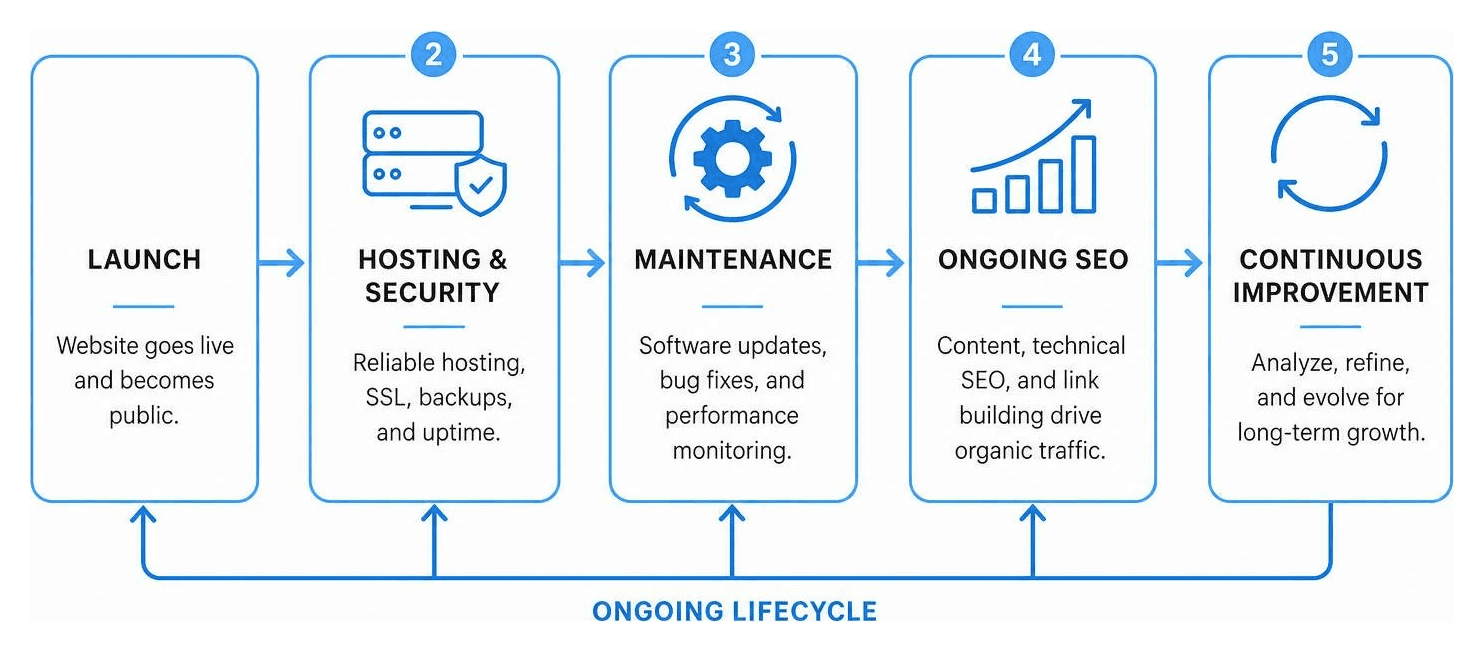
Web Hosting & Security: Reliable business website hosting guarantees high uptime, SSL encryption, automated offsite backups, and server-level protection.
Software Maintenance: Ongoing CMS core updates and security patches prevent vulnerabilities, keep plugins operational, and resolve compatibility bugs.
Organic Visibility: Continuous optimization based on technical documentation from Google Search Central helps build seo friendly websites. Combining technical updates with digital marketing and seo services drives persistent, non-paid organic growth.
Tiered Packages vs Custom Quotes: Pros and Cons
Standardized packages offer transparent pricing and faster decision cycles, letting clients quickly determine what fits their financial outline. They establish clear boundaries upfront, reducing uncertainty. However, pre-packaged tiers can occasionally feel rigid for companies with unique functional requirements or specialized backend workflows.
Conversely, bespoke proposals built through custom web design services provide total flexibility tailored to complex business logic, third-party integrations, and brand-specific user journeys, though they require longer discovery phases prior to kickoff.
Managing Scope Creep and Pricing Pitfalls
A common challenge during website implementation is scope creep—unplanned feature additions that swell project budgets and extend delivery dates. Common causes include unvetted feature requests, indefinite revision cycles, or vague project documentation.
Agencies protect project timelines and client budgets by establishing strict functional specifications upfront. Revisions are bounded within each development phase, while extra functionality is addressed through clear change order procedures. This transparent process keeps projects moving smoothly, ensuring launch dates are met without budget surprises.
When you are ready to transform your online presence, choosing an experienced and down-to-earth agency makes all the difference. Explore our comprehensive web redesign agency complete guide or contact RJP.design today to discover the ideal web design pricing package for your organization.