
Web
Algorithm Update Terms Demystified
Sep 9, 2026

Understanding What an Algorithm Update Means for Your Website
An algorithm update is a change to the systems a search engine uses to decide which pages appear in its results and in what order. For Google, these changes can alter how it evaluates relevance, content quality, usability, trust, links, and spam signals - which may cause rankings and organic traffic to rise, fall, or simply shift between pages.
Google makes thousands of smaller Search changes each year, while only some larger updates are publicly confirmed. Broad core updates reassess results across many topics and sites; targeted updates focus on areas such as spam or low-quality reviews. A ranking decline is not automatically a penalty. Often, it means Google's updated systems believe other pages better satisfy a searcher's needs.
For a small business, the practical takeaway is simple: monitor Google Search Console, avoid reacting to one bad day of data, and keep improving the usefulness, credibility, and technical health of your website. Sustainable improvements tend to hold up better than chasing temporary SEO shortcuts.
I am Ross Plumer, a digital marketing, website design, and development professional who has worked with businesses responsible for more than $20 million in marketed revenue. In this guide to What is an algorithm update, I will translate complex search changes into practical steps for protecting and growing your online visibility.

What is an algorithm update terms explained:
What Is an Algorithm Update and How Does Google Implement It?
Search engines rely on complex computational structures to parse the open web. At its core, an algorithm is simply a finite sequence of rigorous instructions designed to solve a problem—in this case, ordering billions of web pages in fractions of a second based on user intent.

When Google alters these instructions, the entire digital landscape can shift. In 2021 alone, Google performed over 4,000 updates, and the pace has continued to accelerate, averaging roughly 13 adjustments per day. These changes span everything from minor ranking recalibrations to massive overhauls of the primary ranking stack.
Update Type | Primary Focus | Typical Duration | Frequency |
|---|---|---|---|
Core Updates | Broad relevance, content quality, helpfulness | 1 to 6 weeks | 3–5 times per year |
Targeted Updates | Specific policy violations (Spam, Reviews, Site Reputation) | 2 days to 2 weeks | Several times per year |
Minor Tweaks | Small ranking adjustments, natural language model refinements | Instant / Continuous | Thousands per year |
What Is an Algorithm Update in Search Ranking Systems?
To grasp how these changes work, it helps to understand what is seo and how Google processes data. The modern ranking stack is not a single formula. It is a network of machine learning systems, natural language models (like BERT and MUM), and quality classifiers working together.
When an update takes place, Google adjusts how these systems evaluate relevance signals. A page that was previously in position two might slide to position four—not because it did something wrong, but because newer, more comprehensive resources were published. Think of it like a restaurant guide: when new, exceptional eateries open in your city, the old top-10 list must be refreshed to reflect the best available choices.
Core Updates vs Targeted Spam Adjustments
It is essential to distinguish between a broad core update and a targeted system enforcement:
Core Updates: According to Google Search's Core Updates documentation, core updates represent broad adjustments across multiple systems. They do not target specific sites or niches. For instance, the historic March 2024 core update took 45 days to complete and aimed to reduce unhelpful, unoriginal content across the web by roughly 40%. In another instance, the May 2022 core update rolled out over 11 days and 21 hours, bringing significant ranking volatility as content quality was re-evaluated globally.
Targeted Spam Updates: These target violations of Google Search Essentials, such as link manipulation, scaled automated content abuse, and site reputation abuse (parasite SEO). Unlike broad updates, spam updates focus on nullifying manipulative behavior.
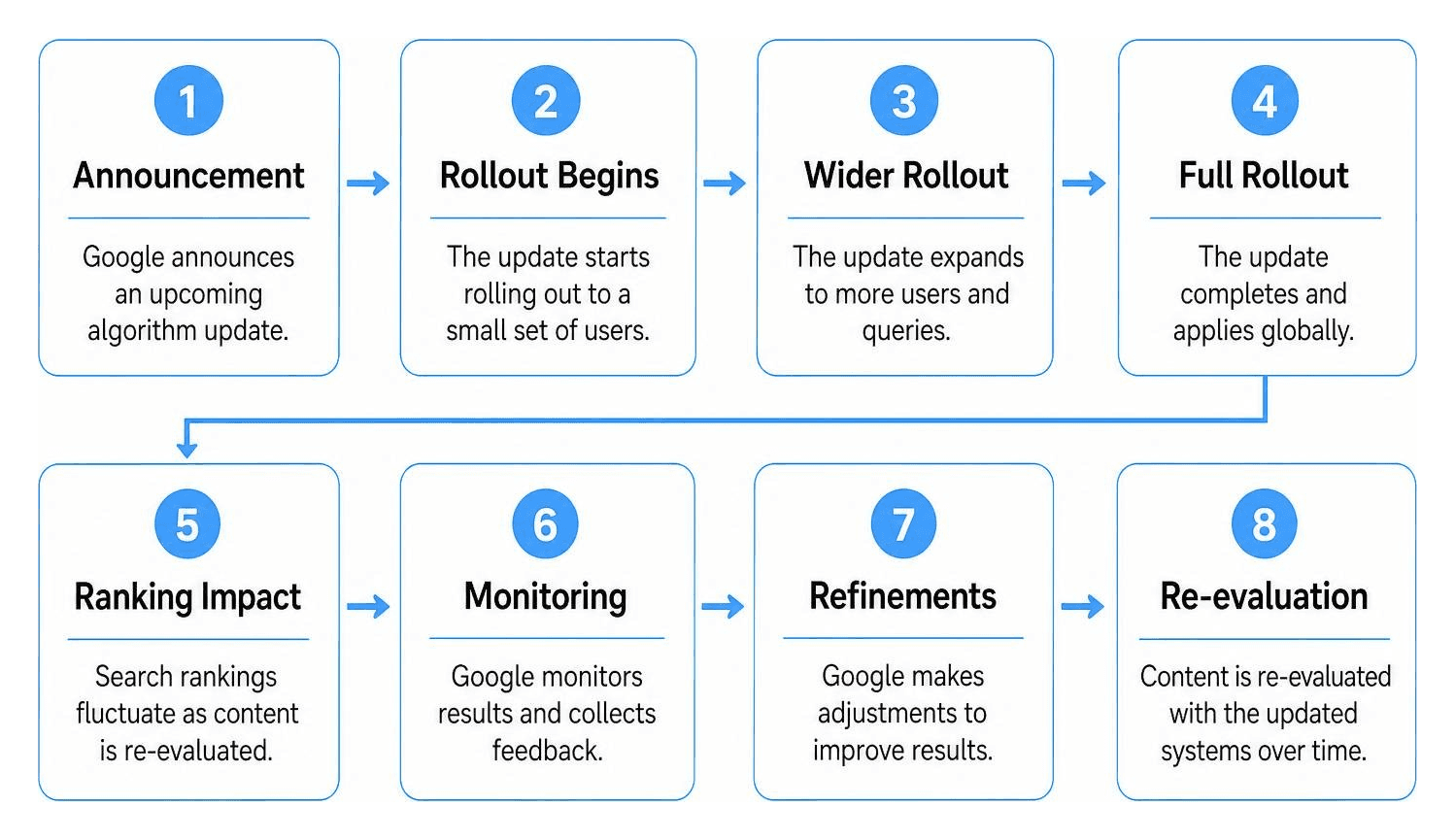
Why Search Engines Modify Ranking Systems Regularly
Google sends visitors to more than 100 million different websites each day. To keep searchers satisfied, search engines must constantly adapt. As detailed in How Google updates Search to improve our results, ongoing evaluation and side-by-side experiments have decreased irrelevant search results by over 40% over the last five years.
These ongoing changes ensure that searchers find safe, fresh, and authoritative answers. For businesses establishing seo for new websites, continuous updates level the playing field by allowing high-quality, relevant newcomers to outrank outdated legacy content.
Navigating Fluctuations, Diagnosing Traffic Drops, and Future-Proofing
Experiencing ranking volatility during a rollout can feel unsettling. However, jumping to make panicked site modifications mid-update often causes more harm than good.

What Is an Algorithm Update Impact and How to Diagnose Ranking Shifts
When an update is officially announced, here is the diagnostic process we recommend following:
Check Rollout Status: Monitor the Google Search Status Dashboard to confirm whether the rollout is active or complete.
Wait for the Dust to Settle: Allow a buffer of at least 5 to 7 days after the update finishes rolling out before drawing conclusions.
Evaluate Performance in Google Search Console: Compare impressions, clicks, and average position for a 28-day period post-update against the 28-day period prior.
Isolate Affected Pages: Distinguish between minor ranking shifts (e.g., position 3 to position 5) and large positional drops (e.g., position 4 to position 28). Minor shifts are normal SERP reshuffling; large drops require a deeper content review.
Conduct a Root-Cause Review: If your visibility drops significantly, professional seo audit services can help you identify whether the drop stems from content relevance gaps, technical performance bottlenecks, or user experience issues.
Achieving sustainable seo ranking improvement after an update requires patience. While small technical fixes can reflect in a few days, broad quality re-evaluations often take several months to fully register in search results.
Sustainable SEO Strategies to Maintain Search Visibility
The most effective way to weather search updates is to build a durable, human-first digital presence. At RJP.design, we help brands implement long-term seo strategies for websites that prioritize real searcher satisfaction over search engine shortcuts.
To future-proof your digital presence, focus on these core pillars:
Demonstrate E-E-A-T: Showcase clear Experience, Expertise, Authoritativeness, and Trustworthiness. Highlight verifiable author credentials and provide original research.
Optimize and Prune Content: Regularly audit your catalog. Use an seo content optimizer to update outdated statistics, deepen shallow posts, and remove or consolidate duplicate, unhelpful pages.
Maintain Technical Excellence: Ensure your site loads quickly, meets modern Core Web Vitals benchmarks, and delivers a smooth mobile experience.
Diversify Your Marketing Channels: Never rely solely on a single organic channel for your pipeline. Combining search optimization with robust email marketing, paid media, and social channels ensures business stability regardless of search index fluctuations.
If you are looking to build a resilient, high-performing web presence that consistently turns visitors into customers, explore our comprehensive digital marketing solutions to see how our team can help your business thrive.