
SEO
How to get found online without shouting into the void
Apr 7, 2026
Why Most Businesses Stay Invisible Online (And How to Fix It)
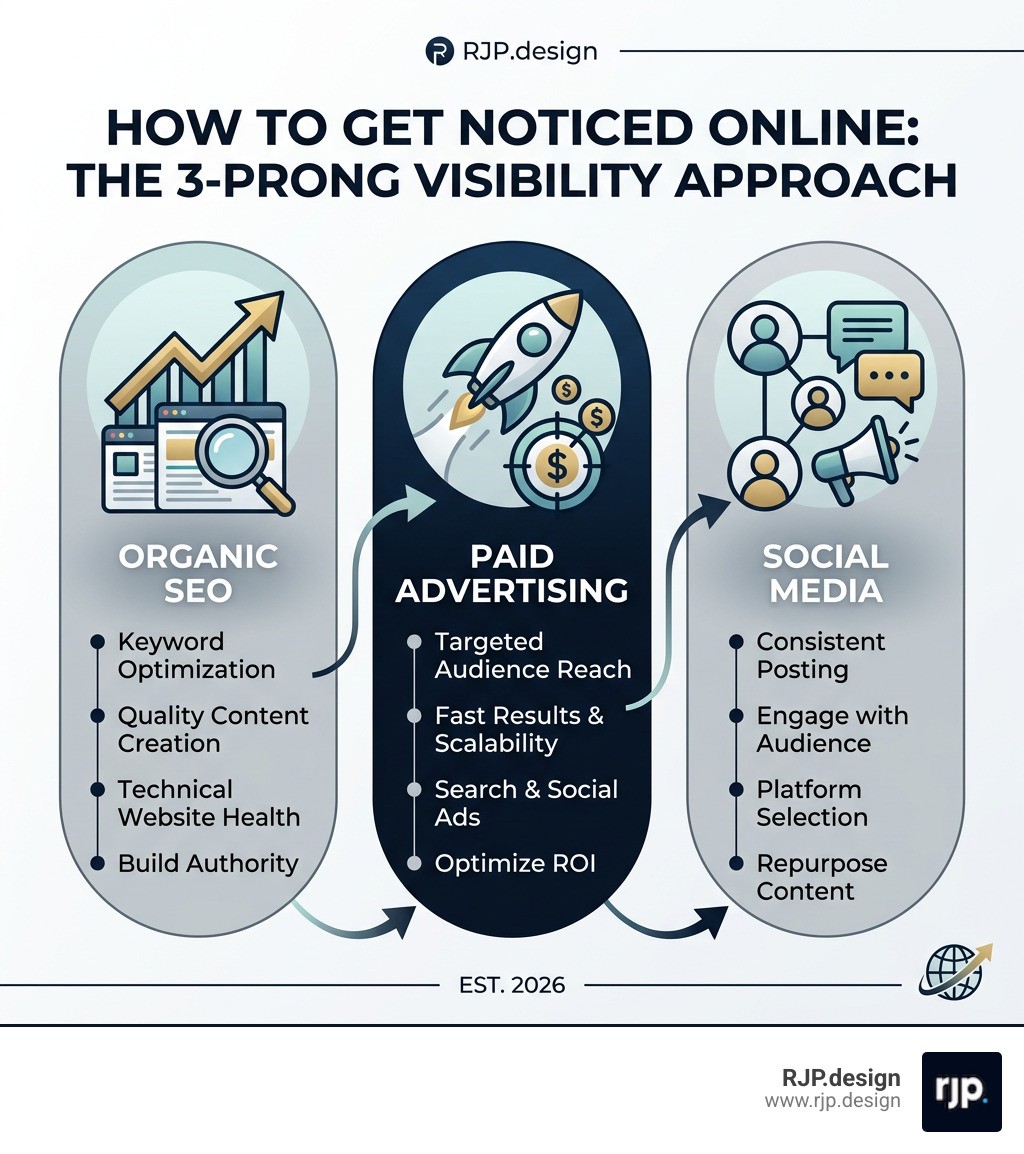
How to get noticed online comes down to three core strategies working together: building organic visibility through SEO and content, amplifying reach through social media, and accelerating results with targeted paid advertising.
Here is a quick breakdown of what actually moves the needle:
Define your niche - Get specific about who you serve and what problem you solve
Optimize for search - Use relevant keywords, mobile-friendly design, and fast load times
Create consistent content - Publish helpful, audience-focused content on a regular schedule
Choose the right platforms - Focus on where your audience already spends time
Engage authentically - Respond, interact, and build real relationships
Repurpose across channels - Extend the life of every piece of content
Track and refine - Use data to double down on what works
You could have the best product or service in your market. But if the right people can't find you, none of it matters.
That is the reality most small business owners run into. They build a website, post occasionally on social media, and then wait. The traffic never comes. The phone stays quiet. And it starts to feel a lot like shouting into the void.
Here is the uncomfortable truth: getting noticed online is not an accident. It is the result of deliberate strategy. Research shows that 83% of employers check candidates' digital presence before making decisions, and 70% of B2B sales now begin with online discovery rather than cold outreach. The same dynamic applies to customers looking for local services, products, or expertise.
The good news? You do not need a massive budget or a full marketing team. You need a clear system.
I am Ross Plumer, a digital marketer and entrepreneur who has helped businesses market over $20 million in revenue by building online visibility strategies that actually convert, and how to get noticed online is something I have spent years refining for businesses of all sizes. In the sections ahead, I will walk you through exactly what works — from laying the right foundation to turning that visibility into real revenue.
Related content about How to get noticed online:
Master the Foundations of How to Get Noticed Online
To truly stand out, we have to stop thinking of "online presence" as just having a website. It is about building a cohesive digital presence for business that acts as a 24/7 salesperson. The foundation of this is personal branding and niche positioning.
Personal branding isn't just for influencers. It is the practice of managing your reputation and the value you provide to your audience. Statistics show that professionals with strong personal brands earn 48% more than those without. Why? Because people buy from people they trust. When you put a face to the business and share your expertise, you move from being a "commodity" to an "authority."
According to scientific research on social media influence, the most successful creators don't try to appeal to everyone. They focus on being recognizable rather than being everywhere. This focus allows you to enhance digital presence by becoming the "go-to" person for a specific topic.
Choosing the Right Niche to Get Noticed Online
One of the biggest mistakes we see is a business trying to be everything to everyone. If you’re a "photographer," you’re competing with millions. If you’re a "wedding photographer for adventurous couples in the Pacific Northwest," you’ve suddenly eliminated 99% of your competition.
To find your niche, ask yourself three questions:
What specific problem am I solving?
Who am I solving it for?
Is this audience willing and able to pay for the solution?
Once you have your niche, you need to back it up with SEO keyword research. This helps you understand the exact language your customers use. Instead of guessing what they want, you use data to provide the answers they are already looking for. For a deeper dive, check out our small business web presence complete guide.
Optimizing for Search Engines and Mobile Users
In 2025 and beyond, SEO is no longer just about stuffing keywords into a page. Google has evolved to prioritize "search intent" and user experience. They use what are known as ABC signals:
Anchors: The text used in links that tells Google what a page is about.
Body: Content that is semantically rich and matches what the user is actually looking for.
Clicks: How users interact with your site (do they stay, or do they bounce immediately?).
Furthermore, with "AI Mode" in search (powered by models like Gemini), Google is looking for content designed for "extraction." This means using clear definitions, bullet points, and structured data so AI can summarize your expertise for the user.
Crucially, about 80% of people use mobile phones to access the internet. If your site isn't among the mobile-friendly websites that load in under three seconds, you are essentially invisible to the majority of your audience. Fast, responsive design is a "must-have," not a "nice-to-have." Improving your technical setup is the fastest way to improve search engine ranking.
Feature | Organic Visibility (SEO) | Paid Visibility (Ads) |
|---|---|---|
Speed | Slow (takes months) | Fast (instant) |
Cost | High upfront effort, low long-term cost | Pay-per-click (ongoing cost) |
Trust | High (users trust organic results more) | Medium (clearly marked as ads) |
Sustainability | High (builds equity over time) | Low (visibility stops when you stop paying) |
Strategic Content and Distribution for Long-Term Growth
Once your foundation is set, you need a "content engine." We recommend building your brand architecture around 3-5 "Content Pillars." These are the core topics you want to be known for. For example, at RJP.design, our pillars might be Web Design, SEO, and Small Business Growth.
Consistency is the secret sauce. You don't need to post ten times a day, but you do need a how to create content strategy that you can actually stick to. Whether it's one high-quality blog post a week or three helpful LinkedIn posts, the algorithm rewards those who show up reliably. This is a core part of effective SEO strategies for websites.
Leveraging Social Media to Get Noticed Online
Social media is no longer just a "broadcast" tool; it is essential infrastructure for visibility. However, you shouldn't try to be on every platform. Pick one "primary" platform where your audience hangs out (like LinkedIn for B2B or Instagram for visual brands) and master it first.
To how to leverage social media effectively, focus on "engagement velocity." This is how quickly people interact with your post in the first hour. To boost this:
Share takeaways, not just links: Don't just drop a link to your blog. Write a summary that provides value directly in the feed.
Use hooks: Spend 80% of your time on the first sentence or the cover slide of your carousel.
Interact: For every post you make, spend time replying to others in your niche.
For those focusing on visual growth, there is more info about Instagram visibility available through professional resources, emphasizing that Instagram is becoming more of a search-driven platform where keywords in your bio and captions matter more than ever.
Building Authority Through Consistency and Interaction
Authenticity is your competitive advantage in an AI-driven world. While AI can write a generic "how-to" guide, it cannot share your personal failures, your unique client stories, or your specific perspective.
Building a community is about being "recognizable somewhere" rather than "everywhere." Respond to every comment. Ask questions. Be kind. Kindness is rare online, and it gets noticed. When you build real relationships with your audience and other influencers in your niche, you create a "moat" around your brand that competitors can't easily cross. This is a pillar of SEO for new websites because engagement leads to social signals that search engines notice.
Measuring Performance and Scaling Results
You cannot manage what you do not measure. We use tools like Google Analytics and Search Console to track what is actually working. Don't get distracted by "vanity metrics" like likes or followers. Instead, focus on:
Traffic Sources: Where are your visitors coming from?
Conversions: Are people signing up for your newsletter or booking calls?
Dwell Time: Are people actually reading your content, or leaving immediately?
Tracking these metrics allows for a website traffic increase that is sustainable. If you see a specific blog post is getting 80% of your traffic, update it, add a better call-to-action, and repurpose it into five social media posts. This iterative process is key to SEO ranking improvement.
Turning Visibility into Sustainable Revenue
At the end of the day, visibility without monetization is just a hobby. To turn how to get noticed online into a business, you need a simple funnel.
For most service-based businesses, a "recurring service" is the best place to start. Create a clear offer that solves a specific problem, and link it in your social media bios and at the end of your blog posts. Use simple tools like a contact form or a booking link to capture leads.
At RJP.design, we specialize in this exact transition. We don't just build websites; we build visibility engines. Whether you need a full service digital marketing services guide or help with business growth online, our team is here to ensure you aren't just "online," but actually being found by the people who matter.
If you are ready to stop shouting into the void and start seeing real results, start growing your brand with RJP.design. We pride ourselves on being a down-to-earth team that prioritizes your satisfaction and your bottom line. Let's get you noticed.